
Sell My Land in Johnston County NC - What Landowners Need to Know in 2026
Key Takeaways
- 2025 revaluation hit landowners hard: Property values in Johnston County jumped an average of 70.6% during the 2025 countywide revaluation, with some parcels increasing over 100%, according to JoCo Report — even with the new lower $0.52 tax rate, typical tax bills rose approximately 32%
- Inventory is climbing and selling timelines are stretching: Active listings in Johnston County reached 2,272 in December 2025, up 16.6% year-over-year, with average days on market rising to 83 days, according to Realtor.com data
- Johnston County is one of NC's fastest-growing counties: The population reached 249,794 in 2024 — a 15.6% increase since the 2020 Census — driven by Raleigh metro spillover, but growth doesn't guarantee fast land sales
How Can You Sell Land in Johnston County NC After the 2025 Revaluation?
You can sell land in Johnston County through a real estate agent, online platforms, or a direct cash offer from a land buyer — though higher property taxes and rising inventory are extending timelines. Selling land in Johnston County, North Carolina in 2026 means navigating the aftermath of a massive 2025 property revaluation that increased average assessments by 70.6%, according to JoCo Report. For vacant landowners, this translates to significantly higher annual tax bills — even after the county cut its tax rate from $0.67 to $0.52 per $100 of assessed value.
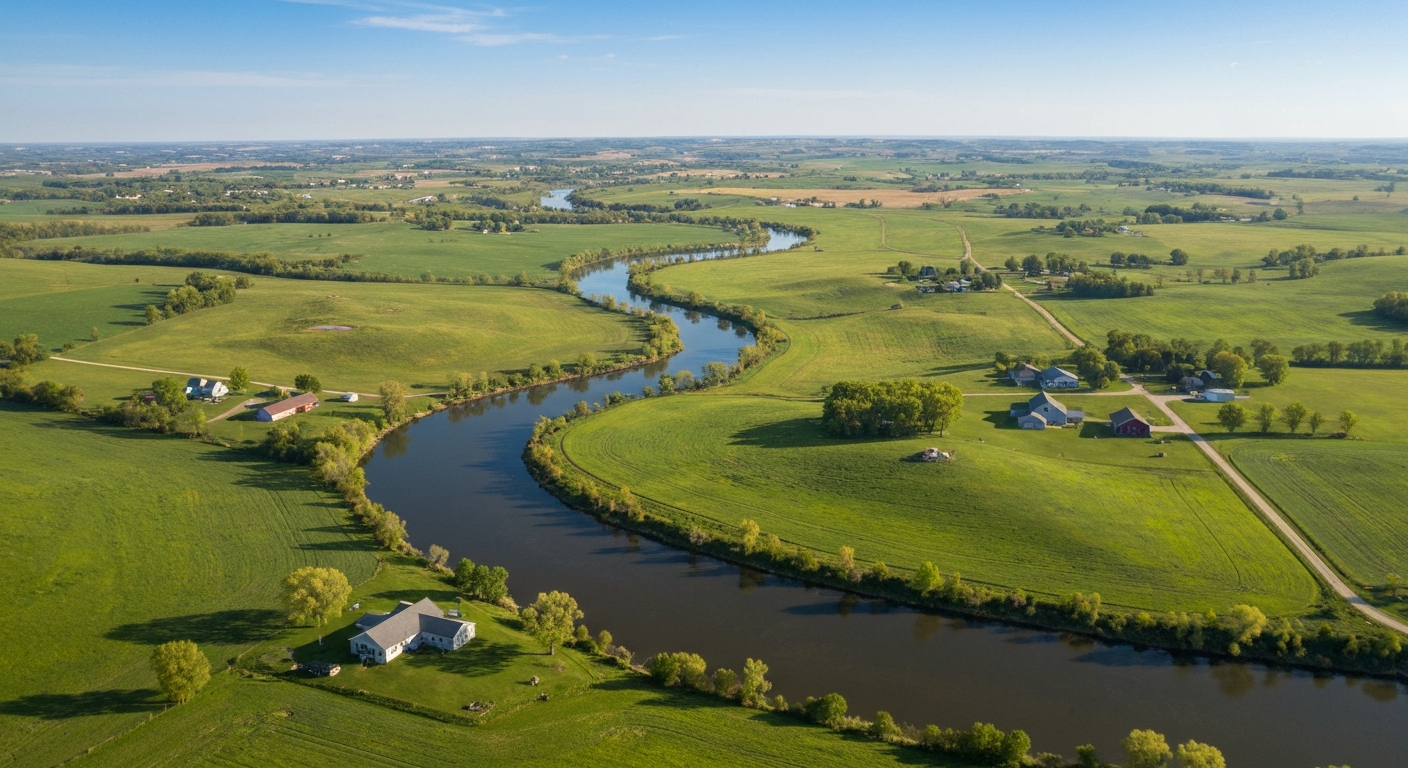
Johnston County's 792 square miles span flat Coastal Plain terrain roughly 30 minutes southeast of Raleigh, where suburban expansion is pushing into what has traditionally been agricultural land. With 964 farms covering 174,111 acres producing nearly $300 million in agricultural products, according to the 2022 USDA Census of Agriculture, the county straddles two identities — fast-growing Raleigh suburb and working rural landscape.
This guide covers what the revaluation means for your property taxes, how the county's zoning rules are changing, current market conditions and selling timelines, and your practical options for selling land in Johnston County.
What Does the 2025 Property Revaluation Mean for Johnston County Landowners?
The 2025 countywide revaluation — Johnston County's first since 2021 — increased average property values by 70.6%, with some properties jumping over 100%, according to JoCo Report's analysis of the county budget. This matters directly for landowners because property taxes are based on assessed value.
The county responded by cutting its tax rate from $0.67 to $0.52 per $100 of assessed value — a 15-cent reduction that the county describes as one of the largest property tax rate cuts in its history, according to the Johnston County government website. However, the math still works against most property owners. A parcel assessed at $100,000 before the revaluation would have generated a $670 tax bill. After the revaluation, that same parcel might be assessed at $170,000, generating an $884 tax bill at the new rate — roughly a 32% increase in actual taxes owed.
The countywide fire tax rate was also reduced to $0.115 per $100, but between the county rate, fire district levies, and any applicable municipal taxes, total carrying costs for vacant land have increased meaningfully. The county's FY 2025-2026 General Fund budget reached $402 million, a 6.9% increase over the prior year's $376 million.
What This Means for Land Sellers
For landowners who hold vacant land that doesn't generate income, the revaluation creates a concrete financial question: are you willing to pay 32% more in annual taxes to continue holding a parcel that may not produce any return? Every year of ownership means another round of property taxes, liability insurance, and maintenance costs. The next scheduled revaluation isn't until 2029, so these higher assessments — and the tax bills they generate — aren't going away.
How Are Johnston County's Zoning Rules Changing?
Johnston County is actively rewriting its development regulations through a new Unified Development Ordinance (UDO), with a draft presented to the County Planning Board in December 2025, according to JoCo Report. The current zoning ordinance dates to 1992, and a majority of the county is zoned Agricultural-Residential (AR), which allows single and two-family housing plus farming uses.
The draft UDO is driven by the Envision Johnston 2040 Comprehensive Land Use Plan. Key provisions that affect landowners include:
- 75-foot vegetative buffers between new subdivisions and working farms — protecting agricultural operations but potentially limiting what a buyer can do with parcels adjacent to active farms
- Eased restrictions on Planned Unit Developments (PUDs) to allow mixed-use, higher-density development near existing infrastructure
- Stronger environmental protections for sensitive areas, including riparian buffers
- Growth directed toward areas with existing water and sewer infrastructure to limit rural sprawl
The rezoning process in Johnston County generally takes approximately four months from start to finish, according to the county planning department. Sellers should understand that a parcel's zoning classification directly affects what a buyer can build — and therefore what they're willing to pay.
Present-Use-Value Tax Programs
Johnston County maintains 174,111 acres of farmland, with cropland spanning 117,085 acres and woodland covering 37,972 acres, according to the 2022 USDA Census of Agriculture. The county ranks 2nd in North Carolina for tobacco production and 3rd for vegetables and sweet potatoes, with total agricultural sales of $299.996 million.
Qualifying agricultural, horticultural, and forestland can be assessed at present-use value rather than market value under N.C.G.S. 105-277.2. When land exits this program — typically through sale to a non-agricultural buyer — rollback taxes for the current year plus three prior years become due, including accrued interest. For agricultural parcels in a rapidly growing county like Johnston, the gap between present-use value and market value can be substantial, making rollback taxes a significant cost that sellers must factor into their pricing strategy.
How Does Johnston County's Land Market Compare to Its Triangle Neighbors?
Johnston County sits in the Raleigh Metropolitan Statistical Area, accessible via I-95 and I-40 — two major interstate corridors. The county's population of 249,794 grew 15.6% since the 2020 Census, roughly three times the statewide growth rate of 5.8%, according to U.S. Census Bureau data. UNC Carolina Demography ranked it among the fastest-growing counties in North Carolina at 3.0% annual growth in 2022-2023.
| Factor | Johnston County | Wake County | Harnett County | Wayne County |
|---|---|---|---|---|
| Population (2024 est.) | 249,794 | ~1,230,000 | ~140,000 | ~124,000 |
| County tax rate (per $100) | $0.52 | $0.5171 | $0.5910 | ~$0.71 |
| 2025 revaluation impact | +70.6% avg | N/A (2023 reval) | N/A (2022 reval) | N/A |
| Active listings (Dec 2025) | 2,272 | N/A | N/A | N/A |
| Avg days on market | 83 days | ~35 days | ~55 days | ~75 days |
| Key selling challenge | Rising inventory, higher taxes | High competition | Limited infrastructure | Population stagnation |
Despite strong population growth, market indicators show a cooling trend. Active listings reached 2,272 in December 2025, up 16.6% year-over-year, according to Realtor.com. Average days on market stretched to 83 days, up 6.4% from the prior year. Months of supply sat at 1.7, and while this still technically indicates a seller's market, the direction of these metrics — more listings, longer timelines — gives buyers increasing leverage.
Redfin shows 165 land-specific listings in Johnston County at a median listing price of $375,000 as of early 2026. Zillow data shows the average home value at $336,821, down 1.5% over the past year. These metrics suggest a market in transition where sellers need to price competitively and expect longer selling timelines than in recent years.
The economic backdrop includes Novo Nordisk's $4.1 billion expansion — the largest life sciences investment in North Carolina history — which will add 1,000 jobs at an average salary of $70,000, according to EDPNC. Johnston County's unemployment rate of 2.9% is well below the national average. However, macro-economic conditions create uneven demand across parcel types and locations, and employment strength alone doesn't guarantee quick land sales.
For more county-level land analysis across the Carolinas and Southeast, explore our blog.
What Are Your Best Options for Selling Land in Johnston County?
With property tax bills up roughly 32% after the revaluation, inventory climbing 16.6% year-over-year, and selling timelines stretching past 83 days, Johnston County landowners face a practical calculation. Every month of holding means paying the higher tax assessment, maintaining liability insurance, and covering maintenance costs — all without any income from vacant land.
Before you sell, take these steps. Verify your property's legal description and boundaries through the Johnston County Register of Deeds. Confirm your parcel's zoning classification through the county planning department — especially important with the UDO update underway. If your land is in a present-use-value program, calculate potential rollback taxes (current year plus three prior years with interest) with your tax professional. Check for any riparian buffer restrictions, easements, or liens.
Johnston County landowners have several selling paths. Listing with a Triangle-area real estate agent provides access to the region's large buyer pool, but commissions and carrying costs during an 83+ day marketing period reduce your net proceeds. Online platforms like Land.com, LandWatch, and Zillow offer broad exposure but require you to manage inquiries, showings, and negotiations. For landowners who want to exit quickly and avoid the uncertainty of an extended listing, companies like Jerez Land provide direct cash offers that close in weeks — no commissions, no carrying costs, and no waiting.
Your decision should weigh your timeline, financial situation, and willingness to carry the property through what market data suggests is a lengthening sales cycle.
Frequently Asked Questions
How do I sell vacant land in Johnston County NC?
Begin by verifying your property description through the Johnston County Register of Deeds and confirming your zoning with the county planning department. If your land is in a present-use-value tax program, calculate potential rollback taxes before setting your price. You can list with a local agent, use online platforms, or request a direct cash offer from a land buyer.
My property taxes in Johnston County just jumped 30% after the revaluation — what's the new tax rate?
The FY 2025-2026 county property tax rate is $0.52 per $100 of assessed value, down from $0.67, according to the Johnston County government. However, because the 2025 revaluation increased average property values by 70.6%, most property owners are paying approximately 32% more in actual taxes despite the rate cut.
How long does it take to sell land in Johnston County?
Average days on market reached 83 days in December 2025, up 6.4% from the prior year, according to Realtor.com. Active inventory has also grown 16.6% year-over-year, meaning sellers face more competition. Properties priced competitively relative to comparable sales tend to sell faster. Direct cash offers from land buyers can close in weeks rather than months.
I have agricultural land with present-use-value tax benefits — what happens if I sell it?
When land enrolled in North Carolina's present-use-value program (N.C.G.S. 105-277.2) is sold and the new owner changes the land use, deferred taxes for the current year plus three prior years — with accrued interest — become due. In Johnston County's rapidly growing market, the gap between present-use value and market value can be substantial, making rollback taxes a significant closing cost.
Should I hold my Johnston County land longer while the county grows, or sell now?
Johnston County's population reached 249,794 in 2024, a 15.6% increase since the 2020 Census, according to the U.S. Census Bureau. UNC Carolina Demography ranked it among the fastest-growing counties in NC. However, population growth doesn't guarantee quick land sales — inventory is rising and selling timelines are lengthening, and 2,783 building permits were issued in 2024 alone, adding to housing supply.
What is the new Unified Development Ordinance in Johnston County?
Johnston County is rewriting its 1992 zoning code through a new UDO, with a draft presented in December 2025. Key provisions include 75-foot buffers between new subdivisions and farms, eased restrictions on mixed-use development near infrastructure, and stronger environmental protections. This may affect what buyers can do with certain parcels.
Disclaimer: This article is for informational purposes only and does not constitute legal, financial, or professional advice. Laws and regulations vary by jurisdiction and change over time. Always consult with qualified professionals before making land purchase decisions. Jerez Land is not responsible for actions taken based on this information.