
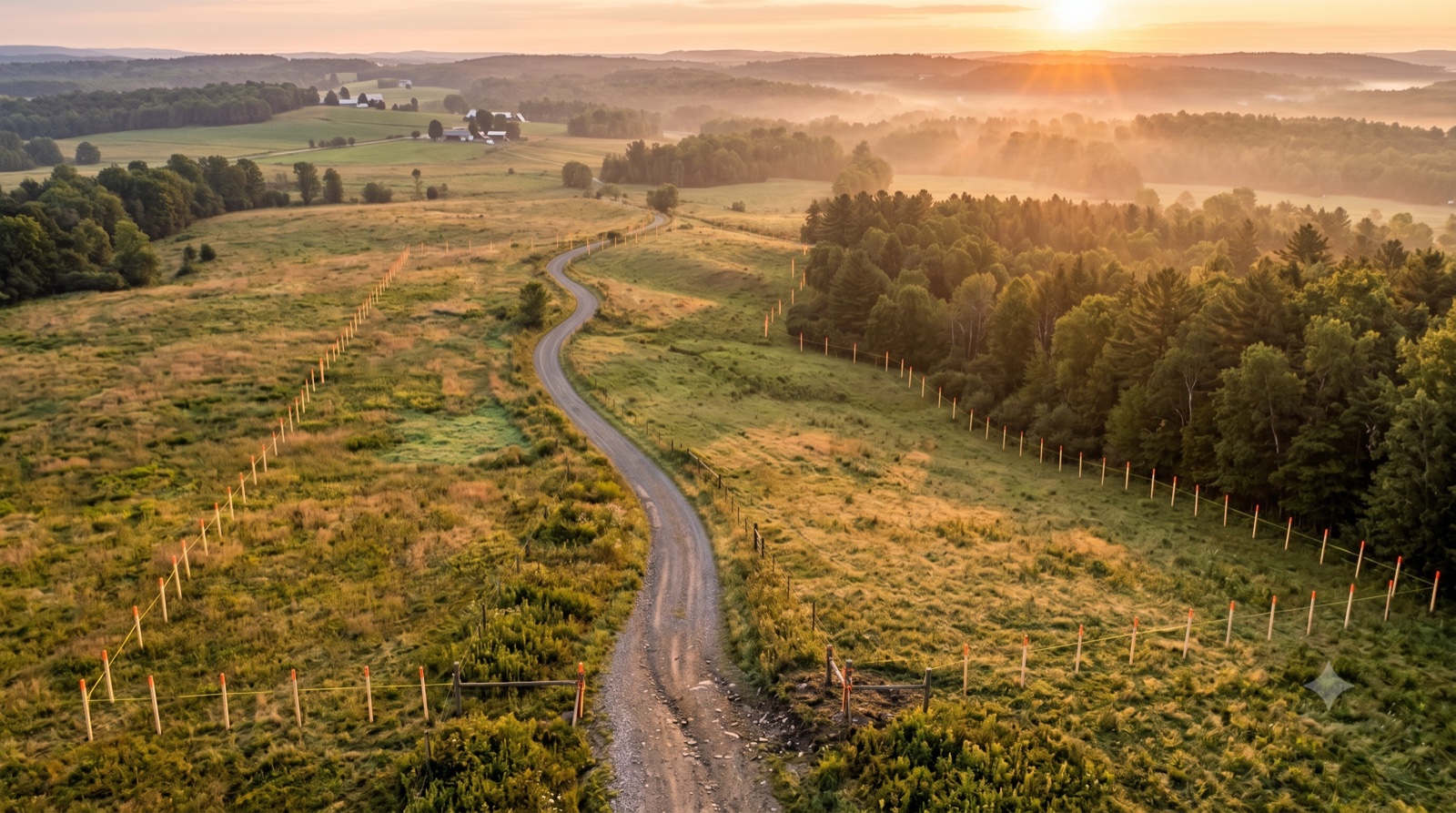
How Much Is My Land Worth? The Real Factors That Drive Land Value
Key Takeaways
- There is no single "price per acre": two parcels in the same county can differ in value by 10x based on road access, utilities, zoning, and flood status — which is why generic per-acre benchmarks routinely mislead landowners
- Assessed value is not market value: local governments typically assess land at 60–90% of market value for tax purposes, and in some states as low as 40%, meaning your tax bill tells you almost nothing about what a buyer will pay
- Land comps are scarce: a rural appraiser may be pulling sales from a 30-mile radius and two years back, which is why a written offer from an active buyer is often the fastest way to learn what your specific parcel is worth today
How Much Is My Land Worth?
Your land is worth what a ready, willing, and able buyer will pay for it on the open market — a value determined almost entirely by specific physical and locational characteristics such as road access, utilities, zoning, topography, and flood status. Rural vacant land is notoriously difficult to value because sales are infrequent, buyers are specialized, and there is no standardized MLS with the data density found in residential real estate. This guide explains the seven factors appraisers actually weigh, how the comp process works for land, the valuation methods used by professionals, and how to get a real number.
What Seven Factors Actually Drive Land Value?
Land value is not random. Appraisers and experienced buyers consistently weigh the same core variables when arriving at a price per acre. Understanding them helps you assess your own parcel honestly before you talk to anyone.
Location and Market Demand
Location is the dominant driver for a reason: it cannot be changed. Proximity to employment centers, population growth, and desirable natural features (lakes, mountains, coastline) all increase demand and compress the pool of substitutes a buyer can choose from. A 50-acre wooded parcel 20 minutes from a growing metro will command a fundamentally different price than an identical parcel 3 hours from the nearest city. According to the REALTORS® Land Institute's 2024 Land Market Survey, the top land markets in 2024 by transaction volume were Texas, Colorado, North Carolina, and Georgia — all states with strong in-migration and population growth.
Road Access and Legal Ingress/Egress
A parcel with no legal road access — known as a landlocked parcel — can lose 30–50% or more of its value compared to an otherwise identical property with paved frontage. The hierarchy matters: paved county road frontage is most valuable, followed by maintained gravel road, unmaintained road or easement, and finally landlocked (access by permission only). If your deed does not include a recorded easement to a public road, confirm your legal access with the county before listing.
Utilities: Water, Power, and Sewer
The presence or absence of utilities substantially affects both value and the buyer pool. A parcel with municipal water, sewer, and electric service at the road can support immediate residential development. A parcel that requires a well, septic system, and electric line extension from a half-mile away reduces the pool of buyers and adds $30,000–$80,000 or more in development costs before a house can be built — costs the market price discounts accordingly.
Zoning and Entitlements
What the land can legally be used for directly determines its value ceiling. Residentially or commercially zoned land with active entitlements (approved plat, grading permit, utilities permit) commands the highest premiums because the developer's approval risk has already been resolved. Agricultural-zoned land values are determined more by income potential. Unzoned rural land sits at a discount because future use is uncertain. According to the 2023 RLI/NAR Land Market Survey, 52% of REALTORS® reported difficult zoning regulations as a challenge to land transactions in their market over the prior five years.
Topography, Flood Zone Status, and Soil Quality
Flat, dry, buildable land is simply more valuable than land that is hilly, heavily wooded, or located in a FEMA Special Flood Hazard Area (SFHA). Properties in a 100-year flood zone face restricted financing options (most conventional lenders require flood insurance), reduced buildable area, and a narrower buyer pool. Soil quality matters for agricultural land — the USDA NRCS National Commodity Crop Productivity Index (NCCPI) score on farmland directly predicts crop yield potential and rental income, both of which appraisers capitalize into value.
Parcel Size and Price-Per-Acre Economics
This is one of the most counterintuitive dynamics in land sales: smaller parcels almost always sell at a higher price per acre than larger parcels in the same area — often several times higher. The inverse relationship exists because the pool of buyers who can write a small check for a residential-sized lot is much larger than the pool able to fund a large acreage purchase, especially since bank financing for vacant land is scarce. The smaller parcel also has fewer challenges (no internal road network needed, simpler due diligence). Sellers expecting to receive the same per-acre price as a nearby small-lot sale should understand this distinction clearly.
Timber, Mineral Rights, and Subsurface Value
If your parcel has a merchantable timber stand, a current timber cruise from a licensed forester will quantify the value of standing wood — which can range from a few hundred dollars per acre to several thousand for mature hardwood or pine. If you own the mineral rights and the region has oil, gas, or coal activity, those rights may carry independent value and should be appraised separately. Note that in many rural transactions, mineral rights have been severed from surface rights through prior conveyances, so confirm what you actually own in your deed before representing mineral ownership to a buyer.
How Do Land Comps Work Differently Than House Comps?
The comparable sales approach that dominates residential real estate appraisal is also the primary method for land, but the data quality problem is far more acute.
The Scarcity of Comparable Sales Data
A residential appraiser in a suburban subdivision can typically find five to ten similar-sized homes that have sold within a mile in the last six months. A rural land appraiser may be searching within a 30-mile radius, pulling sales from two or three years ago, and making significant adjustments for differences in road access, topography, or timber. According to Haystack Land, a land valuation platform, "In a rural county you might find one comparable sale from two years ago, 30 miles away. That's a guess, not a comp." This is not a flaw in the methodology — it reflects the genuine illiquidity of rural land markets.
How Adjustments Work
When a land appraiser finds a comparable sale, they adjust its price per acre up or down to account for differences between the comp and the subject. According to People's Company, a farmland management and appraisal firm, standard adjustment categories include: legal and physical access, annual precipitation or water rights, topography, utilities, zoning, soil characteristics, crop yield history, and flood risk. Each adjustment is derived from matched-pair analysis of sales where only one variable differs — allowing the appraiser to isolate the contribution of each characteristic.
Days on Market for Land vs. Homes
Land takes significantly longer to sell than residential property, reflecting the smaller buyer pool and the specialized nature of the product. According to the REALTORS® Land Institute and NAR's 2024 Land Market Survey (released April 2025), residential land typically sold in under 60 days — and in some Midwest markets (RLI Region 7), under 45 days. However, this figure represents only the most liquid land category. The 2019 RLI/NAR Land Market Survey found that timber land averaged 230 days on market, ranch land averaged 180 days, and recreational land averaged 125 days — all substantially longer than developed residential land, which sold in approximately 120 days that year. Our guide on how long it takes to sell land covers market timing in detail, including how the selling method affects your timeline.
What Are the Three Professional Valuation Methods?
Licensed appraisers use three formal approaches to value when working on land. Understanding what each measures helps you interpret any appraisal you receive — or recognize when a quick online estimate is not a substitute.
| Valuation Method | What It Measures | Best Suited For | Main Limitation |
|---|---|---|---|
| Sales comparison | Recent sales of similar parcels, adjusted for differences | Most rural, recreational, and residential land | Comps are scarce and dated in thin rural markets |
| Income approach | Income the land produces, capitalized into value | Actively rented cropland and pasture | Useless for land that produces no income |
| Residual (development) | Development revenue minus costs and builder profit | Parcels near infrastructure with near-term development potential | Highly sensitive to assumptions; inappropriate for remote land |
The Sales Comparison Approach
The sales comparison approach is the most commonly weighted method for rural and agricultural land. It analyzes recent sales of comparable parcels in the same market area, adjusts for differences in key characteristics, and derives an indicated value for the subject property. According to People's Company, the sales comparison approach "carries significant weight in farmland appraisals, particularly when reliable, recent comparable sales data is available." When comps are scarce, the reliability of this approach diminishes — which is why rural land appraisals are often more complex and expensive than residential appraisals.
The Income Approach for Farmland
The income approach capitalizes the property's income-producing capacity into a value estimate. For agricultural land, this typically means dividing the current cash rent by a market-derived capitalization rate — the same logic used to value rental houses or commercial buildings. The USDA National Agricultural Statistics Service publishes annual cash rent surveys by county that appraisers use as inputs. This approach is most reliable for high-quality, actively rented agricultural ground and less useful for recreational, timber, or residential land that produces no regular income.
The Residual (Subdivision Development) Approach
For land with potential residential or commercial development, appraisers may use a residual approach that estimates the gross revenue from a hypothetical development, deducts all development costs and a developer's profit margin, and treats the remainder as the land's current value. This approach is complex and sensitive to assumptions — a small change in assumed lot prices or development costs can swing the land value by tens of thousands of dollars. It is most appropriate for parcels already near infrastructure where development is near-term feasible, not for remote rural land.
Why National and Regional Benchmarks Mislead
The USDA NASS Land Values Summary tracks farm real estate — land plus farm buildings on operating farms — and is frequently misquoted as a benchmark for vacant land. It is not. A raw, unimproved parcel without structures, utilities, or income history trades in a different market with different buyers, according to the USDA's own methodology notes. Worse, regional averages flatten exactly the variables that drive your parcel's value: a landlocked, wooded 40 in a declining county and a road-front buildable 40 near a growing town can sit in the same "region" while their values differ several-fold. The only meaningful comparison set is recent sales of genuinely similar parcels in your immediate market — and in thin rural markets, even those need careful adjustment.
Why Is Assessed Value Not the Same as Market Value?
This is one of the most common points of confusion for landowners. Your annual property tax bill is calculated using your assessed value — a number set by your local government for taxation purposes only. It is not the price a buyer will pay.
According to Experian, assessed value is "determined by the local government to calculate property taxes," and it often differs substantially from market value. States and counties apply an assessment ratio — a uniform percentage of market value used as the tax base. In Georgia, for example, property is assessed at 40% of fair market value by state law. In South Dakota, assessed value equals 50% of market value. Some states assess at closer to 80–90% of market value, while others — like Mississippi, which assesses vacant land at 15% of market value — are significantly lower. The result is that an assessed value of $30,000 might correspond to a market value anywhere from $33,000 to $200,000 depending on your state's formula.
Assessed values also lag behind market conditions. Many counties reassess every four or five years, meaning your assessed value may reflect prices from several years ago — either overstating or understating current value depending on which direction the market has moved. For a real number, you need actual recent sales of comparable parcels, not your tax bill. If you have decided to sell and want a written number without a full listing process, you can request a no-obligation cash offer — a real buyer's offer is often the fastest way to convert a valuation question into a concrete decision.
What Are Your Options for Getting a Real Value — and Selling?
Getting an accurate value for your land requires more than a quick Google search. Here is a realistic overview of your options, including what each costs and what it misses.
Free online estimators (Zillow, LandWatch, AcreValue) show active listings and some recent sales, but rural land data is sparse. AcreValue's land valuation tool is available in approximately 18 states and uses soil and crop yield data to estimate agricultural ground values — useful for farmland, less so for recreational or timber parcels. Zillow and Realtor.com show listing prices, not sale prices, and often have significant gaps in rural area coverage. These tools are a reasonable starting point but not a defensible valuation.
Comparable sales research at your county assessor's office or through your county's online GIS/property search tool gives you actual recorded sale prices — the same data an appraiser uses. Pull five to ten sales within 20 miles in the last two years for parcels of similar size and use. This is free and often surprisingly informative if you live in an active market. Note that delinquent property taxes reduce your net proceeds even if the market value is solid — our guide to selling land with back taxes explains exactly how that math works at closing.
A licensed appraisal costs $400–$1,500 for rural land, depending on complexity and parcel size, and produces a defensible, documented value estimate. This is the right tool if you need a number for estate planning, bank financing, legal proceedings, or a partnership dispute — including inherited land situations where a date-of-death valuation establishes the stepped-up tax basis. For a straightforward sale decision, it is often more than you need.
A direct cash offer from a land buyer provides a real, written number at no cost and with no obligation — often within days. A cash offer reflects what an active buyer will actually pay for your specific parcel today, after weighing the same factors an appraiser would (access, utilities, zoning, topography) plus the carrying costs, resale timeline, and transaction expenses the buyer takes on so you don't have to. For owners weighing a sale decision rather than financing or estate paperwork, it is the most direct way to turn an abstract "value" question into a concrete decision: a real number, in writing, that you can accept or decline.
If you would like to explore what Jerez Land would pay for your parcel, you can request a cash offer at no cost and with no obligation. For more guides on land valuation, selling strategies, and regional market data, visit our blog.
Frequently Asked Questions
How do I find out what my land is worth for free?
Start by pulling comparable sales from your county assessor's property records or online GIS portal — these are public records showing actual sale prices. Then check active listings on LandWatch or Zillow to see what sellers are asking nearby. AcreValue provides soil and crop data that helps value agricultural ground in about 18 states. None of these tools replace a licensed appraisal, but together they give you a reasonable baseline range.
Can I just look up the per-acre price for my region?
There is no meaningful national answer — vacant land values vary by orders of magnitude based on location, road access, utilities, zoning, and flood status. Published averages like the USDA's farm real estate series measure operating farms with buildings, not raw land, and routinely mislead vacant landowners in both directions. The only reliable answer comes from recent sales of genuinely comparable parcels in your immediate market, or a written offer from an active buyer.
Will my smaller parcel command a higher price per acre than larger tracts nearby?
Yes, significantly. Smaller parcels consistently sell at higher prices per acre than larger parcels in the same area — often several times higher — because the buyer pool is larger and financing is easier. Never assume you can extrapolate per-acre pricing from a nearby small-lot sale to a large tract, or vice versa.
Is my assessed value close to my land's market value?
Usually not. Assessed value is set by local government for property tax purposes and is calculated using an assessment ratio that varies by state — ranging from 15% to 100% of market value depending on jurisdiction. It also typically lags behind actual market conditions. Your tax bill tells you what the government uses to calculate your taxes; it does not tell you what a buyer will pay.
What would a cash buyer actually offer for my parcel?
Cash buyers price each parcel individually based on its access, utilities, zoning, topography, and how quickly it can realistically resell in that market — the same fundamentals an appraiser weighs, plus the carrying costs, closing costs, and resale risk the buyer absorbs. The offer arrives as a real, written number you can accept or decline, with no fees or commissions deducted, which makes it a useful data point even if you ultimately list instead.
Do I need to pay for a formal land appraisal?
A licensed appraisal — typically $400–$1,500 for rural land — is worth the cost when you need a defensible, documented value for estate settlement, bank financing, legal proceedings, tax appeals, or partnership disputes. For a straightforward sale decision, a combination of your own comp research and a no-cost cash offer from a buyer gives you enough information to make an informed choice without the expense.
Disclaimer: This article is for informational purposes only and does not constitute legal, financial, or professional advice. Laws and regulations vary by jurisdiction and change over time. Always consult with qualified professionals before making land purchase decisions. Jerez Land is not responsible for actions taken based on this information.