
How to Sell Land on Facebook Marketplace
Key Takeaways
- Facebook Marketplace has no dedicated land category. Its listing tool splits into "Item for sale," "Vehicle for sale," and a home-sale flow built around property type, bedrooms, bathrooms, and square footage, according to Facebook's own Help Center — none of which is designed for raw acreage.
- Social media shopping scams are a large and growing problem, not a fringe risk. People reported losing $2.1 billion to scams that started on social media in 2025, and shopping scams were the single most-reported category, according to FTC Consumer Advice. Meta's own safety guidance flags off-platform payment and contact requests as the leading warning sign.
- Marketplace's algorithm favors nearby local searchers, which suits a small platted lot near a town's buyer pool far better than a large rural or addressless tract that depends on buyers searching in from outside the immediate area.
How to Sell Land on Facebook Marketplace
Yes, you can list vacant land on Facebook Marketplace, but there is no dedicated land category — you route acreage through a home-sale flow built for bedrooms and bathrooms or a generic item listing, and the platform mainly surfaces your parcel to nearby local searchers rather than the land-focused buyers who could actually close on rural acreage.
That gap between "technically possible" and "actually works" is the entire story of selling land on Facebook Marketplace. For a small residential lot two miles from a courthouse square, the local audience Marketplace is built around can be exactly the right buyer pool. For forty acres down a gravel road with no assigned address, that same local-audience design works against you, and the platform's total lack of buyer vetting turns every serious inquiry into a screening exercise. This guide walks through how to actually build the listing, where it breaks down for raw land specifically, and how to protect yourself from the scam and no-show patterns that are common on the platform. If you want the wider comparison across every selling channel, see where to sell land online; for the closest sibling platform problem, see sell my land on Zillow.
How Do You Actually Build a Land Listing on Facebook Marketplace?
You build a land listing by choosing a workaround category, substituting maps and aerials for photos, front-loading the parcel data buyers need in the description, and manually pinning a location since there is usually no street address to auto-populate one. None of these steps are unique to Marketplace, but each one is harder for raw land than it is for a house.
There's No "Land" Category — So Which One Do You Pick?
Facebook's listing flow gives you three real starting points: "Item for sale," "Vehicle for sale," and a property flow for homes and rentals, according to Facebook's Help Center article on selling on Marketplace. The property flow asks for property type (apartment, condo, house, townhouse), bedrooms, bathrooms, and square footage — fields that have no honest answer for a vacant parcel. Because of that mismatch, land-selling guides such as Sell Now Land Buyers' walkthrough consistently recommend listing under the general "Item for sale" flow instead, using a catch-all category like Miscellaneous, and putting the property specifics into the title and description rather than trying to force them into fields designed for houses. It is a workaround, not a feature — Facebook did not build a path for raw acreage, and you are adapting a tool meant for something else.
What Photos Do You Post When There's Nothing to Photograph?
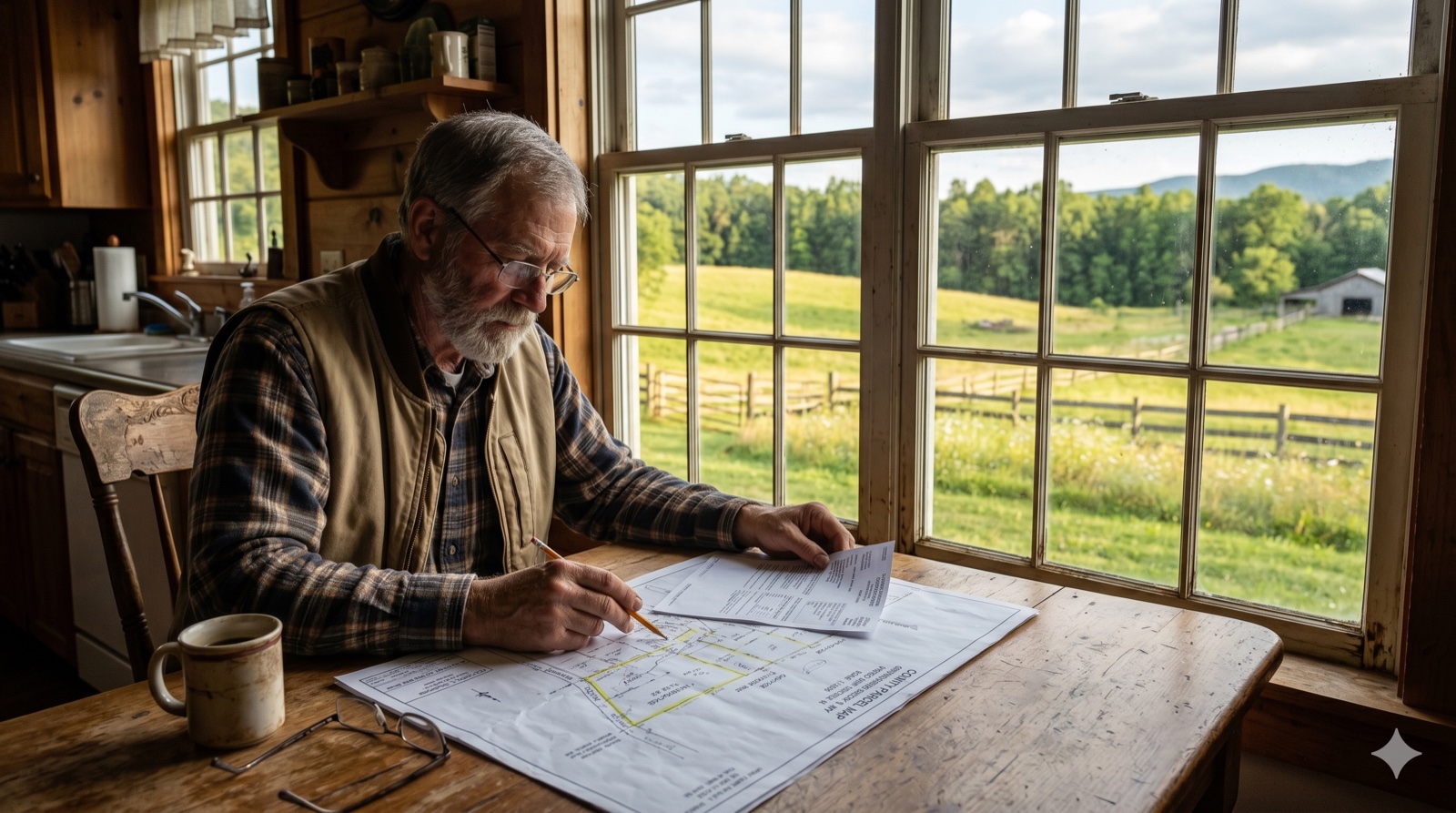
Since there's no structure, use an aerial or satellite image with the parcel boundary marked, a county plat or GIS map showing the tract shape and adjoining roads, and ground-level shots of any road frontage or distinguishing features — the same visual proof a land-specific listing would use, substituted for the interior and curb-appeal photos a house listing depends on. Put your clearest boundary or aerial shot first, since Facebook displays only the featured image prominently in search results and feed placements before a buyer clicks in.
How Do You Set the Location Without a Street Address?
You manually set the location pin to the parcel's actual coordinates or nearest identifiable road intersection, because Facebook's location field is what determines which nearby searchers ever see your listing, and an inaccurate or missing pin means the algorithm shows your land to the wrong area — or to no one. Sell Now Land Buyers' guide is explicit that getting this right matters more for land than almost any other detail, since unlike a house, there is frequently no existing address record for Facebook's system to match against. In practice, sellers use GPS coordinates from a deed or GIS site to place the pin manually rather than relying on autocomplete, and note the coordinates again in the description as a backup for buyers who want to verify location themselves.
What Should the Description Actually Include?
The description needs to answer every question a serious land buyer has before they will bother reaching out: total acreage, county and approximate location, the Assessor's Parcel Number (APN), road access and frontage, available utilities or the nearest utility line, zoning or land-use designation, annual property taxes, and any HOA or deed restrictions. Land-specific guides emphasize writing as if the reader has never seen the property and doesn't know the area — a house listing can lean on the buyer's familiarity with a neighborhood; a raw parcel usually cannot. If you have not pinned down what the parcel is actually worth before you set an asking price, how much is my land worth is worth reading first.
Why Does Marketplace Struggle Specifically With Land — Beyond Just the Category Problem?
Marketplace struggles with land because its core matching mechanism — showing listings to people physically near the pin — assumes the right buyer lives close by, and that assumption holds for a house but frequently fails for rural acreage, where the buyer pool is often regional, out-of-state, or investor-driven rather than local. Listing-rules guidance aimed at real estate sellers on the platform even instructs sellers to list "only in the actual city and zip code" where the property sits, reinforcing that the whole system is tuned around hyper-local search behavior rather than the wider geographic reach a land marketplace is built to provide.
That local bias compounds the address problem. A house listing benefits from Marketplace matching an exact street address to nearby home shoppers already primed to search that way. A rural parcel with no address, pinned imprecisely to a road intersection, is invisible to the specific geo-radius searches that drive most Marketplace traffic — and it never reaches the land-focused buyer searching from three counties or three states away, the way it would on a dedicated land marketplace such as those covered in where to sell land online.
Why Do So Many Facebook Marketplace Inquiries Turn Out to Be Unqualified?
Most Marketplace inquiries on land turn out to be unqualified because the platform has no financing pre-check, no agent representation, and no built-in way to confirm a "buyer" can actually pay for what they're asking about — Facebook connects two strangers and lets the conversation start there. Land-specific guides such as Cash for Land FL's Marketplace tips consistently advise sellers to request proof of funds — typically a bank statement or letter — before taking a listing down or setting aside time for a showing, precisely because Marketplace itself provides no such filter. On a house, a buyer's agent and a mortgage pre-approval do informal screening before a seller ever meets the buyer. On a Facebook Marketplace land listing, that screening step doesn't exist unless you build it yourself, one message thread at a time.
How Common Are Scams and No-Shows on Facebook Marketplace, and What Do They Look Like?
Scams and no-shows are common enough on Facebook Marketplace that both Meta and the FTC publish standing warnings about them: people reported losing $2.1 billion to scams that began on social media in 2025, with shopping scams the most-reported category, according to FTC Consumer Advice. On land specifically, the two patterns sellers run into most are the overpayment scam — a "buyer" sends more than the agreed amount and asks for the difference back, then reverses the original payment — and the no-show, where a buyer who seemed serious in messages simply never appears for the scheduled viewing, with no explanation and no way to hold them accountable. Meta's own safety guidance names off-platform payment requests and unsolicited screenshots of "sent" payments as the clearest red flags, advising sellers to confirm funds landed in their own account rather than trusting anything the other party shows them.
How Do You Stay Safe Selling Land on Facebook Marketplace?
Stay safe by never accepting a payment method you can't verify or reverse — no wire transfers, gift cards, or crypto — by insisting on a face-to-face meeting in a public place rather than at the property alone, and by verifying funds directly with your own bank rather than trusting a screenshot. The FTC's general marketplace guidance is blunt on payment: legitimate buyers don't need you to accept anything outside a traceable, reversible payment method, and anyone who insists otherwise is the clearest warning sign in the entire transaction. For a rural showing specifically, meet the buyer at a public location first, or bring someone with you to the parcel, and never share bank account or wire details over Messenger regardless of how far along the conversation feels. None of this replaces a real closing — even a buyer found on Facebook Marketplace still needs a deed prepared, title work done, and funds handled through an escrow or attorney closing, the same as any other land sale.
Facebook Marketplace vs. Land Marketplace vs. Direct Cash Buyer for Vacant Land
| Factor | Facebook Marketplace | Land-Specific Marketplace | Direct Cash Buyer |
|---|---|---|---|
| Dedicated land category? | No — routed through home-sale or generic item flow | Yes — built for acreage, zoning, timber, water | N/A |
| Handles no street address well? | Poorly — location matching depends on an accurate pin | Yes — parcel/APN search built in | Yes — you just describe the parcel |
| Buyer audience | Mostly local, general shoppers | Buyers actively searching for land | The buyer is the company |
| Buyer proof of funds required by the platform? | No — you must ask yourself | No — you must ask yourself | Not applicable — no buyer financing gap |
| Scam/no-show exposure | Elevated — no vetting, common overpayment and no-show patterns | Lower — buyers self-select as land shoppers | Minimal — one direct conversation |
| Closing handled for you? | No — you still arrange deed, title, and closing | No — same requirement | Often coordinated by the buyer |
| Listing cost | Free | Free (basic) / paid upgrades | No listing needed |
| Best for | Small platted lots near town, addressed parcels | Rural, agricultural, recreational acreage | Sellers who want speed and certainty over any listing |
When Does Facebook Marketplace Actually Work — and When Does It Waste Months?
Facebook Marketplace works reasonably well for a small residential lot that already has a street address, sits inside or near a town, and is priced low enough for a local buyer to pay cash without financing — the conditions under which its local-search design becomes an advantage instead of a limitation. It tends to waste months on large rural acreage, addressless tracts reached down unnamed roads, or land priced high enough that a buyer needs financing Marketplace does nothing to arrange, because none of those situations match what the platform's location-matching and buyer pool were built around. If your parcel falls in that second group, a direct cash offer skips the listing, the location-pin workaround, and the buyer-screening problem entirely — see what a no-obligation offer looks like.
Your Alternative to Listing on Facebook Marketplace
If the category workaround, the address problem, and the buyer-vetting burden make Facebook Marketplace feel like more risk than a small parcel is worth, a direct sale removes all three at once: no listing to build, no location pin to get right, no stranger's proof of funds to chase down, and no showing to schedule at a property with no cell signal and no witnesses. Request a no-obligation cash offer on your land — we evaluate the parcel directly, present a firm written number, and handle the deed and closing details ourselves. For more on how a direct purchase compares to listing anywhere online, see sell my land for cash and are we-buy-land companies legit. Browse more guides on the blog.
Frequently Asked Questions
My 40 acres has no street address — how do I even set the location on a Facebook Marketplace listing?
Use the GPS coordinates for the parcel — pulled from your deed, a county GIS site, or a mapping app standing on the property — to manually set the location pin rather than relying on Facebook's address autocomplete, which is built to match existing street addresses and often can't locate raw acreage. Place the pin at the parcel's approximate center or at the nearest identifiable road intersection, and repeat the coordinates in the listing description as a backup, since Facebook's location field is what determines which nearby searchers ever see your listing in the first place.
I got a message from a "buyer" who wants to overpay and have me wire back the difference — is this a scam?
Yes, this is one of the most common scam patterns on Facebook Marketplace and across social media generally, and you should not send any money back. In the classic version, the "buyer" sends a payment larger than the agreed price and asks you to refund the difference; once you do, the original payment gets reversed or disputed, leaving you out both the refund and the land. Meta's own safety guidance advises confirming any payment landed in your actual account — not trusting a screenshot — before taking any action, and the FTC's Consumer Advice reinforces that a request to pay or refund outside a traceable, reversible method is itself the warning sign, regardless of how convincing the story sounds.
I've had three people say they're coming to see my land and none of them showed up — is that normal on Facebook Marketplace?
Unfortunately, yes — no-shows are a routine problem specifically because Facebook Marketplace has no financing pre-check, no agent involvement, and nothing stopping someone from expressing casual interest with no real intent to buy. Land-specific selling guides consistently recommend asking for proof of funds, such as a bank statement, before you treat any inquiry as serious enough to plan around, since the platform itself provides no vetting step before two strangers start messaging. If you're repeatedly losing time to no-shows, that pattern alone is a sign the listing is attracting browsers rather than buyers, and a channel with built-in buyer qualification may serve you better.
Is there a real estate category for land on Facebook Marketplace?
No. Facebook's Marketplace listing tool splits into "Item for sale," "Vehicle for sale," and a home-sale flow built around property type, bedrooms, bathrooms, and square footage, according to Facebook's own Help Center — there is no field set designed for raw acreage. Land sellers commonly work around this by listing under the general "Item for sale" flow using a catch-all category, then putting all the parcel-specific details — acreage, APN, zoning, utilities, access — into the title and description instead of relying on any dedicated field.
Do I need proof of funds before I take my land off the market for a Facebook Marketplace buyer?
Yes, and land-specific selling guides recommend requesting it — typically a current bank statement or a lender's pre-approval letter — before you pause your search, decline other inquiries, or schedule a showing for any single buyer. Because Facebook Marketplace performs no financial vetting of buyers on its own, that screening step falls entirely on you, and skipping it is the most common reason sellers waste weeks holding a listing off the market for someone who was never actually positioned to close.
Does Facebook Marketplace work for selling large rural acreage, or only small lots?
It works far better for small, addressed, platted lots near a town than for large rural acreage. Marketplace's location-matching favors nearby local searchers, which suits a lot inside or near a populated area with a real street address and a lower price point a local cash buyer can afford without financing. Large tracts down unnamed roads, parcels with no assigned address, and land priced high enough to require financing all work against the platform's design, since the buyers most likely to want that kind of land are searching regionally or nationally rather than in your immediate zip code.
Disclaimer: This article is for informational purposes only and does not constitute legal, financial, or professional advice. Facebook and Meta's platform policies, listing tools, category structure, and safety features can change at any time — always consult Facebook's current Help Center documentation before relying on the steps described here. Scam patterns evolve, and no set of precautions eliminates risk entirely; use independent judgment and verify any buyer or payment through your own bank before completing a transaction. Laws, closing requirements, and title procedures vary by state and county. Always consult a licensed real estate professional, title company, or attorney before selling land. Jerez Land is not responsible for actions taken based on this information.