
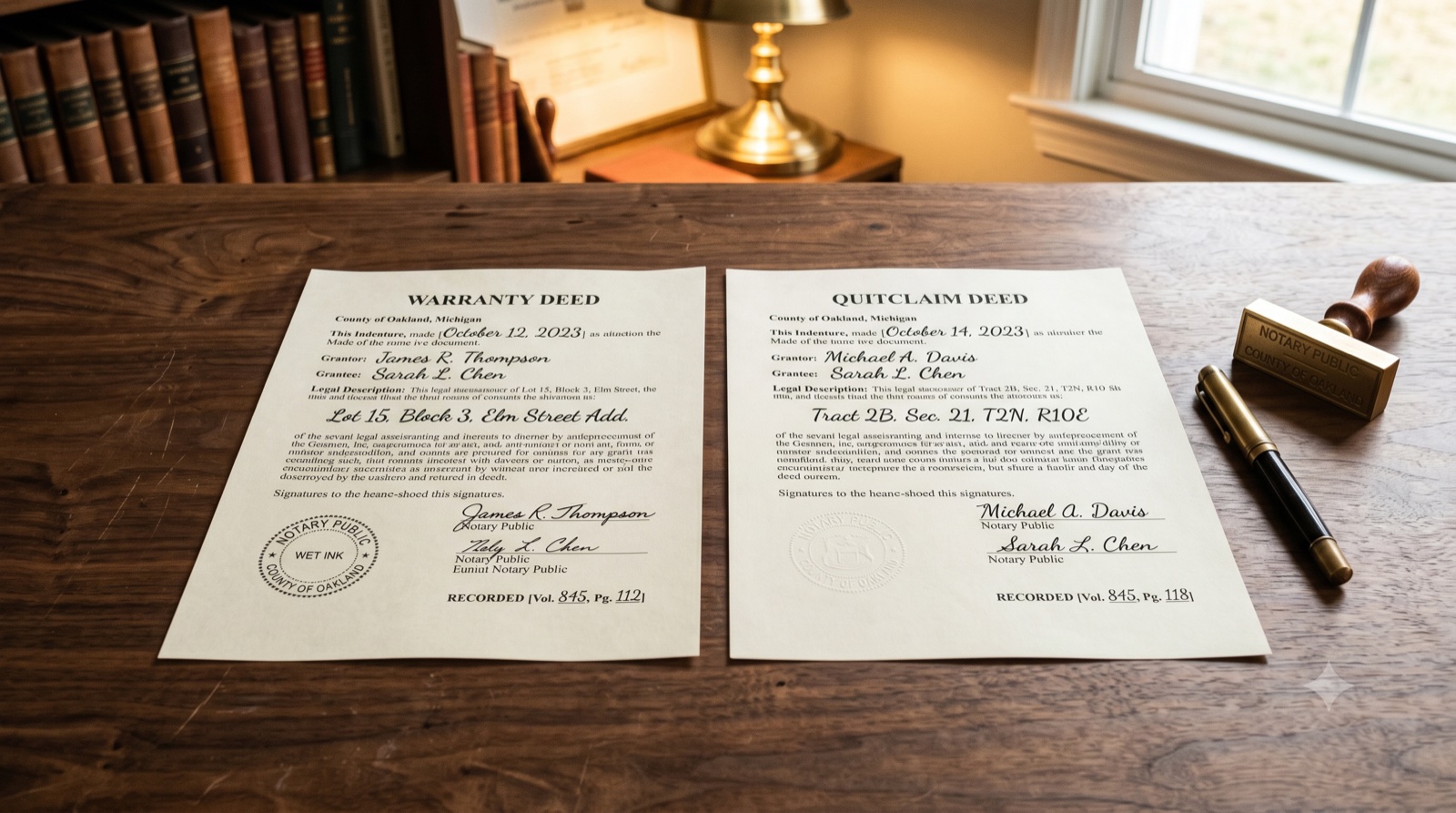
Quitclaim vs. Warranty Deed When Selling Land: Which Do You Need?
Key Takeaways
- A general warranty deed guarantees clear title back to the beginning of the property's history — the seller is liable for any defect discovered later, even one created before they owned it
- A quitclaim deed conveys whatever interest the grantor has — and nothing more — if the grantor has a defective title, the buyer inherits the defect with no recourse against the seller
- Most arm's-length land sales use a warranty deed — a quitclaim deed appearing in a standard sale is a red flag that the seller may be uncertain about what they actually own
Quitclaim vs. Warranty Deed: What's the Difference When Selling Land?
A general warranty deed guarantees your ownership and promises to defend the buyer's title against all claims, past and future. A quitclaim deed conveys only what interest you have without any guarantees. In most arm's-length land sales, a general warranty deed is expected; a quitclaim deed is a red flag.
The type of deed you sign determines exactly what you are guaranteeing to the buyer — and what you remain liable for if a title problem surfaces later. In most straightforward land sales, a general warranty deed is the standard. Quitclaim deeds serve a legitimate role in specific situations, but showing up with one in an arm's-length transaction raises an immediate question: what does the seller not know, or not want to guarantee, about this land?
This guide covers the three main deed types used in land sales, what each guarantees, when each is appropriate, and why buyers — and the title companies insuring them — care so much about the distinction. For a broader look at all the documents involved in a land sale, see our guide on what paperwork is needed to sell land.
What Is a General Warranty Deed?
A general warranty deed is the broadest and most protective deed a seller can give a buyer, according to Cornell Law School LII. By signing a general warranty deed, the seller makes six traditional covenants (promises) to the buyer:
- Covenant of seisin — the seller actually owns the property and has the right to convey it
- Covenant of the right to convey — the seller has the legal authority to sell (not just ownership, but also the absence of restrictions preventing the sale)
- Covenant against encumbrances — there are no undisclosed liens, easements, or other encumbrances on the property
- Covenant of quiet enjoyment — the buyer's possession will not be disturbed by a third party claiming a superior title
- Covenant of warranty — the seller will defend the buyer's title against any future claims
- Covenant of further assurances — the seller will execute any additional documents needed to perfect the buyer's title
The critical feature of a general warranty deed: these covenants extend back through the entire chain of title — not just to events that happened while the seller owned the property. If a neighbor's ancestor forged a deed 80 years ago that affected this parcel, the general warranty deed seller is potentially on the hook, according to Cornell Law School LII.
When Is a General Warranty Deed Used?
General warranty deeds are the standard in most residential and rural land transactions in the United States. Buyers and their lenders expect them. If you are selling land to a new buyer in an arm's-length transaction — whether to a neighbor, an investor, or a company like Jerez Land — a general warranty deed is the appropriate instrument in most cases.
What Is a Special Warranty Deed?
A special warranty deed conveys the same six covenants as a general warranty deed, but with one critical limitation: the seller only warrants against defects that arose during their period of ownership, according to Cornell Law School LII. The seller makes no promises about what happened to the title before they acquired it.
Special warranty deeds are common in:
- Estate sales and executor's deeds — executors are not willing to personally warrant against events before the deceased acquired the property
- Bank and lender-owned properties (REO) — banks selling foreclosed property typically won't warrant title going back decades
- Commercial real estate transactions — particularly where sophisticated buyers and sellers have negotiated the warranty's scope
- Tax deed sales — government entities conveying tax-foreclosed property often use special warranty or no-warranty deeds
Buyers receiving a special warranty deed can still protect themselves with title insurance, which covers defects that the deed's warranties don't address.
What Is a Quitclaim Deed?
A quitclaim deed conveys only whatever interest, if any, the grantor currently has in the property — without making any warranties about the quality or validity of that interest, according to Cornell Law School LII. The classic formulation: "I give you whatever I have, if I have anything at all."
If the grantor has a perfect, unencumbered fee simple title, a quitclaim deed conveys exactly that. If the grantor has a defective title, a lien-encumbered title, or no title at all, the quitclaim deed conveys exactly that — and the grantee has no deed-based recourse against the grantor.
Legitimate Uses of a Quitclaim Deed
Quitclaim deeds are not inherently problematic — they are the right instrument in specific circumstances:
- Adding or removing a spouse from title (at marriage, divorce, or estate planning)
- Transferring property between family members who already know the title history
- Correcting a minor defect in a prior deed — a curative quitclaim from a prior grantor
- Transferring property into or out of a trust or LLC where the same party controls both sides
- Resolving a potential adverse claim — a neighbor quitclaims away any interest they might have in a disputed strip of land
The Quitclaim Red Flag in a Land Sale
A quitclaim deed appearing in an arm's-length land sale between strangers should trigger immediate scrutiny. It signals one of two things: the seller doesn't know if they have clear title, or the seller knows they have a title problem and wants to avoid warranty liability. In either case, a buyer should demand a title search and title insurance before closing, and should seriously consider insisting on a general or special warranty deed instead.
Deed Type Comparison Table
| Deed Type | Warranty Scope | Typical Use | Buyer's Protection | Seller's Liability |
|---|---|---|---|---|
| General Warranty | Full — back to beginning of title history | Standard arm's-length sales | Highest | Highest |
| Special Warranty | Limited — only the seller's ownership period | Estate sales, bank-owned, commercial | Moderate | Limited to seller's period |
| Quitclaim | None — conveys only what grantor has | Family transfers, corrections, trust transfers | Lowest | None |
| Bargain and Sale Deed | Implied — grantor held title, no encumbrances claimed | Some states' equivalent of special warranty | Moderate | Varies by state |
Note: some states use different terminology. A "grant deed" in California or a "statutory warranty deed" in Washington function similarly to a general warranty deed in other states. The name matters less than the covenants recited in the document.
What Type of Deed Will You Sign When Selling Land?
In a direct sale to Jerez Land or any arm's-length buyer, you'll typically sign a general warranty deed prepared by the closing title company or attorney. This is standard, expected, and what allows the title company to issue a clean owner's policy to the buyer.
If your title has complications — a lien, a cloud, a prior defect — the deed type becomes part of the negotiation along with how the title issue is resolved. See our related guide on how to sell land with a lien or cloud on title for how those situations are handled.
Request a no-obligation cash offer from Jerez Land — we'll review your parcel, work through the title picture, and give you a firm written number on your specific land. No commissions. No listing fees. We handle the paperwork. For a full overview of land selling guides, visit our blog.
For more on the costs and process involved in closing, see who pays closing costs when selling land. Curious whether direct buyers are legitimate? Read are we-buy-land companies legit.
Frequently Asked Questions
Can I sell land with a quitclaim deed?
Technically yes — a quitclaim deed is a legally valid conveyance in all U.S. states. But most buyers, their lenders, and title companies expect a general or special warranty deed in an arm's-length sale. A quitclaim deed in a normal sale signals potential title problems, may make the property uninsurable by a title company, and may cause buyers or lenders to walk away.
I'm selling land and need to give a general warranty deed — what exactly am I promising to the buyer?
A general warranty deed includes six traditional covenants: seisin (seller owns the land), right to convey (seller has authority to sell), against encumbrances (no undisclosed liens or easements), quiet enjoyment (no third-party claims will disturb the buyer's possession), warranty (seller will defend title), and further assurances (seller will sign additional documents if needed to perfect title). These warranties extend back through the full chain of title.
I inherited land and the estate attorney says to use a special warranty deed — what's different about that from a general warranty deed?
Both convey the same covenants, but a special warranty deed limits the seller's liability to defects that arose only during the seller's ownership. A general warranty deed covers defects anywhere in the chain of title, even from before the seller acquired the property. Special warranty deeds are common in estate sales and bank-owned property transactions.
Does title insurance replace the need for a warranty deed?
Title insurance and warranty deeds serve different protective functions. A warranty deed creates a direct claim by the buyer against the seller if a title defect surfaces. Title insurance provides a separate layer of coverage from the title insurance company for defects not discovered in the title search. They work together — and in most standard land sales, you need both.
I want to use a quitclaim deed to limit my liability — but would a buyer or lender even accept that?
A warranty deed creates personal liability on the seller if a title defect is later discovered. That liability acts as a strong incentive for sellers to ensure their title is actually clean before signing. A quitclaim deed eliminates the seller's liability entirely, leaving the buyer with no recourse if a hidden defect surfaces — which is why buyers and their title insurers treat quitclaim deeds in arm's-length sales as a warning sign.
Can a title company issue title insurance on a property conveyed by a quitclaim deed?
It depends on the circumstances. A title company may insure a property conveyed by quitclaim deed if the underlying title search shows a clean chain of title. But the company will want to understand why a quitclaim was used rather than a warranty deed. In many cases — especially where the quitclaim was used in lieu of a warranty deed specifically because of a known defect — the title company will decline to insure or require curative work before issuing a policy.
Disclaimer: This article is for informational purposes only and does not constitute legal advice. Deed requirements and terminology vary by state. Always consult a licensed real estate attorney before executing or accepting any deed type. Jerez Land is not responsible for actions taken based on this information.