
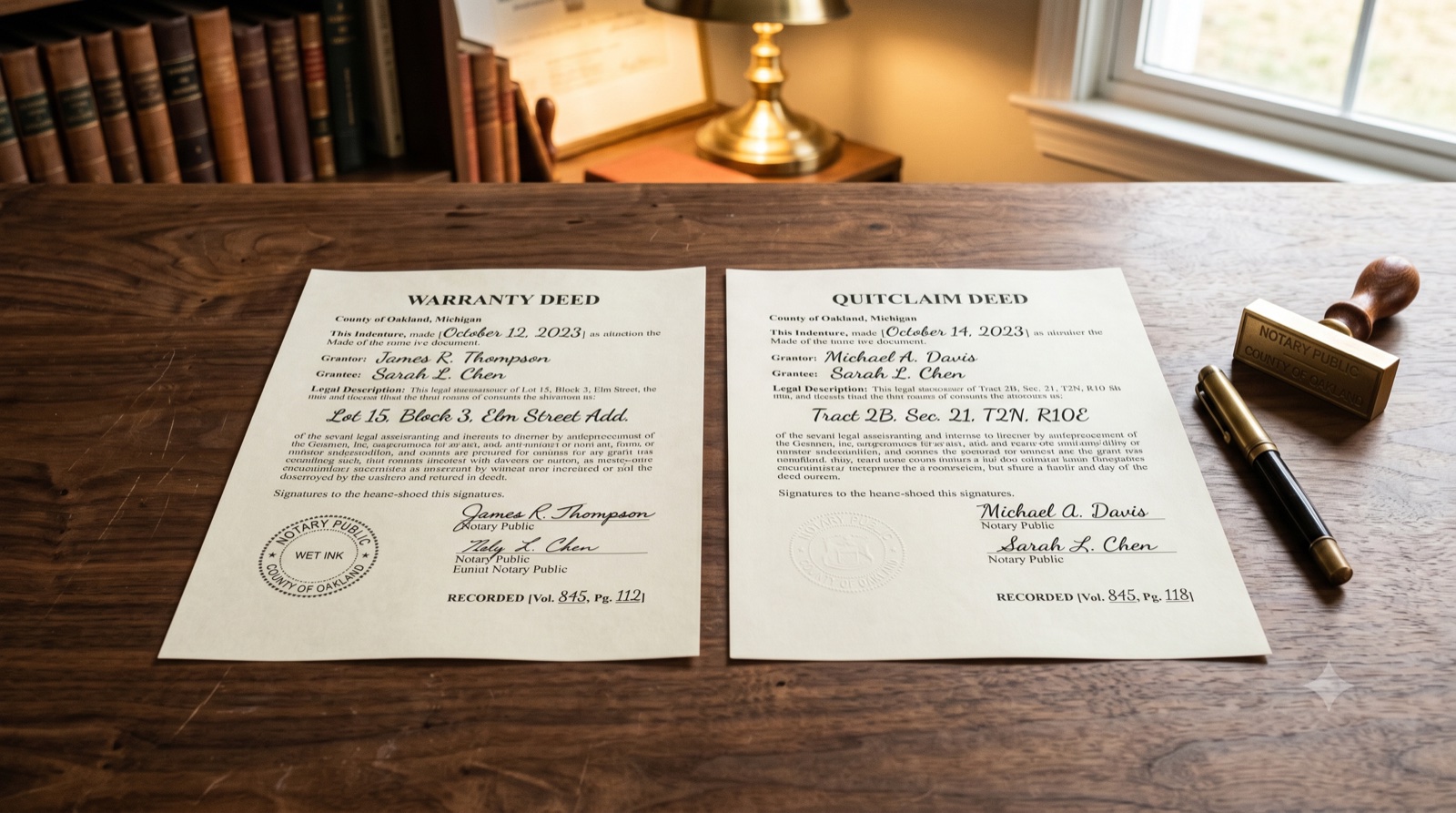
Are Land Titles Public Record?
Key Takeaways
- Recorded deeds and land records are public, filed at a county office — called a Register of Deeds, County Recorder, Clerk of Superior Court, or Chancery Clerk depending on the state — and searchable there, often online, by owner name or parcel number.
- "Title" is not one document you can pull up. It's a legal conclusion built from the entire chain of recorded instruments — deeds, mortgages, liens, easements — going back through every prior owner. There's no single "title certificate" sitting in a drawer.
- What's private: the title insurance policy itself, an attorney's confidential title opinion, and in about a dozen non-disclosure states, the exact sale price. Those are all built from the public record — they just aren't part of it.
Are Land Titles Public Record?
Yes, the underlying records are public — every deed, mortgage, lien, easement, and plat affecting your parcel is filed and searchable at the county level. But "title" itself isn't a public document you can request a copy of, because title isn't a document at all — it's the legal conclusion drawn from that entire recorded history.
That distinction trips up a lot of landowners, especially anyone preparing to sell for the first time. This guide covers what's genuinely public about your land, why the office that holds those records has a different name depending on which state you're in, what title actually means once you look past the paperwork, and exactly how to pull your own deed and ownership history before you do anything else. If you're gathering documents to close a sale rather than just researching your own parcel, see what paperwork you need to sell land. If your search turns up something concerning, selling land with a lien or cloud on title covers what to do next.
What's Actually Public at the County Level?
Every recorded instrument affecting your land — the deed that transferred it to you, any mortgage or deed of trust, recorded liens, easements, and subdivision plats — is a public record maintained by a county office, and in most counties you can search it yourself for free. This has been true in every US state for as long as land has been recorded; recording a deed is what makes your ownership official and puts the world on notice of it, according to Nolo's consumer guide on deed recording.
The recording office typically maintains at least two searchable indexes: a grantor/grantee index (organized by buyer and seller names) and, increasingly, a parcel or tract index tied to the property itself. Search by either your name, a prior owner's name, or your parcel number, and you'll usually get a list of every recorded document touching that history, often with a scanned image of the actual instrument. Many counties put this online now; others still require an in-person or mailed request, per the Sacramento County Public Law Library's overview of recorded real estate documents.
What you will not find in this search is a document labeled "title." You'll find the raw material title is made of.
Why Isn't the Recording Office Called the Same Thing Everywhere?
The office that records land documents has a different legal name in nearly every state, even though it performs the identical function everywhere: Register of Deeds, County Recorder, County Clerk, Clerk of Superior Court, and Chancery Clerk are the most common titles, and they all maintain the same category of public land records.
| State example | What the office is called |
|---|---|
| North Carolina | Register of Deeds (and Clerk of Superior Court for some related filings) |
| Mississippi | Chancery Clerk |
| Georgia | Clerk of Superior Court |
| Many Midwestern states | Register of Deeds |
| Many Northeastern states | County Clerk |
| California and many Western states | County Recorder |
North Carolina is a useful example of why this can trip people up: the state's own guidance notes that to fully understand the legal status of a parcel, you sometimes need to check both the Register of Deeds office and the Clerk of Superior Court's office, since certain filings — judgments, some liens — land in the court clerk's records rather than the recorder's, according to the North Carolina Secretary of State's land records FAQ. Mississippi consolidates land recording under the Chancery Clerk, who serves as the county's custodian of public land records. Georgia routes it through the Clerk of Superior Court, and the statewide Georgia Superior Court Clerks' Cooperative Authority lets you search real estate records across all 159 counties from one login. None of this changes what's public — it only changes which door you knock on. The NC Association of Registers of Deeds and county-level directories like Deeds.com's recorder listings can point you to the correct office by state and county.
Is "Title" Something You Can Actually Look Up?
No — title is not a document, it's a legal conclusion. Rocket Mortgage's explainer on deed versus title puts it plainly: title is the concept of legal ownership rights, while a deed is the specific document that transfers those rights from one person to the next. What most people picture when they imagine "getting the title" doesn't exist as a single filed record.
Instead, title is established by the chain of title — the unbroken sequence of every recorded deed, will, court order, and conveyance affecting a parcel, traced backward from the current owner to the earliest available record. Rocket Mortgage describes building a chain of title as reviewing all of those recorded documents in sequence, not looking up one file. Each recorded deed is a link in that chain; a title search is the act of walking the chain link by link to confirm it's unbroken and free of defects — a break, an unresolved lien, or a missing signature anywhere in that sequence is what creates a "cloud" on an otherwise clean-looking record.
This is also the difference between a title search, an attorney's title opinion, and title insurance. All three start from the same public record. A title search or abstract simply compiles the recorded documents in order. An attorney's title opinion goes further — the attorney reviews that compiled history and gives a professional judgment on whether title is good, but that opinion only covers what a diligent search of the public record could find, per LegalClarity's comparison of title opinions and title insurance. Title insurance goes further still: it's a private indemnity policy, examined against the same public record, that also covers hidden defects no records search could ever catch — forged prior deeds, missing heirs, clerical recording errors — according to the California Department of Insurance's consumer guide. You can read more about when that extra layer of protection is worth buying in do you need title insurance to sell land.
What's Public vs. What's Private?
| Public record (free to search at the county) | Private product (built from the public record) |
|---|---|
| Recorded deeds and prior conveyances | The title insurance policy itself |
| Recorded mortgages / deeds of trust | An attorney's confidential title opinion |
| Recorded liens and judgments affecting the parcel | The title company's internal "title plant" database |
| Recorded easements and rights-of-way | Sale price, in roughly a dozen non-disclosure states |
| Recorded plats and subdivision surveys | Personal financial and identifying details beyond what's in the recorded instrument |
On that sale-price line: in most states, the price you paid (or will sell for) becomes part of the public record once the deed or a transfer-tax declaration is recorded. But roughly a dozen states are "non-disclosure" states, where the sale amount is not required to be reported publicly, and only the buyer, seller, and lender see the actual figure, according to Redfin's rundown of non-disclosure states. Check your own state's practice before assuming a past sale price on your land is — or isn't — publicly visible.
How Do You Actually Find Your Deed and Chain of Title?
Start with your county recorder's office — whatever it's called locally — and search by your name or your parcel's tax/parcel ID; most counties will hand you a scanned copy of your recorded deed for free or a small fee. From there, working backward through the grantor/grantee index one recorded conveyance at a time is how you build your own chain of title.
- Find the correct office. Use a state directory like the NC Association of Registers of Deeds (for NC) or a national listing such as Deeds.com's recorder directory to identify the right county office and its search portal.
- Search by name or parcel number. Enter your own name as grantee to pull your deed, or search a prior owner's name to trace further back. If you know your parcel number, a parcel index search is usually faster and avoids name-spelling mismatches.
- Pull everything attached to the parcel, not just the deed. Note any recorded mortgages, liens, judgments, or easements tied to your parcel ID — these are the items a buyer's title search will find regardless of whether you looked first.
- Cross-check with the assessor or GIS site. The recorder's office proves the legal chain of ownership; the county assessor or GIS portal shows you the parcel boundaries, acreage, and current tax status tied to that same parcel ID.
- Note anything that looks incomplete. A missing link in the chain, an unrecorded prior deed, or a decades-old lien with no release on file are all things worth flagging before a buyer's title company finds them for you. If your search turns up a parcel where a deed was apparently never recorded at all, see how to sell a parcel with no recorded deed.
Why This Matters Before You Sell
Pulling your own deed and chain of title costs nothing and takes an afternoon, and it tells you exactly what a buyer's title company is about to find anyway — before it becomes a surprise in the middle of a closing. Most rural land sits on a chain of title nobody has looked at closely since the last conveyance, sometimes decades ago, and old liens, unreleased mortgages, or a missed signature can sit there quietly until a sale forces them into view.
If your search turns up something clean, you've confirmed what you already believed and you're ready to move. If it turns up a lien, a missing link, or an unrecorded deed somewhere in the chain, that's useful information now rather than a delay later — and it's fixable in most cases well before closing. Either way, checking the public record yourself is the first real step in preparing to sell, not an afterthought.
If you'd rather skip the paperwork chase entirely, request a no-obligation cash offer and we'll pull the county record ourselves as part of underwriting your parcel — as a direct buyer, we work through title issues as part of the purchase rather than asking you to clear them first. For more on getting your parcel sale-ready, see the blog or start with how much your land is worth.
Frequently Asked Questions
I inherited land but can't find the deed anywhere — how do I look it up at the county?
Go to the recorder's office (Register of Deeds, County Recorder, or Clerk of Superior Court, depending on the state) for the county where the land sits and search their grantor/grantee index by the deceased owner's name, or by the parcel number if you have it from a tax bill. Most counties offer this search online for free; if not, you can request it in person or by phone. The recorded deed that transferred the land to your relative, and any deed transferring it before that, will be in that index even if your family's paper copy was lost.
I want to see every past owner of my parcel, not just the current one — is that public?
Yes. Every recorded deed transferring that parcel is part of the public record, so you can trace ownership backward as far as the county's records go by following each grantor/grantee pair in sequence — the person who sold to you, the person who sold to them, and so on. This sequence of recorded conveyances is exactly what's called the chain of title. Some counties' records go back over a century; others only became consistently organized more recently, so how far back you can trace depends on your specific county's record-keeping history.
My title company found a lien I never knew about — could I have found it myself in the public record?
Usually, yes — most liens a title company flags are recorded documents sitting in the same public index anyone can search, including old judgments, unpaid contractor liens, or a mortgage that was paid off but never formally released. A careful search of your parcel's recorded history at the county recorder's office would likely have surfaced the same lien before you ever listed the land. The exceptions are the rare hidden defects — forged signatures, undisclosed heirs, clerical recording errors — that no records search can catch, which is exactly what title insurance exists to cover beyond the public record.
Is the price I paid for my land public information?
It depends on your state. In most states, the sale price becomes part of the public record through the recorded deed or an accompanying transfer-tax declaration. In roughly a dozen "non-disclosure" states, however, the exact sale amount is not required to be made public, and typically only the buyer, seller, and lender know the real figure. Check whether your state discloses sale prices before assuming a comparable sale's price on file is accurate — or assuming yours will be visible to others.
What's actually the difference between a title search and title insurance?
A title search compiles and reviews the recorded documents affecting a parcel — deeds, liens, mortgages, easements — and confirms whether the chain of ownership looks complete and unbroken. Title insurance starts from that same public record but goes further: it's a paid policy that also protects against defects no records search could ever find, like a forged deed somewhere in the chain or an heir nobody knew existed. In short, a title search tells you what the public record shows; title insurance protects you against what it doesn't.
Do I need to hire someone to read my own deed, or can I do it myself?
You can pull and read your own recorded deed for free at the county recorder's office, and doing so is entirely reasonable if you just want to confirm basic facts — who's named on it, the legal description, whether it was actually recorded. Where it makes sense to bring in an attorney or title company is if you find something confusing in the legal description, spot a lien or judgment you don't understand, or are getting ready to actually close a sale, since interpreting a defect correctly and clearing it both carry real legal weight.
Disclaimer: This article is for informational purposes only and does not constitute legal advice. Recording practices, office names, index structures, and sale-price disclosure rules vary by state and county and can change; always confirm current procedures with your specific county recorder's office. A public records search is not a substitute for a professional title search, an attorney's title opinion, or title insurance before closing a sale. Jerez Land is not responsible for actions taken based on this information.