
Do I Need Title Insurance to Sell Land? What Sellers Should Know
Key Takeaways
- Title insurance protects the buyer, not the seller — in a typical land sale the buyer purchases an owner's policy that defends their new ownership against pre-existing defects, so the seller is rarely the one who "needs" a policy, according to the American Land Title Association
- Your real obligation as a seller is to deliver marketable title — a title free of significant defects that a reasonable buyer would object to — and title insurance is the mechanism that lets the buyer and title company confirm and protect that, according to Cornell Law School LII
- A cash buyer has no lender, so a lender's policy isn't required — but an owner's policy is still common and strongly recommended, because the title risks on vacant land don't disappear just because there's no mortgage, according to the Consumer Financial Protection Bureau
Do I Need Title Insurance to Sell Land?
No—in almost every land sale, the seller does not buy title insurance to protect themselves. Title insurance is designed to protect the buyer's ownership interests against defects that existed before closing. Your responsibility as a seller is to deliver marketable title, and title insurance is the tool the buyer (and the title company) use to verify and insure that title before money changes hands. So the more useful question for a seller isn't "do I need a policy," it's "what does the buyer's title insurance require of me, and who pays for it?"
This guide explains the two kinds of title insurance, the difference between a title search and a title insurance policy, who customarily pays the premium, and why vacant and rural land carries elevated title risk that makes title insurance matter even more. For a broader overview of every document involved in a sale, see what paperwork is needed to sell land, and for the full menu of land-selling guides, visit our blog.
What Does Title Insurance Actually Cover?
Title insurance is fundamentally different from the insurance most people know. Homeowner's, auto, and health insurance protect against future events. Title insurance protects against past events — defects in the chain of ownership that already exist on the day of closing but haven't surfaced yet, according to the American Land Title Association.
A title policy generally covers losses caused by problems such as:
- Undisclosed or unreleased liens — an old mortgage, a tax lien, or a judgment that was never properly cleared from the record
- Forgery and fraud — a forged signature or impersonation somewhere in the chain of title
- Errors in public records — a misindexed deed, a clerical mistake, or a defective legal description
- Missing heirs and undisclosed interests — a relative or prior co-owner with a claim nobody knew about
- Boundary, easement, and access disputes — depending on the policy and any survey, conflicts over where the land actually is and who can cross it
Crucially, these are problems that may have originated decades before the current seller ever owned the land. That's why the buyer wants protection that reaches back through the entire history of the parcel, not just the current owner's tenure.
How a Title Policy Differs From a Deed Warranty
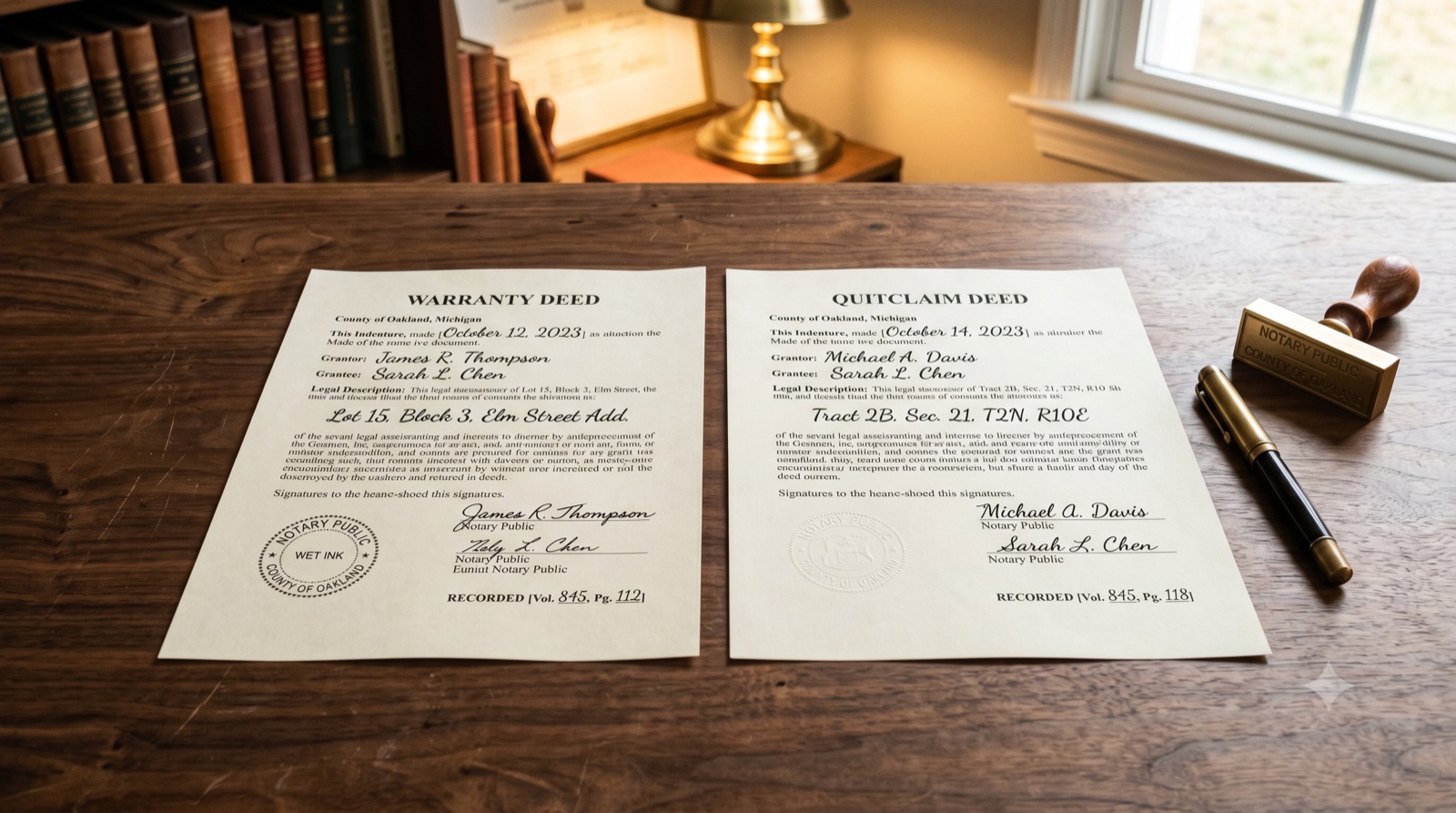
A warranty deed and a title insurance policy both protect the buyer, but through different channels. A warranty deed gives the buyer a claim against the seller personally if a defect appears later. A title policy gives the buyer a claim against the insurance company. They're complementary, not redundant — which is why most arm's-length land sales involve both. For the deed side of that equation, see quitclaim vs. warranty deed when selling land.
Owner's Policy vs. Lender's Policy: What's the Difference?
There are two separate title insurance policies in a typical real estate transaction, and they protect two different parties, according to First American.
An owner's policy protects the buyer's ownership and equity for as long as the buyer (or their heirs) hold an interest in the property. A lender's policy (also called a loan or mortgagee policy) protects only the lender's security interest, up to the outstanding loan balance, and exists only because a lender required it as a condition of the mortgage.
Both are typically a one-time premium paid at closing — there are no recurring payments, according to the Consumer Financial Protection Bureau. The premium scales with the purchase price rather than being a flat fee, and when both policies are issued at the same closing the lender's policy is usually discounted because the title work is shared.
| Feature | Owner's Title Policy | Lender's Title Policy |
|---|---|---|
| Who it protects | The buyer / new owner | The mortgage lender |
| What it protects | Ownership and equity | The loan balance |
| How long it lasts | As long as the owner or heirs hold an interest | Until the loan is paid off |
| Required by law? | No (optional, but strongly recommended) | No, but lenders require it to fund a loan |
| Relevant in a cash sale? | Yes — still common and recommended | No — there is no lender |
| Premium | One-time, at closing | One-time, at closing (often discounted) |
What This Means When You Sell to a Cash Buyer
A cash buyer has no mortgage, which means there is no lender to require a lender's policy — so that policy simply doesn't exist in the deal, according to the Consumer Financial Protection Bureau. An owner's policy is still common and widely recommended, because the underlying title risks on a parcel are identical whether the buyer pays cash or borrows. A serious cash land buyer will typically still order a title commitment and obtain an owner's policy to protect their own purchase.
The Seller's Real Job: Delivering Marketable Title
Most purchase contracts require the seller to convey marketable title at closing, even if the contract doesn't spell out the phrase, according to Cornell Law School LII. Marketable title means a title free of significant defects or clouds that a reasonable buyer would find objectionable. If the seller can't deliver it, the buyer can usually walk away without penalty.
This is where a seller's responsibilities and the buyer's title insurance intersect. Title insurance doesn't replace the seller's duty to deliver clean title — it confirms it. The process generally runs like this:
- Title search — a title professional examines public records (deeds, mortgages, liens, judgments, easements) to reconstruct the chain of title, according to LANDTHINK.
- Title commitment — the title company issues a commitment promising to insure the property, subject to certain conditions and exclusions.
- Schedule B exceptions — the commitment lists items the policy will not cover, such as recorded easements, mineral reservations, restrictions, and unpaid taxes, according to The Closing Agent. Anything the seller needs to clear shows up here.
- Curative work — the seller (or the buyer's team) resolves the items that block clean conveyance, then the policy issues at closing.
Title Search vs. Title Insurance Policy
These are often confused but do different jobs. A title search (or abstract) is a backward-looking summary of what the records show. A title insurance policy is a forward-looking promise that pays the insured if a covered defect that the search missed surfaces later, according to LANDTHINK. You need the search first to get the policy.
| Title Search / Abstract | Title Insurance Policy | |
|---|---|---|
| What it is | A review and summary of recorded documents | A contract that pays for covered losses |
| Direction | Looks backward at history | Looks forward, protects against the unknown |
| What it catches | Defects already in the record | Defects the search missed (forgery, missing heirs, errors) |
| Who relies on it | Both parties, before closing | The insured party, after closing |
For how an actual lien or cloud gets cleared during this process — payoffs, releases, and quiet-title actions — see our dedicated guide on how to sell land with a lien or cloud on title. And if you're dealing with an old loan that was never marked satisfied, see selling land with an old unreleased mortgage or deed of trust.
Who Pays for Title Insurance on a Land Sale?
Who pays the owner's title insurance premium is a matter of local custom and negotiation, not a single national rule, according to Redfin. In some states the seller customarily pays the owner's policy as a way of guaranteeing clear title; in others the buyer pays. Many transactions split the various title and settlement charges. State insurance regulators such as the California Department of Insurance and the North Carolina Department of Insurance publish consumer guidance, but the actual allocation comes down to your purchase agreement.
Because the customary split varies so widely and overlaps with deed prep, recording, and settlement fees, we cover the full breakdown in a separate guide. See who pays closing costs when selling land for the state-by-state customs and how a cash buyer often absorbs these costs entirely. The key point for this article: the title-insurance line item is negotiable, and a reputable cash buyer frequently agrees to cover it.
Why Vacant and Rural Land Carries Extra Title Risk
Title insurance matters more on raw and rural land than on a typical suburban house, because vacant parcels accumulate exactly the kind of quiet, long-running defects that title insurance is built to catch, according to RFD-TV.
- Heirs' property and probate gaps — land that passed through generations without formal probate can leave multiple heirs with fractional, unrecorded interests and no single clear owner, according to the Center for Agricultural Law and Taxation. This is one of the most common rural title problems.
- Severed and reserved minerals — oil, gas, or mineral rights that were carved off the surface decades ago often sit on the chain of title without ever being exercised, and frequently appear as Schedule B exceptions.
- Old, unreleased mortgages and liens — a long-paid loan that was never formally released can linger on the record for years on a parcel nobody visits.
- Access and easement uncertainty — rural easements (farm-to-market roads, utility crossings) sometimes lack precise legal descriptions, creating questions about legal access.
- Vague or conflicting legal descriptions — older parcels described by metes-and-bounds or outdated references can overlap or gap with neighbors, especially where no recent survey exists.
For sellers, none of this is a reason to panic. It's a reason the buyer's title work matters — and a reason an experienced cash buyer is often better equipped to push a complicated rural title to closing than a retail buyer who backs out at the first exception. If your situation involves inherited land with no clean ownership, see selling heirs' property with no clear title.
How Title Insurance Works in a Sale to Jerez Land
When you sell directly to Jerez Land, the closing title company runs the search, issues the title commitment, and the buyer-side owner's policy is part of the standard closing — you don't have to arrange or buy a policy to protect yourself. Your role is to help deliver marketable title, and we work through the Schedule B items with the title company rather than walking away when something comes up.
We give a firm written offer priced to your specific parcel, and a reputable cash buyer typically absorbs the carrying, marketing, and resale risk along with the closing logistics. If you'd rather not navigate title complications alone, that's exactly the kind of work a direct buyer is set up to handle.
Request a no-obligation cash offer from Jerez Land — we'll review your parcel, work through the title picture with the closing company, and give you a firm written number on your land. No commissions. No listing fees. If you want a second set of eyes on the legal side, see do I need a lawyer to sell land.
Frequently Asked Questions
Do I need to buy title insurance when I sell my land?
Generally no. Title insurance protects the buyer's ownership, not the seller, so in a typical land sale the seller does not buy a policy for their own protection. The seller's responsibility is to deliver marketable title — a title free of significant defects. The buyer purchases an owner's title insurance policy to protect that new ownership against defects that may have existed before closing.
What's the difference between an owner's and a lender's title policy when my buyer is financing?
An owner's policy protects the buyer's ownership and equity for as long as they or their heirs hold an interest in the property. A lender's policy protects only the mortgage lender's interest, up to the loan balance, and exists only when there is a loan. Both are one-time premiums paid at closing. In a cash sale there is no lender, so only the owner's policy is relevant.
Do I need title insurance if the buyer is paying cash?
A cash buyer has no lender, so a lender's policy is not required and does not exist in the deal. An owner's policy is still optional but strongly recommended, because the title risks on a parcel are the same whether the buyer pays cash or borrows. Most serious cash buyers still order a title commitment and obtain an owner's policy to protect their purchase.
Who pays for title insurance when selling land?
It depends on state custom and what is negotiated in the purchase agreement — there is no single national rule. In some states the seller customarily pays the owner's policy; in others the buyer does. The allocation is negotiable, and reputable cash land buyers often agree to cover title insurance and other closing costs as part of their offer.
Are a title search and title insurance the same thing?
No. A title search, or abstract, is a backward-looking summary of the recorded documents affecting a property. Title insurance is a forward-looking policy that pays the insured party if a covered defect the search missed surfaces later — such as a forged deed, a missing heir, or a recording error. You need the title search first in order to obtain the insurance policy.
Why does vacant land have more title problems than a house?
Vacant and rural land accumulates quiet, long-running defects that often go unnoticed because nobody lives there. Common issues include heirs' property from generations of unprobated estates, minerals severed off decades ago, old mortgages or liens that were never formally released, and easements or legal descriptions that are vague or conflicting. Title insurance is built to catch exactly these kinds of pre-existing defects.
Disclaimer: This article is for informational purposes only and does not constitute legal advice. Title insurance requirements, customs, and terminology vary by state. Always consult a licensed real estate attorney or title professional before relying on any title insurance arrangement in your transaction. Jerez Land is not responsible for actions taken based on this information.