
Should You Sell Land at Auction? Pros, Cons & What to Expect
Key Takeaways
- An auction trades a marketing process for a deadline — instead of waiting for one buyer to surface over months on the market, an auction concentrates competing bidders into a single event with a fixed sale date, which can shorten the timeline considerably
- Auction fees come from multiple directions — buyers typically pay a buyer's premium (commonly 5%–10% added on top of the winning bid) while sellers often cover marketing costs and sometimes a commission, even if the property does not sell, according to auction industry sources
- The two big risks are price and no-sale — an absolute auction sells to the highest bidder no matter how low the bid lands, and a reserve auction can end with no sale at all if bidding stalls below your number, leaving you with the marketing bill and no closing
Should You Sell Land at Auction?
A land auction can get your property sold in roughly 45 days with a hard deadline and competitive bidding, but you sacrifice price control and may owe marketing fees whether the land sells or not, making it a speed-for-certainty trade-off. Maybe — but only after you understand exactly what you're trading. Selling land at auction can compress a months-long sale into a single event with a hard deadline, which is appealing if you need to move a property quickly. The catch is that you give up control over the final price and take on real costs whether or not the land actually sells.
This guide explains how land auctions work, the difference between absolute and reserve formats, the fees buyers and sellers each pay, and the timeline you can realistically expect. It also covers when an auction makes sense and when a direct cash sale gives you the speed of an auction without the gamble. If you're weighing your options more broadly, start with our overview of the best way to sell land.
How Does a Land Auction Work?
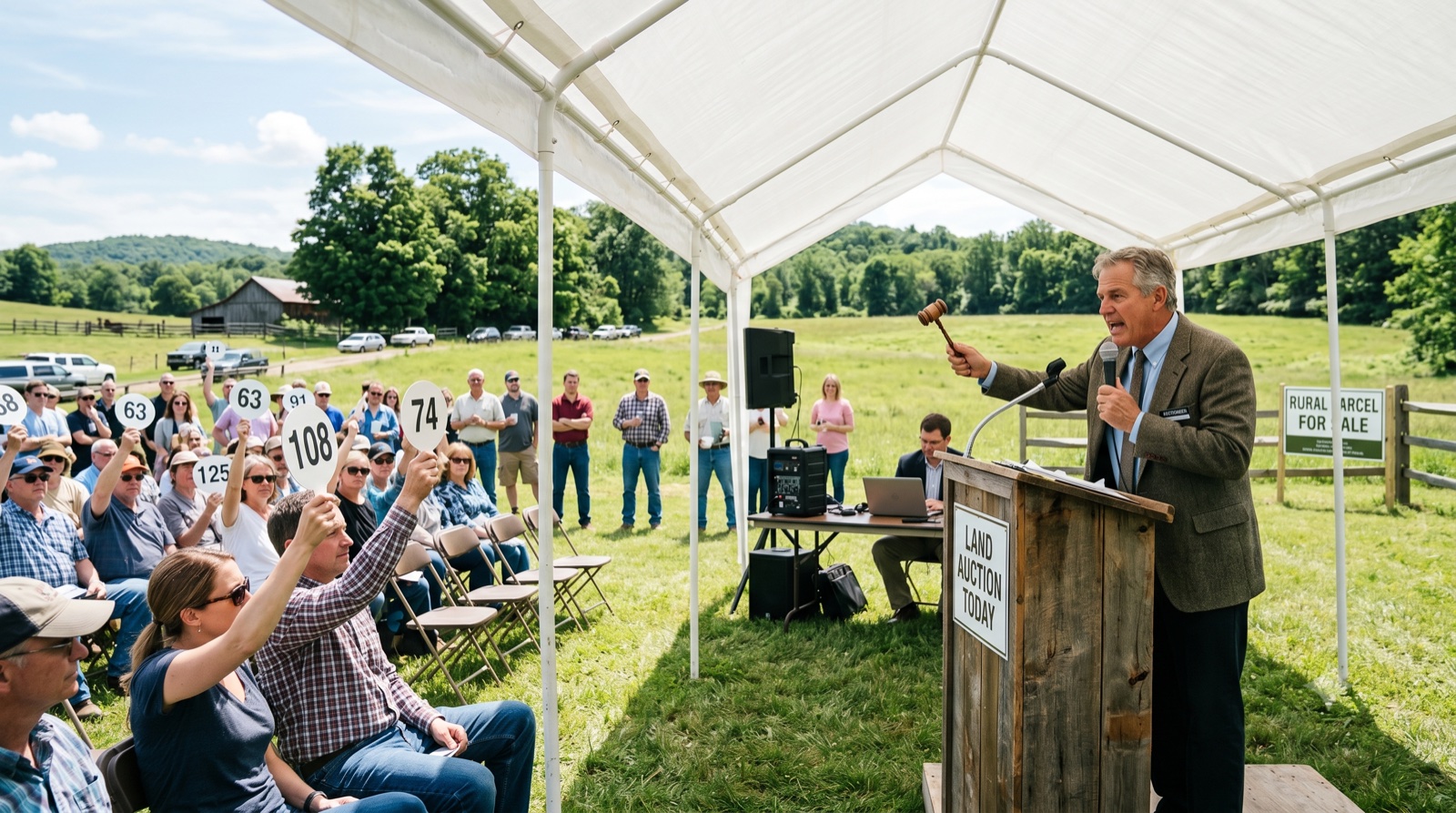
In a land auction, an auctioneer markets the property for a set period, then runs a competitive bidding event — in person, online, or both — where buyers bid against each other until no one outbids the high bidder, according to National Land Realty. Rather than spreading marketing across months of open-ended listing, the auction condenses it into a defined campaign that ends on a scheduled sale date.
The defined deadline is the whole point. It manufactures urgency: every interested buyer knows the property will sell (or be offered) on a specific day, so they have to act rather than wait. For the right parcel with genuine competing demand, that pressure can drive bidders to commit quickly.
Absolute vs. Reserve Auctions
The single most important decision in any land auction is the format, because it determines whether you control the outcome.
| Auction Type | What It Means | Who Holds the Risk |
|---|---|---|
| Absolute (no reserve) | The land sells to the highest bidder regardless of price — there is no minimum | The seller; you must accept the high bid even if it's low |
| Reserve (with reserve) | The seller sets a minimum and can confirm or reject the high bid | More balanced, but the property may not sell at all |
An absolute auction sells the property to the highest bidder no matter how low the final bid is, with no minimum and no right to reject. Absolute auctions draw the most bidders because buyers know the land is genuinely selling, but they expose the seller to the full risk of a disappointing result.
A reserve auction lets the seller set an undisclosed minimum and confirm or decline the high bid at the end. That protects you from selling far too low — but it also means the auction can end with no sale if bidding never reaches your number, as discussed below.
Online vs. In-Person
Many auctioneers now run land auctions online or in a hybrid format, opening bidding to buyers anywhere instead of only those who show up in person. Online platforms widen the bidder pool and let participants review terms and due-diligence documents in advance. The mechanics of fees and formats are the same — the difference is reach and convenience, not the underlying economics.
What Does It Cost to Sell Land at Auction?
Auction costs are structured differently from a traditional listing, and they can come at you from more than one direction. Understanding each one matters, because some are owed even if the land never sells.
The Buyer's Premium
In most land and real estate auctions, the buyer pays a buyer's premium — an extra percentage added on top of the winning bid. For land and rural property, this commonly ranges from about 5% to 10%, according to Ranch and Farm Auctions. So if a parcel hammers down at $100,000 with a 10% buyer's premium, the buyer actually pays $110,000, the seller receives the $100,000 bid, and the auction company keeps the $10,000 premium.
The buyer's premium is the auction industry's primary way of getting paid without charging the seller a traditional commission. But it has a quiet effect on your proceeds: because bidders know they'll owe the premium on top of their bid, they tend to bid somewhat lower than they otherwise would, which can pull down the hammer price.
Seller Commission and Marketing Fees
The buyer's premium doesn't always mean the seller pays nothing. Depending on the auction company and contract, sellers may face:
- Marketing expenses — auctioneers commonly require the seller to fund the advertising campaign (signage, online listings, mailers, email, and social ads), which industry sources put in the range of a few hundred dollars and up
- A seller commission — some land auctioneers charge a commission of roughly 1%–10% of the sale price in addition to the buyer's premium, according to Prime Land Buyers
- Entry or listing fees — non-refundable upfront fees, often a few hundred dollars, to cover initial setup and administration
The exact mix varies widely by company. Some platforms charge the seller no commission and rely entirely on the buyer's premium; others charge the seller marketing fees, a commission, and an entry fee. Read the auction contract closely before you sign, and confirm in writing exactly what you owe — and when.
The Cost That Hurts Most: Fees With No Sale
Here is the part many sellers miss. In a reserve auction, you can still owe the marketing and listing fees even if the property doesn't sell, according to auction industry sources. A "no-sale" event means you've paid to advertise the land, generated public bidding that landed below your reserve, and walked away with no closing and a bill. For more on why some parcels struggle to attract buyers in the first place, see our guide on why won't my land sell.
Pros and Cons: Speed vs. Price Uncertainty
The case for an auction comes down to speed and a deadline. The case against it comes down to cost and uncertainty. Weigh both honestly against your situation.
The Pros
- A defined sale date. The auction creates a hard deadline that compresses the sale into a known window. A typical real estate auction runs roughly 45 days from listing to sale day — about 15–20 days of due diligence and prep, then around 30 days of marketing, according to Wiregrass Auction Group. That's faster than many open-ended listings.
- Competitive bidding can work in your favor. When a parcel has genuine demand and multiple interested buyers, the head-to-head bidding can push the price up on auction day.
- A clear, transparent process. Terms and deadlines are published in advance, and all bidders compete on the same footing.
The Cons
- You don't control the price. In an absolute auction, the land sells at whatever the top bid is, even if that's well below what you hoped. The auction discount is real: properties sold at auction can fetch less than comparable properties sold through a traditional process, and a no-sale can dent how buyers perceive the property's value, according to Tranzon and other auction-industry commentary.
- The outcome is uncertain. A reserve auction can end with no sale. An absolute auction can end with a painfully low price. Either way, the result isn't guaranteed until the gavel falls.
- Fees stack up — sometimes whether you sell or not. Between the buyer's premium suppressing bids, seller marketing costs, possible commissions, and non-refundable entry fees, the all-in cost can be significant. And a no-sale still leaves you owing the marketing bill, according to industry sources.
- It's a public event. A poorly attended auction or a low result happens in plain view, which can make a future sale harder.
If a fast, predictable timeline is what's driving you toward an auction, it's worth comparing against other fast-sale paths first. Our guide on how to sell land fast lays out the options, and how long it takes to sell land sets realistic expectations for each.
Your Options for Selling Land Quickly
If the appeal of an auction is speed and a deadline, you essentially have three paths:
Option 1: Sell at auction. Accept the marketing costs, the buyer's premium dynamic, and the price uncertainty in exchange for a hard sale date. Best when your parcel has clear competing demand and you can stomach the risk of a low result or a no-sale.
Option 2: List with an agent. A traditional listing may bring a higher price over time, but it's open-ended, involves commissions, and offers no deadline. For help deciding, see our guide on whether you need a realtor to sell land.
Option 3: Sell directly to a cash buyer. A direct cash buyer like Jerez Land gives you much of an auction's speed without the gamble. We evaluate your specific parcel and present a firm written cash offer — no buyer's premium, no seller commissions, no marketing fees, and no risk that the property fails to sell on the day. Because we buy and hold the property ourselves, we absorb the carrying, marketing, and resale risk, so you don't.
Request a no-obligation cash offer and you'll know your number before you commit to anything — no public bidding, no fees that hit whether you sell or not, and a timeline you control. Unlike an auction, the offer is firm and the outcome is certain.
To understand how land is valued before you decide, see how much your land is worth and who pays closing costs when selling land. For more guides on selling land in any situation, visit our blog.
Frequently Asked Questions
I'm considering a land auction — what's the difference between absolute and reserve?
In an absolute (no-reserve) auction, the land sells to the highest bidder regardless of price — there is no minimum and the seller cannot reject the high bid. In a reserve auction, the seller sets a minimum and can confirm or decline the high bid at the end. Absolute auctions attract more bidders because the sale is guaranteed, but they expose the seller to a low result. Reserve auctions protect against selling too low, but the property may not sell at all.
Who pays the buyer's premium at a land auction?
The buyer pays the buyer's premium. It's an extra percentage — commonly 5%–10% for land and rural property — added on top of the winning bid. For example, a $100,000 winning bid with a 10% premium means the buyer pays $110,000 total, the seller receives the $100,000 bid, and the auction company keeps the $10,000. Because buyers factor the premium into their bids, it can quietly suppress the hammer price.
I'm selling at a reserve auction — will I still owe fees if it doesn't sell?
Often, yes. In a reserve auction, the seller can still owe marketing expenses, listing fees, or entry fees even when the property doesn't sell, according to auction industry sources. A "no-sale" event means you've paid to advertise the land and run the bidding but have no closing to show for it. Always confirm in the auction contract exactly which fees are owed regardless of outcome.
I need to sell my land fast — how long does a land auction actually take?
A typical real estate auction runs about 45 days from listing to sale day — roughly 15–20 days of due diligence and preparation, followed by about 30 days of marketing, according to Wiregrass Auction Group. Some contracts allow a marketing period of anywhere from 30 days to six months. The defined sale date is the main advantage over an open-ended listing, but closing still takes additional time after the auction.
Will I get a higher price selling land at auction?
Not necessarily. Competitive bidding can raise the price when a parcel has genuine demand, but auctions can also produce an "auction discount" — a final price below what a comparable property might fetch through a traditional sale, according to auction-industry commentary. The buyer's premium also tends to pull hammer bids down. The result is uncertain until the auction ends, which is the core trade-off versus a firm cash offer.
How is selling to a cash buyer different from selling at auction?
A cash buyer like Jerez Land gives you a firm written offer on your specific parcel before you commit — no public bidding, no buyer's premium, no seller commission, and no marketing fees. There's no risk the property fails to sell on the day. Because the buyer absorbs the carrying, marketing, and resale risk, you trade the chance of a competitive bidding bump for certainty: a known number, no fees that hit whether you sell or not, and a timeline you control.
Disclaimer: This article is for informational purposes only and does not constitute legal, financial, or professional advice. Auction terms, fees, and laws vary by company, platform, and jurisdiction and change over time. Always review any auction contract carefully and consult a licensed professional before making decisions about selling your property. Jerez Land is not responsible for actions taken based on this information.