
Selling Land That Has an Old Oil or Gas Well On It
Key Takeaways
- A physical well on your land does not automatically make you responsible for plugging it — plugging and abandonment liability generally follows the well's operator or owner, not the surface owner, though that can shift toward the landowner if the operator is defunct and you disturb or try to profit from the well, according to the Pennsylvania DEP and the State Energy & Environmental Impact Center
- A well is either producing, plugged, or orphaned, and the difference drives everything — an orphaned well is an unplugged well with no solvent operator, and there are roughly 141,959 documented orphaned wells nationwide plus a far larger undocumented population, with a federal program funding state plugging, according to the Interstate Oil and Gas Compact Commission and the U.S. Department of the Interior
- You can look up any well's regulatory status yourself — state oil and gas commissions publish free GIS well-viewer maps and wellbore databases searchable by API number, county, or location, so you can confirm status and operator before you sell, according to the Railroad Commission of Texas and Ohio DNR
Can You Sell Land With an Old Oil or Gas Well On It?
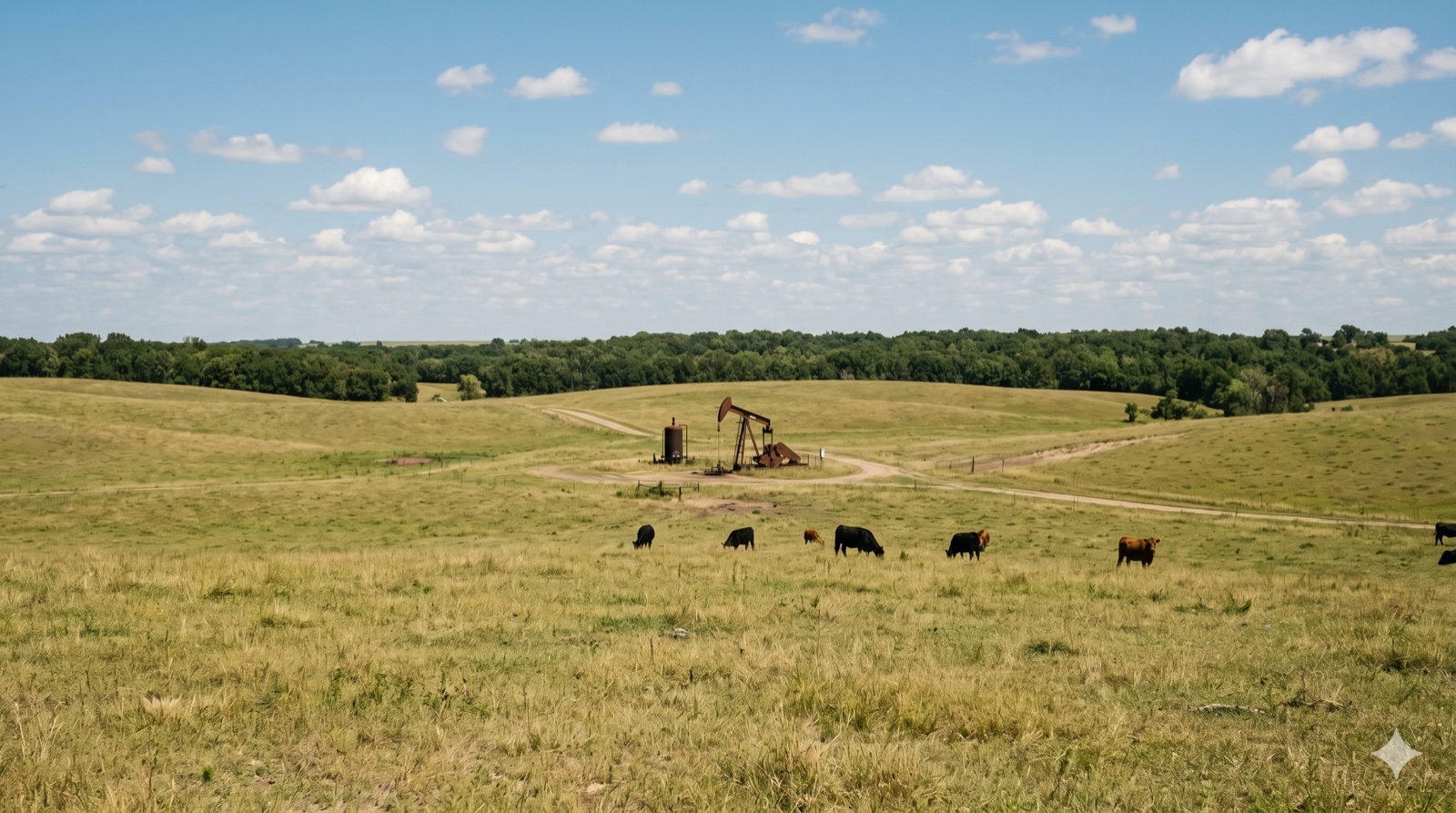
Yes. A wellhead, a rusting pumpjack, a capped pipe in the weeds, or an old tank battery sitting on your acreage does not make the land unsellable. Land with a well on it changes hands regularly—and while a well can narrow the buyer pool and complicate conventional financing, pushing parcels toward cash buyers, these parcels still sell. What the well does is add a layer of questions a buyer will want answered — is it plugged, still producing, or orphaned; who is on the hook to plug it; and is anything leaking. Sort those out and you have a sellable parcel.
This guide is about a physical well on the surface of your land — the wellbore itself and the equipment around it. That is a different problem from who owns the minerals underneath, which is about the mineral estate rather than the pipe in the ground. If your real question is that the minerals were sold off by a prior owner, start with our companion guide on selling land with severed mineral or oil and gas rights and the broader explainer on mineral rights vs. surface rights. Here we stay on the surface: there's a well on my land — now what?
If you'd rather skip the research and just get a number, you can request a no-obligation cash offer on your parcel, or browse more guides on our blog.
Plugged, Producing, or Orphaned — Which Well Do You Have?
The single most important fact about the well on your land is its regulatory status, because that one word decides who is liable and how a buyer reads the parcel. There are three practical categories.
A plugged (properly abandoned) well. When a well reaches the end of its life, the operator is supposed to permanently seal it — a process called plug and abandonment, or P&A — by setting cement plugs at depth to isolate the hydrocarbon zones and protect groundwater, then removing surface equipment, according to the National Academies' work on well plugging. A well that has been properly plugged and has a plugging record on file with the state is the cleanest case. The liability has been discharged; what remains is a sealed hole, sometimes with a marker.
A producing (or otherwise active) well. This well is still operated by a solvent company under a lease. Someone is responsible for it, someone may be paying royalties, and the operator has ongoing rights to be on your surface (more on that below). It is not orphaned and not your liability, but it is an active, occupied use of your land.
An orphaned or abandoned well. An abandoned well is one that is no longer operated and maintained under current rules; it may be plugged or unplugged. An orphaned well is a subset — an unplugged well that is no longer in production and has no solvent owner or operator, which is what makes it the government's problem to plug, according to the Interstate Oil and Gas Compact Commission (IOGCC). As of the end of 2023, roughly 141,959 orphaned wells were documented across 29 reporting states, with hundreds of thousands more estimated to be undocumented, per the IOGCC and USGS datasets. Many date to the late 1800s and early 1900s, before modern regulation.
Knowing which of the three you have is not guesswork — the state keeps the record, and you can pull it.
Who Is Actually Liable to Plug the Well — You or the Operator?
Usually you're not responsible for plugging a well just because it sits on your land—but there are important exceptions, and the nuance matters.
The baseline: liability follows the operator, not the landowner. Plugging and abandonment is the legal responsibility of the well's owner or operator — the working-interest party who drilled or holds it — not the surface owner, according to state guidance compiled by the National Agricultural Law Center and state agencies. Simply owning a parcel that happens to have a legacy well on it generally does not make you the party responsible for that well, as the Pennsylvania DEP states plainly in its landowner guidance.
Where it can shift toward you. Two things move the needle. First, if you disturb the well, try to produce it, take economic benefit from it, or improperly hide or remove it, you can make yourself financially responsible — the Pennsylvania DEP warns landowners about exactly this. Second, when the operator is bankrupt, dissolved, or untraceable, there is no solvent party left, and the practical burden can land on the state's orphan-well program or, in some situations, on the surface owner, depending on the state and the lease, according to the State Energy & Environmental Impact Center and the National Agricultural Law Center. Courts are still shaping this: a Colorado federal court has recognized that surface owners may even stand as creditors for an operator's future plugging obligation.
Bonding is supposed to be the backstop — and often isn't enough. Before drilling, an operator must post a bond or financial assurance so the state has money to plug the well if the company walks away. Historically those bonds have covered only a small fraction of real plugging costs — single-well plugging has been reported to average well into the six figures in some states while bonds were a fraction of that — which is precisely why orphaned wells accumulate faster than bonds can pay for them, according to NCSL's summary of state bonding requirements and multiple oversight reports. When the bond falls short, the gap becomes a public problem.
The federal plugging money. Recognizing the scale, the 2021 Bipartisan Infrastructure Law dedicated roughly $4.7 billion to plugging orphaned wells, with the bulk flowing to states to plug wells on state and private land; the Interior Department reported dozens of states lining up to plug well over 10,000 wells in the first waves, according to the U.S. Department of the Interior. If a truly orphaned well sits on your land, this program — run through your state — is often the realistic path to getting it plugged, not your own checkbook.
What Rights Does the Operator Have on My Surface?
If the well is still under an active lease, the operator's presence isn't trespassing — it flows from the mineral estate. In most oil and gas states the mineral owner (or their lessee) holds the dominant estate and has an implied easement to use as much of the surface as is reasonably necessary to develop the minerals, according to explainers on Texas surface-use law from Chas. S. Middleton and others. In practice that implied right can support the physical things you may see on your land:
- The wellbore and wellhead itself
- Access roads and a two-track to reach it
- A tank battery, separators, and other production equipment
- Historically, pits (reserve or produced-water pits) and gathering lines
That right is not unlimited. It must be exercised with due regard for the surface owner and cannot cause unnecessary damage, and many states apply the accommodation doctrine, which requires the operator to accommodate an existing surface use when the operator has a reasonable alternative way to reach the minerals. A recorded surface use agreement, if one exists, spells out pad size, road placement, and damage payments — and those terms can carry over to whoever buys the land. For how these surface burdens relate to easements generally, see our guides on selling land with an easement and selling land with a pipeline or utility easement.
The key point for a seller: an active well means an operator with legitimate ongoing surface rights, and a buyer will want to see the lease and any surface agreement to know what they're taking on.
How Do I Check the Well's Status and Whether It's Leaking?
You can run two straightforward checks — a state database lookup and an environmental inspection — to find out what a buyer will eventually discover anyway.
Look the Well Up in the State Oil & Gas Database
Every oil and gas producing state runs a regulatory agency — the Railroad Commission of Texas, Ohio DNR Division of Oil & Gas Resources, the Oklahoma Corporation Commission, the Pennsylvania DEP, and their counterparts — and nearly all publish a free GIS well-viewer map plus a searchable wellbore database. You can typically search by API number, county, operator, or by zooming to your parcel on the map. Texas's Public GIS Viewer and Wellbore Query, Ohio's Oil & Gas Well Locator, and Oklahoma's OCC Well Data Finder all let a landowner pull up a well and see its type, status, and operator of record, according to those agencies.
Every regulated well carries a unique API number — a standardized identifier whose first digits encode the state and county — which is the fastest way to pin down the exact wellbore in the state record. What you're looking for: is it listed as producing, shut-in, plugged, or orphaned, and is there a plugging report on file. If the well is already in the state's orphan inventory, that's important to know before you list; if it's shown as plugged with a record, that's the reassuring case. Pennsylvania and other states also ask that any undocumented well you discover be reported so it can be added to the inventory — reporting it does not make you responsible for it.
Watch for Environmental Red Flags
Old wells can leak. Nationally there are roughly 3 million abandoned oil and gas wells, and by EPA-cited figures about two-thirds have not been properly plugged, according to the NRDC. Unplugged and failing wells can leak methane (an explosion and climate risk), and can allow brine / "produced water" — salty fluid that may carry heavy metals or naturally occurring radioactivity — and compounds like benzene or hydrogen sulfide to reach soil and groundwater, according to the NRDC and environmental researchers. Practical signs worth noting: a persistent oily or sulfur smell, dead vegetation or a salt scar around the wellhead, bubbling in nearby water, or visibly deteriorating casing. None of this dooms a sale, but it's exactly what an honest seller flags and a serious buyer investigates.
Plugged vs. Orphaned vs. Producing at a Glance
| Plugged (properly abandoned) | Orphaned / unplugged abandoned | Producing / active | |
|---|---|---|---|
| Status in state record | Plugging report on file | In (or headed for) orphan inventory | Producing or shut-in, operator listed |
| Who's liable to plug | Already done; discharged | Operator if solvent — else state program / possibly landowner exposure | Current operator |
| Surface use today | Sealed hole, maybe a marker | Idle equipment, possible hazard | Active roads, tank battery, equipment |
| Environmental concern | Lowest | Highest (methane, brine, leaks) | Managed under permit |
| Typical buyer pool | Widest | Narrowest; mostly cash/specialty | Narrower; buyer inherits the lease |
Does a Well Affect Disclosure, Salability, Financing, and Title?
A well touches all four, and knowing how lets you sell without a nasty surprise late in escrow.
Disclosure. A seller generally has a duty to disclose known material facts and latent defects — conditions that a reasonable buyer would care about and couldn't easily discover themselves — and a well (especially an unplugged or leaking one) is squarely the kind of fact courts treat as material. Some states even have a dedicated oil-and-gas disclosure form. Failing to disclose a known well can give a buyer grounds to rescind or sue, according to real-estate disclosure guidance across multiple states. The safe move is simple: disclose the well, hand over whatever records you have, and let the buyer's diligence confirm it.
Salability and financing. A well narrows the retail buyer pool and can stall a financed purchase. Lenders and their appraisers must weigh environmental hazards and proximity to oil and gas operations on value and marketability, and Fannie Mae requires appraisers to comment on such hazards; its multifamily guidance, for instance, keeps well equipment a set distance from structures, according to the Fannie Mae Selling Guide. Reliable appraisals near active wells are also harder to obtain. The upshot: a mortgage buyer may not clear underwriting on a parcel with a well — which pushes these parcels toward cash buyers, who have no lender to satisfy.
Title. Old leases, surface use agreements, and mineral reservations show up in the title commitment's Schedule B exceptions, the same way any recorded interest does. That's normal documentation, not a defect in your surface — but if there's also a lien or other cloud tangled up with the oil and gas history, see our guide on selling land with a lien or cloud on title. And if you're an out-of-area owner trying to sort this from a distance, selling land as an out-of-state owner covers that logistics side.
What Are Your Options for Selling Land With a Well On It?
If there's a well on your acreage, you have three realistic paths:
Option 1: List it on the open market with full disclosure. This can work — especially for a properly plugged well with a clean record and no environmental flags. Be ready, though, for some retail buyers to walk once they see the well, and for financed buyers to hit lenders and appraisers who balk at oil and gas operations on or near the collateral.
Option 2: Get the well resolved first, then sell. If the well is orphaned, you can report it to the state and pursue plugging through the state's orphan-well program (often funded now by the federal Bipartisan Infrastructure Law money). If it's an active lease you'd rather not pass along, that's a negotiation with the operator. Both routes can work, but they take time — sometimes a lot of it — and you're at the mercy of a program queue or a company's cooperation.
Option 3: Sell directly to a cash buyer who handles wells. A direct buyer like Jerez Land purchases land with the well in place, as-is. We look up the well's status in the state database, read any lease or surface use agreement, weigh whether it's plugged, orphaned, or producing, and factor the operator's surface rights and any plugging exposure into our underwriting — then present a firm written cash offer on your specific parcel. Because we buy for cash, there's no lender to decline the deal, and because we absorb the carrying costs, the marketing, and the resale risk ourselves, we can often move faster than a traditional listing even when the well situation is messy. Every offer is individually priced to your parcel — there's no generic formula, because no two wells (or the parcels around them) are alike.
Request a no-obligation cash offer and tell us what you know about the well — plugged, producing, or just an old pipe you found in the brush — and we'll review the parcel, the well record, and any lease together. There are no commissions and no listing fees. Not sure what your land is worth with the well factored in? Our guide on how much is my land worth covers what drives value, and for more guides, visit our blog.
Frequently Asked Questions
If there's an abandoned oil or gas well on my land, am I responsible for plugging it?
Usually not just because it's on your land. Plugging and abandonment liability generally follows the well's operator or owner, not the surface owner, and simply owning a parcel with a legacy well on it typically doesn't make you the responsible party. That can change if you disturb the well, try to produce it, take economic benefit from it, or improperly hide it — and if the operator is bankrupt or untraceable, the practical burden may fall to the state's orphan-well program or, in some situations, expose the landowner. Rules vary by state, so confirm with your state agency and an attorney.
I found a well on my land — is it plugged, orphaned, or producing, and how do I know which?
A plugged (properly abandoned) well has been permanently sealed with cement and has a plugging record on file — the cleanest case. A producing or active well is still operated by a solvent company under a lease, so someone else is responsible for it. An orphaned well is an unplugged well no longer in production with no solvent operator, which makes it the government's responsibility to plug. The status decides who is liable and how a buyer reads the parcel, and it's recorded in the state oil and gas database.
How do I find out the status of a well on my property?
Go to your state oil and gas agency — the Railroad Commission of Texas, Ohio DNR, Oklahoma Corporation Commission, Pennsylvania DEP, or their equivalent. Nearly all publish a free GIS well-viewer map and a searchable wellbore database. You can search by API number (the well's unique identifier), by county, by operator, or by zooming to your parcel on the map, and see whether the well is listed as producing, shut-in, plugged, or orphaned, plus whether a plugging report exists.
Does an old well hurt my land's value or make it harder to sell?
It can narrow the buyer pool and complicate a financed sale. Lenders and appraisers must weigh environmental hazards and proximity to oil and gas operations on value and marketability, so a mortgage buyer may not clear underwriting on a parcel with a well. That pushes these parcels toward cash buyers, who have no lender to satisfy. A properly plugged well with a clean record affects value far less than an orphaned or leaking one. A cash buyer weighs the specific well rather than applying a blanket discount.
I discovered a well before listing my property — do I have to disclose it to buyers?
Yes — disclose it. A seller generally has a duty to disclose known material facts and latent defects, and a well (especially unplugged or leaking) is exactly the kind of fact a reasonable buyer would want and courts treat as material. Some states have a dedicated oil and gas disclosure form. Hand over whatever records you have and let the buyer's diligence confirm the details. Failing to disclose a known well can give a buyer grounds to rescind the contract or sue.
I have a well on my property — will a cash buyer still purchase it as-is?
Many experienced cash land buyers — including Jerez Land — will. We buy the parcel as-is with the well in place, look up its status in the state database, read any lease or surface use agreement, and factor the operator's surface rights and any plugging exposure into a firm written cash offer on your specific parcel. There's no lender to decline the deal, and we absorb the carrying and resale risk that comes with a well on the land, so you don't have to get it plugged or resolved before you sell.
Disclaimer: This article is for informational purposes only and does not constitute legal, financial, or professional advice. Laws and regulations vary by jurisdiction and change over time. Always consult a licensed real estate attorney and your state oil and gas regulatory agency before making decisions about oil or gas wells, plugging liability, or property transactions. Jerez Land is not responsible for actions taken based on this information.