
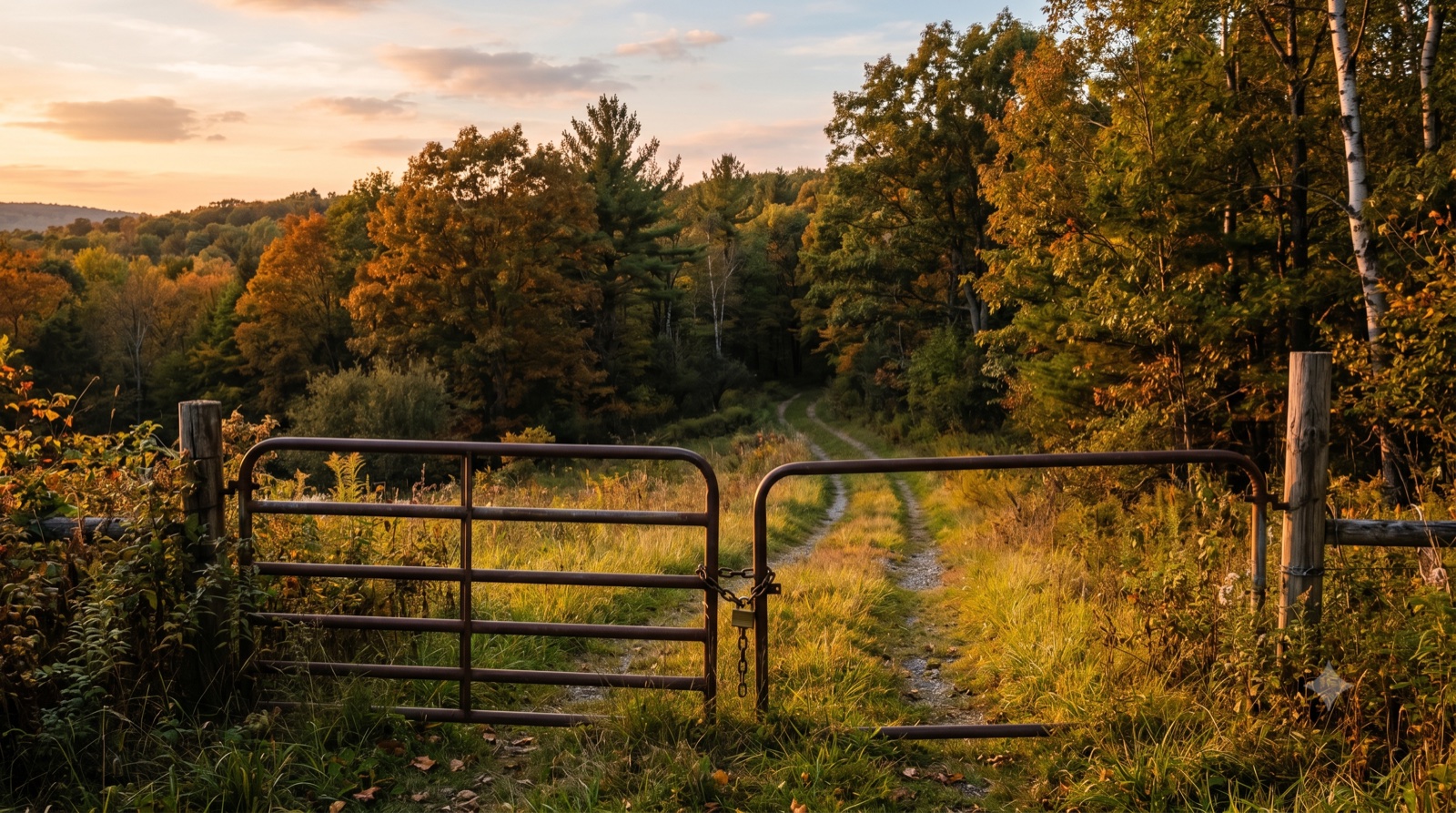
Selling Land With a Shared or Private Road Maintenance Agreement: What It Means for Your Sale
Key Takeaways
- A recorded road maintenance agreement (RMA) rarely stops a land sale — it's a document filed in the county land records that spells out who maintains a shared or private road and how each owner's share of the cost is split, and because it runs with the land it conveys to the buyer automatically along with your access rights, per Cornell Law School LII
- This is not a no-access problem — you DO have legal access — an RMA governs a road you already have the recorded right to use, which is the opposite of a landlocked parcel with no legal way in; lenders and title companies care about the RMA precisely because access exists but is privately maintained, according to Fannie Mae and Freddie Mac guidance
- A cash buyer purchases the parcel with the RMA in place, as-is — an experienced land buyer reads the recorded agreement, understands the cost-sharing obligation that transfers with the deed, and reflects it in a firm written cash offer on your specific parcel rather than stalling over financing conditions the way a mortgage-dependent retail buyer often does
Can You Sell Land With a Shared or Private Road Maintenance Agreement?
Yes — a parcel reached by a private or shared road that's governed by a recorded road maintenance agreement is entirely sellable, and in most cases there is nothing to fix, remove, or renegotiate before closing. A road maintenance agreement (RMA), sometimes called a private road maintenance agreement (PRMA), is a recorded document that identifies a privately owned road, states which owners have the right to use it, and spells out how the cost of upkeep is divided among them. Because it runs with the land, that agreement — and the access it protects — transfers to your buyer automatically when the deed changes hands, according to Cornell Law School LII. The real question isn't whether you can sell; it's understanding how the RMA affects financeability and which buyer will move forward without getting hung up on it.
This is a fundamentally different situation from a landlocked parcel. Here you have legal access — a recorded easement or right-of-way lets you reach a public road. It's just that the road is private and shared, so the owners maintain it themselves instead of the county doing it. If your parcel genuinely has no legal way in, that's a separate problem covered in our guide on how to sell land with no road access and our overview of selling landlocked land. This post is about the far more common and far more manageable case: access exists, it's private, and there's an agreement about who keeps it up.
What Is a Road Maintenance Agreement, and Why Do Lenders and Title Companies Care?
A road maintenance agreement is a written, recorded contract among the owners who share a private road. It typically identifies the road and the parcels it serves, grants or references each parcel's access easement, and — most importantly — sets out how the owners split the cost of grading, graveling, plowing, drainage, and repairs. Some RMAs assign a flat annual amount per lot; others apportion by usage or by a simple equal share, and many require a majority vote of the benefited owners before any large assessment above the routine annual fee.
The reason mortgage lenders and title companies pay attention to an RMA comes down to two things: continuous access and who pays to keep the road usable. A private road that falls into disrepair can threaten emergency-vehicle access and the long-term value of every parcel it serves, so the secondary-mortgage market built rules around it:
- Fannie Mae generally expects an adequate, legally enforceable agreement or covenant for the maintenance of a private street, and its appraisal guidance treats private-street maintenance as a site condition the appraiser must address, per the Fannie Mae Selling Guide's site section. Fannie Mae also waives that requirement where the property sits in a state whose statutes already define private-road maintenance responsibilities.
- Freddie Mac does not require a separate maintenance agreement, but it does require legally adequate ingress and egress — meaning a private road must be covered by a recorded easement describing the road and its location, per the Freddie Mac Seller/Servicer Guide.
- FHA does not mandate a maintenance agreement either, but under HUD Handbook 4000.1 private streets and shared driveways must be protected by a permanent recorded easement (or be owned and maintained by a homeowners association), and the road must be all-weather and passable by emergency and service vehicles, per HUD's private-roadways reference.
- USDA Rural Development similarly requires a permanent recorded easement or HOA maintenance for private roads and does not strictly require an RMA, though an individual lender still may, per USDA financing guidance.
The common thread: what every program truly insists on is a recorded, permanent access right. The maintenance agreement is the layer on top that shows the road will actually be kept up. That's why an RMA is a feature to disclose and hand over — not a defect to cure.
Recorded vs. Unrecorded Agreements — Why the Difference Matters at Closing
Not every private-road arrangement is written down, and among those that are, not all are recorded. This distinction is where sales sometimes get complicated, so it's worth understanding before you list.
A recorded RMA has been filed with the county recorder or register of deeds and is attached to the chain of title for each affected parcel. Because it's recorded, it surfaces in a title search, it binds future owners, and it satisfies the "legally enforceable agreement" language in lender guidelines. Recording is what makes the agreement run with the land — a covenant that runs with the land transfers automatically to the new owner, who is bound by and benefits from it just like the original parties, according to Cornell Law School LII.
An unrecorded or purely handshake arrangement is far weaker. It may bind the people who signed it, but it doesn't reliably bind a future buyer, it won't show up cleanly in a title commitment, and a cautious lender may treat the property as if it has no maintenance agreement at all. If you have only an informal understanding among neighbors, that doesn't make your land unsellable — but it does make it more important to sell to a buyer who isn't depending on conventional financing that hinges on a recorded agreement.
Here's the reassuring part for many sellers: even where no agreement exists, a growing number of states have statutory default rules that fill the gap. Under California Civil Code Section 845, when an easement is shared, owners split maintenance in proportion to their use absent an agreement. Maine's Title 23, Section 3121 requires each benefited owner to share the cost of repairs in proportion to the benefit received (and equally where the road is the primary access). Missouri lets a court apportion costs among benefited owners by equal division, assessed value, front footage, or usage under Section 228.369. Connecticut's Public Act 14-67 imposes proportionate cost-sharing on benefited residential owners when there's no written agreement, per McCarter & English. Fannie Mae's own guidance leans on exactly these statutes — waiving the RMA requirement in states that legislate the responsibility. So even an unrecorded situation is often backstopped by law.
How Do the Cost-Sharing Obligation and Access Rights Transfer With the Deed?
When you sell, two things move to the buyer together, and it helps to see them as a package.
The access right transfers. The recorded easement or right-of-way that lets your parcel reach the public road is appurtenant to your land — it benefits the parcel itself, not you personally, so it passes to whoever owns the parcel next, according to Cornell Law School LII on appurtenant rights and running with the land. Your buyer inherits the same legal ability to use the private road that you had.
The maintenance obligation transfers too. Because a recorded RMA is a covenant running with the land, the buyer steps into your shoes on the cost-sharing side — they pick up the annual assessment, the share of repairs, and any voting rights or duties the agreement defines. You are not leaving a hidden liability behind and you are not carrying it forward after closing; it simply moves with ownership. In practice, the title company confirms the RMA in the record, the buyer acknowledges it, and closing proceeds.
For a seller, the takeaway is that you don't have to "settle up" the road account or terminate anything. You disclose the agreement, provide a copy, and let it convey. The main thing to have ready is a clean copy of the recorded RMA and easement — part of the standard paperwork needed to sell land.
Shared-Road Parcel vs. No-Legal-Access Parcel — A Quick Comparison
The single most important distinction to keep straight is that having an RMA means you have access. It is the opposite of being landlocked. Here's how the two situations — plus a plain public-road parcel — line up:
| Recorded RMA (shared/private road) | Unrecorded / handshake road | No legal access (landlocked) | |
|---|---|---|---|
| Do you have legal access? | Yes — recorded easement | Yes, but weakly documented | No — this is the core problem |
| Runs with the land to buyer | Yes — access and cost-share both convey | Access may not bind a buyer | N/A — nothing to convey |
| Conventional financing typical? | Usually — satisfies lender access rules | Often problematic | Very difficult |
| What the seller must do | Disclose and hand over the agreement | Disclose; consider recording or statutory backstop | Try to obtain an easement first |
| Right guide for this case | This post | This post | No road access / landlocked |
The takeaway: an RMA is an access solution, not an access problem. It exists because you can already reach your land — it just formalizes who keeps the road usable.
How Does an RMA Affect Value and Financeability?
The effect of a maintenance agreement on a parcel's marketability is usually modest and often positive, because a recorded RMA is exactly what a lender and title company want to see on a private road. The financeability picture generally breaks down like this:
- Recorded RMA (or a statutory-default state): Cleanest scenario. The access is documented, the maintenance is spelled out, and most loan programs are satisfied. The private road rarely blocks a conventional, FHA, or USDA loan.
- Recorded easement but no maintenance agreement, in a non-statutory state: Financeable but bumpier. Fannie Mae's guidance allows a lender to proceed in some cases while indemnifying against street-condition losses — which makes some lenders skittish and can slow a deal.
- Unrecorded or handshake arrangement: The most friction. A conventional buyer's lender may pause until something is recorded, even though the land itself is fine.
Value is influenced less by the existence of the agreement and more by the condition and cost of the road. A well-maintained gravel road with a reasonable annual assessment is a non-issue. A rough, washboarded road with a history of special assessments, or an RMA with a large looming repair vote, is something a careful buyer will weigh. Note that these are qualitative marketability factors, not a formula — how any specific feature affects a parcel is exactly the kind of thing our guide on how much your land is worth treats case by case rather than with a one-size discount.
What Are Your Disclosure Duties?
Most states impose a duty to disclose known material facts about a property, and a recorded road maintenance obligation — especially the annual cost and any pending assessment — is typically material to a buyer. The safe, honest approach is to disclose the RMA up front, provide the recorded agreement and easement, and note the current assessment and any known upcoming road work. Because the agreement is already in the public record, a buyer's title search will surface it anyway, per the American Land Title Association's overview of how title insurance and the title search work; getting ahead of it builds trust and avoids a renegotiation late in escrow. If your title also carries other clouds — old liens, boundary questions — our guide on selling land with a lien or cloud on title covers how those get resolved at closing.
Why Retail Buyers Sometimes Stall
A financed retail buyer, represented by an agent, is at the mercy of their lender's overlays. Even when the RMA is perfectly adequate, an underwriter may request additional documentation, a specific easement description, or confirmation that the state's statute applies — and each request adds days. If the road is only handshake-maintained, a conventional loan can stall out entirely. This is the same dynamic that slows other problem parcels: the land is fine, but the conventional buyer pool and their financing conditions narrow the field.
A Cash Buyer Buys It As-Is — Road Agreement and All
A direct cash buyer approaches an RMA differently. Instead of routing it through a mortgage underwriter, the buyer reads the recorded agreement, confirms the access easement, understands the cost-sharing share that will transfer with the deed, and purchases the land with the RMA in place, as-is. There's nothing for you to record, amend, or litigate first. The buyer absorbs the carrying costs, the marketing effort, and the resale risk that come with a privately maintained parcel — including the narrower financed-buyer pool on the back end — and reflects all of that in a firm written cash offer on your specific parcel.
What Are Your Options for Selling Land With a Shared or Private Road?
If your parcel is reached by a private or shared road with a maintenance agreement, you have three main paths:
Option 1: List it and disclose the RMA. Put the property on the open market, disclose the agreement, and hand over the recorded RMA and easement up front. This works well when the road is well kept, the RMA is recorded, and the state's rules are lender-friendly — but be prepared for financed buyers whose lenders may request extra documentation or pause if the maintenance arrangement is informal.
Option 2: Clean up the paperwork first. If your road arrangement is only a handshake, you can try to get the owners to sign and record a formal RMA before selling. That can widen your buyer pool — but it requires cooperation from every benefited owner, and coordinating neighbors around a recorded agreement can take months without any guarantee they'll all sign.
Option 3: Sell directly to a cash buyer. If you want speed and certainty, a direct cash buyer like Jerez Land purchases land with the road agreement in place, as-is. We read the recorded RMA and easement, confirm your access, factor the cost-sharing obligation into our underwriting, and present a firm written cash offer on your specific parcel — no lender overlays, no formulas, and no waiting on neighbors to sign anything.
Request a no-obligation cash offer and we'll review your property, its access easement, and its maintenance agreement together. There are no commissions or listing fees, and we can often move faster than a traditional sale — even when the road is private and shared.
Weighing whether to go it alone or list? Our guides on whether you need a realtor to sell land, who pays closing costs when selling land, and the paperwork needed to sell land cover the decisions that come up alongside a private-road sale. And if your real issue is that the parcel has no legal access at all, start with our guide on selling land with no road access instead. For more guides on selling land in less-than-perfect situations, visit our blog.
Frequently Asked Questions
I have land on a shared road with a maintenance agreement — can I still sell it?
Yes. A recorded road maintenance agreement rarely prevents a sale. It's a document filed in the county land records that identifies a private road, protects each owner's right to use it, and sets how upkeep costs are split. Because it runs with the land, the agreement and your access rights convey to the buyer along with the deed. You generally don't need to change or terminate it before selling — you disclose it, provide a copy, and the title company confirms it during closing. The main effect is that a financed buyer's lender may want to see the recorded agreement, while a cash buyer proceeds without that hurdle.
Is a parcel with a road maintenance agreement the same as a landlocked property?
No — it's the opposite. A landlocked parcel has no legal way to reach a public road, which is a serious defect that has to be solved before most buyers will move forward. A parcel with a road maintenance agreement already has legal access through a recorded easement; the road is simply private and shared, so the owners maintain it themselves. Lenders and title companies care about the RMA precisely because access exists but is privately kept up. If your parcel genuinely has no legal access, that's a different situation with its own solutions.
My lender asked about the private road maintenance agreement — what do they actually want to see?
Lenders want assurance that a privately owned road will stay usable so access — including for emergency vehicles — is protected long term. Fannie Mae generally expects a legally enforceable maintenance agreement, though it waives that where a state's statutes already define private-road responsibilities. Freddie Mac, FHA, and USDA focus on a permanent recorded easement rather than always requiring a separate agreement, but an individual lender may still ask for one. The common requirement across programs is a recorded, permanent access right; the maintenance agreement is the extra layer showing the road will actually be maintained.
My road agreement isn't formally recorded — will that prevent me from selling?
A recorded agreement is filed with the county and attached to each parcel's chain of title, so it shows up in a title search, binds future owners, and satisfies lender requirements — it runs with the land. An unrecorded or handshake arrangement may bind the people who signed it but doesn't reliably bind a future buyer and won't appear cleanly in a title commitment, which makes conventional financing harder. Even without any agreement, many states have statutes that require benefited owners to share road-maintenance costs proportionately, which can backstop the gap. An unrecorded arrangement doesn't make land unsellable, but it points toward a cash buyer who isn't depending on that documentation.
When I sell land with a road maintenance agreement, does the cost-sharing obligation transfer to my buyer?
Yes. Because a recorded road maintenance agreement is a covenant that runs with the land, the buyer steps into your position on both sides: they inherit your recorded right to use the private road and they take on your share of the maintenance costs, including any annual assessment and voting rights the agreement defines. You don't have to settle up the road account or terminate anything before closing. You disclose the agreement, provide a copy, and it conveys with the deed. Statutory default rules in some states apportion costs proportionately even where no written agreement exists.
I'm selling land with a private road — will a cash buyer purchase it as-is?
Many experienced cash land buyers — including Jerez Land — purchase land with the road maintenance agreement in place, as-is. We read the recorded RMA and easement, confirm your access, and factor the cost-sharing obligation that transfers with the deed into a firm written cash offer on your specific property. Because we don't rely on a mortgage, there are no lender overlays to satisfy and nothing for you to record, amend, or litigate first — and we absorb the carrying and resale risk that come with a privately maintained parcel.
Disclaimer: This article is for informational purposes only and does not constitute legal, financial, or professional advice. Laws and regulations vary by jurisdiction and change over time. Always consult a licensed real estate attorney before making decisions about easements, rights-of-way, road maintenance agreements, or property transactions. Jerez Land is not responsible for actions taken based on this information.