
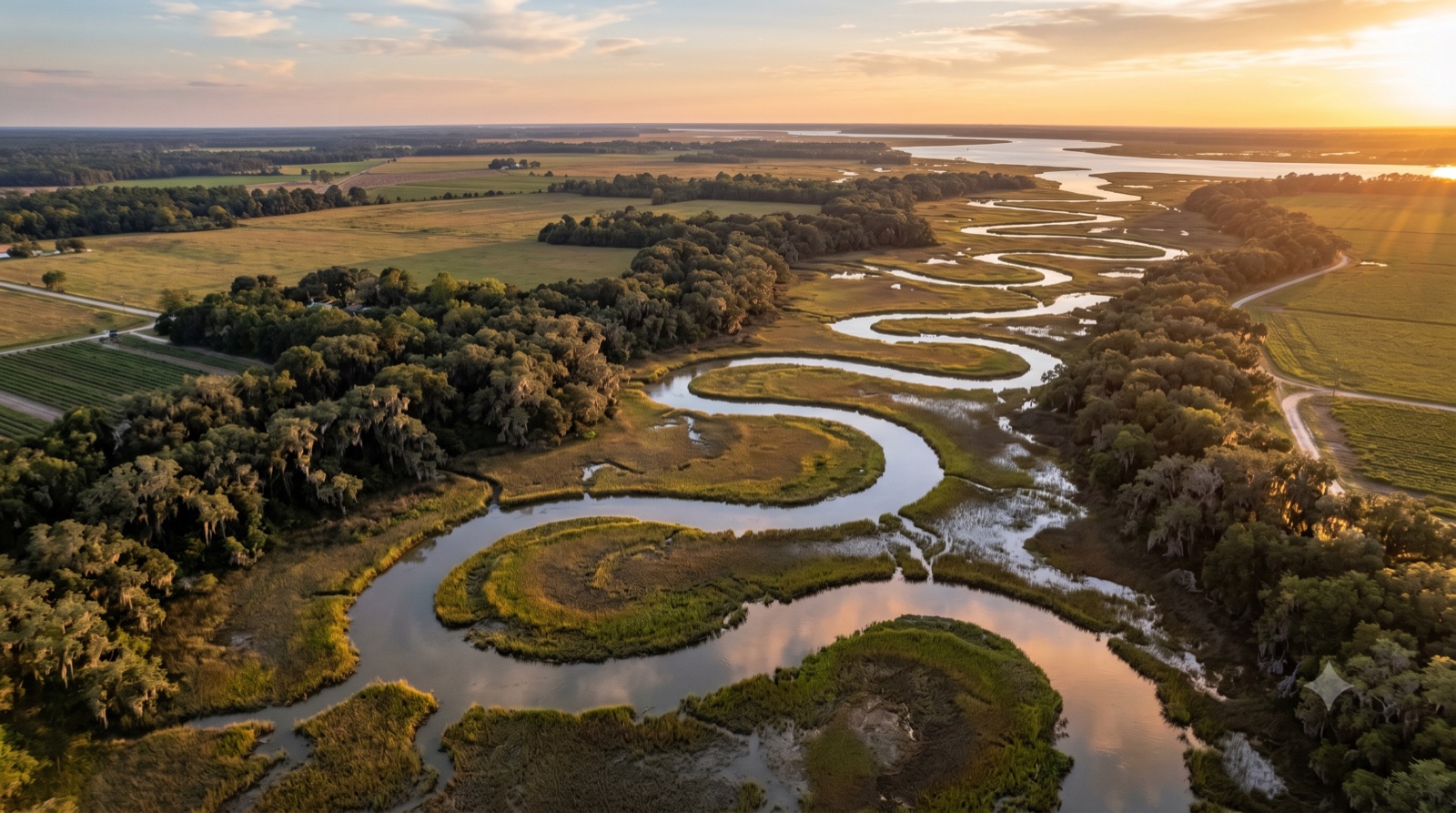
Sell My Land in Calhoun County SC - What Landowners Need to Know
Key Takeaways
- Calhoun County is one of South Carolina's smallest and least-populated counties, with a 2020 census population of 14,119 — down from 15,175 in 2010 — and an estimated 14,200 in 2024, according to the U.S. Census Bureau and World Population Review; at roughly 381 square miles of land it is also the smallest county in the state by land area
- South Carolina's deed recording fee is $1.85 per $500 of sale price, split into a $1.30 state portion and a $0.55 county portion, customarily paid by the seller, according to the SC Department of Revenue Deed Recording Fee Manual 2024
- Vacant and non-owner-occupied land is assessed at 6% of fair market value in South Carolina under SC Code § 12-43-220, compared to 4% for primary residences and qualifying agricultural use — a higher-cost category to hold idle
How Can You Sell Land in Calhoun County South Carolina?
To sell land in Calhoun County, you'll need an attorney-supervised closing (required in South Carolina), pay a $1.85-per-$500 deed recording fee, and plan for a potentially longer timeline since the county has relatively few local buyers and a thin market.
Selling land in Calhoun County, South Carolina means working within the state's attorney-supervised closing requirement, a deed recording fee that functions as a transfer tax, and a thin, rural land market built around Midlands row-crop farming and pine timber. The county sits in the central Midlands between Columbia and Orangeburg, straddling the Interstate 26 corridor, yet remains one of the quietest land markets in the state — the USDA counts just 286 farms across 108,019 acres of farmland, with a total agricultural product value of $80,522,000 in 2022, according to the 2022 Census of Agriculture.
For landowners considering a sale, this guide covers the full tax picture for vacant parcels, how attorney-supervised closings work in South Carolina, the agricultural use-value and rollback-tax rules that catch many sellers off guard, and how Calhoun compares to its neighbors. For a broader look at the state's rules, see our South Carolina land selling guide. For more county-level analysis, browse the Jerez Land blog.
What Are the Tax Costs of Holding Land in Calhoun County?
South Carolina uses a tiered assessment ratio system under SC Code § 12-43-220. Owner-occupied primary residences are assessed at 4% of fair market value, while all other real property — including vacant land, investment parcels, and non-owner-occupied lots — is assessed at 6% of fair market value. That means a dormant vacant parcel carries a 50% higher assessment ratio than a home the owner lives in.
Calhoun County's overall property tax burden is modest by national standards. The county collects, on average, about 0.57% of a property's fair market value in annual property tax, and the median property tax bill countywide is roughly $537, according to tax-rates.org. But "modest" is relative: for land that produces no income, every dollar of tax is pure carrying cost, and those costs compound year after year for absentee owners holding parcels they rarely visit.
The total tax on any given parcel is built from a stack of millage rates — the county base levy, the school district levy, any special-purpose or fire district levies, and a municipal levy if the land sits inside St. Matthews, Cameron, or another incorporated town. Taxes are due by January 15 each year; unpaid taxes accrue penalties and can ultimately result in a tax sale. South Carolina also requires countywide reassessments every five years, so a long-held parcel's taxable value can step up sharply at reassessment.
How Agricultural Use Value and Rollback Tax Work
If land qualifies for agricultural use under SC Code § 12-43-232 — generally at least five acres actively farmed, or tracts producing timber — it can be taxed on its agricultural use value rather than its market value, a substantial reduction for working farmland and timberland. Timberland and cropland held by individuals or family partnerships are the most common qualifiers, and with 39,809 acres of woodland and 56,369 acres of cropland countywide, much of Calhoun's farmland is enrolled, according to the USDA 2022 Census of Agriculture.
The catch comes when use changes. Under SC Code § 12-43-220(d), when land that has been taxed at agricultural use value is converted to a non-agricultural use — for example, when a buyer develops it or simply lets it sit idle and removes the ag classification — the county can assess a rollback tax. The rollback recaptures the difference between the taxes actually paid under use value and the taxes that would have been due at full market value, for the year of change plus the prior five years (a window narrowed from the former rules). A seller who has enjoyed years of low ag-use taxes can find a meaningful rollback bill triggered by the sale or by the buyer's change of use. Verify your classification and any rollback exposure with the Calhoun County Assessor (102 Courthouse Drive, Courthouse Annex Suite 107, St. Matthews, SC 29135; 803-874-3613) before listing.
For more on how unpaid or delinquent taxes affect a land sale, see our guide on selling land with back taxes.
What Zoning and Closing Rules Apply in Calhoun County?
South Carolina is an attorney-closing state. Under the precedent set in State v. Buyers Service Co., 357 S.E.2d 15 (S.C. 1986), the South Carolina Supreme Court held that real estate closings constitute the practice of law. Every deed transfer — vacant land, cash sale, or inherited-property conveyance — must be supervised by a licensed South Carolina attorney. There are no exceptions for cash transactions or simple deals.
The closing process in Calhoun County follows this sequence:
- Title search: The attorney examines records at the Calhoun County Clerk of Court, who also serves as Register of Deeds (102 Courthouse Drive, First Floor, St. Matthews, SC 29135; 803-874-3524), to confirm the seller holds clear, marketable title — especially important where inherited or intestate property is involved
- Deed preparation: The attorney drafts the warranty or quitclaim deed based on the chain of title
- Closing: Buyer, seller, and attorney meet (or sign remotely) to execute documents and transfer funds
- Recording: The attorney records the deed with the Clerk of Court / Register of Deeds and pays the deed recording fee — $1.85 per $500 of sale price, the $1.30 state portion and $0.55 county portion both remitted at recording
- Disbursement: The attorney disburses proceeds to the seller, less any outstanding liens, delinquent taxes, rollback taxes, or legal fees
For sellers who need to understand what documents are required, our paperwork needed to sell land guide covers the typical set — deed, survey (if required), easement disclosures, and property tax clearance.
Zoning and Land Use in Calhoun County
Calhoun County administers land use for unincorporated areas through its Building and Planning Department, with agricultural, residential, and commercial classifications. Incorporated towns such as St. Matthews and Cameron maintain their own municipal regulations. Much of the county is working farmland, timber, or river-bottom land along the Congaree and Santee systems, some of it in floodplain. Before any sale or development, confirm the current zoning designation, any flood-zone status, and applicable use restrictions with the county. For parcels near the I-26 interchanges, frontage and access rules may differ from interior farm tracts.
How Does Calhoun County Compare to Neighboring South Carolina Counties?
Calhoun County's population has edged down from 15,175 in 2010 to 14,119 in 2020, then held roughly flat at an estimated 14,200 in 2024, according to the U.S. Census Bureau and World Population Review. It is among the least-populated counties in South Carolina and the smallest by land area. That small, stable population is the single most important fact for a landowner to understand: the pool of local retail buyers is genuinely thin, and a parcel can sit unsold for a long time waiting for the right person to come along.
| Factor | Calhoun County | Orangeburg County | Lexington County | Richland County |
|---|---|---|---|---|
| Population (2024 est.) | ~14,200 | ~83,100 | ~310,000 | ~415,000 |
| Population trend | Flat / very slight decline | Declining | Growing | Growing slowly |
| County seat | St. Matthews | Orangeburg | Lexington | Columbia |
| Land character | Row crops, pine timber, river bottom | Row crops, manufacturing | Suburban + farmland | Urban + suburban |
| Distance to Columbia | ~35–45 min | ~50 min | Adjacent | Contains Columbia |
| Key land market signal | Very thin market, ag/timber | Heirs' property, absentee | High demand, low inventory | Strong urban demand |
Calhoun's farm economy is overwhelmingly crop-driven: crops accounted for $62,111,000 of the county's $80,522,000 in 2022 agricultural sales, with cotton ranking 3rd among all South Carolina counties at $17,420,000, alongside peanuts, corn, soybeans, and vegetables, according to the USDA 2022 Census of Agriculture. Average farm size is 378 acres — large tracts, often family-held for generations. Woodland makes up 39,809 of the county's 108,019 farmland acres, so pine timber is a significant part of the land base.
The I-26 corridor between Columbia and Orangeburg does pass through the county, which gives some parcels logistical appeal. But it is important to frame that realistically: the interstate carries traffic past Calhoun more than it drives demand into it. The bulk of the county remains quiet agricultural and timber land, and a far cry from the development pressure seen in fast-growing Lexington and Richland to the north.
Why Calhoun's Thin Market Matters for Sellers
In a county this small, there is no deep bench of cash buyers competing for rural acreage. Listing a vacant tract often means months of carrying costs — property tax, mowing or maintenance, and the simple opportunity cost of capital tied up in land — while you wait for a buyer who may want a survey, financing contingencies, or a price reduction. For owners of timberland or farmland, and for out-of-state owners who can't easily monitor the parcel, that waiting period is the real cost of a thin market.
What Are Your Options for Selling Land in Calhoun County?
Calhoun County landowners holding vacant or non-producing parcels face a widening gap between carrying costs and a slow path to sale. A small, flat population limits the pool of local buyers; the 6% assessment ratio means higher tax bills than owner-occupied property; and a change of use can trigger a rollback tax recapturing up to five prior years of ag-use savings.
Before selling, confirm your property's legal description and recording history through the Calhoun County Clerk of Court / Register of Deeds (102 Courthouse Drive, First Floor, St. Matthews, SC 29135; 803-874-3524). Verify your current tax status, ag-use classification, and any delinquent or rollback exposure through the Calhoun County Treasurer (102 Courthouse Drive, Suite 108; 803-874-1242) and the Assessor (Suite 107; 803-874-3613). If the parcel was inherited without a will, consult a South Carolina real estate attorney about clearing title before listing.
Sellers have several paths. Listing with a local agent who understands agricultural and timber land provides exposure but involves commission costs and, in a thin market, a long timeline. Online land platforms reach out-of-state hunting, timber, and investment buyers. For landowners who want a specific number — not an open-ended listing — request a cash offer from Jerez Land. We provide firm, parcel-specific written offers that absorb the carrying, marketing, and resale risk of a slow market, handle the attorney-supervised closing, and can close in weeks without commissions or listing fees.
Deciding whether you need a realtor to sell land and understanding how much your land is worth before negotiating puts you in a stronger position regardless of which path you choose.
Frequently Asked Questions
How do I sell vacant land in Calhoun County SC?
Confirm your property's legal description through the Calhoun County Clerk of Court / Register of Deeds (102 Courthouse Drive, First Floor, St. Matthews, SC 29135; 803-874-3524) and check for delinquent or rollback taxes through the Treasurer and Assessor. South Carolina requires a licensed attorney to supervise the closing — including title examination, deed preparation, and recording. You can list with a local agent, use land-focused platforms, or request a direct cash offer from a land buyer.
I'm holding vacant land in Calhoun County — what will property taxes cost me?
Vacant and non-owner-occupied land is assessed at 6% of fair market value under SC Code § 12-43-220, compared with 4% for owner-occupied homes and qualifying agricultural use. Calhoun County collects, on average, about 0.57% of fair market value in annual property tax, with a median bill near $537, according to tax-rates.org. The exact bill depends on the stack of county, school, and special-district millage rates that apply to your parcel.
What is South Carolina's deed recording fee and who pays it?
South Carolina charges $1.85 per $500 of sale price — a $1.30 state portion plus a $0.55 county portion — recorded at closing as the Deed Recording Fee, according to the SC Department of Revenue Deed Recording Fee Manual 2024. By custom, the seller pays this fee, though the parties may negotiate otherwise in the purchase contract.
Do I need to hire an attorney to sell my land in Calhoun County?
Yes. Under State v. Buyers Service Co., 357 S.E.2d 15 (S.C. 1986), the South Carolina Supreme Court held that real estate closings are the practice of law. Every deed transfer — including vacant land and cash transactions — must be supervised by a licensed South Carolina attorney, who handles title examination, deed preparation, and recording with the Clerk of Court / Register of Deeds.
Will I owe a rollback tax when I sell agricultural land in Calhoun County?
You may. Under SC Code § 12-43-220(d), when land taxed at agricultural use value is converted to a non-agricultural use, the county can assess a rollback tax that recaptures the difference between use-value and full-market-value taxes for the year of change plus the prior five years. Selling itself does not always trigger it, but a buyer's change of use can. Confirm your classification and any exposure with the Calhoun County Assessor (803-874-3613) before closing.
I need to sell my land in Calhoun County quickly — is that realistic?
Calhoun is one of South Carolina's smallest and least-populated counties, with roughly 14,200 residents and a flat population trend, according to the U.S. Census Bureau and World Population Review. That means a thin pool of local buyers and, often, a long timeline for a traditional listing. Sellers who need certainty and speed frequently prefer a firm written cash offer that absorbs the carrying and resale risk of a slow market rather than waiting months for a retail buyer.
Disclaimer: This article is for informational purposes only and does not constitute legal, financial, or professional advice. Laws and regulations vary by jurisdiction and change over time. Always consult with qualified professionals before making land purchase decisions. Jerez Land is not responsible for actions taken based on this information.