
Sell My Land in Jasper County SC - What Landowners Need to Know
Key Takeaways
- Jasper County is the fastest-growing county in the United States: the population grew from 24,777 in 2010 to 28,791 in 2020 to an estimated 35,618 in 2024 — a 23.7% increase from April 2020 to July 2024 alone — driven by Savannah metro spillover and I-95 corridor growth, according to U.S. Census Bureau data
- Vacant and non-owner-occupied land is assessed at 6% of fair market value under SC Code § 12-43-220, while vacant land lying dormant does not qualify for the 4% agricultural use rate, according to the Jasper County Assessor — making idle parcels a higher-cost hold as surrounding land values rise
- South Carolina deed recording fee is $1.85 per $500 of sale price, seller-paid by custom ($1.30 state + $0.55 county), according to the SC Department of Revenue Deed Recording Fee Manual 2024
How Can You Sell Land in Jasper County South Carolina?
You sell land in Jasper County through a South Carolina attorney-supervised closing, a state-required process where an attorney examines title, prepares your deed, and oversees recording — all for a $1.85 per $500 deed recording fee customarily paid by the seller.
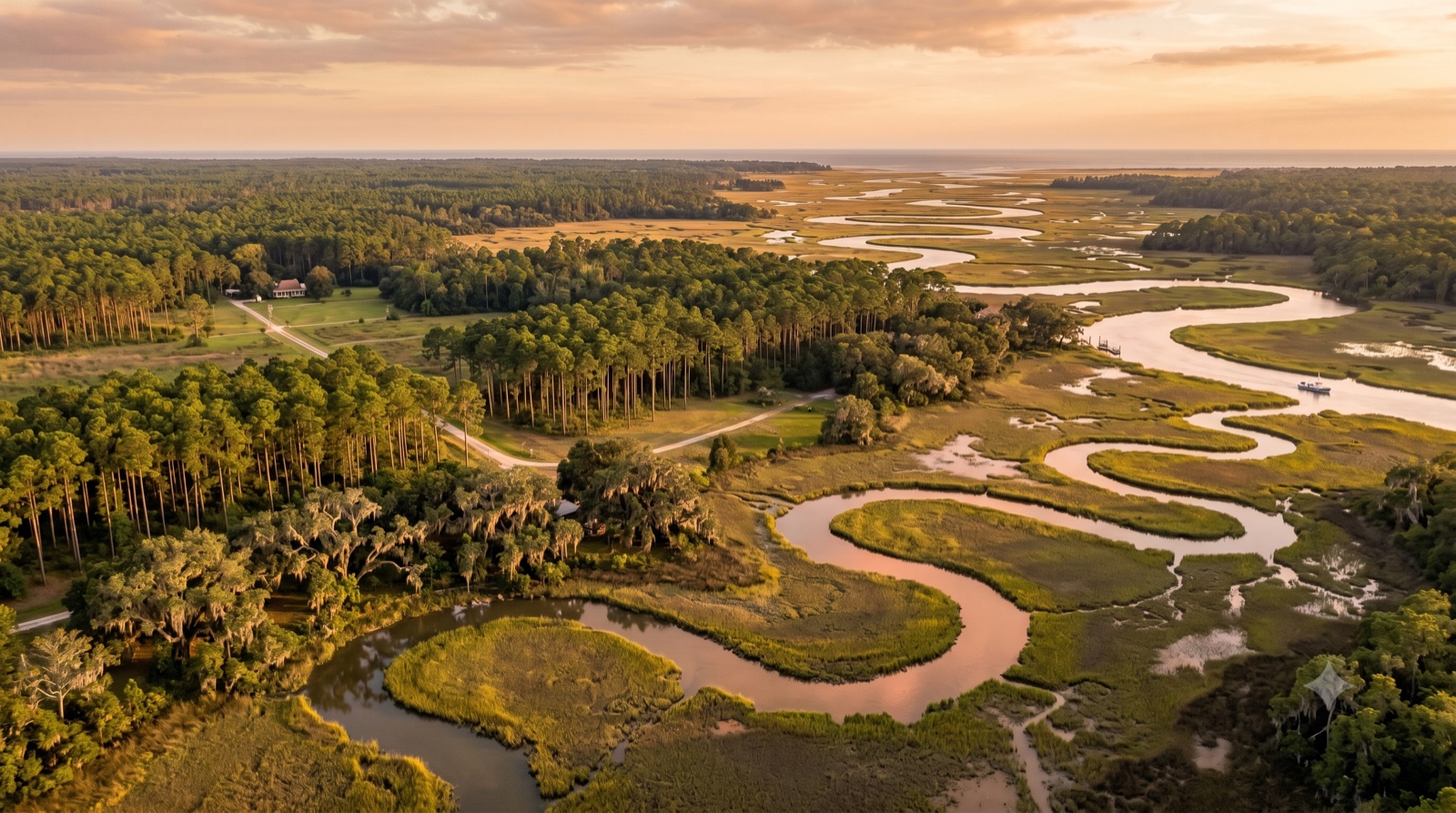
Selling land in Jasper County, South Carolina means operating in the fastest-growing county in the United States — a place where development pressure from Savannah, Georgia, and Bluffton/Hilton Head is rapidly reshaping what rural lowcountry land is worth and who wants to buy it. The county covers 653 square miles anchored by Ridgeland along I-95, with timber tracts, wetland systems, and a manufacturing base that includes TICO (Terminal Investment Corp.), one of North America's largest fleet operators.
This guide explains South Carolina's attorney-supervised closing requirement, how the state's 6% assessment ratio affects vacant land carrying costs, what agricultural-use classification means for Jasper County parcels, and how the county's extraordinary growth compares to its neighbors. For the full state-level picture, start with our South Carolina land selling guide.
What Are the Tax and Carrying Costs of Holding Vacant Land in Jasper County?
South Carolina taxes real property based on a tiered assessment ratio system under SC Code § 12-43-220. Owner-occupied primary residences are assessed at 4% of fair market value. All other real property — including vacant land, investment parcels, and out-of-state-owned parcels — is assessed at 6%. Jasper County's Assessor has clarified that vacant land lying dormant does not qualify for agricultural-use classification, per the county's FAQ on agricultural qualifications; to obtain the lower 4% agricultural rate, land must be actively farmed, grazed, or producing qualifying timber.
Jasper County's effective property tax rate is approximately 0.57%, calculated on median home values of $325,500 producing a median annual tax of approximately $1,852, according to county tax data. For vacant land, the 6% assessment ratio (versus 4% for homes) means the effective burden is proportionally higher. As surrounding land values rise in response to Savannah metro growth, assessed values at reassessment can increase substantially — and with the 6% ratio, so do the tax bills.
How Property Tax Bills Add Up for Vacant Land
For a vacant parcel appraised at $60,000, the 6% assessment ratio produces an assessed value of $3,600. At a combined millage rate (county, school, fire) of approximately 150–180 mills — typical for unincorporated Jasper County — the annual tax bill would be $540–$648. As the Savannah metro continues to push land values upward, those appraisals — and the tax bills they produce — are likely to rise at each five-year reassessment.
South Carolina's five-year reassessment cycle means assessments can jump significantly from one cycle to the next in high-growth areas. Jasper County landowners who have held land for a decade may face substantially higher assessments at the next review. Additionally, if agricultural-use classification was previously applied and the land changes hands or loses its qualifying use, a rollback tax applies — recovering the difference between agricultural-use assessments and market-value assessments for up to five prior years. Sellers should confirm with the Jasper County Assessor (358 Third Avenue, Room 215, Ridgeland, SC 29936; 843-717-3620) whether any rollback tax obligation exists before closing.
For landowners dealing with back taxes from prior years, our selling land with back taxes guide explains how tax liens are resolved at closing in South Carolina.
What Closing and Zoning Requirements Apply to Land Sales in Jasper County?
South Carolina requires attorney supervision for every real estate closing without exception. The South Carolina Supreme Court established this rule in State v. Buyers Service Co., 357 S.E.2d 15 (S.C. 1986), holding that examining title, preparing deeds, and disbursing funds constitute the practice of law. This applies equally to vacant land sales, cash transactions, and inherited parcels where no mortgage is involved.
In Jasper County, the attorney-supervised closing follows this sequence:
- Title search: The attorney examines records at the Jasper County Register of Deeds (358 Third Avenue, Ridgeland, SC 29936; PO Box 836; 843-717-3615) to confirm marketable title — identifying any liens, judgments, easements, or heirs' property complications before closing proceeds
- Deed preparation: The attorney prepares the warranty or quitclaim deed based on the confirmed chain of title
- Deed recording fee: South Carolina's $1.85 per $500 deed recording fee is paid at the time of recording — $1.30 to the state and $0.55 to the county — and by custom is paid by the seller, according to the SC Department of Revenue Deed Recording Fee Manual 2024
- Closing and disbursement: The attorney oversees execution of all documents, collects the purchase price, satisfies any outstanding liens, and disburses net proceeds to the seller
- Recording: The deed is recorded at the Jasper County Register of Deeds to complete the transfer
Our paperwork needed to sell land guide identifies the typical document set — deed, survey (if required), tax clearance, and any applicable easement disclosures — that sellers should gather before the attorney begins the title exam.
Zoning and Land Use in Jasper County
Jasper County's Planning and Building Department (358 Third Avenue, Ridgeland; 843-726-7700) administers land use regulations for unincorporated areas. Given the county's rapid growth, zoning designations are increasingly relevant — particularly for parcels near the I-95 corridor, Ridgeland's expanding commercial zones, and the Heritage communities near Bluffton. The Town of Ridgeland maintains its own municipal zoning for incorporated areas. Sellers should verify current zoning before listing, as parcels that were agricultural a decade ago may now fall within residential or commercial overlay districts that affect buyer expectations.
The county's position near the Savannah River and Port of Savannah also means some parcels may fall within FEMA flood zones or Army Corps of Engineers wetland jurisdictions. Sellers should disclose any known wetland determinations or flood designations — and buyers conducting due diligence will typically order a wetland delineation on lowcountry parcels before closing.
How Does Jasper County Compare to Neighboring South Carolina Counties?
Jasper County's growth trajectory is extraordinary by any measure. From 24,777 residents in 2010 to 28,791 in 2020 to an estimated 35,618 in 2024, the county grew by 6% (approximately 2,200 residents) in the July 2024–July 2025 period alone — making it the fastest-growing county in the United States, according to U.S. Census Bureau estimates reported by the Post and Courier. This growth is driven primarily by spillover from the Savannah, Georgia metro, Bluffton/Hilton Head expansion, and I-95 corridor logistics investment.
| Factor | Jasper County | Beaufort County | Hampton County | Allendale County |
|---|---|---|---|---|
| Population (2024 est.) | ~35,618 | ~210,000+ | ~18,300 | ~7,800 |
| Population trend | Fastest-growing in US | Growing | Declining | Severely declining |
| Effective tax rate | ~0.57% | Higher (higher values) | Lower | Low rate, tiny market |
| Top industries | Manufacturing, logistics, construction | Tourism, military, healthcare | Agriculture, government | Agriculture |
| Distance to Savannah, GA | ~25 min | ~45 min | ~60 min | ~90 min |
| Key land market signal | Development pressure, I-95 proximity | Very high demand | Absentee/rural market | Distressed, low demand |
Jasper County's economy is built around construction (driven by residential and commercial growth), manufacturing, and logistics tied to the Ports of Savannah and Charleston. Major employers include Jasper County School District, SC Department of Corrections, Jasper County Government, TICO Manufacturing (fleet vehicles, 80 employees in Ridgeland), Palmetto Electric Co-Op, and Walmart. The SC LMI Community Profile (updated January 2026) identifies building construction, heavy civil engineering, and nonmetallic mineral product manufacturing as the county's base economy sectors.
Heirs' Property and Timber Land in Jasper County
Jasper County is among the 15 South Carolina counties served by the Center for Heirs' Property Preservation, which addresses land passed down informally through generations — a common pattern in rural lowcountry communities where African-American families built land equity after emancipation without formal estate planning. As land values in Jasper County rise due to development pressure, heirs' property becomes more valuable — and more contested.
For sellers holding heirs' property, the path to a conventional sale requires clearing title. This typically means either a quiet-title action through the Jasper County circuit court, a voluntary partition agreement signed by all co-owners, or assistance from a nonprofit like the Center for Heirs' Property Preservation. Without clear title, no South Carolina attorney can close a conventional sale. Our selling inherited land with multiple heirs guide walks through the consent and deed process specific to South Carolina multi-owner situations.
The county's timber land is also notable. Longleaf pine and mixed hardwood-pine tracts are common in Jasper County's interior. South Carolina taxes timber at harvest through the severance tax — not as annual property tax — so standing timber is not directly taxable as real property. However, land classified for timber production must demonstrate active management to retain agricultural-use assessment; dormant timber tracts revert to the 6% ratio. Understanding the difference is consequential for annual holding costs.
For more county-level land analysis across South Carolina, explore our blog.
What Are Your Options for Selling Land in Jasper County?
Jasper County's position as the fastest-growing county in the United States creates both opportunity and urgency for landowners. Rising land values driven by Savannah metro expansion and I-95 logistics growth mean parcels that sat idle for years are now attracting attention from developers, conservation buyers, and investors. At the same time, the 6% assessment ratio on vacant land means carrying costs are climbing with every reassessment cycle.
Before listing, confirm your property's legal description and current tax status through the Jasper County Register of Deeds (843-717-3615) and Assessor (843-717-3620). Verify zoning through the Planning and Building Department (843-726-7700) — particularly important if the parcel is near the I-95 corridor or Ridgeland's growth edge. Check whether any agricultural-use classification applies and whether a rollback tax would be triggered by a sale. If the land was inherited, have a South Carolina attorney confirm the chain of title before listing.
Sellers have several paths. Listing with a local real estate agent familiar with Jasper County's rural and development land segments gives you market exposure. Online platforms like Land.com and LandWatch reach out-of-state investors and conservation buyers. Understanding how much your land is worth in a rapidly appreciating market helps you evaluate any offer you receive.
For a parcel-specific firm written offer without commissions, listings fees, or open-ended timelines, request a cash offer from Jerez Land. We handle the SC attorney-supervised closing and can close in weeks — and in a fast-moving market, speed can matter as much as price.
Frequently Asked Questions
How do I sell vacant land in Jasper County SC?
Confirm your property's legal description through the Jasper County Register of Deeds (358 Third Avenue, Ridgeland; 843-717-3615) and check tax status through the Assessor (843-717-3620). South Carolina requires a licensed attorney to supervise all closings, including cash sales of vacant land. Options include listing with a local agent, using land-focused online platforms, or requesting a direct cash offer.
I own vacant land in Jasper County — what's the annual property tax rate I'll pay?
Vacant land lying dormant is assessed at 6% of fair market value under SC Code § 12-43-220, as confirmed by the Jasper County Assessor. Actively farmed or timber-producing land may qualify for the 4% agricultural-use rate. Jasper County's effective tax rate is approximately 0.57% on median values, but as assessed values rise with the county's rapid growth, the 6% ratio produces proportionally higher bills on vacant parcels at each reassessment.
What is South Carolina's deed recording fee and who pays it?
South Carolina charges $1.85 per $500 of sale price — $1.30 state + $0.55 county — paid at recording, per the SC Department of Revenue Deed Recording Fee Manual 2024. By custom the seller pays this cost. On a $200,000 land sale, the fee would be $740; on a $400,000 sale, $1,480.
Can I avoid hiring an attorney and close a sale myself in Jasper County to save money?
No. Under State v. Buyers Service Co., 357 S.E.2d 15 (S.C. 1986), the South Carolina Supreme Court held that real estate closings are the practice of law. All deed transfers — including vacant land, cash-only transactions, and inherited parcels — must be supervised by a licensed South Carolina attorney who examines title, prepares the deed, and oversees recording and disbursement.
Why is Jasper County the fastest-growing county in the United States?
Jasper County's growth is driven by geographic proximity to Savannah, Georgia (approximately 25 minutes south of Ridgeland), spillover from Bluffton and Hilton Head's saturated real estate markets, and I-95 corridor logistics investment tied to the Ports of Savannah and Charleston. The county's population grew from 24,777 in 2010 to approximately 35,618 in 2024 — a 43.8% increase — outpacing every other county in the United States in the most recent annual growth period, according to U.S. Census Bureau estimates.
My farmland qualified for agricultural-use tax assessment — will I owe a rollback tax when I sell?
Yes. If land was classified for agricultural use at the 4% assessment ratio and that classification is lost — through a sale, a change in use, or a buyer's decision not to continue farming — South Carolina imposes a rollback tax recovering the difference between the agricultural-use assessment and the market-value assessment for up to five prior years, per the Jasper County Assessor's agricultural qualifications guidance. Sellers should confirm with the Assessor (843-717-3620) whether this applies before closing.
Disclaimer: This article is for informational purposes only and does not constitute legal, financial, or professional advice. Laws and regulations vary by jurisdiction and change over time. Always consult with qualified professionals before making land purchase decisions. Jerez Land is not responsible for actions taken based on this information.