
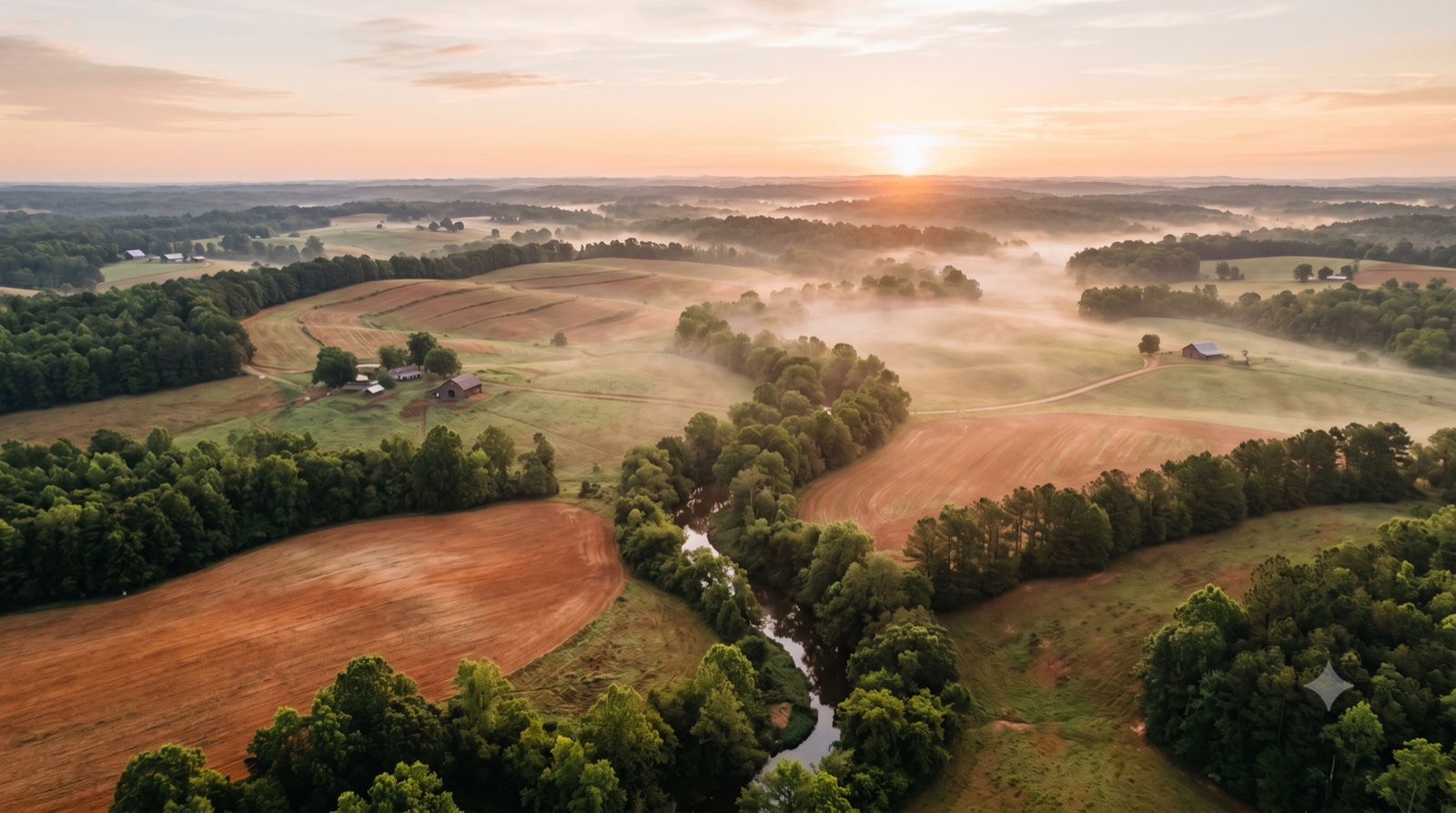
Sell My Land in Lanier County GA - What Landowners Need to Know
Key Takeaways
- Lanier County's farm economy runs almost entirely on crops, not timber: The 2022 USDA Census of Agriculture reports 99% of the county's $26.8 million in agricultural sales came from crops, with 13,073 irrigated acres — 27% of all land in farms, the highest irrigation share of any neighboring county — meaning a parcel's irrigated or dryland status is a defining factor in who wants to buy it.
- Georgia assesses all real property at 40% of fair market value, but land enrolled in Conservation Use Valuation Assessment (CUVA) is taxed on 40% of current-use value instead — and breaching that 10-year covenant triggers a penalty equal to twice the accumulated tax savings, not three times, according to Georgia Code § 48-5-7.4 and the Georgia Farm Bureau.
- Lanier County's population dropped from 10,078 in 2010 to 9,877 in 2020, then reversed course: recent estimates put the county near 10,859 residents with roughly 2.22% growth in the most recent year, making it one of the growing counties in its immediate south Georgia region rather than a shrinking one, according to U.S. Census Bureau data.
How Can You Sell Land in Lanier County Georgia?
Selling land in Lanier County, Georgia means navigating an irrigated, crop-driven farm economy, Georgia's attorney-required closing process, a statewide 40% assessment ratio, and a $1-per-$1,000 transfer tax — and whether your specific acreage is irrigated or dryland ground can matter more to a buyer here than almost anywhere else in south Georgia. Lanier County covers roughly 185 square miles of land (200 square miles including Banks Lake and other water) in the flat Coastal Plain of south-central Georgia, with the county seat of Lakeland anchoring an economy built overwhelmingly around row crops. According to the 2022 USDA Census of Agriculture, Lanier County reported a total market value of agricultural products sold of approximately $26.8 million across 133 farms and 48,841 acres of farmland — with crops accounting for 99% of that value, a figure that sharply contradicts the generic "agriculture and forestry" label some directories apply to the county.
This guide covers Georgia's property tax structure for vacant land, the CUVA and FLPA programs that affect sale timelines, the attorney-managed closing process, how Lanier County compares to its neighbors, and practical steps for landowners ready to sell. For a broader look at the Georgia closing framework, see our guide on how to sell land in Georgia.
What Are the Tax Costs of Holding Land in Lanier County?
Georgia uses a uniform 40% assessment ratio applied to the fair market value of all real property, including vacant land, per the Georgia Department of Revenue. The Board of Assessors determines fair market value; the Tax Commissioner then applies the millage rate to the assessed value to produce the annual bill. Georgia's Department of Revenue does not publish per-county millage figures in a machine-readable format — for the current Lanier County millage rate, contact the Lanier County Tax Commissioner's Office directly, since state-level averages would not reliably reflect what a specific parcel owes.
What is verifiable at the state level is the assessment mechanics: for a parcel assessed at market value, a $100,000 vacant tract carries an assessed value of $40,000, with the actual tax bill depending on the millage rate the Tax Commissioner applies to that figure. Properties enrolled in CUVA, however, are taxed on 40% of current-use value — the income-producing value of the land for agriculture — rather than 40% of open-market value. Because Lanier's rural land is overwhelmingly cropland (30,586 of the county's 48,841 farm acres) rather than woodland (10,250 acres), this conservation-use break applies to a large share of the county's parcels, and it typically applies to actively farmed or irrigated ground more often than idle or cutover tracts.
CUVA and FLPA: What They Mean for a Sale
Georgia's Conservation Use Valuation Assessment (CUVA) requires landowners to sign a 10-year covenant promising to keep the property in agricultural, timber, or conservation use, per Georgia Code § 48-5-7.4. If the property is sold and the buyer refuses to assume the covenant — or if the use changes — the covenant is breached. The breach penalty is twice the difference between the tax paid under current-use assessment and the tax that would otherwise have been due for each year of the covenant, plus interest — not three times, a distinction worth getting right before you assume a worst-case liability on a covenant you're inheriting or negotiating around. That potential liability must be disclosed and negotiated at closing, which is why verifying covenant status with the Lanier County Tax Assessor before listing is essential — especially on actively farmed row-crop ground, where CUVA enrollment is common.
The Forest Land Protection Act (FLPA) functions similarly but is specifically for qualifying forest land of 200 acres or more, with comparable rollback penalties on breach. Given how little of Lanier County's land in farms is woodland (10,250 acres, versus 30,586 acres of cropland), FLPA is a less common fit here than CUVA — most active-use covenants on Lanier parcels are more likely tied to row-crop or irrigated agriculture. If your parcel carries an active covenant, you generally have three options: sell with the covenant assigned to the buyer, breach the covenant and pay the penalty, or wait until the covenant expires.
Beyond taxes, vacant land in Lanier County carries standard carrying costs: liability insurance, maintenance of any irrigation infrastructure (pivots, wells, pumps), and ad valorem taxes that accrue whether or not the land is producing income. If your land is actively farmed or leased to a tenant grower, our guide on selling farmland walks through what drives that kind of sale, and if you're behind on taxes, see our guide on selling land with back taxes.
What Zoning and Closing Rules Apply to Lanier County Land?
Lanier County's land-use and permitting functions run through county government, with the city of Lakeland maintaining its own municipal zoning and land development code for property inside city limits. Unincorporated areas of the county — which make up most of its farmland and rural acreage, including the community of Stockton — fall under county zoning administered jointly with the city's zoning department. For your parcel's assessment record, property characteristics, and covenant status, contact the Lanier County Tax Assessor's Office at (229) 482-2090 (56 W Main Street, Suite 2, Lakeland, GA 31635) — that office handles property assessment and record-keeping. For zoning classification, setback questions, or building permits, contact Lanier County government or the City of Lakeland directly, depending on whether the parcel sits inside or outside city limits; the Tax Assessor's published duties do not include permitting.
Deed transfers are recorded through the Lanier County Clerk of Superior Court at 56 W. Main St., Suite 5, Lakeland, GA 31635, (229) 482-3594. This office maintains the public land records and is where you will verify the legal description, check for liens, and confirm any covenant status on your parcel before listing.
Georgia's Attorney-Required Closing Process
Georgia law requires a licensed Georgia attorney to supervise every real estate closing. The attorney conducts the title examination, prepares the deed, handles disbursement of proceeds, and records the deed with the Clerk of Superior Court. The process for a vacant land sale typically runs:
- Contract execution: Buyer and seller agree on terms in writing. Georgia uses the standard GAR form or a custom purchase agreement.
- Title examination: The attorney searches the Lanier County Superior Court deed records for a period sufficient to establish marketable title, checking for liens, encumbrances, judgments, and covenant status.
- Closing: All parties sign the deed and settlement statement. The attorney disburses funds and collects the transfer tax.
- Recording: The attorney records the warranty or limited warranty deed. Georgia's transfer tax of $1 per $1,000 of consideration (or fraction thereof) is paid at recording — on a $150,000 sale the tax is $150.
Georgia's transfer tax is among the lower state-level rates in the Southeast, and there is no additional county-level transfer tax in Lanier County. Seller closing costs (excluding commissions) typically run in the 1–3% range on Georgia land transactions, covering the attorney fee, title search, and prorated property taxes.
Wondering whether you even need an agent for a rural land sale? Our guide on whether you need a realtor to sell land breaks down the tradeoffs, and if the land came to you through an estate, see how to sell inherited land.
How Does Lanier County Compare to Neighboring Georgia Counties?
Lanier County's farm economy stands apart from its neighbors in one specific way: how much of its farmland is actually irrigated. At 13,073 irrigated acres — 27% of all land in farms — Lanier has a meaningfully higher irrigation share than Berrien, Clinch, or Atkinson counties, according to the 2022 USDA Census of Agriculture. That matters directly for a seller, because irrigated row-crop ground and dryland or non-irrigable acreage sell into two different buyer pools: active growers and farm operators bid aggressively on irrigated ground with working pivots and wells, while dryland tracts compete in a thinner, more patient market.
| Factor | Lanier County | Berrien County | Clinch County | Atkinson County |
|---|---|---|---|---|
| County seat | Lakeland | Nashville | Homerville | Pearson |
| Land in farms (2022) | 48,841 acres | 127,226 acres | 44,721 acres | 75,760 acres |
| Largest land-in-farms use | Cropland (30,586 ac) | Cropland (70,410 ac) | Woodland (19,027 ac) | Cropland (41,366 ac) |
| Crop share of ag sales | 99% | 64% | 94% | 54% |
| Irrigated acres (% of land in farms) | 13,073 (27%) | 21,567 (17%) | 5,494 (12%) | 10,058 (13%) |
| Statewide rank, total ag sales | 97th of 159 | 38th of 159 | 63rd of 159 | 53rd of 159 |
| Population (recent est.) | ~10,860 | ~18,900 | ~6,900 | ~8,400 |
Why the Irrigated-vs-Dryland Split Matters More Here
Lanier's 27% irrigation share is the highest among these four counties, and the gap is not small — it's more than double Clinch County's 12% and roughly double Atkinson's 13%, per USDA figures. Clinch County, despite generating 94% of its ag sales from crops, actually has more woodland (19,027 acres) than cropland (17,840 acres) in its land-in-farms total, underscoring how different "crop county" can look acre-for-acre versus dollar-for-dollar. For a Lanier County seller, the practical takeaway is that a parcel with an existing center-pivot rig, a working irrigation well, or documented water rights is a fundamentally different asset than an equivalent dryland tract nearby — the infrastructure itself, not just the soil, is a real part of what a buyer is evaluating. Confirming irrigation status, well permits, and equipment condition before marketing a parcel is worth doing regardless of which side of that split your land falls on.
For more county-level land analysis across the state, explore our blog.
What Are Your Options for Selling Land in Lanier County?
Landowners in Lanier County face a distinct calculation depending on whether their acreage is irrigated or dryland: irrigated row-crop ground draws real interest from working farm operators, while dryland or cutover tracts sit in a thinner, slower-moving pool of buyers. Add in Georgia's ad valorem tax obligations, potential CUVA penalty exposure on a breach, and the cost of maintaining any irrigation equipment on the property, and the holding-cost picture gets clearer the longer a parcel sits unsold. If your land is actively farmed or leased out, our guide on selling farmland walks through what typically drives that kind of transaction.
Before listing, take these steps. Confirm your parcel's legal description and check for any active CUVA or FLPA covenants through the Lanier County Tax Assessor's Office (Chief Appraiser Jason Webrand) at (229) 482-2090, 56 W Main Street, Suite 2, Lakeland, GA 31635. Verify your property tax status with the Lanier County Tax Commissioner's Office at (229) 482-3795, 56 W Main St Suite 1, Lakeland, GA 31635, and confirm no delinquent taxes exist. If your parcel has an active or recently-used irrigation system, document the well permit and equipment condition — that documentation matters to a buyer evaluating irrigated ground. Curious where to even begin on value? See how much is my land worth and what paperwork you'll need.
For sellers who want a firm number quickly, Jerez Land provides parcel-specific written cash offers — no listing fees, no agent commissions, and the Georgia attorney closing process handled from our side. Because we buy for cash and absorb the carrying, marketing, and resale risk on a property that may sit before the right buyer appears, our offers reflect that risk and are based on the individual parcel, not a formula. Request a cash offer and we will review your parcel and respond with a specific written number, not a range.
Frequently Asked Questions
I inherited 40 acres of dryland peanut ground in Lanier County but live in Atlanta — is it worth less than my neighbor's irrigated center-pivot field?
Not automatically less valuable, but it is a different kind of asset to a buyer. USDA figures show Lanier County has the highest irrigation share of any neighboring county at 27% of land in farms, and active farm operators typically pay closer attention to irrigated ground with working pivots or wells than to dryland acreage. Your dryland parcel can still sell — it just competes in a different, generally thinner buyer pool, and confirming its actual soil and access characteristics matters more than assuming it's simply worth less.
My grandfather enrolled our family's land near Lakeland in CUVA years ago and I want to sell before the covenant ends — what am I on the hook for?
If the buyer won't assume the covenant or the land's use changes, breaching it triggers a penalty equal to twice the property tax savings accumulated during the covenant period, plus interest, under Georgia Code § 48-5-7.4 — not three times, a common misstatement. Before listing, confirm the covenant's start date and current status with the Lanier County Tax Assessor's Office, because that determines how much savings has accrued and therefore the size of any breach penalty you'd be negotiating around at closing.
I own a small parcel in Lanier County that was carved off a larger farm and has never been irrigated — can I still sell it, or is dryland ground basically unsellable here?
You can still sell it. Dryland and non-irrigable acreage in Lanier County is not unsellable — it simply draws a smaller, more patient pool of buyers compared to irrigated row-crop ground, since 99% of the county's agricultural sales value comes from crops and buyers actively farming here weigh irrigation access heavily. Confirming legal access, boundary lines, and any covenant status through the Lanier County Clerk of Superior Court is the practical first step regardless of irrigation status.
I'm selling land in Georgia — what transfer taxes will I pay?
Georgia levies a real estate transfer tax of $1 per $1,000 of consideration (or fraction thereof). On a $100,000 parcel, the tax is $100. The seller typically pays it at closing when the deed is recorded with the Clerk of Superior Court. There is no separate county transfer tax in Lanier County.
I'm selling my land in Georgia — do I need to hire a lawyer for closing?
Yes. Georgia law requires a licensed Georgia attorney to supervise real estate closings, conduct the title examination, prepare the deed, disburse funds, and record the deed with the Clerk of Superior Court. This applies to all land transactions, including those between private parties and cash buyers.
I'm considering land in Lanier County — is the local market actually growing?
Growing, cautiously. Lanier County's population fell from 10,078 in the 2010 Census to 9,877 in 2020, but recent estimates put it near 10,859 residents with roughly 2.22% growth in the most recent year, according to U.S. Census Bureau data. That reverses the decade-long decline and puts Lanier among the growing counties in its immediate south Georgia region, though a county this size still has a modest local buyer base compared to nearby Berrien or Lowndes counties.
Disclaimer: This article is for informational purposes only and does not constitute legal, financial, or professional advice. Laws and regulations vary by jurisdiction and change over time. Always consult with qualified professionals before making land selling or purchasing decisions. Jerez Land is not responsible for actions taken based on this information.