
Sell My Land in Perquimans County NC - What Landowners Need to Know
Key Takeaways
- Perquimans County levies an extra 1% local land transfer tax: On top of North Carolina's statewide excise tax, Perquimans imposes a local land transfer tax of $1.00 per $100 of sale price (1%, rounded up to the next dollar), collected by the county when the deed is recorded, according to the Perquimans County Tax Administrator — a cost found in only a small group of northeastern NC counties
- This is Albemarle row-crop country, not a busy land market: Perquimans reported just 137 farms across 78,264 acres of farmland in the 2022 USDA Census of Agriculture, with soybeans, wheat, and corn dominating a landscape of coastal-plain cropland, pine woods, and sound-side marsh — a small, slow rural market with a limited buyer pool
- Perquimans has one of the lowest county tax rates in the region: Its 2025-26 rate is $0.5200 per $100 of assessed value, according to the North Carolina Department of Revenue — well below neighboring Chowan ($0.6950), Gates ($0.6700), and Pasquotank ($0.6200)
How Can You Sell Land in Perquimans County North Carolina?
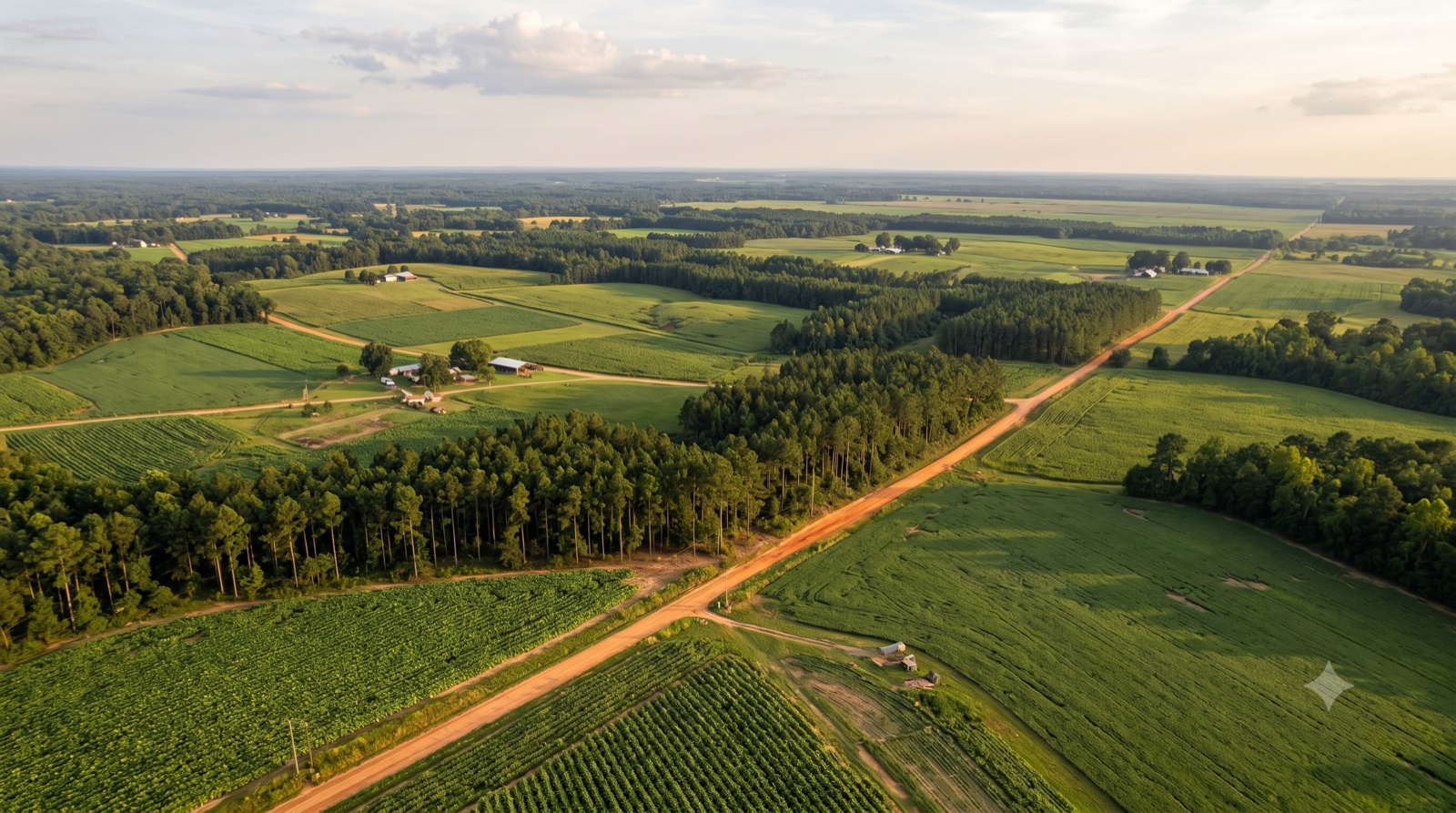
Selling land in Perquimans County, North Carolina means selling into a small, slow, water-shaped market in the northeastern corner of the state, where a licensed attorney must close the deal and the county charges its own 1% land transfer tax on top of the state excise tax. Perquimans sits on the north shore of the Albemarle Sound, and its land is a patchwork of flat coastal-plain cropland, pine timber, and tidal marsh. The 2022 USDA Census of Agriculture recorded 137 farms across 78,264 acres of farmland here, with soybeans, wheat, and corn the dominant crops — a landscape of working farms and quiet rural tracts rather than a fast-moving lot market.
This guide covers North Carolina's property tax system and the Present-Use Value deferral program that most working farmland here is enrolled in, the state's attorney-closing requirement plus the county's extra land transfer tax, how Perquimans County compares to neighboring Chowan, Gates, and Pasquotank counties, and the practical steps for completing a land sale. For a broader overview of the process across the state, visit our guide on how to sell land in North Carolina.
What Are the Property Tax and Carrying Costs of Holding Land in Perquimans County?
North Carolina assesses all real property — including vacant land — at 100% of fair market value, unlike states that apply fractional assessment ratios. The county then applies its rate per $100 of that assessed value. According to the North Carolina Department of Revenue's 2025-2026 county tax rate schedule, Perquimans County's rate is $0.5200 per $100 of assessed value, one of the lowest in the northeastern Albemarle region. Perquimans completed its most recent reappraisal in 2024, with the next scheduled for 2032, so assessed values were reset to current market levels relatively recently.
For comparison, Tax-Rates.org reports an average effective property tax rate of about 0.62% of home value in Perquimans County, with a median annual property tax bill of roughly $982 on a median home value near $159,100 — keeping the county at the lower end of the state range, which reflects its rural, agricultural tax base.
How the Present-Use Value (PUV) Program Can Reduce Your Tax Bill
North Carolina's Present-Use Value program, authorized under N.C. Gen. Stat. §§ 105-277.2 through 105-277.7, allows qualifying agricultural, horticultural, and forestland to be assessed on its income-producing value rather than market value. According to the NC Forest Service, this program can reduce property taxes by up to 90% for eligible parcels. The NCDOR's Use-Value Manual caps agricultural land at no more than $1,200 per acre for the best classification tier — a state tax-assessment value under the NC Present-Use-Value program, not a market price — and forestland is capitalized at a fixed 9% rate set by statute. In a county where the overwhelming majority of acreage is in active row-crop production, a very large share of Perquimans farmland sits under PUV enrollment.
To qualify, a parcel must meet minimum acreage thresholds — 10 acres for field crops or pasture, 5 acres for horticultural use, and 20 acres under a qualified timber management plan — and must generate at least $1,000 in gross annual income for crop and horticultural land. Applications are due by January 31 each year with the county Tax Administrator. If ownership changes or the land is converted to a non-qualifying use, deferred taxes from the current year plus the three prior years become immediately due with interest — a "rollback" that can be a meaningful, often overlooked cost when an enrolled farm tract changes hands.
For landowners carrying back taxes on a Perquimans County parcel, resolving delinquency before listing is important because a tax lien will appear in any title search and must be satisfied at closing.
Perquimans County Tax Administrator Contact
Perquimans County Tax Administrator (Bill Jennings) | 107 N. Front St., Hertford, NC 27944 | Phone: (252) 426-7010 | Website: perquimanscountync.gov/tax-administrator
What Closing and Zoning Requirements Apply in Perquimans County?
North Carolina is an attorney-close state. Under established North Carolina case law and State Bar opinions, a licensed North Carolina attorney must conduct or supervise every real estate closing — including reviewing title, preparing the deed, coordinating payoffs, and recording the deed with the Register of Deeds. A title company can issue title insurance but cannot replace the attorney's legal role.
The closing sequence for a Perquimans County land sale typically works as follows: the buyer's (or seller's, if agreed) attorney orders a title search through Perquimans County's deed records, resolves any clouds on title, prepares a warranty deed, and schedules the closing. The seller pays the state excise tax — $1 per $500 of the sale price, or $2 per $1,000 — directly to the Register of Deeds when the deed is recorded. This tax is conventionally a seller cost in North Carolina transactions, according to HomeLight's transfer tax analysis. Perquimans then adds its local land transfer tax of $1.00 per $100 of sale price (1%, rounded up), collected by the county at recording, according to the Perquimans County Tax Administrator. For a parcel selling at $50,000, that is $100 in state excise tax plus roughly $500 in county land transfer tax — a combined transfer cost sellers here must budget for that landowners in most of North Carolina do not face. If you need to understand what documents are required, see our overview of the paperwork needed to sell land.
Zoning and Permitting in Perquimans County
Perquimans County administers planning, zoning, and building inspections through its county offices in Hertford, with the bulk of unincorporated land carrying agricultural designations. Because so much of the county fronts the Albemarle Sound, the Perquimans River, and the Little River, waterfront and low-lying tracts carry added considerations: flood-zone status, wetland delineations, septic suitability on marshy soils, and Coastal Area Management Act (CAMA) rules that can apply near the water. For any proposed land use change — whether subdividing, placing a manufactured home, or constructing a building — permits are required from the county inspection office, and coastal or wetland parcels may require additional state review before development.
Perquimans County Register of Deeds | 128 N. Church St., Hertford, NC 27944 | Phone: (252) 426-5660 | Register of Deeds: Jackie Frierson
How Does Perquimans County Compare to Neighboring Counties?
Perquimans County's population edged down from 13,453 in the 2010 Census to 13,005 in 2020 — a decline of roughly 3.3% — before recovering modestly to an estimated 13,244 in 2024, according to U.S. Census Bureau and Data USA figures. That is a gentler slide than several neighbors, but the county remains one of the smallest and most rural in the state, with a land economy tied to row crops and quiet sound-side acreage rather than growth-driven demand.
| Factor | Perquimans County | Chowan County | Gates County | Pasquotank County |
|---|---|---|---|---|
| Population (latest est.) | ~13,244 | ~14,100 | ~10,400 | ~42,200 |
| Population trend | Declining (−3.3% 2010–2020) | Declining (−7.3%) | Declining (−14.1%) | Stable / Growing |
| County tax rate (per $100) | $0.5200 | $0.6950 | $0.6700 | $0.6200 |
| Top industry | Row-crop agriculture / health care | Agriculture / maritime tourism | Agriculture & forest products | Regional hub (Elizabeth City) |
| Key selling challenge | Small, slow market; extra 1% land transfer tax | Thin rural market | Steep population loss | Larger metro-anchored market |
The largest industries by employment in Perquimans County are health care and social assistance (about 867 workers), accommodation and food services (about 573), and public administration (about 557), according to Data USA. With a labor force of only about 5,550 workers, the county has no large private-sector engine — much of the working-age population commutes toward Elizabeth City in neighboring Pasquotank for jobs and services. For context on land valuation, see our guide on how much is my land worth.
Perquimans County's median household income of approximately $67,917 (2024, according to Data USA) and relatively low poverty rate of about 9.8% reflect a stable but aging rural community. Many landowners here are older family-farm owners or heirs holding cropland, wood lots, or waterfront remnants they no longer actively use. For context on how a small, slow market affects your options, keep reading below.
Motivated-Seller Signals in Perquimans County
Several patterns concentrate motivated sellers in Perquimans County. With only 137 farms — averaging 571 acres and, per the 2022 USDA data, 95% family-operated — and an aging ownership base, a steady trickle of farmland passes to the next generation each year. Heirs who have moved away frequently inherit a back field, a stand of pine, or a marshy sound-side parcel they have no intention of farming. As row-crop operations consolidate, smaller or oddly shaped leftover tracts — too small to farm profitably, encumbered by PUV rollback exposure, or limited by wetland and flood constraints — are exactly the parcels that sit idle. The county's delinquent tax rolls and periodic tax foreclosure proceedings are administered through the Perquimans County Tax Administrator's office.
For more county-level land analysis across North Carolina and the Southeast, explore our blog.
What Are Your Options for Selling Land in Perquimans County?
In a small, slow county where the land economy revolves around row-crop farms and quiet waterfront acreage, a vacant parcel — or a leftover farm tract, wood lot, or marshy sound-side remnant — can be genuinely hard to sell. The natural buyers are working farmers and a thin trickle of recreational or waterfront buyers, and they want acreage that fits their plans, not a hard-to-develop remnant. Understanding your options helps you choose the path that fits your timeline and financial goals.
Listing with a real estate agent gives your parcel the broadest market exposure through the MLS and land-specific platforms. Agents who know the northeastern NC Albemarle market can reach operators, hunters, and waterfront buyers. Agent commissions typically run 5–6% of the sale price, plus the state excise tax, the county's 1% land transfer tax, and other closing costs, and rural tracts in a thin market can sit listed for many months. If you own farmland or timberland, an agent with genuine agricultural experience matters more than a general residential broker.
For Sale By Owner (FSBO) and online platforms like Land.com, LandWatch, and LandAndFarm let you list directly. These platforms have active audiences of land buyers, but marketing a rural parcel effectively — with boundary surveys, flood and wetland status, PUV enrollment, and access documentation — requires time and knowledge of what northeastern NC buyers look for. Waterfront and low-lying parcels especially need clear documentation of what can and cannot be built.
Working with a direct cash buyer like Jerez Land means skipping the listing period, agent commissions, and the uncertainty of buyer financing. We make parcel-specific, firm written offers based on a full review of your property — location, access, encumbrances, flood and wetland status, soil and use designations, and condition — and we absorb the carrying costs, marketing expense, and resale risk. Our offers are not formulas; they reflect what we can actually do with your specific land. Before deciding, you may want to read our guide on whether you need a realtor to sell land.
To move forward, reach the Perquimans County Register of Deeds (Jackie Frierson) at 128 N. Church St., Hertford, NC 27944, (252) 426-5660 for deed and title questions, or the Perquimans County Tax Administrator (Bill Jennings) at 107 N. Front St., Hertford, NC 27944, (252) 426-7010 for tax, PUV, and land transfer tax questions. When you are ready, request a cash offer to get a specific number on your Perquimans County parcel.
Frequently Asked Questions
I need to sell my Perquimans County land fast — what's the quickest way?
The fastest path to closing on a Perquimans County parcel is working with a direct cash buyer who does not require mortgage financing. Cash closings eliminate lender timelines and can often close in two to four weeks once title is clear. Before any sale, confirm your property's legal description with the Perquimans County Register of Deeds, verify there are no delinquent taxes, and check whether the land is enrolled in Present-Use Value, since deferred-tax rollback may come due at closing.
Who pays the transfer taxes when selling land in Perquimans County?
Perquimans County sellers face two transfer taxes. First, the North Carolina state excise tax of $1 per $500 of sale price ($2 per $1,000) is conventionally paid by the seller at recording. Second, Perquimans imposes a local land transfer tax of $1.00 per $100 of sale price (1%, rounded up), collected by the county when the deed is recorded. On a $50,000 sale that is about $100 in state excise plus roughly $500 in county land transfer tax.
Do I need an attorney to sell land in North Carolina?
Yes. North Carolina requires a licensed attorney to supervise every real estate closing — this is not optional or waivable by the parties. The attorney conducts the title examination, prepares the deed, coordinates the disbursement of funds, and records the deed with the county Register of Deeds. Closing cannot be completed by a title company alone.
What is the property tax rate in Perquimans County NC?
Perquimans County's rate is $0.5200 per $100 of assessed value for fiscal year 2025-26, according to the North Carolina Department of Revenue — one of the lowest in the northeastern Albemarle region, below Chowan, Gates, and Pasquotank. The county last reappraised in 2024, with the next reappraisal scheduled for 2032. Land enrolled in the Present-Use Value program may be taxed at significantly lower amounts based on income-producing capacity rather than market value.
I inherited a farm tract in Perquimans County that I've never farmed — how do I sell it?
Start by confirming the deed and legal description at the Perquimans County Register of Deeds and checking with the Tax Administrator whether the tract is enrolled in Present-Use Value, because selling or converting enrolled land can trigger rollback taxes for the current year plus the three prior years. Clear any delinquent taxes and confirm the estate has clear title. A direct cash buyer can often handle a straightforward inherited tract without requiring you to first invest in surveys or improvements.
I live out of state and own vacant land in Perquimans County — can I still sell it?
Yes. Out-of-state owners regularly sell Perquimans County land without traveling to North Carolina. Because the state requires an attorney-supervised closing, the closing attorney can coordinate title work, the deed, and recording remotely, and documents can typically be signed and notarized where you live and returned for closing. A direct cash buyer familiar with absentee-owner sales can manage the process end to end, which is often the simplest route when you cannot be on-site.
Disclaimer: This article is for informational purposes only and does not constitute legal, financial, or professional advice. Laws and regulations vary by jurisdiction and change over time. Always consult with qualified professionals before making land purchase decisions. Jerez Land is not responsible for actions taken based on this information.