
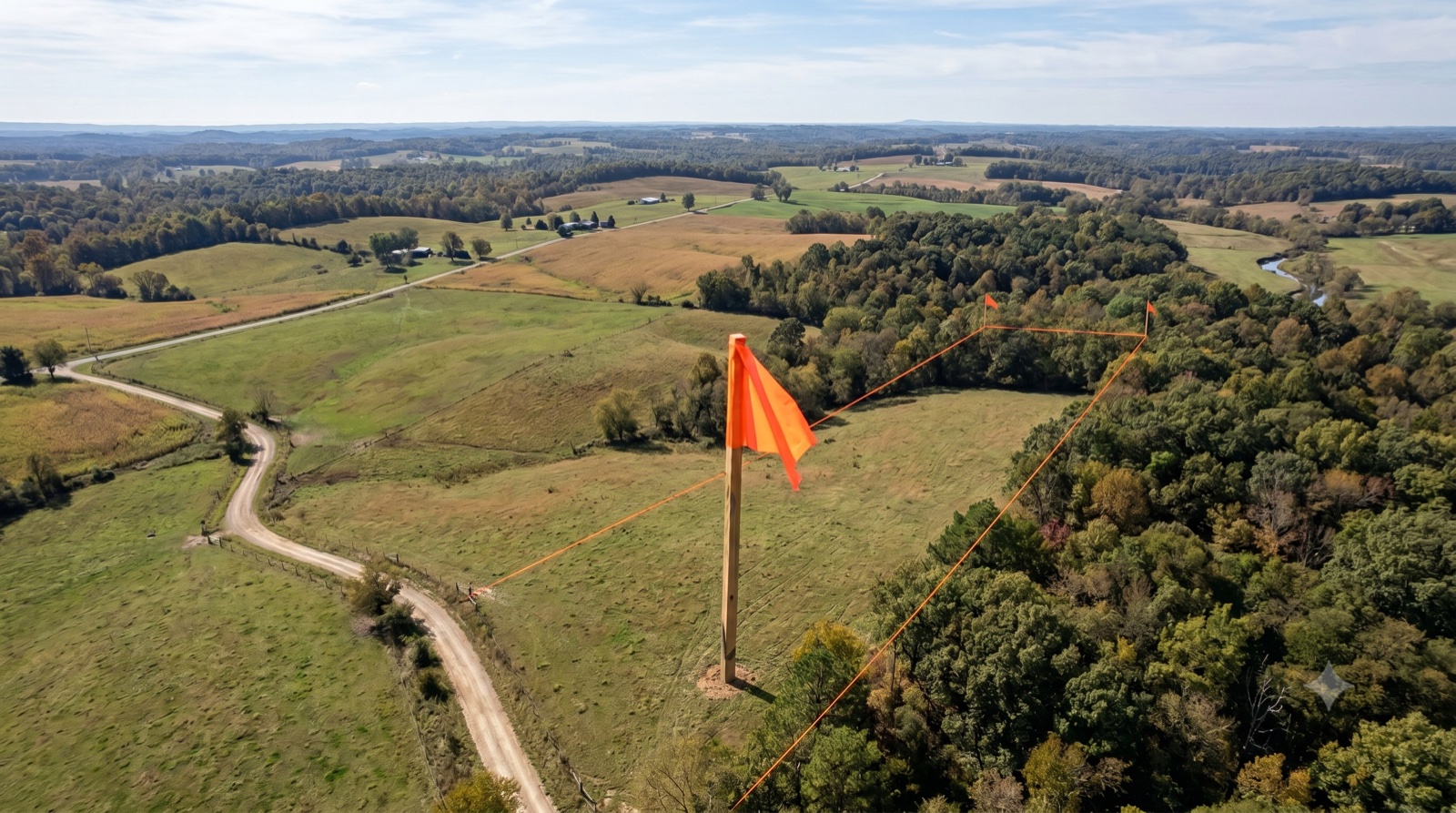
Can I Sell Part of My Land? A Guide to Subdivision, Splits, and When to Sell the Whole Parcel
Key Takeaways
- Yes, you can sell part of your land — but it requires a legal subdivision process: To convey a portion of an existing parcel, most counties require a boundary survey, a new legal description, plat approval (for divisions above a minimum size threshold), and deed recording — a process that takes 6–18 months and costs $5,000–$25,000+ depending on location and complexity
- Zoning sets the floor on how small you can go: Every county has minimum lot size requirements that limit how small a subdivided parcel can be — rural agricultural zones commonly require 5, 10, or 40 acres as a minimum, which determines whether splitting is legally possible at all
- Selling a strip to a neighbor is often the simplest split: Boundary line adjustments between adjacent landowners — adding acreage to a neighbor's existing parcel rather than creating a new standalone lot — may bypass full subdivision approval in some counties, making neighbor sales the fastest partial-sale path
Can I Sell Part of My Land?
Yes — you can sell a portion of land you own, but you cannot simply draw a line on a map and hand someone a deed. Conveying a portion of a parcel requires creating a new legal description through a licensed land surveyor, obtaining county approval for the division, and recording a new deed against the newly described parcel. In most counties, dividing land above a minimum acreage threshold triggers the formal subdivision platting process, which involves zoning review, infrastructure requirements, and planning commission approval.
This guide covers how subdivision works, what it costs and how long it takes, when selling a strip to a neighbor is simpler, when subdividing is worth the investment versus selling the whole parcel, and how a cash buyer can offer a clean alternative if you decide the process isn't worth it.
For related context, see how to sell land by owner and paperwork needed to sell land.
How Does Subdividing Land Work?
Subdivision is the legal process of dividing one recorded parcel into two or more separately conveyable parcels. Every jurisdiction has its own rules, but the core steps follow a consistent pattern:
Step 1: Confirm Zoning and Minimum Lot Size
Before spending money on a survey, verify that your county's zoning regulations allow the size of parcel you intend to create. Minimum lot size requirements vary dramatically:
- Agricultural zones: Commonly 5, 10, 20, or 40 acres minimum, depending on the state and county's rural density goals
- Rural residential zones: Often 1–5 acres minimum
- Suburban/residential zones: Frequently 6,000–15,000 square feet (well under one acre)
If your intended split would create a parcel smaller than the zoning minimum, you cannot legally convey it as a standalone parcel — you would need a variance or rezoning, which adds months and significant uncertainty.
Contact the county planning or zoning department (often called the Community Development Department, Planning Department, or Building and Zoning) before proceeding. Most offer free pre-application consultations.
Step 2: Commission a Boundary Survey
A licensed professional land surveyor must locate the existing boundaries of your parcel, establish the proposed new boundary line, prepare a legal description for each resulting parcel, and produce a plat or survey drawing showing the division. According to American Congress on Surveying and Mapping standards, surveys must meet state minimum technical standards for boundary determination.
Survey costs range widely: $2,000–$8,000 for a simple rural split with clear existing monuments; $8,000–$20,000+ for wooded, hilly, or poorly documented parcels where the surveyor must research deed history and physically locate obscured corners. Timeline: 3–8 weeks in most markets, longer in rural areas with backlogs.
Step 3: Plat Approval (for Formal Subdivisions)
Most counties require planning board or county commissioner approval before a recorded plat can be filed for divisions that create new standalone parcels. The review process examines:
- Access: Does each new parcel have deeded access to a public road, or is a new easement required?
- Utilities: Are water and sewer available, or will the parcel rely on well and septic? Many counties require a percolation test before approving a parcel for septic use
- Infrastructure: For larger subdivisions, the county may require road improvements, storm drainage, or dedications of land for public use
- Environmental: Wetlands, flood zones (FEMA NFIP mapped areas), and steep slopes may restrict buildable area or require separate environmental review
For a simple two-parcel split in a rural county, this review is often administrative (staff-level approval in 30–60 days). For larger splits, it may require a public hearing.
Step 4: Record the Plat and New Deed
Once approved, the surveyor's plat is recorded with the county recorder, register of deeds, or equivalent office. A new deed conveying the separated parcel is then prepared (typically by a title company or closing attorney) and recorded at the same time. The new parcel receives its own parcel identification number (APN or tax ID) and can now be conveyed independently.
| Step | Who Does It | Typical Cost | Typical Timeline |
|---|---|---|---|
| Zoning/lot size review | You + county planning dept | Free–$500 (pre-app) | 1–2 weeks |
| Boundary survey | Licensed land surveyor | $2,000–$20,000+ | 3–8 weeks |
| Plat/subdivision approval | County planning board | $500–$3,000 (filing fees) | 30 days–12 months |
| Perc test (if septic needed) | Certified percolation tester | $500–$2,000 | 2–4 weeks |
| Recording + new deed | Title company or attorney | $500–$2,000 | 1–2 weeks |
| Total | $5,000–$25,000+ | 6–18 months |
Can I Sell a Strip of Land to My Neighbor?
Selling a strip of your land to an adjacent landowner — to straighten a boundary line, give them additional buffer, or add acreage to their existing parcel — is often the simplest partial-sale scenario. The reason: many counties treat boundary line adjustments between adjacent owners differently from formal subdivisions, because the result does not create a new standalone parcel — it modifies the boundaries of two existing ones.
Boundary Line Adjustment vs. Subdivision
A boundary line adjustment (sometimes called a lot line adjustment or parcel merger adjustment) moves the line between two existing adjacent parcels without creating a new parcel. The transferred land becomes part of the neighbor's existing parcel rather than a new tax ID. Many counties approve these at the staff level with minimal review, because no new parcel is being created and no new development access is required.
Key considerations:
- The neighbor must own the adjacent parcel: This only works for transfers between adjacent landowners
- Both parcels must remain conforming: After the adjustment, both the seller's remaining land and the neighbor's expanded land must still meet minimum lot size requirements
- A survey is still required: You cannot convey a described portion without a licensed surveyor establishing the new boundary
- The deed must reference the correct legal description: Both deeds (the conveyance to the neighbor and the update to your remaining parcel) must be prepared and recorded simultaneously
For transfers between non-adjacent parties — a buyer who doesn't already own land next to yours — you cannot use a boundary line adjustment. That's a true subdivision.
Request a no-obligation cash offer from Jerez Land if you'd prefer to sell the entire parcel rather than manage the subdivision process — we buy land as-is, with no prep work required on your end.
What Does Subdivision Actually Cost and How Long Does It Take?
The numbers above are general ranges. Here is what drives cost and timeline at the extremes:
Factors That Increase Cost and Timeline
- Dense tree cover or steep terrain: Makes survey fieldwork slower and more expensive — surveyors must physically locate corners that may be obscured by decades of vegetation
- Poorly documented title history: If prior deeds have conflicting legal descriptions or gaps in the chain of title, the surveyor must research and reconcile before drawing the new boundary
- County planning board backlog: In rural counties with limited planning staff, approval queues of 6–9 months are not unusual
- Environmental constraints: Parcels with wetlands, 100-year floodplain, or protected habitat may require federal or state agency review on top of local approval
- Required infrastructure: If the county requires a new road, drainage improvements, or utility extensions as a condition of subdivision approval, those costs can reach tens of thousands of dollars
Factors That Reduce Cost and Timeline
- Simple, flat, well-documented parcel: Existing survey monuments in place, clean title, flat terrain — surveys can be completed in 3–4 weeks
- Administrative-level approval: Rural counties with small lot split exemptions (e.g., splits of 4 parcels or fewer that bypass full platting) can move through staff review in 30–45 days
- Adjacent owner sale: Boundary line adjustments to a neighbor typically skip the most time-consuming approval steps
When Is Subdividing Worth It vs. Selling the Whole Parcel?
Subdividing makes financial sense when the per-unit value of divided parcels significantly exceeds the whole-parcel value — and when the time and cost of subdivision don't consume that premium. It does not make sense when the costs are high, approval is uncertain, or the market for smaller parcels is thin.
Scenarios Where Subdivision May Be Worth It
- Large rural parcel where the back 40 acres has a different best use: If your 200-acre parcel has 160 acres of timber and 40 acres of buildable waterfront, subdividing the waterfront may realize significantly more than selling the whole parcel to a timber buyer
- Heir situation with disagreement on price: Multiple heirs who cannot agree on a sale price may agree that each gets a subdivided parcel and can sell independently. See how to sell inherited land for more on heir situations.
- Neighbor willing to pay a premium: A neighbor who wants a specific strip of your land for practical reasons (better road access, a pond, boundary cleanup) may pay well above the generic per-acre value for that specific piece
Scenarios Where Selling the Whole Parcel Is Better
- Subdivision costs would consume the value differential: If the split costs $20,000 and takes 18 months, the premium from dividing needs to exceed that plus the carrying costs during that period
- Zoning doesn't permit the intended division: If minimum lot size rules prohibit the split, the option doesn't exist without a variance — which adds uncertainty and cost
- Market for smaller parcels is weak: In some rural counties, there is no buyer pool for 10-acre residential parcels; the only buyers want 100+ acre tracts for farming or hunting. Dividing reduces your buyer pool rather than expanding it
- You need to sell quickly: The 6–18 month subdivision timeline is incompatible with selling fast. If you need the proceeds within 90 days, subdivision is not a realistic path
What Access and Utility Issues Can Block a Partial Sale?
Access is often the deal-killer in partial land sales. Every parcel must have legal access to a public road — either direct frontage or a recorded easement that runs with the land. If you split your parcel and the back portion has no road frontage and no recorded easement, you cannot sell it (or if sold, the buyer cannot legally reach it — creating future title and liability problems).
Creating a New Access Easement
If the portion you want to sell does not have road frontage, you can grant an easement across your remaining land. The easement must be:
- Recorded with the county at the time of the conveyance
- Described by a metes-and-bounds legal description (which requires a surveyor)
- Sized to accommodate the intended use (vehicular access easements are typically 20–60 feet wide)
Some counties require a minimum road improvement standard (gravel, drainage) before approving a subdivision that relies on a new private easement.
Utilities
If the parcel being sold will require a home or other improvements, the buyer will need water and sewer (or well and septic). If county sewer is unavailable, a percolation test is typically required to demonstrate soil suitability for septic — and must be completed before approval in most jurisdictions. This adds $500–$2,000 and 2–4 weeks to the process.
Not Ready to Subdivide? A Cash Buyer Can Take the Whole Tract
If the subdivision process sounds like more time, money, and uncertainty than you want to take on, selling the entire parcel to a direct cash buyer is a clean alternative. You skip the survey, the planning approval, the access easement work, and the 6–18 month wait — and close in 2–3 weeks.
Cash buyers purchase land as-is, in its current configuration. You don't need to subdivide, improve access, or do any prep work. The buyer evaluates the whole parcel and makes a written offer with a specific dollar amount.
Request a no-obligation cash offer from Jerez Land. We purchase vacant land in most states, handle all title and closing logistics, and close fast — no subdivisions, no prep, no commissions.
For related guidance, explore how long does it take to sell land, capital gains tax when selling land, and the full blog.
Frequently Asked Questions
I want to sell a strip of land to my neighbor—is there a faster way than full subdivision?
Yes — and this is often the simplest partial sale. When you sell a portion of your land to an adjacent landowner who will add it to their existing parcel (rather than use it as a standalone parcel), many counties process this as a boundary line adjustment rather than a formal subdivision. You still need a licensed surveyor to establish the new boundary and prepare an updated legal description for both parcels, but the approval process is typically shorter and less expensive than a full subdivision.
I'm selling a portion of my land—do I have to pay for a professional survey?
Yes. You cannot legally convey a described portion of a parcel without a licensed land surveyor establishing the new boundary and preparing a legal description for the resulting parcels. The deed for the transferred land must reference this new legal description, and the surveyor's plat must typically be recorded with the county before or simultaneously with the conveyance.
How long does subdividing land take?
A simple two-parcel split with administrative-level county approval can take as little as 3–6 months from engaging a surveyor to recording the new deed. A more complex split requiring planning board approval, environmental review, or infrastructure improvements can take 12–18 months or longer. County planning backlogs and survey fieldwork are the most variable elements.
I'm subdividing my land—what's the smallest parcel size the county will allow?
Minimum lot sizes are set by county or municipal zoning ordinances and vary significantly by zone and jurisdiction. Agricultural zones commonly require 5–40 acres minimum per parcel. Rural residential zones often require 1–5 acres. Suburban residential zones may allow fractions of an acre. Contact your county planning or zoning department before engaging a surveyor — if the proposed split violates minimum lot size requirements, a variance or rezoning is required before proceeding.
Part of my land has no road access—can I still sell it?
You must create a recorded access easement before conveying the landlocked portion. The easement runs across your remaining land and must be described by a surveyor, recorded with the county, and sized to accommodate vehicular access. Some counties will not approve the subdivision until the easement meets minimum road improvement standards (gravel surface, drainage). Selling a landlocked parcel without a recorded easement creates serious future title problems for the buyer.
Is it worth the time and cost to subdivide, or should I just sell the whole property?
Subdivision makes financial sense when the per-unit value of the subdivided parcels significantly exceeds the whole-parcel value — and that differential is larger than the cost ($5,000–$25,000+) and the opportunity cost of the 6–18 month process. When subdivision costs are high, approval is uncertain, or you need to sell quickly, selling the whole parcel to a cash buyer is typically the better outcome. A direct cash buyer closes in 2–3 weeks with no prep work.
Disclaimer: This article is for informational purposes only and does not constitute legal, financial, or professional advice. Subdivision laws, zoning requirements, and minimum lot sizes vary significantly by jurisdiction and change over time. Always consult with a licensed land surveyor, real estate attorney, and your county planning department before initiating any subdivision process. Jerez Land is not responsible for actions taken based on this information.