
Sell My Land in Johnston County OK - What Landowners Need to Know
Key Takeaways
- Oklahoma's documentary stamp tax is $0.75 per $500 of consideration: Paid at the county clerk's office when the deed is recorded, this transfer tax costs $150 on a $100,000 sale. Unlike most closing costs, it is technically negotiable between buyer and seller, though sellers customarily pay it in Oklahoma.
- Johnston County's effective property tax rate is approximately 0.53%, among the lowest in the country and well below the national average — Oklahoma itself being a low-tax state. The county ranks 58th of Oklahoma's 77 counties by median property tax, with a median annual property tax of approximately $342, according to PropertyTax101 data. The county's assessment ratio runs approximately 11–13.5% of fair cash value under Oklahoma's ad valorem system.
- The county is defined by cattle ranchland, Arbuckle foothills, and Lake Texoma recreation: Johnston County covers approximately 658 square miles in south-central Oklahoma, with an arm of Lake Texoma reaching into its southern edge and the Blue River and Pennington Creek crossing the county. Ranching is the economic backbone — livestock and poultry account for roughly 93% of the county's agricultural sales, according to the 2022 USDA Census of Agriculture.
How Can You Sell Land in Johnston County Oklahoma?
To sell land in Johnston County, Oklahoma, start with an abstract of title compiled by a licensed abstracter, confirm your parcel status through the Johnston County Clerk, pay documentary stamp tax of $0.75 per $500, and reach buyers through a land broker, online platforms, or a direct cash offer.
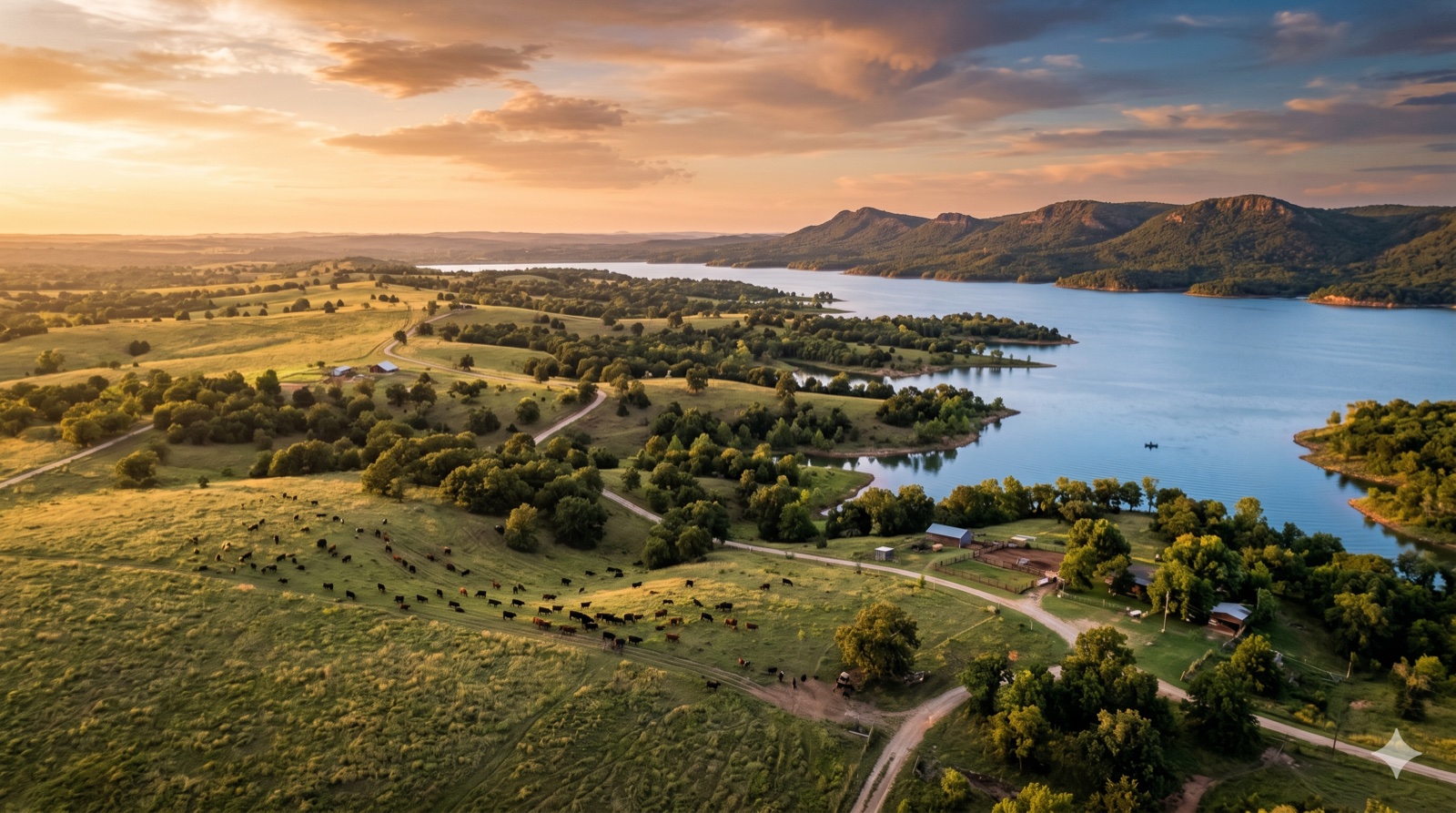
Selling land in Johnston County, Oklahoma involves a documentary stamp tax of $0.75 per $500, an abstract-of-title tradition rooted in Oklahoma's unique land record history, and a rural market shaped by cattle pasture, Arbuckle-foothill ranch ground, and recreational tracts along Lake Texoma and the Blue River. The county seat is Tishomingo, the historic capital of the Chickasaw Nation. Johnston County sits in south-central Oklahoma where the rolling pasture and oak savanna of the Arbuckle uplands meet the lake and river bottoms feeding the Red River — a terrain of grazing land, spring-fed streams, and waterfowl and deer country that makes it one of the more recreation-driven rural land markets in the region.
This guide covers Oklahoma's ad valorem property tax system, the abstract-of-title process, how Johnston County compares to its south-central Oklahoma neighbors, and practical steps for landowners ready to sell. For a full overview of the Oklahoma land sale process, see our guide on how to sell land in Oklahoma.
What Are the Tax Costs of Holding Land in Johnston County?
Oklahoma's property tax system is administered at the county level. Each county assessor determines fair cash value for all real property, then applies the state-mandated assessment percentage to arrive at taxable assessed value. For most real property in Oklahoma — including vacant land, ranchland, pasture, and rural acreage — the assessment ratio runs between approximately 11% and 13.5% of fair cash value, depending on the assessor's determination and any applicable exemptions, according to the Oklahoma Tax Commission's ad valorem guidelines.
Johnston County's millage rate, applied to the assessed value, produces an effective tax rate of approximately 0.53% of fair market value — among the lowest in Oklahoma and below the national average of roughly 0.9%, according to PropertyTax101 data. The median property tax in Johnston County is approximately $342 per year on a median home value of roughly $64,900.
For a vacant 160-acre ranch parcel in Johnston County, the math works as follows at a simplified level: a parcel with a fair cash value of $120,000, assessed at 11% ($13,200 assessed value), at a representative millage rate, produces a modest annual tax bill. The exact figure depends on the specific millage rates for the school district, county, and any special levies applicable to the parcel's location.
Agricultural Use-Value Assessment
Oklahoma allows qualifying agricultural land to be assessed on its use value — its capacity to produce agricultural income — rather than its full market value. For Johnston County's working cattle pasture and hay ground, this ag use-value treatment can hold assessed values well below what a comparable parcel would carry if assessed at market. Land enrolled in genuine agricultural use, such as cattle grazing or hay production, generally benefits from this lower basis. A change in use — for example, taking pasture out of production or subdividing for lake-recreation lots — can trigger reassessment, so confirm the current classification with the county assessor before assuming a particular tax figure carries forward to a buyer.
Oklahoma's Ad Valorem Calendar and Delinquency
Oklahoma property taxes are assessed as of January 1 each year. Tax bills are issued in the fall and are due in two equal installments: the first by December 31, and the second by March 31 of the following year. Taxes not paid by the March 31 deadline begin accruing interest. After three years of delinquency, the county treasurer can offer the property for resale — a process distinct from a tax lien sale in other states.
Out-of-state landowners holding Johnston County parcels sometimes fall behind on tax payments because Oklahoma does not require lenders to escrow property taxes on rural land loans the way residential mortgage servicers do. If your property has accumulated back taxes, our guide on selling land with back taxes explains how delinquent amounts are handled at closing.
Beyond taxes, holding costs for Johnston County land include liability insurance for hunting or lake-access use, fence and cattle-guard maintenance, and brush, cedar, and erosion control across pasture and creek-bottom acreage. For absentee owners, periodic mowing or grazing leases are common ways to keep ranch ground in usable condition while it sits.
What Closing Requirements and Land Traditions Apply in Johnston County?
Oklahoma has no mandatory attorney-required closing law for real estate transactions. Closings are commonly handled by title insurance companies, escrow officers, or abstract companies — with attorneys often involved when title issues arise. What makes Oklahoma distinctive is its deep abstract-of-title tradition, which predates the widespread adoption of title insurance in the state.
An abstract of title is a chronological summary of every recorded document in the chain of title for a specific parcel — deeds, mortgages, judgments, liens, and court records — compiled by a licensed abstracter from county records. In many Oklahoma rural counties, including Johnston County, buyers still request an abstract rather than a title commitment for initial due diligence. An attorney then renders a title opinion based on the abstract before title insurance is issued or the transaction closes.
For Johnston County land, abstracting fees for a standard land transaction run approximately $575, with a title examination fee of approximately $200 for the attorney review, according to the Old Republic Title fee schedule for Oklahoma. These costs are typically split between buyer and seller or negotiated in the contract.
Deeds in Johnston County are recorded with the Johnston County Clerk at the Johnston County Courthouse, 403 West Main Street, Room 101, Tishomingo, OK 73460, (580) 371-3184. The County Clerk acts as the agent of the Oklahoma Tax Commission for documentary stamp tax collection. Stamps are affixed to the deed at recording.
Severed Minerals: Selling Surface As-Is
South-central Oklahoma has a long history of oil, gas, and aggregate interests, and it is common for the mineral estate beneath a Johnston County parcel to have been severed from the surface decades ago — sold off, reserved in an old deed, or split among many heirs. The county is also a major producer of sand, gravel, limestone, and dolomite, so aggregate and rock interests can be reserved separately as well. As a result, owning the surface does not automatically mean you own what is below it. Many sellers are surprised to learn during the abstract review that they hold the surface only.
This does not stop a sale. Surface acreage with severed or partial minerals is bought and sold routinely. The cleanest path for most landowners is to sell the surface as-is and let the abstract and title work document exactly what mineral interest, if any, conveys. If you want to understand the distinction before you sell, our guide on mineral rights versus surface rights walks through how the two estates are separated and conveyed.
Documentary Stamp Tax: The Calculation
Oklahoma's documentary stamp tax is $0.75 per $500 of consideration (or fraction thereof), per the Oklahoma Tax Commission's Chapter 30 rules. The formula: divide the sale price by 500, round up to the nearest whole number, multiply by $0.75. For example:
- $50,000 sale: $50,000 ÷ 500 = 100 × $0.75 = $75
- $100,000 sale: $100,000 ÷ 500 = 200 × $0.75 = $150
- $250,000 sale: $250,000 ÷ 500 = 500 × $0.75 = $375
The tax is negotiable between buyer and seller but is customarily paid by the seller. Certain transfers are exempt, including transfers to government entities, gifts with no consideration, and some foreclosure-related conveyances. Questions about the paperwork involved are covered in our paperwork needed to sell land guide.
Property tax questions and current assessed value can be confirmed through the Johnston County Assessor at the Johnston County Courthouse, 403 West Main Street, Suite 102, Tishomingo, OK 73460, (580) 371-3465.
How Does Johnston County Compare to Neighboring Oklahoma Counties?
Johnston County's 2020 Census population was 10,276, up modestly from 10,086 in 2010 and holding near 10,500 in recent estimates, according to U.S. Census and WorldPopulationReview data — a rare pattern of slight stability-to-growth among small rural Oklahoma counties. The county seat, Tishomingo, holds roughly 3,000 residents and anchors the county as the historic capital of the Chickasaw Nation and home to Murray State College. Most of the county's land is open ranch country, with lake and river frontage adding a recreational layer.
| Factor | Johnston County | Marshall County | Murray County | Pontotoc County |
|---|---|---|---|---|
| Population (2020 Census) | 10,276 | 15,312 | 13,904 | 38,065 |
| Population trend (2010–2020) | Slight growth | Growing | Growing | Growing |
| Effective tax rate | ~0.53% | ~0.54% | ~0.44% | ~0.53% |
| County seat | Tishomingo | Madill | Sulphur | Ada |
| Primary land character | Ranch pasture / lake & river recreation | Lake Texoma / pasture / lake lots | Arbuckles / springs / Chickasaw NRA | Ada hub / pasture / oil country |
| Lake Texoma frontage | Yes (northern arm) | Yes (major) | No | No |
All of these counties sit in south-central Oklahoma and share a rural, ranching-and-recreation character. Johnston County's defining feature relative to its neighbors is its blend of cattle pasture, Arbuckle-foothill grazing ground, and access to both Lake Texoma and the spring-fed Blue River — a mix that supports working cattle operations alongside an active recreational-tract buyer pool.
Marshall County to the south is the Lake Texoma county proper, where extensive lake frontage drives a strong lake-lot and second-home market that lifts its land values and tax base. Murray County to the west is Arbuckle Mountain and spring country, anchored by Sulphur and the Chickasaw National Recreation Area, drawing recreation and tourism buyers. Pontotoc County to the north is the regional population and employment hub built around Ada, with a broader economy and a larger local buyer base. Johnston County's combination of affordable ranch ground and lake-and-river recreation gives it a buyer pool that reaches well beyond its own small population.
Economy and Major Employers
Johnston County's economy centers on cattle ranching, hay and forage production, aggregate and stone mining, education, and public-sector employment. Major employers include Murray State College in Tishomingo, the Chickasaw Nation, Johnston County Public Schools, area aggregate and quarry operations, and city and county government, according to regional economic profiles. Tishomingo's role as the Chickasaw Nation capital adds a tribal-government and cultural presence, and the Tishomingo National Wildlife Refuge — established in 1946 on the upper end of Lake Texoma — anchors the county's waterfowl and wildlife identity.
The 2022 USDA Census of Agriculture reported total market value of agricultural products sold in Johnston County of approximately $25.5 million, with livestock and poultry accounting for roughly 93% of sales and crops the remainder — a profile that reflects the county's heavy emphasis on cattle and pasture. The average farm runs approximately 478 acres, and the bulk of the county's farms fall in the 50-to-179-acre and 180-to-499-acre ranges, capturing the mid-size cattle-and-hay operations that define the local land market. Top commodities are cattle and calves, hay, and wheat for grain. (Land-use acreage detail is summarized from City-Data's compilation of the USDA county profile; the USDA cp40069 profile remains the authoritative source.)
For more county-level land analysis across Oklahoma and neighboring states, explore our blog.
What Are Your Options for Selling Land in Johnston County?
Johnston County land tends to fall into a few categories for sellers: working cattle pasture and hay ground, Arbuckle-foothill ranch tracts, and recreational parcels marketed around Lake Texoma, the Blue River, and deer and waterfowl hunting. Each category faces the same basic reality — the county's small local population (about 10,500 residents) means much of the demand comes from buyers outside the county, and reaching that audience requires either listing with a land-specialized broker, using platforms like Land.com or LandWatch, or selling directly to a land investment company. If your acreage is working ag ground, our guide on selling farmland covers pasture and hay-ground valuation considerations, and for lake-and-river recreational tracts, selling hunting land walks through what hunting and recreation buyers look for.
If your parcel carries timber along the creek bottoms, see our selling timberland guide. If you inherited Johnston County land from a family member and are working through title or probate issues, our guides on how to sell inherited land and selling inherited land with multiple heirs walk through the process step by step. For a grounded understanding of what factors affect your parcel's value before requesting any offer, see our how much is my land worth guide, and if you are weighing whether to list, our do you need a realtor to sell land guide compares your paths. Out-of-state owners can also review our selling land as an out-of-state owner guide.
The annual carrying cost on even a low-taxed Johnston County parcel adds up over time: at the county's approximate 0.53% effective rate, a parcel with a fair cash value of $100,000 generates roughly $530 per year in taxes — modest individually, but a decade of non-productive holding equals $5,000-plus in taxes alone before insurance, fencing, and maintenance. Severed-mineral and aggregate uncertainty, lake-access questions, and the time it takes a buyer's lender to work through the abstract can also stretch out a traditional listing.
Jerez Land buys Oklahoma land for cash. We provide parcel-specific written offers — not ranges or per-acre formulas — based on the specific acreage, location, access, pasture and forage condition, lake or river frontage, surface-versus-mineral status, and legal standing of your parcel. Because we buy as-is and take on the carrying, marketing, and resale risk ourselves, our offer reflects a direct-purchase price rather than a retail listing number, and that is the trade-off for a fast, certain close with no agent commissions and no listing period. We coordinate the abstract and closing process on our side. To confirm your parcel's recorded status before you sell, the Johnston County Clerk records deeds at 403 West Main Street, Room 101, Tishomingo, and the Johnston County Assessor verifies assessed value at 403 West Main Street, Suite 102, Tishomingo. Request a cash offer and we will respond with a firm written number.
Frequently Asked Questions
How do I sell vacant land in Johnston County Oklahoma?
Start by confirming your parcel's legal description and checking for any liens, severed minerals, or delinquent taxes through the Johnston County Clerk (580) 371-3184 and Assessor (580) 371-3465, both in the courthouse at 403 West Main Street in Tishomingo. Oklahoma uses an abstract-of-title tradition, so a licensed abstracter compiles the chain-of-title record before closing. You can list with a land broker, use online platforms, or request a direct cash offer from a land buyer.
What's the property tax rate on my Johnston County land?
Johnston County's effective property tax rate is approximately 0.53% of fair market value — among the lowest in Oklahoma and below the national average of roughly 0.9%. Oklahoma assesses real property at approximately 11–13.5% of fair cash value, and the county's millage rates applied to that assessed value produce a median annual property tax of around $342. Qualifying agricultural land may be assessed on its use value rather than full market value.
When I sell my Johnston County land, how much will I owe in documentary stamp tax?
Oklahoma's documentary stamp tax is $0.75 per $500 of consideration, or fraction thereof. To calculate: divide the sale price by 500, round up to the nearest whole number, and multiply by $0.75. On a $100,000 land sale the tax is $150; on a $200,000 sale it is $300. The tax is collected by the County Clerk when the deed is recorded and is customarily paid by the seller, though it is negotiable.
What is the abstract-of-title tradition in Oklahoma?
An abstract of title is a compiled chronological history of every recorded document in a property's chain of title — deeds, mortgages, judgments, and liens — prepared by a licensed abstracter from county courthouse records. In rural Oklahoma, including Johnston County, buyers often request an abstract for initial due diligence before title insurance is issued. An attorney then renders a title opinion based on the abstract. Abstracting fees run approximately $575 and attorney title opinion fees approximately $200, according to the Old Republic Title Oklahoma fee schedule.
Do I own the minerals under my Johnston County land?
Not necessarily. South-central Oklahoma has a long history of oil, gas, and aggregate interests, and the mineral or rock estate beneath many Johnston County parcels was severed from the surface long ago — sold, reserved in an old deed, or split among heirs. The county is a major sand, gravel, and stone producer, so aggregate interests may be held separately too. Owning the surface does not automatically mean you own what is below it. This does not prevent a sale; surface acreage with severed or partial minerals is bought and sold routinely, and the abstract and title work will document exactly what conveys.
My Johnston County property borders Lake Texoma — does that affect my land's value?
Yes. An arm of Lake Texoma reaches into southern Johnston County and the spring-fed Blue River and Pennington Creek cross the county, and parcels with lake frontage, river access, or strong deer and waterfowl ground draw a recreational buyer pool from across Oklahoma and Texas. The Tishomingo National Wildlife Refuge on the upper lake reinforces the area's wildlife appeal. This recreational demand makes lake-and-river tracts a distinct and active buyer segment for Johnston County sellers, alongside the county's traditional cattle-pasture and ranch buyers.
Disclaimer: This article is for informational purposes only and does not constitute legal, financial, or professional advice. Laws and regulations vary by jurisdiction and change over time. Always consult with qualified professionals before making land selling or purchasing decisions. Jerez Land is not responsible for actions taken based on this information.