Sell My Land in Kalkaska County MI - What Landowners Need to Know
Key Takeaways
- Michigan transfer tax is seller-paid at $3.75 per $500 state plus county tax of $0.55–$0.75 per $500: Unlike states with no transfer tax, Michigan sellers fund both levies at closing — at the typical $0.55 county rate that totals $4.30 per $500 (0.86%) of the sale price, a real line item even on the modest, sandy-soil recreational parcels common in Kalkaska County
- Kalkaska County property is assessed at 50% of true cash value (SEV), with taxable value capped annually by Proposal A (1994) at the lesser of inflation or 5% — but taxable value uncaps and resets to SEV whenever the property is sold, which can meaningfully raise annual tax bills for buyers
- Population is one of the few growing rural counties in northern Michigan: From 16,571 in 2010 to 17,939 in 2020 to roughly 18,000 in recent estimates — modest growth of about 8% over the decade — yet roughly 42% of the county is state-owned Pere Marquette State Forest, leaving a thin private land base dominated by jack and red pine hunting tracts owned heavily by absentee recreational buyers, according to U.S. Census Bureau and state forestry data
How Can You Sell Land in Kalkaska County Michigan?
Selling land in Kalkaska County, Michigan means contending with a property tax system built on two layers — the State Equalized Value (SEV) and a taxable value cap that resets at sale — a seller-paid transfer tax of $3.75 per $500 (state) plus $0.55–$0.75 per $500 (county), and a land market shaped by jack-pine forest, recreational hunting tracts, and a private parcel base squeezed between vast blocks of state forest land.
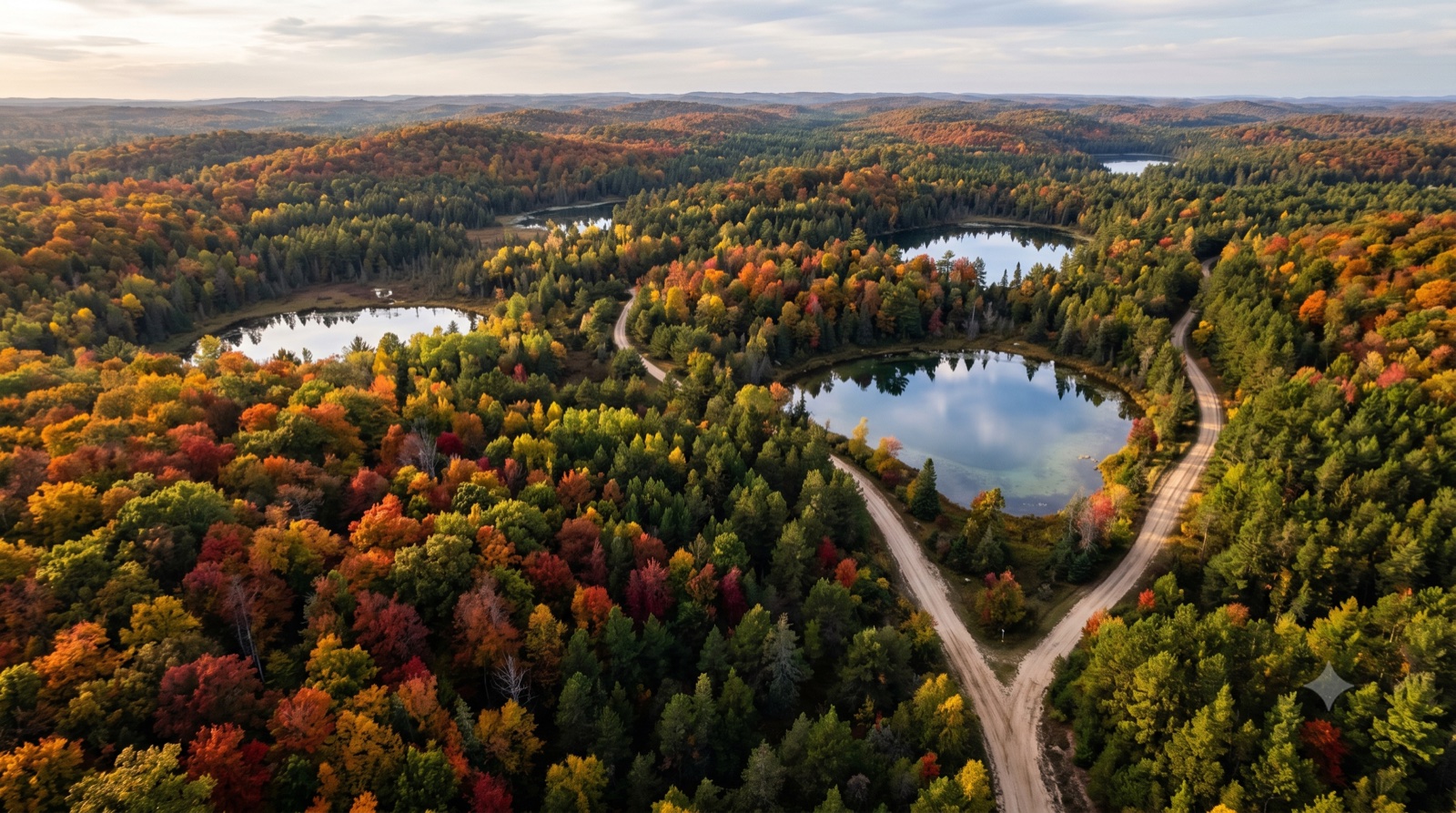
The county sits in the northern Lower Peninsula, with the village of Kalkaska serving as the county seat near the geographic center of the county. The terrain is flat to gently rolling glacial outwash plain, with sandy soils that favor jack pine, red pine, and aspen over row-crop agriculture. Roughly 42% of the county is state-owned land, most of it within the Pere Marquette State Forest, and the county holds an estimated 283,000 acres of forest overall. Inland lakes, the Manistee and Boardman river headwaters, and the famous spring trout opener in the village anchor a land market built far more on recreation than on farming.
This guide walks through Kalkaska County's property tax mechanics, Michigan's title-company closing process, how the county compares to its neighbors, and your practical options for exiting a parcel. For the statewide picture, start with our Michigan land selling guide, and browse more county guides on our blog.
What Are the Tax Costs of Holding Land in Kalkaska County?
Kalkaska County's effective property tax rate on vacant land typically runs approximately 0.9% of true cash value, with median annual bills around $1,123, governed by Michigan's State Equalized Value (SEV) system and Proposal A's annual taxable-value cap.
Michigan's property tax system is more layered than most states. Every parcel has two relevant values: the State Equalized Value (SEV), which equals 50% of the assessor's estimate of true cash value (market value), and the taxable value, which is the figure millage rates are actually applied to.
Under Proposal A (1994), taxable value increases annually at the lesser of the Consumer Price Index or 5% — regardless of how fast market values rise. This cap protects long-term owners from large tax swings. However, when a property is sold, taxable value uncaps and resets to the property's current SEV in the year following the sale. For buyers purchasing land that has been held for many years — common in Kalkaska County, where hunting tracts pass within families for decades — this uncapping can substantially increase the annual tax bill.
Kalkaska County's effective property tax rate on land typically lands near 0.9% of true cash value for non-homestead vacant parcels, though the relationship between assessed value, taxable value, and market price means the figure varies widely by township, school district, and how long the parcel has been held. The median property tax bill in the county runs approximately $1,123 per year, according to tax-rates.org and Ownwell. Millage rates differ by township and school district; the Kalkaska County Equalization Department publishes annual millage rates and reports, and the Michigan Department of Treasury publishes total millage rates statewide.
Michigan Transfer Tax: Seller Pays Both State and County Levies
Michigan's real estate transfer tax is seller-paid at two levels:
- State transfer tax: $3.75 per $500 of sale price (or fraction thereof)
- County transfer tax: $0.55 per $500 of sale price (statutory rate; some counties are authorized up to $0.75 per $500)
- Combined: $4.30 per $500 at the standard county rate, or approximately 0.86% of the purchase price
On a $40,000 land sale, the combined transfer tax at the standard rate would be $344. This is a meaningful cost compared to states like Mississippi (which charges $0.00) or Tennessee (which charges $0.37 per $100, or 0.37%). Michigan sellers should factor both levies into their net proceeds calculation, especially on lower-priced wooded parcels where every closing cost erodes a thin net.
Certain transfers are exempt from Michigan's transfer tax, including transfers between spouses, certain foreclosure deeds, and transfers where no money changes hands. See the Michigan State Treasury for a complete exemption list.
If you're an out-of-state owner managing a Kalkaska County parcel from afar, our guide on selling land as an out-of-state owner covers the remote-closing logistics Michigan title companies handle routinely.
What Closing Requirements and Zoning Rules Apply in Kalkaska County?
Michigan does not require a licensed attorney to be present at a real estate closing. Closings are routinely handled by title companies, which conduct the title search, issue title insurance, prepare the deed (warranty deed or limited warranty deed), and record documents with the county Register of Deeds. Attorney involvement is optional but advisable for complex transactions — particularly those involving easements, two-track access across state forest land, timber rights, or Qualified Forest Program recapture.
When you sell land in Kalkaska County, the deed is recorded at the Kalkaska County Register of Deeds, located at 605 N. Birch Street, Kalkaska, MI 49646, phone (231) 258-3315 (Registrar Jo Ann DeGraaf). Office hours are Monday through Friday, 8:00 a.m. to 5:00 p.m. The closing typically follows these numbered steps:
- Title search — the title company examines the chain of title at the Register of Deeds to confirm clear ownership and flag any liens, easements, or unpaid taxes
- Purchase agreement and disclosures — the parties sign, and any Qualified Forest Program enrollment or plat restrictions are identified
- Deed preparation — the title company drafts the warranty or limited warranty deed
- Closing and transfer tax — the seller pays the state and county transfer tax, and funds are disbursed
- Recording at the Register of Deeds — the deed is recorded at 605 N. Birch Street, and taxable value uncaps in the following year
The Kalkaska County Equalization Department (which oversees county property assessment) is in the county complex in the village of Kalkaska, phone (231) 258-3340.
Michigan's Qualified Forest Program: Tax Savings with Recapture on Sale
Michigan's Qualified Forest Program (QFP) is a state tax incentive for forestland owners with at least 20 acres of forestland. Qualifying landowners receive two benefits: an exemption from school operating millage (up to 16 mills depending on township), and protection from taxable-value uncapping when the property transfers within the program. Michigan also runs a separate Commercial Forest program through the DNR, which lowers taxes to a flat per-acre rate in exchange for keeping the land open to public hunting and fishing — common on larger timber tracts and worth checking before any sale.
The savings can be significant in Kalkaska County, where school operating millage is often the largest single millage component, and where forested parcels bordering the Pere Marquette State Forest are common. However, when QFP property is sold and the new owner does not continue the program, a recapture provision applies. The seller (or buyer, depending on the purchase agreement) must repay the taxes that would have been paid without the QFP exemption, going back up to 10 years, according to MSU Extension. The Commercial Forest program carries its own withdrawal penalties. This is similar to Tennessee's Greenbelt rollback and can represent a substantial sum on parcels held under either program for many years.
Before accepting any offer on QFP- or Commercial Forest-enrolled land, consult with the Michigan Department of Agriculture and Rural Development (MDARD), the DNR, or a qualified forester to calculate potential recapture liability. If your parcel is primarily wooded, our guide on selling timberland covers what buyers look for.
Zoning and Land Use
Kalkaska County's townships maintain their own zoning ordinances; rural land is generally zoned agricultural, forest-recreational, or residential-rural, with recreational and forestry uses typically permitted by right. The village of Kalkaska anchors the populated core, with smaller communities at Rapid City, Fife Lake, and South Boardman. Lake-adjacent parcels frequently carry shoreline or setback rules, and older platted recreational subdivisions may have recorded plat restrictions that survive a sale.
The Pere Marquette State Forest and Michigan DNR hold vast public land throughout Kalkaska County. Proximity to that public land can be a selling point for buyers seeking hunting and trail access, or a limitation for those seeking privacy and clear access. Because so much of the county is state-owned, private inholdings are often small, irregular, or reachable only by seasonal two-track — details that matter to buyers and that a title company will want documented. If you've inherited such a parcel with siblings, our guide on selling inherited land with multiple heirs explains how to align co-owners before listing.
How Does Kalkaska County Compare to Neighboring Michigan Counties?
Kalkaska County's population has grown modestly over the past decade and a half — 16,571 in 2010, 17,939 in 2020, and roughly 18,000 in recent estimates, per U.S. Census Bureau data. That makes it one of the few northern-Lower-Peninsula rural counties posting real growth rather than decline, helped by its position within commuting reach of Traverse City. Median household income runs in the mid-$50,000s, with a meaningful share of land held by absentee recreational owners rather than year-round residents, according to Census and Data USA figures.
| Factor | Kalkaska County | Grand Traverse County | Missaukee County | Crawford County |
|---|---|---|---|---|
| Population (2020 census) | 17,939 | 95,238 | 15,052 | 12,988 |
| Population trend | Growing (~8% 2010–2020) | Strong growth | Stable/slight growth | Stable/slight decline |
| Effective tax rate | ~0.90% | ~1.00% | ~0.85% | ~0.90% |
| County seat | Kalkaska | Traverse City | Lake City | Grayling |
| Distance to Traverse City | ~25 mi | County hub | ~50 mi | ~50 mi |
| Key recreational draw | Pere Marquette State Forest, jack-pine hunting, trout opener | Grand Traverse Bay, wine country | Lake Missaukee, state forest | Au Sable River, Hartwick Pines |
The comparison shows Kalkaska County as a small, growing, forest-dominated county whose land market is pulled in two directions — affordable recreational hunting tracts on its own sandy ground, and spillover demand from the booming Grand Traverse region next door. Grand Traverse dwarfs its neighbors in population and price; Missaukee and Crawford share Kalkaska's recreation-and-state-forest profile far more closely. All four counties depend on tourism, hunting, and seasonal property ownership rather than large-scale farming, which the USDA data confirms.
Economy and Absentee Ownership
According to the USDA 2022 Census of Agriculture, Kalkaska County had just 181 farms covering 25,005 acres — only a small slice of a 571-square-mile county — with total agricultural sales of about $16.6 million and an average farm size of 138 acres. Tellingly, woodland made up 10,831 of those farm acres (about 43%), nearly matching cropland — a clear signal that even the county's "farms" are heavily forested, and that most of Kalkaska's private land is pine and aspen recreational ground, not row crops. Outside those farms, the dominant uses are hunting, off-road recreation, and timber.
The absentee-owner dynamic defines Kalkaska County's land market. Many wooded recreational parcels — jack-pine and red-pine tracts bordering or surrounded by the Pere Marquette State Forest — were bought decades ago by downstate Michigan and out-of-state families as deer-camp ground. Those original buyers are often now in their 70s and 80s, or have passed the land to heirs who rarely visit. Succession, estate settlement, and outright sale are increasingly common as a generation of hunting-camp owners ages out. Absentee owners managing land from a distance routinely underestimate annual carrying costs: taxes, liability exposure, basic maintenance, and the quiet erosion of title and access clarity over decades. Wooded recreational lots in a county this rural also draw a thin buyer pool and can sit on the market for a long time, with few clean comparable sales to anchor a price.
For help understanding what your parcel might be worth before you list, our guide on how much is my land worth explains the factors that drive value in northern Michigan's recreational market — and why scarce comps and seasonal demand make wooded tracts hard to price.
What Are Your Options for Selling Land in Kalkaska County?
You have three main paths: list with a land broker for seasonal market access, work with a title company on direct marketing, or request a direct cash offer from a land buyer for speed and certainty.
The most common Kalkaska County seller is an out-of-state or downstate Michigan owner who inherited or bought a jack-pine hunting tract decades ago, no longer uses it, and is now weighing whether ongoing taxes and upkeep justify holding on. Watch for the signals that usually mean it's time to sell: you haven't set foot on the parcel in years, the tax bill arrives and you'd struggle to say exactly where the land is, you've inherited a hunting tract alongside siblings who all live out of state, or you're simply tired of paying every year for land that does nothing for you. Any one of those is a reason landowners in this county decide to cash out.
Before accepting any offer, take these steps. Confirm your current taxable value and SEV through the Kalkaska County Equalization Department ((231) 258-3340). Verify deed and title through the Register of Deeds (605 N. Birch St., Kalkaska, (231) 258-3315). Check for delinquent property taxes through the Kalkaska County Treasurer ((231) 258-3310) — Michigan's tax-forfeiture timeline moves faster than most states once a parcel falls behind, and our guide on selling land with back taxes explains how to handle a balance at closing. If the property is enrolled in the Qualified Forest or Commercial Forest program, contact MDARD or the DNR to calculate potential recapture liability. And gather the basic paperwork needed to sell land so the title company can move quickly.
Sellers have several realistic paths. Listing with a Michigan land-specialist agent or recreational property broker gives access to downstate and Traverse-City-area buyers through platforms like LandSearch and Lands of America — but demand for wooded hunting tracts is seasonal, commissions apply, comps are scarce, and a remote owner may wait many months for the right buyer. For landowners who want a specific number in hand quickly — without the uncertainty of seasonal demand cycles — Jerez Land provides a direct, parcel-specific written cash offer for your land. Because we buy for cash and absorb the carrying, marketing, and resale risk ourselves, our offer is an individually priced, firm written number that reflects the certainty and speed we provide, not a retail listing price. There are no agent commissions, no repairs, and a closing timeline driven by when the title is clear and the deed records at the Register of Deeds, not when the seasonal market cooperates.
Frequently Asked Questions
I inherited a hunting tract in Kalkaska County and live out of state — can I sell it without traveling there?
Verify your deed and title through the Kalkaska County Register of Deeds ((231) 258-3315, 605 N. Birch St., Kalkaska). Check your current taxable value and confirm any Qualified Forest or Commercial Forest enrollment through the Equalization Department ((231) 258-3340), and confirm no delinquent taxes with the Treasurer ((231) 258-3310). Michigan does not require an attorney at closing — title companies handle most rural recreational land transactions. You can list with a recreational land broker, market on platforms like LandSearch and Lands of America, or request a direct cash offer from a land buyer.
I own wooded land in Kalkaska County but haven't visited in years — what's my typical annual property tax bill?
Kalkaska County's effective property tax rate on vacant land generally falls near 0.9% of true cash value, though it varies widely by township, school district, and how long the parcel has been held. The median annual tax bill runs approximately $1,123, according to tax-rates.org and Ownwell. Taxable value equals 50% of the assessor's true cash value (SEV), capped annually at the lesser of CPI or 5% under Proposal A (1994). When a property sells, taxable value uncaps and resets to the current SEV, which can substantially increase annual taxes for the buyer. Millage rates vary by township and school district; the Kalkaska County Equalization Department publishes the full schedule annually.
What is Michigan's real estate transfer tax and who pays it?
Michigan charges two seller-paid transfer taxes: $3.75 per $500 of sale price (state) and $0.55 per $500 (county, with some counties authorized up to $0.75), totaling $4.30 per $500 at the standard rate — approximately 0.86% of the purchase price. On a $50,000 land sale, the combined transfer tax at the standard rate is $430. Certain transfers — between spouses, some foreclosure deeds — are exempt. The transfer tax is paid at closing and recorded alongside the deed with the Kalkaska County Register of Deeds.
Is an attorney required to close a land sale in Michigan?
No. Michigan does not require a licensed attorney to be present at a real estate closing. Title companies conduct the title search, issue title insurance, prepare the deed, collect the transfer tax, and record the documents with the Register of Deeds. Attorney involvement is optional but recommended for transactions involving Qualified Forest or Commercial Forest recapture, two-track access across state forest land, timber rights, plat restrictions, or complex ownership history.
My forest land is enrolled in the Qualified Forest Program — what happens to my taxes if I sell?
Michigan's Qualified Forest Program (QFP) exempts qualifying forestland owners (20+ acres, with a forest management plan) from school operating millage — up to 16 mills depending on township — and prevents taxable-value uncapping during qualifying transfers. When QFP property is sold to a buyer who does not continue the program, a recapture provision requires repayment of the school operating millage savings for up to 10 years, according to MSU Extension. Michigan's separate Commercial Forest program carries its own withdrawal penalties. QFP recapture can equal several thousand dollars on a long-held parcel and must be addressed in the purchase agreement before closing.
Is Kalkaska County Michigan population growing or declining?
Kalkaska County's population is growing modestly: 16,571 in 2010, 17,939 in 2020, and roughly 18,000 in recent estimates, per U.S. Census Bureau data — about 8% growth over the decade, making it one of the few northern Lower Peninsula rural counties posting real gains rather than decline. The growth is helped by its position within commuting reach of Traverse City. Even so, roughly 42% of the county is state-owned Pere Marquette State Forest, and much of the private land is held by absentee recreational owners and out-of-state hunting-camp families, creating a steady stream of estate-driven and maintenance-fatigue sales.
Disclaimer: This article is for informational purposes only and does not constitute legal, financial, or professional advice. Laws and regulations vary by jurisdiction and change over time. Always consult with qualified professionals before making land purchase decisions. Jerez Land is not responsible for actions taken based on this information.