
Sell My Land in Newaygo County MI - What Landowners Need to Know
Key Takeaways
- Newaygo County is growing, which makes its slow land market counterintuitive: The population rose from 48,373 in 2010 to just under 50,000 in 2020, with an American Community Survey estimate of 50,792 for 2024 — unlike much of rural Michigan, the constraint here is not a shrinking population
- Michigan uncaps taxable value when land changes hands: A long-held parcel's taxable value resets to roughly 50% of true cash value the year after transfer, so the seller's tax bill is a poor guide to the buyer's — one of the most common surprises in a Michigan land deal, per the Michigan Department of Treasury
- Forest and farm program covenants change who will buy your parcel: Commercial Forest enrollment requires public foot access for hunting and fishing at $1.30 per acre, while a PA 116 farmland lien must be repaid when the land is sold
How Can You Sell Land in Newaygo County Michigan?
Selling land in Newaygo County means working through a title company rather than an attorney, verifying your legal description through the Newaygo County Register of Deeds, and understanding that this market is slow for reasons that have nothing to do with population decline — the county is growing.
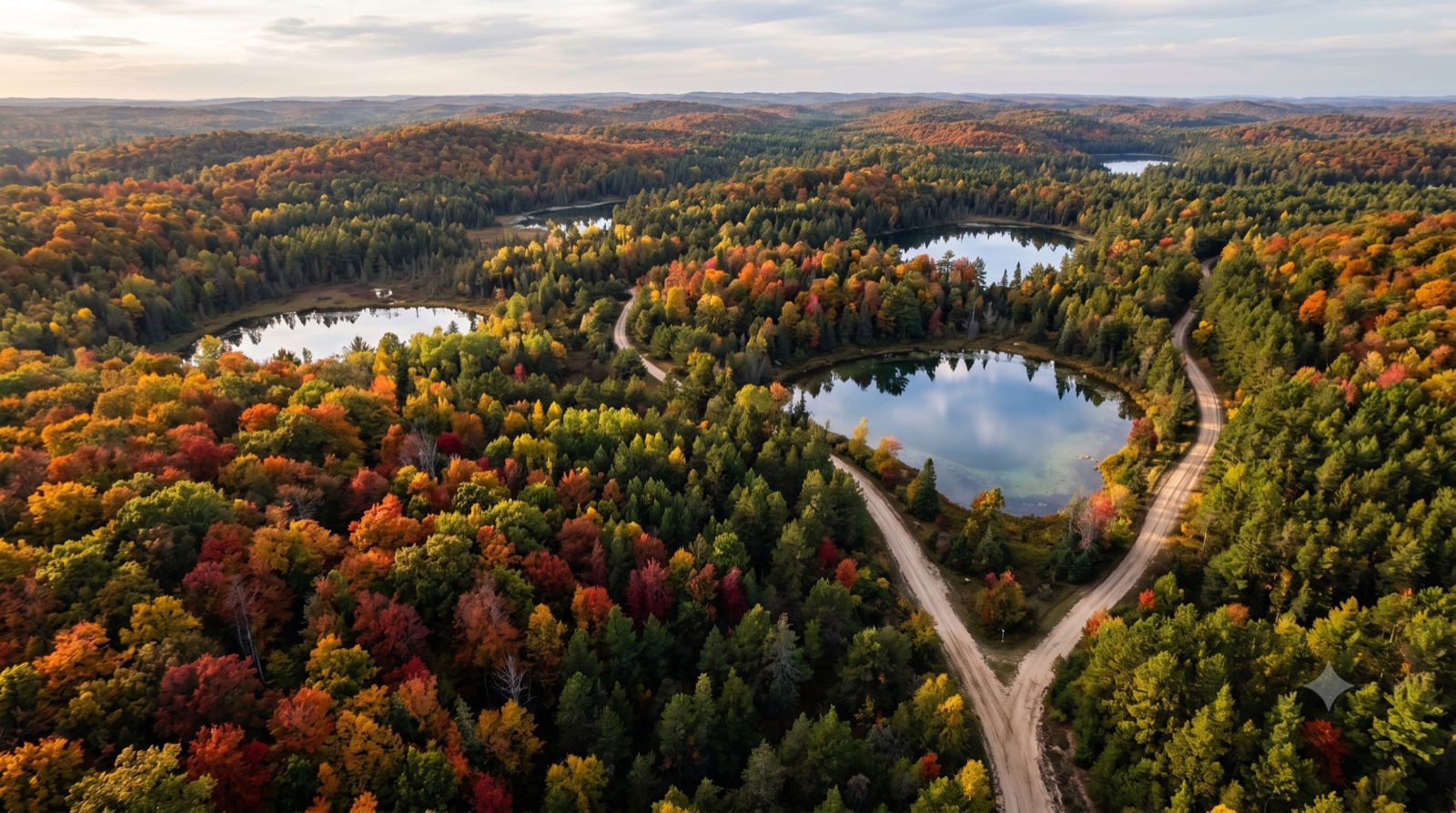
The process is shaped by Michigan's combined state and county transfer tax of $8.60 per $1,000 of value, assessment at 50% of true cash value, the uncapping of taxable value on transfer, and a landscape where a large share of the county sits inside the Manistee National Forest. The county covers roughly 810 to 840 square miles depending on the source, holds more than 230 natural lakes and over 350 miles of rivers and streams, and is anchored by the Muskegon River and the Croton, Hardy, and Newaygo dams. White Cloud is the county seat; Fremont is the largest city.
This guide covers Michigan's assessment and uncapping mechanics, the state's forest and farmland tax programs and how their covenants affect a sale, how Newaygo compares to its neighbors, and practical steps for selling. For a complete overview of the statewide process, start with our guide on how to sell land in Michigan. For a broader look at land articles across the region, explore our blog.
What Are the Tax Costs of Holding Land in Newaygo County?
Michigan assesses property at 50% of true cash value. The local assessor sets State Equalized Value (SEV), which represents approximately half of market value, according to the Michigan State Tax Commission's Transfer of Ownership Guidelines. Your annual bill is driven by taxable value and the local millage — and taxable value is where Michigan gets unusual.
Tax-Rates.org estimates Newaygo County's median effective property tax rate at approximately 1.30%, which would make it the highest among its rural neighbors. Treat the underlying dollar figures with caution: that estimate is anchored to a median home value well below current levels (Data USA puts the county's median property value at approximately $186,700), so the implied median bill is stale. For an actual number on your parcel, use the Michigan Department of Treasury's property tax estimator with your local millage rather than relying on any aggregator.
Uncapping: Why the Seller's Tax Bill Doesn't Predict the Buyer's
This is the single most important tax mechanic in a Michigan land sale, and it routinely derails deals mid-diligence.
While one owner holds a property, annual growth in taxable value is capped at the lesser of 5% or the rate of inflation, under Michigan's Proposal A. Over a long hold, taxable value drifts far below SEV — a family that has owned a tract for thirty years may pay a fraction of what the land's actual value implies. Then, according to the Michigan Department of Treasury, a transfer of ownership uncaps it: in the year following the transfer, the cap comes off and taxable value resets to 50% of true cash value.
The practical consequence: your buyer's tax bill can jump sharply relative to what you have been paying. Quoting your own annual bill to a prospective buyer is not just unhelpful, it can blow up the deal when they discover the reset. Partial transfers cause partial uncapping — conveying a 50% undivided interest triggers a 50% uncapping the following year. Certain family transfers are exempt from uncapping; confirm your specific situation with the local assessor or a Michigan real estate professional, since the exemption list is specific and getting it wrong is expensive.
The Forest and Farmland Programs — and Their Covenants
Michigan offers three programs that reduce carrying costs and materially change who will buy your land.
The Qualified Forest Program (QFP), administered by MDARD, requires 20 to 39 contiguous acres with at least 80% productive forestland, or 40+ acres with at least 50% productive forestland, plus an approved forest management plan, according to MSU Extension. Enrollment exempts the property from up to 18 mills of school operating tax and carries an annual fee equal to 2 mills. Two features matter for a sale: QFP does not require public access, and its Taxable Value Affidavit can keep the previous owner's taxable value from uncapping on transfer — a genuinely unusual benefit that makes an enrolled forest tract easier to sell than an identical unenrolled one. Withdrawal triggers a recapture tax, and the amount is larger if no timber harvest occurred during enrollment.
The Commercial Forest (CF) program, administered by the Michigan DNR, taxes enrolled land at a specific tax of $1.30 per acre — but requires public foot access for hunting and fishing. That is the trade-off, and it is decisive for recreational buyers: an enrolled tract cannot be posted against public hunters. A buyer who wants privacy must withdraw and pay a penalty, on top of a withdrawal application fee of $1.00 per acre with a $200 minimum and $1,000 maximum. Whether your parcel is CF-enrolled changes your buyer pool, not just your tax bill.
PA 116 (the Farmland Development Rights Agreement, administered by MDARD) covers farms of 40+ acres with at least 51% in agricultural use, 5 to 39 acres with at least 51% agricultural use plus gross income of at least $200 per acre of cleared tillable land, or an MDARD-designated specialty farm of at least 15 acres with at least $2,000 in annual gross income. The critical point for sellers: early termination requires repaying the last seven years of tax credits plus 6% simple interest (except on death or disability), and the lien must be repaid when the land is sold, according to MDARD. A PA 116 agreement is an encumbrance that follows the parcel to the closing table.
If your parcel carries delinquent taxes, our guide on selling land with back taxes explains how that affects a sale. If you're carrying a tract with ongoing costs and no near-term plan, it may be worth requesting a no-obligation cash offer.
What Zoning and Closing Rules Apply to Newaygo County Land?
Land use in rural Newaygo County is administered at the township level, with municipal ordinances applying inside incorporated cities including White Cloud, Fremont, and Newaygo. Outside those boundaries, expect township zoning, deed restrictions, health department requirements for on-site septic, and floodplain rules along the Muskegon River and the impoundments. Parcels inside or adjacent to the Manistee National Forest raise access, easement, and boundary questions that deserve attention before you market the land. Verify requirements for a specific parcel with the township and county rather than relying on general guidance.
Michigan's Title-Company Closing Process
Michigan does not require an attorney at closing. Title companies are authorized to handle closings and escrow, holding earnest money and closing funds and issuing the owner's policy. That makes Michigan closings simpler and generally faster than in attorney states like Alabama or Georgia.
A typical Michigan land closing runs:
- Purchase agreement: Buyer and seller agree in writing
- Title commitment: The title company searches the record and issues a commitment identifying liens, encumbrances, and easements — including any CF, QFP, or PA 116 enrollment
- Closing and escrow: The title company handles signing, prorations, and disbursement
- Transfer tax: State and county transfer taxes are collected at closing
- Recording: The deed is recorded with the Newaygo County Register of Deeds (Stewart K. Sanders, 1087 Newell St., White Cloud, MI 49349; mailing P.O. Box 885; 231-689-7246). Documents are registered until 4:00 PM
Michigan's State Real Estate Transfer Tax is $3.75 per $500 of value (or fraction thereof), and the county transfer tax is $0.55 per $500 — a combined $4.30 per $500, or $8.60 per $1,000. The tax applies to transfers valued at $100 or more and is computed per $500 or fraction thereof, so it rounds up. In Michigan the seller almost always pays the transfer tax, unlike the buyer-pays convention common in the Southeast. On a $100,000 land sale, the combined transfer tax is roughly $860 — a meaningfully larger closing cost than Alabama's $100 or Georgia's $100 on the same price.
For a complete checklist of documents, see our guide to paperwork needed to sell land. If you live elsewhere, see selling land as an out-of-state owner.
How Does Newaygo County Compare to Neighboring Michigan Counties?
Newaygo is the largest and least-poor of its rural neighbors — and carries the highest effective property tax rate of the group. Median household income is approximately $63,304 and the poverty rate approximately 12.8%, slightly below Michigan's 13.2%, according to Census Reporter. Homeownership runs about 86.5%, per Data USA.
| Factor | Newaygo County | Oceana County | Lake County | Mecosta County |
|---|---|---|---|---|
| Population (ACS 2024) | ~50,792 | ~26,915 | ~12,563 | ~41,242 |
| Population trend | Growing (+3.3% 2010–2020) | Roughly flat | Growing | Growing |
| Assessment basis | 50% of true cash value | 50% of TCV | 50% of TCV | 50% of TCV |
| Effective tax rate | ~1.30% | ~1.16% | ~1.05% | ~1.13% |
| County seat | White Cloud | Hart | Baldwin | Big Rapids |
| Dominant land use | Dairy and livestock, forest, lake recreation | Asparagus and fruit belt | National forest, lakes | Farmland, lakes, university town |
| Key selling challenge | Public-land competition, uncapping, small fragmented tracts | Specialized ag buyer pool | Thinnest local buyer pool | Student-inflated demographics |
Effective rates are Tax-Rates.org estimates, used consistently across the four counties so the comparison holds internally; they carry the same stale-value caveat noted above. Manufacturing is the county's dominant employment sector at approximately 4,730 workers, followed by retail trade and health care, per Data USA. Major employers include Gerber Products in Fremont, Magna Mirrors, and Corewell Health Gerber Hospital — though published sources disagree on which is largest, so treat any ranking with skepticism.
A Growing County With a Slow Land Market
This is the part worth understanding, because it contradicts the usual rural-Michigan story. Newaygo's population is up, not down. So why is land slow to move?
Public land competes with your parcel — for free. A large share of the county lies within the Manistee National Forest. A buyer who wants to hunt, fish, or camp does not have to buy anything; hundreds of thousands of acres are already open to them. Private recreational tracts here compete against free access, which is a very different problem than a shrinking population.
The tracts are small and fragmented. The 2022 USDA Census of Agriculture profile (cp26123) shows 795 farms averaging just 146 acres, with 45% of farms in the 10-to-49-acre range and 41% reporting under $2,500 in annual sales. This is a county of small hobby, recreational, and lifestyle parcels, not consolidated commercial ground — which means a thin, idiosyncratic buyer pool for any given parcel rather than a deep bench of operators.
Agriculture is intensifying onto less land. Land in farms fell 15% since 2017 while the market value of products sold rose 49% to $190.7 million. Newaygo is a livestock county — 59% of sales are livestock and products, led by milk at $86.4 million (10th in Michigan) and cattle at $22.5 million (11th), with strong vegetable and fruit production as well. Marginal acreage is leaving agriculture and looking for a non-agricultural buyer, and those buyers are seasonal and often from outside the county.
Uncapping and covenants add friction at exactly the wrong moment. A long-held tract's taxable value resets on transfer; a CF-enrolled tract must stay open to public hunters; a PA 116 lien has to be repaid at closing. Each of these surfaces during diligence, after a buyer is emotionally committed but before they are contractually bound — which is when deals die.
If your property is a recreational tract, our guide on selling hunting land covers what buyers in markets like this look for. For wooded parcels, see selling timberland; for working ground, selling farmland. If access is the issue, see selling landlocked land. For how land values get established, see how much your land is worth.
What Are Your Options for Selling Land in Newaygo County?
Newaygo County landowners are in an unusual position: the county is growing, but the land market is still slow, because the friction is structural rather than demographic. Understanding that is the difference between pricing your expectations correctly and wondering what is wrong with your parcel.
Before selling, verify your legal description and check for liens through the Newaygo County Register of Deeds (Stewart K. Sanders, 1087 Newell St., White Cloud, MI 49349; 231-689-7246); independent record searches are available 9:00 AM to 4:00 PM Tuesday through Thursday. Confirm your tax standing and any delinquency with the County Treasurer (Jason O'Connell, 1087 Newell St., White Cloud, MI 49349; 231-689-7230), and assessment questions with the Newaygo County Equalization Department (1087 Newell St., White Cloud, MI 49349; 231-689-7244). All three share the same building. Most importantly, determine whether your parcel is enrolled in Commercial Forest, the Qualified Forest Program, or PA 116 before you list — enrollment status changes both your buyer pool and your closing math, and it is the most commonly overlooked item on a Newaygo tract.
Newaygo landowners have several paths. Listing with an agent who specializes in west Michigan recreational and lake property gives the broadest exposure to the seasonal and Grand Rapids-area buyers who make up much of the demand, though commissions of roughly 5% to 6% plus closing costs reduce net proceeds and marketing periods run long. Whether you need an agent depends on your parcel and timeline; our guide on whether you need a realtor to sell land walks through the trade-offs. Online platforms like LandWatch and Land And Farm reach land buyers directly. For landowners who want to avoid extended marketing timelines and ongoing carrying costs, companies like Jerez Land provide direct cash offers priced individually to the parcel — no commissions, no listing fees, and a firm written number, with the buyer absorbing carrying costs, marketing expense, and resale risk. Request a cash offer to see what your parcel qualifies for.
Frequently Asked Questions
I'm selling vacant land in Newaygo County MI — where do I start?
Start by verifying your legal description and checking for liens through the Newaygo County Register of Deeds in White Cloud, and confirm your tax standing with the County Treasurer. Then determine whether the parcel is enrolled in Commercial Forest, the Qualified Forest Program, or PA 116, because each carries covenant or lien obligations that must be resolved or assigned at closing. Michigan does not require an attorney — a title company handles the closing and escrow. From there you can list with an agent who specializes in west Michigan recreational property, use online land platforms, or request a direct cash offer.
I inherited a hunting parcel in Newaygo County and live downstate — will the property taxes jump when it transfers to me?
Possibly, and it is worth checking before you make plans. Michigan caps annual growth in taxable value at the lesser of 5% or inflation while one owner holds the property, so a long-held parcel's taxable value drifts far below its State Equalized Value. A transfer of ownership uncaps it, and taxable value resets to 50% of true cash value in the following year — which can mean a sharp increase over what the previous owner paid. Certain family transfers are exempt from uncapping, so confirm your specific situation with the local assessor. If the parcel is in the Qualified Forest Program, its Taxable Value Affidavit can prevent the uncapping entirely.
My Newaygo County land is in the Commercial Forest program — can I stop people from hunting on it?
No, not while it stays enrolled. The Michigan DNR's Commercial Forest program taxes enrolled land at a specific tax of $1.30 per acre in exchange for required public foot access for hunting and fishing — an enrolled tract cannot be posted against public hunters. To gain privacy you must withdraw, which requires an application fee of $1.00 per acre (minimum $200, maximum $1,000) plus a withdrawal penalty. This matters when you sell: a recreational buyer who wants exclusive use will price in the cost and hassle of withdrawing, so enrollment status shapes who will buy your parcel and on what terms.
Does Michigan charge a transfer tax on land sales?
Yes, and it is higher than in much of the Southeast. Michigan's State Real Estate Transfer Tax is $3.75 per $500 of value or fraction thereof, and the county transfer tax is $0.55 per $500 — a combined $4.30 per $500, or $8.60 per $1,000. The tax applies to transfers valued at $100 or more and rounds up to the next $500. In Michigan the seller almost always pays. On a $100,000 land sale, the combined transfer tax is roughly $860.
Do I need an attorney to close a land sale in Michigan?
No. Michigan is a title-company state — attorneys are not required at closing. A title company searches the record, issues a title commitment and owner's policy, holds earnest money and closing funds in escrow, handles prorations and disbursement, and records the deed with the county Register of Deeds. For properties in this county, that is the Newaygo County Register of Deeds in White Cloud. Many sellers still consult an attorney on unusual title, covenant, or estate issues, but it is a choice rather than a requirement.
Newaygo County's population is growing — so why is my land taking so long to sell?
Because the friction here is structural rather than demographic. A large share of the county sits inside the Manistee National Forest, so recreational buyers can hunt and fish for free instead of buying. The parcels are small and fragmented — the 2022 USDA Census of Agriculture counts 795 farms averaging just 146 acres, with 45% in the 10-to-49-acre range and 41% reporting under $2,500 in annual sales — which means a thin, idiosyncratic buyer pool for any given tract. Michigan's uncapping of taxable value on transfer, Commercial Forest public-access requirements, and PA 116 liens all surface during diligence and stall deals. Long marketing periods here are normal and are not a sign that something is wrong with your parcel.
Disclaimer: This article is for informational purposes only and does not constitute legal, financial, or professional advice. Laws and regulations vary by jurisdiction and change over time. Always consult with qualified professionals before making land purchase decisions. Jerez Land is not responsible for actions taken based on this information.