
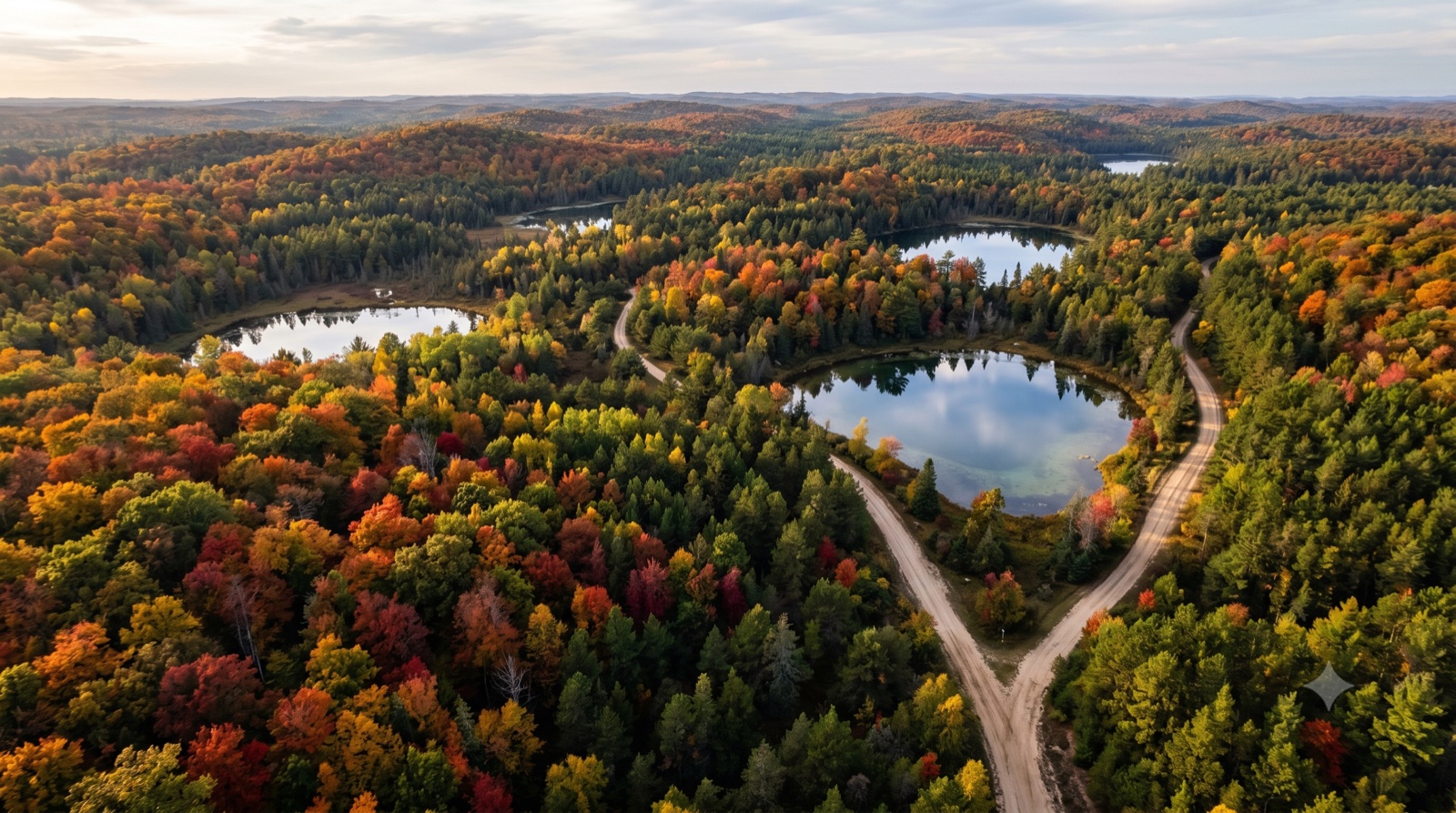
Sell My Land in Mackinac County MI - What Landowners Need to Know
Key Takeaways
- Roughly 54% of Mackinac County is state and federal land, including about 135,000 acres of federal forest, according to Mackinac County's own government website — private acreage in this county is genuinely scarce, which is the single most distinctive fact about its land market
- Michigan transfer tax is seller-paid at $3.75 per $500 state plus $0.55 per $500 county — a combined $4.30 per $500, or about 0.86% of the sale price, which the seller funds at closing
- Only about 2.9% of Mackinac County's land area is "land in farms" — 19,050 acres across 88 farms, per the USDA 2022 Census of Agriculture (cp26097) — meaning nearly all of the county's private land base is forest, shoreline, and recreational tracts that never appear in agricultural statistics at all
How Can You Sell Land in Mackinac County Michigan?
Selling land in Mackinac County, Michigan means working inside a county where roughly 54% of the ground is already publicly owned, 51% of the total area is water, and the private land that remains is mostly forest and shoreline held by seasonal and out-of-county owners. Practically, that means a title-company closing, a seller-paid transfer tax of $4.30 per $500, and a thin, seasonal buyer pool.
Mackinac County occupies the eastern end of Michigan's Upper Peninsula at the Straits of Mackinac, with St. Ignace as the county seat. The U.S. Census Bureau puts the county's total area at about 2,101 square miles — 1,022 square miles of land against 1,079 square miles of water. The county's own government website states a different figure, roughly 1,093 square miles or 691,000 acres, reflecting a different boundary and rounding convention. Both are published numbers; neither is a typo, and it is worth knowing they disagree before you compare any acreage claim you read elsewhere.
This guide covers Mackinac County's property tax mechanics, Michigan's title-company closing process, the forest and farmland programs that can trigger a recapture bill at sale, how the county compares to its Upper Peninsula neighbors, and your practical options for exiting a parcel. For the statewide picture, start with our Michigan land selling guide, or browse everything in our land selling library.
What Are the Tax Costs of Holding Land in Mackinac County?
Mackinac County's effective property tax rate on land falls somewhere between about 0.81% and 0.97% depending on which source you use, and the sub-area spread within the county is wider than that gap suggests. Tax-Rates.org reports the county collects an average of 0.97% of assessed fair market value with a median annual bill near $1,217. Ownwell reports a median effective rate of 0.81%.
Those two figures are not reconcilable by averaging them, and you should not try. They rest on different denominators and different vintages. What matters more for a landowner is the variation within the county: Ownwell's sub-area breakdown runs from roughly 0.75% in Hessel to 1.26% in Curtis, with St. Ignace near 0.86% and Mackinac Island near 1.11%. Where your parcel sits — which township, which school district — moves your bill more than the countywide average does.
Michigan's property tax system is also more layered than most states. Every parcel carries two relevant values: the State Equalized Value (SEV), which is roughly 50% of the assessor's estimate of true cash value, and the taxable value, which is the number millage rates are actually applied to.
Under Proposal A (1994), taxable value rises each year at the lesser of the Consumer Price Index or 5%, regardless of how fast market values move. That cap protects long-term owners. But when a property transfers, taxable value "uncaps" and resets to the parcel's SEV in the year following the sale, according to the Michigan Department of Treasury. On land that has been in the same family for thirty or forty years — extremely common along the Les Cheneaux shoreline and in the county's older platted tracts — that reset can raise the buyer's annual bill sharply. It is not a seller cost, but it is a real part of how a buyer prices your parcel, and an informed seller should expect it to come up.
Michigan Transfer Tax: The Seller Funds Both Levies
Michigan's real estate transfer tax is seller-paid at two levels:
- State transfer tax: $3.75 per $500 of sale price, or fraction thereof
- County transfer tax: $0.55 per $500 of sale price, or fraction thereof
- Combined: $4.30 per $500 — approximately 0.86% of the purchase price
On an $80,000 land sale, the combined transfer tax comes to $688. The tax generally applies when consideration is $100 or more. Certain transfers are exempt, including transfers between spouses and transfers where no money changes hands; the Michigan Department of Treasury publishes the full exemption list. Confirm your recording fees directly with the Register of Deeds — those are set locally and change more often than the transfer tax does.
If you are managing a Mackinac County parcel from downstate or out of state, our guide on selling land as an out-of-state owner covers the remote-closing logistics Michigan title companies handle as routine work.
What Closing Requirements and Land Programs Apply in Mackinac County?
Michigan does not require an attorney at a real estate closing, and Mackinac County land sales are handled by title companies as a matter of course. The title company runs the search, issues title insurance, prepares the warranty or limited warranty deed, collects the transfer tax, and records with the county Register of Deeds. Attorney involvement is optional but genuinely worth it where shoreline access rights, island parcels, timber rights, or a forest-program recapture are in play.
The Mackinac County Register of Deeds, Mary Jo Savard, is located in the Mackinac County Courthouse at 100 S. Marley, St. Ignace, MI 49781, phone (906) 643-7306.
The Mackinac County Treasurer, Tina Massey, is in the same building at 100 S. Marley, Room 30, St. Ignace, MI 49781, phone (906) 643-7318. Delinquent county property taxes are handled through this office.
The Mackinac County Equalization Department — which oversees county property assessment and can confirm your SEV and taxable value — is at 100 S. Marley, Room 120, in the Courthouse Annex, phone (906) 643-7310.
Michigan's Qualified Forest Program: Real Savings, Real Recapture
Michigan's Qualified Forest Program (QFP), administered by MDARD, is the program most likely to affect a Mackinac County land sale, because so much of the county's private acreage is productive forest.
QFP requires a minimum of 20 contiguous acres per tax parcel. Parcels between 20 and 39.9 acres must be at least 80% stocked with productive forest; parcels of 40 acres or more must be at least 50% stocked, according to MSU Extension. Enrolled owners receive an exemption from school operating millage and protection from taxable-value uncapping on qualifying transfers.
The recapture is where sellers get caught. When QFP land leaves the program, the repayment is calculated as the school operating millage minus 2 mills, multiplied by the taxable value at conversion, multiplied by the number of years the property was enrolled — and if no qualifying harvest ever occurred, that amount is doubled, per MSU Extension. On a parcel enrolled for a decade with no harvest, that is not a rounding error. Get the number from MDARD in writing before you sign anything.
Michigan's Commercial Forest (CF) program, administered by the DNR, works differently and carries its own exit cost: a withdrawal application fee of $1 per acre with a $200 minimum and $1,000 maximum, plus a withdrawal penalty calculated as acres withdrawn times the county valuation per acre times the average township millage rate times the years enrolled, capped at seven years, under MCL 324.51108. Commercial Forest land also carries a public access requirement for hunting and fishing that transfers with the land — buyers ask about this, so know your status.
For agricultural ground, PA 116 Farmland Development Rights Agreements run 10 to 90 years and cover parcels of 40+ acres with at least 51% active agricultural use, or 5 to 39.9 acres meeting an income test, per MDARD. Early termination outside of death or disability requires repaying the last seven years of tax credits plus 6% simple interest, and unpaid amounts become a lien recorded with the Register of Deeds.
If your parcel is primarily wooded, our guide on selling timberland covers what buyers actually evaluate.
Zoning and Land Use
Mackinac County's townships administer their own zoning, and rural land is generally zoned forest-recreational, agricultural, or rural residential, with recreational and forestry uses broadly permitted. Shoreline parcels along Lake Huron and Lake Michigan carry additional setback and shoreline protection rules, and older recorded plats frequently carry restrictions that survive a sale. Island parcels — including those in the Les Cheneaux group and on Mackinac Island itself — carry access, utility, and permitting constraints that have no equivalent on mainland ground.
If your parcel is one lot inside a recorded subdivision plat, our guide on selling an HOA or subdivision lot explains how plat restrictions and association dues factor into a closing.
How Does Mackinac County Compare to Neighboring Michigan Counties?
Mackinac County's population is best described as roughly flat, and the current estimates genuinely disagree. The 2020 Census counted 10,834 residents. The Census Bureau's 2024 vintage estimate puts the county at about 11,144, an increase; USAFacts reports about 10,740 for 2024, a slight decline. Both are published estimates from the same underlying program family at different vintages. The honest read is a small, aging county that is not booming and not collapsing.
| Factor | Mackinac County | Chippewa County | Luce County | Schoolcraft County |
|---|---|---|---|---|
| Population | 10,834 (2020); 10,740–11,144 (2024 est., sources differ) | ~36,300 (2024 est.) | 5,339 (2020) | 8,047 (2020) |
| Effective tax rate | 0.81%–0.97% (sources differ) | 0.52%–1.29% (sources differ) | 0.86%–0.98% | 0.45%–1.01% (sources differ) |
| County seat | St. Ignace | Sault Ste. Marie | Newberry | Manistique |
| Defining land feature | 54% public land; 51% water; Straits shoreline and Les Cheneaux Islands | Largest UP county by area; shares Hiawatha National Forest | Very high public-land share; Tahquamenon Falls and Muskallonge Lake State Parks | Seney National Wildlife Refuge (95,212 acres) dominates the interior |
| Market character | Thin, seasonal, waterfront-driven | Largest regional employment base | Smallest population in the group | Lake Michigan frontage at Manistique |
Note the tax-rate ranges: for three of these four counties, Ownwell and Tax-Rates.org disagree by a factor of two or more. That is a genuine limitation of countywide effective-rate estimates in rural Michigan, where taxable value and market value drift far apart on long-held parcels. Treat the table as directional and confirm your own parcel with the Equalization Department.
The Public Land Factor and Who Actually Buys Here
The 54% public-land share is the fact that shapes everything else about this market. It cuts two ways for a seller. Scarcity of private ground, especially private ground with water frontage, is real and supports demand. But adjacency to state and federal land also means many buyers can access the recreation they want without buying anything, and it means large blocks of the county will never come to market to create comparable sales.
The USDA 2022 Census of Agriculture (cp26097) confirms how little of this county is farmed: 88 farms working 19,050 acres, averaging 216 acres each, with total agricultural sales of about $5.87 million — 76% livestock, 24% crops, with cattle and calves at roughly $843,000 and forage the dominant crop at 6,324 acres. Land in farms fell about 24% since 2017. Against a land base of roughly 654,000 to 691,000 acres, farm ground is under 3% of the county. Nearly all of Mackinac County's private land is forest, shoreline, and recreational tract that never shows up in agricultural data at all.
The buyer pool reflects that. Mackinac Island sits within the county, as does the Les Cheneaux archipelago — 36 islands along roughly 12 miles of Lake Huron shoreline around Cedarville and Hessel, a long-established boating and second-home destination. The Michigan DNR maintains a county snowmobile trail system, and Hiawatha National Forest's 12,230-acre Mackinac Wilderness lies within the county. Demand for recreational and waterfront-adjacent land is real but strongly seasonal, and much of it originates downstate or out of state rather than locally.
Absentee owners consistently underestimate what holding costs over a decade: annual taxes, liability exposure, plat-association dues where they apply, and the slow erosion of title clarity as a parcel passes between generations without a survey or a clean deed. For help understanding what drives value here, see how much is my land worth, and if you are weighing whether to involve an agent at all, see do you need a realtor to sell land.
What Are Your Options for Selling Land in Mackinac County?
The most common Mackinac County seller is an out-of-state or downstate owner who bought or inherited a wooded or shoreline-adjacent parcel decades ago, has not used it in years, and is now weighing whether the annual carrying cost still makes sense. The usual signals apply: you could not confidently walk someone to the property line, the tax bill arrives and you resent it, you inherited the parcel alongside siblings who all live elsewhere, or a plat association keeps mailing dues notices for land nobody visits.
Before accepting any offer, do four things. Confirm your SEV and taxable value with the Equalization Department at (906) 643-7310. Verify your deed and title through the Register of Deeds at (906) 643-7306. Check for delinquent taxes with the Treasurer at (906) 643-7318 — Michigan's tax-forfeiture timeline moves faster than most states once a parcel falls behind. And if the parcel is enrolled in QFP, Commercial Forest, or PA 116, get the recapture or withdrawal figure in writing from MDARD or the DNR before you agree to a price, because that number changes what the deal is actually worth to you.
From there, sellers have real choices. Listing with a Michigan land specialist or recreational property broker reaches downstate buyers through platforms like LandSearch and Lands of America — but demand here is seasonal, commissions apply, and a remote owner can wait a long time for the right buyer in a county this small. For landowners who want a specific number in hand without riding out a seasonal demand cycle, Jerez Land provides a direct, parcel-specific written cash offer for your land. We buy for cash and absorb the carrying costs, marketing expense, and resale risk ourselves, so our offer reflects the certainty and speed we provide rather than a retail listing price. No agent commissions, no listing period, and a closing timeline driven by when title is clear.
Frequently Asked Questions
I inherited a wooded parcel in Mackinac County and I live downstate — can I sell it without traveling up there?
Yes. Michigan does not require an attorney or the seller's physical presence at closing, and Mackinac County land sales are handled by title companies that close remotely as routine work. You can sign with a mobile notary or through remote online notarization where the title company permits it, and funds are wired. Start by confirming your deed and title through the Mackinac County Register of Deeds at (906) 643-7306, and check for delinquent taxes with the Treasurer at (906) 643-7318.
My Mackinac County land is enrolled in the Qualified Forest Program — what happens when I sell?
A recapture bill may come due. Michigan's Qualified Forest Program requires 20 contiguous acres minimum and exempts enrolled owners from school operating millage. When the land leaves the program, repayment equals the school operating millage minus 2 mills, times the taxable value at conversion, times the years enrolled — and that amount is doubled if no qualifying harvest ever occurred, according to MSU Extension. On a long-enrolled parcel this can be substantial. Get the figure in writing from MDARD before agreeing to a price, and address who pays it in the purchase agreement.
I'm selling my Mackinac County land for $80,000 — what transfer tax will I owe?
You will owe $688. Michigan charges two seller-paid transfer taxes: $3.75 per $500 of sale price at the state level and $0.55 per $500 at the county level, totaling $4.30 per $500, or about 0.86% of the price. The tax generally applies when consideration is $100 or more. Certain transfers are exempt, including those between spouses and those where no money changes hands. The tax is paid at closing and recorded with the deed at the Mackinac County Register of Deeds.
Is an attorney required to close a land sale in Michigan?
No. Michigan does not require a licensed attorney at a real estate closing. Title companies conduct the title search, issue title insurance, prepare the deed, collect the transfer tax, and record with the county Register of Deeds. Attorney involvement is optional but advisable for transactions involving Qualified Forest Program or Commercial Forest recapture, shoreline and riparian access rights, island parcels, timber rights, or a complicated ownership history.
Why would the property tax bill on my Mackinac County land jump after I sell it?
Because Michigan's taxable value uncaps on transfer. Under Proposal A (1994), taxable value rises annually at the lesser of CPI or 5% while you own the property, but when the parcel sells, taxable value resets to the State Equalized Value in the following year, per the Michigan Department of Treasury. On land held in one family for decades, taxable value can sit far below SEV, so the buyer's first full-year bill can be much higher than yours ever was. It is a buyer cost rather than a seller cost, but it affects what buyers will offer.
Is Mackinac County's population growing or declining?
It is roughly flat, and the current estimates disagree. The 2020 Census counted 10,834 residents. The Census Bureau's 2024 vintage estimate puts the county near 11,144, while USAFacts reports about 10,740 for 2024. Rather than a clear trend, the picture is a small, aging, seasonally driven county. A large share of land is held by absentee and out-of-county owners, which produces a steady stream of estate-driven and carrying-cost-fatigue sales regardless of the headline population number.
Disclaimer: This article is for informational purposes only and does not constitute legal, financial, or professional advice. Laws and regulations vary by jurisdiction and change over time. Always consult with qualified professionals before making land purchase decisions. Jerez Land is not responsible for actions taken based on this information.