
Sell My Land in Prentiss County MS - What Landowners Need to Know
Key Takeaways
- Mississippi charges $0.00 in state deed transfer tax: Prentiss County sellers pay no state-level transfer tax at closing, though Mississippi law requires a licensed attorney to examine title and handle the closing
- Vacant land is assessed at 15% of true value, not 10%: Mississippi's Class II ratio applies to vacant land, timber tracts, and all non-owner-occupied property — 50% higher than the 10% ratio for owner-occupied homes, according to Mississippi State University Extension
- Prentiss County's farm base is consolidating, not shrinking: Farm count fell 10% between 2017 and 2022 while land in farms rose 17% and average farm size jumped 30% to 290 acres, per the USDA 2022 Census of Agriculture — fewer operators working more ground, which narrows the pool of local buyers for an ordinary tract
How Can You Sell Land in Prentiss County Mississippi?
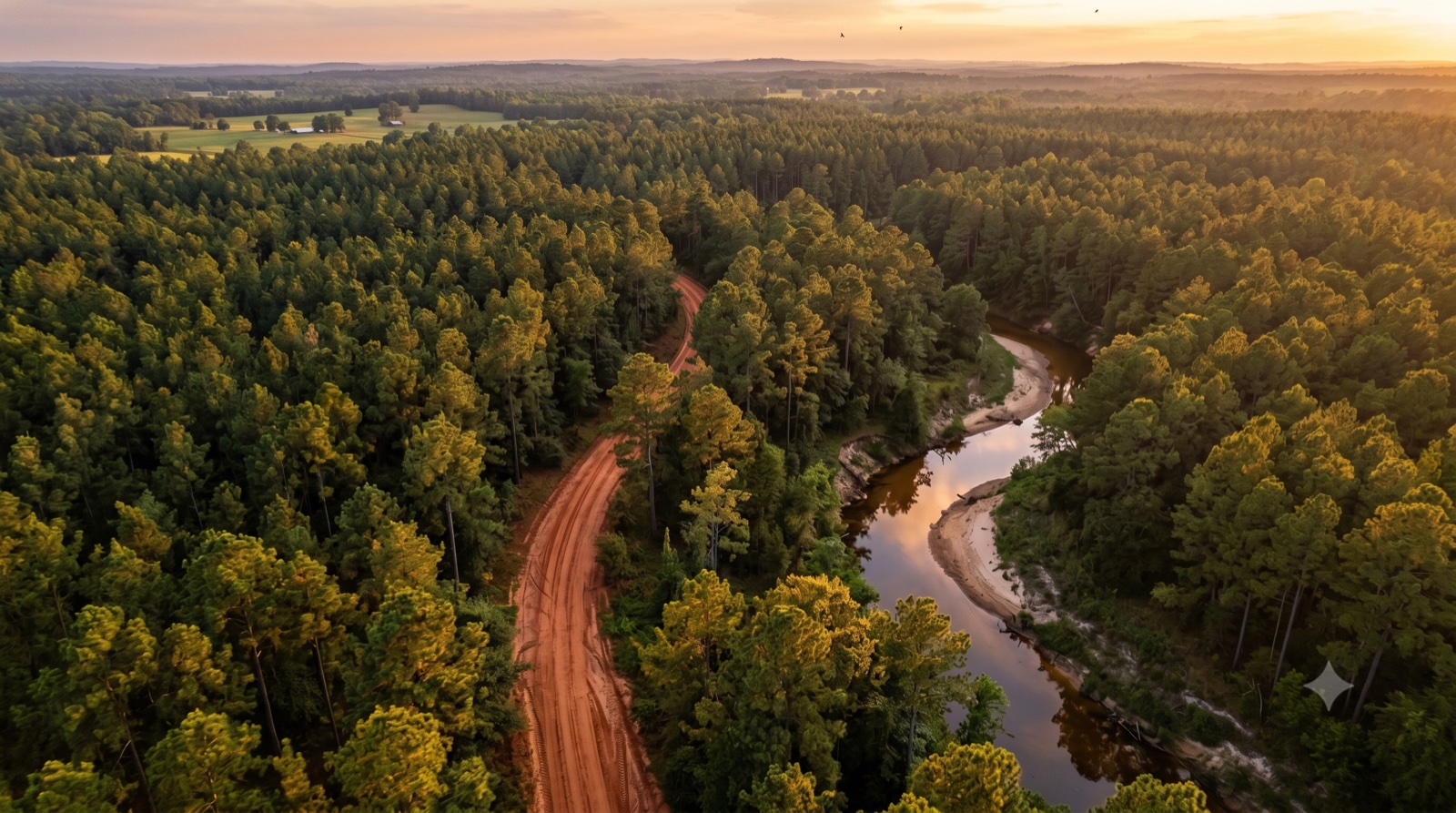
You can sell land in Prentiss County through Mississippi's attorney-required closing process, with no state transfer tax and deeds recorded at the Chancery Clerk in Booneville — the two factors most likely to complicate your sale are the 15% vacant-land assessment ratio and, for parcels along the Natchez Trace Parkway, a federally enforced scenic easement that restricts what can be built or cut. Prentiss County covers 415 square miles of northeast Mississippi hill country, with Booneville as the county seat and roughly 60 people per square mile across the county as a whole.
Prentiss County borders Alcorn County to the north, Tishomingo County to the east, Itawamba County to the southeast, Lee County to the southwest, Union County to the west, and Tippah County to the northwest. US Highway 45 and Mississippi Highways 4, 30, and 145 carry traffic through the county, and Northeast Mississippi Community College anchors Booneville.
This guide covers the tax costs of holding vacant land in Prentiss County, the Natchez Trace scenic easement question that catches sellers by surprise, Mississippi's attorney-required closing process, how the county compares to its neighbors, and your practical options for selling.
What Are the Tax Costs of Holding Land in Prentiss County?
Mississippi taxes vacant land at a higher assessment ratio than owner-occupied housing. Class II property — which covers agricultural land, rental property, business property, and most vacant parcels — is assessed at 15% of true value, while owner-occupied residential property is assessed at 10%, according to Mississippi State University Extension. A vacant tract therefore carries a structurally heavier assessment than a neighboring house of equivalent value, every year, whether or not the land produces a dollar of income.
Prentiss County's specific millage rate is set annually by the county, the school district, and any municipal or special taxing districts. We do not publish a county millage or effective-rate figure here, because no current figure traceable to the county or the Mississippi Department of Revenue could be confirmed — undated third-party "county average" tax rates circulate widely online and are frequently stale. For the rate that actually applies to your parcel, call the county tax office directly using the contact information further down this page.
How the Tax Bill Compounds on Non-Productive Land
The annual obligation is the point. Land that generates no rent, no timber revenue, and no crop lease payment produces a bill that repeats every single year, and that bill is pure carrying cost. For absentee owners — someone who inherited a tract near Booneville and now lives three states away — those payments quietly erode whatever the land represents, and notices mailed to an outdated address are easy to miss entirely.
Mississippi taxes attach on January 1 each year, and delinquent parcels are offered at tax sale on the last Monday in August. Owners who fail to redeem within two years of the tax sale risk losing the property outright. If your parcel has fallen behind, our guide on how to sell land with back taxes explains how that gets resolved inside a sale.
Mississippi Use-Value Assessment and the Reforestation Tax Credit
Mississippi allows qualifying agricultural land to be assessed on its use value rather than market value. If land is in commercial agricultural production, the owner may apply through the county tax assessor to have it valued using a capitalized-income approach under Mississippi Code § 27-35-50, with the 15% Class II ratio then applied to that use value. This is a tax-assessment mechanism, not a market valuation, and enrollment is not automatic — it requires an application at the county level.
Mississippi also offers a Reforestation Tax Credit equal to 50% of approved reforestation costs, including site preparation, seedlings, and planting labor, with a lifetime cap of $75,000 per taxpayer, according to the Mississippi Forestry Commission. Landowners must be non-industrial private forest owners working from a plan prepared by a Registered Forester. Standing timber in Mississippi is not subject to ad valorem tax until harvest, at which point a severance tax applies. With 39,868 acres of woodland counted inside Prentiss County farms alone in the 2022 Census of Agriculture, these provisions reach a meaningful share of the county's rural acreage. If your tract carries planted pine or natural hardwood, see our guide on how to sell timberland.
What Closing Requirements and Land-Use Rules Apply in Prentiss County?
Mississippi is an attorney-state for real estate closings, and a licensed Mississippi attorney must examine and certify title before a land sale can close, per The Mississippi Bar. That requirement holds whether you list with an agent, sell to a neighbor, or sell to a direct buyer.
The closing sequence runs:
- Title search: The attorney searches land records filed with the Prentiss County Chancery Clerk for liens, easements, judgments, and encumbrances
- Title certification and insurance: The attorney certifies marketable title; title insurance may be issued against defects the search did not surface
- Closing: The parties execute the deed, seller's affidavits, and settlement statement
- Recording: The deed is recorded with the Prentiss County Chancery Clerk
The Prentiss County Chancery Clerk, David "Bubba" Pounds, maintains the county's land and deed records at 100 North Main Street (mailing: PO Box 477), Booneville, MS 38829, phone 662-728-8151. The Prentiss County Tax Collector, Homer "Rusty" Cole Jr., can be reached at PO Box 283, Booneville, MS 38829, phone 662-728-5044. Prentiss County maintains a separate Tax Assessor's office; because no contact number for it could be confirmed on the county's own website, ask the Chancery Clerk or Tax Collector to route you rather than relying on a third-party directory listing.
Mississippi's $0.00 state transfer tax keeps closing costs comparatively low against states that levy a deed or documentary tax.
The Natchez Trace Parkway Scenic Easement — The Local Complication Sellers Miss
The Natchez Trace Parkway runs through Prentiss County, and it is a National Park Service unit rather than an ordinary state highway. To protect the Parkway's viewshed, Mississippi, Alabama, and Tennessee purchased scenic easements from adjoining landowners and transferred those rights to the federal government; roughly 3,000 private and commercial neighbors share the Parkway boundary across the three states, according to the National Park Service.
Where a parcel is encumbered by one of those easements, the NPS-published restrictions are real and enforceable:
- Buildings may be erected only for farm or residential purposes, and only with prior Parkway approval — commercial and industrial structures are not permitted
- Mature trees and shrubs may not be removed without Parkway consent, which the NPS identifies as the most commonly violated provision
- No dumps, trash, or unsightly material
- Signage is limited to a single 18" × 24" sign advertising the property or products sold on it
One critical qualification: these restrictions attach to land where a scenic easement was actually purchased, not automatically to every parcel that happens to sit near the Parkway corridor. Whether your specific tract carries one is a question for the title search and the Chancery Clerk's records — and it is exactly the sort of encumbrance that surfaces late and derails an unprepared sale. We have deliberately not repeated the widely circulated claim that adjoining owners are barred from direct driveway access onto the Parkway, because the NPS's own published scenic-easement material does not state it.
Outside the Parkway corridor, most Prentiss County land beyond municipal limits is lightly regulated, and agricultural and timber uses generally proceed without county use permits. Manufactured-home placement, subdivision, or commercial development warrants a direct call to county government in Booneville. If your land came to you through an estate, our guide on selling inherited land with multiple heirs covers Mississippi's Chancery Court process.
How Does Prentiss County Compare to Neighboring Mississippi Counties?
Prentiss County recorded 25,008 residents in the 2020 Census, and recent estimates have held essentially flat rather than declining — a meaningful distinction from much of rural north Mississippi. What is changing is not the number of people but the structure of the farm economy, and that is what actually governs who might buy your land.
| Factor | Prentiss County | Alcorn County | Union County | Tippah County |
|---|---|---|---|---|
| Population (2020 Census) | 25,008 | 34,740 | 27,777 | 21,815 |
| Land area | 415 sq mi | 400 sq mi | 416 sq mi | 458 sq mi |
| County seat | Booneville | Corinth | New Albany | Ripley |
| Position | Center of the group | North, on the TN line | West | Northwest |
| Land character | Soybean and cotton ground, pine and hardwood uplands | Hill country, Corinth regional center | Hill country, manufacturing base | Hill-country timber and pasture |
| Local anchor | Northeast Mississippi Community College | Regional retail and health care | Furniture manufacturing | Small-farm and timber economy |
Alcorn County to the north is the largest of the group and the smallest by land area in the state, with Corinth serving as the regional retail and medical center. Tippah County to the northwest shares Prentiss's hill-country timber and pasture profile in a thinner market — see our guide to selling land in Tippah County, MS. Union County to the west carries a genuine manufacturing employment base around New Albany.
Consolidation Is What Thins the Buyer Pool Here
The USDA 2022 Census of Agriculture tells a clear story about Prentiss County. The county reported 439 farms working 127,115 acres, with an average farm size of 290 acres. Compared to 2017, farm count fell 10% while land in farms rose 17% and average farm size climbed 30%. The total market value of agricultural products sold reached $31.57 million, up 49%, with crops accounting for 69% of sales and livestock and poultry the remaining 31%.
Read that together and the pattern is consolidation, not decline. Soybeans lead by a wide margin at 35,115 acres, followed by forage at 6,128 acres, cotton at 5,982 acres, and corn for grain at 4,218 acres, alongside a cattle inventory of 16,594 head. Land in farms is split roughly 59,170 acres of cropland, 20,369 acres of pastureland, and 39,868 acres of woodland.
For a seller, that matters more than the population line. When the number of operators falls while acreage rises, the remaining buyers are larger, fewer, and more selective — they are expanding operations looking for ground that fits an existing footprint, not first-time buyers looking for a homesite. A 20-acre parcel of mixed pine and pasture that does not adjoin an active operation can sit a long time in a county whose agricultural economy is growing in dollars while shrinking in headcount. If your tract is row-crop ground, see our farmland selling guide; for a statewide view of the process, see how to sell land in Mississippi, and for county-level analysis across the state, explore our blog.
What Are Your Options for Selling Land in Prentiss County?
Prentiss County landowners face a specific version of the rural land problem: a stable population that nonetheless offers a narrowing set of realistic buyers, a 15% assessment ratio on unproductive acreage, and — for tracts near the Natchez Trace — a federal encumbrance that has to be identified before anyone can price the parcel honestly.
Before listing or accepting any offer, verify your property records through the Prentiss County Chancery Clerk at 662-728-8151 (100 North Main Street, Booneville). Confirm your tax status with the Prentiss County Tax Collector at 662-728-5044. Ask specifically whether a Natchez Trace Parkway scenic easement appears in your chain of title — this is the single question most likely to change what your parcel can be used for. If the tract carries merchantable pine or hardwood, engage a Mississippi Registered Forester for a timber cruise, since standing timber value is not reflected in an assessed use value. And if you are unsure where to begin, see how much is my land worth.
Sellers have several paths. Listing with a Mississippi land-specialist agent exposes the property to recreational, timber, and farm-expansion buyers across northeast Mississippi. Online land platforms reach buyers looking specifically for rural acreage, though hill-country tracts can be slow to move. For landowners who want a firm written number without extended market exposure, Jerez Land provides a parcel-specific cash offer for your land. As a direct buyer we absorb the carrying costs, the marketing time, and the resale risk on a parcel that may wait a long while for the right operator — and the Mississippi attorney handles the closing exactly as state law requires.
If you live outside Mississippi, our guide on selling land as an out-of-state owner covers handling the sale remotely. If you are still weighing whether to involve an agent, see whether you need a realtor to sell land.
Frequently Asked Questions
I inherited land in Prentiss County and live out of state — can I sell it without coming back?
Yes, in most cases. Start by contacting the Prentiss County Chancery Clerk at 662-728-8151 to verify your deed and legal description, and the Prentiss County Tax Collector at 662-728-5044 to confirm your tax status. Mississippi requires a licensed attorney to examine title and handle the closing, and that attorney can typically coordinate remote signing through a notary in your home state. If the property passed through an estate with multiple heirs, the attorney will confirm that everyone with an interest signs the deed.
My land borders the Natchez Trace Parkway — does that restrict what I can do with it?
Only if your specific parcel carries a scenic easement. Mississippi, Alabama, and Tennessee purchased scenic easements from adjoining landowners along the Parkway and transferred those rights to the federal government to protect the viewshed. Where an easement exists, the National Park Service restricts buildings to farm or residential purposes with prior Parkway approval, prohibits removing mature trees or shrubs without consent, bars dumping, and limits signage to one 18" × 24" sign. Land merely near the corridor is not automatically encumbered — the title search and the Chancery Clerk's records will tell you which applies to your tract.
How much will I pay in property taxes on vacant land in Prentiss County?
Mississippi assesses vacant land, timber tracts, and other non-owner-occupied property at 15% of true value under the Class II ratio, compared to 10% for owner-occupied homes, according to Mississippi State University Extension. The dollar amount depends on the combined county, school district, and municipal millage applied to that assessed value. Because no current Prentiss County millage figure traceable to a primary source could be confirmed, contact the county tax office for the rate on your specific parcel rather than relying on third-party estimates.
Does Mississippi charge a transfer tax when I sell my land?
No. Mississippi levies a $0.00 state deed transfer tax, so sellers owe no state-level transfer tax regardless of sale price. That makes Mississippi one of the lowest-closing-cost states for land transactions. A licensed Mississippi attorney still handles the title examination, deed preparation, and recording, and those services carry their own fees.
I have farm ground in Prentiss County but no one seems interested — why is that?
Prentiss County's farm economy is consolidating rather than declining, and that narrows the buyer pool. Between 2017 and 2022 the number of farms fell 10% while land in farms rose 17% and average farm size grew 30% to 290 acres, per the USDA 2022 Census of Agriculture. The buyers who remain are larger operations expanding an existing footprint, so they favor ground that adjoins or complements what they already work. A parcel that does not fit that pattern can wait a long time even in a county where agricultural sales rose 49%.
Do I need an attorney to sell land in Prentiss County?
Yes. Mississippi requires a licensed attorney to examine and certify title for real estate transactions, prepare the deed, and oversee closing. This applies to every land sale, including a direct sale between private parties. After closing, the deed is recorded with the Prentiss County Chancery Clerk at 100 North Main Street (PO Box 477), Booneville, MS 38829, phone 662-728-8151.
Disclaimer: This article is for informational purposes only and does not constitute legal, financial, or professional advice. Laws and regulations vary by jurisdiction and change over time. Always consult with qualified professionals before making land purchase decisions. Jerez Land is not responsible for actions taken based on this information.