
Sell My Land in Taylor County GA - What Landowners Need to Know
Key Takeaways
- Taylor County has lost roughly 11% of its population since 2010: From 8,906 residents in 2010 to 7,816 in 2020 to an estimated 7,786 in 2024 per Census Reporter and Data USA — one of the thinner local buyer pools in west-central Georgia
- Poultry, not timber, is what the county's farms actually sell: Poultry and eggs generated $34.5 million of $68.8 million in total agricultural sales in 2022, per the USDA 2022 Census of Agriculture county profile — though woodland covers 31,684 acres of the county's land in farms, making managed pine a real land use even where it is not a headline commodity
- A CUVA or FLPA covenant on your parcel changes your sale: Georgia's conservation-use programs run 10-year covenants, and breaching a CUVA covenant carries a penalty of twice the tax savings received, plus interest, under O.C.G.A. § 48-5-7.4
How Can You Sell Land in Taylor County Georgia?
You can sell land in Taylor County through a licensed Georgia attorney who examines title, prepares the deed, and records it with the Clerk of Superior Court in Butler, paying a transfer tax of $1 per $1,000 of consideration. The two things most likely to complicate a Taylor County sale are a conservation-use covenant sitting on the parcel and the thin buyer pool that comes with a county of fewer than 8,000 people.
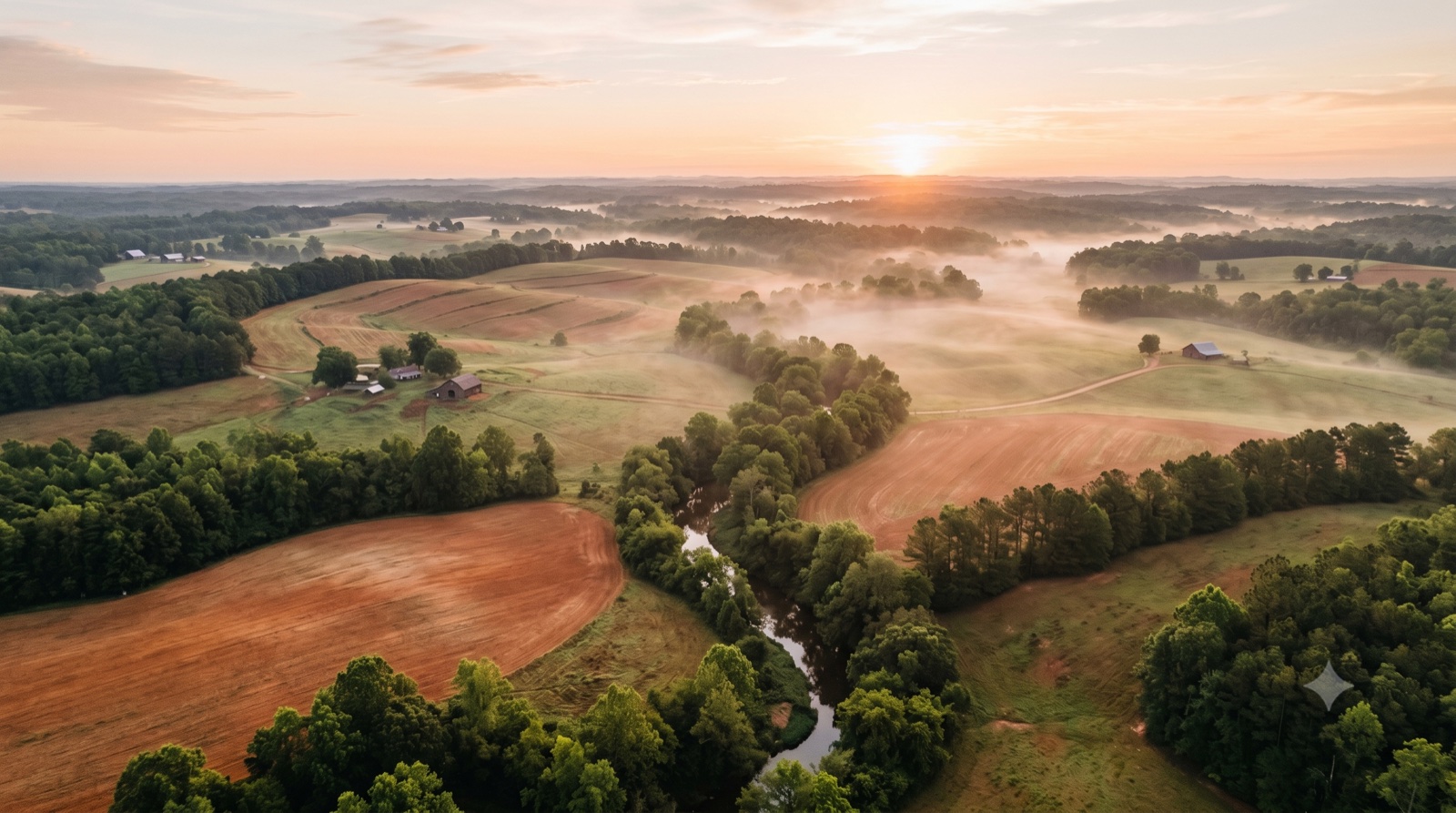
Taylor County covers roughly 377 square miles in west-central Georgia, seated at Butler. Its defining physical feature is the fall line, which runs directly through the county: north of it lies rolling Piedmont with clay-based soils, and south of it the flatter, sandy Upper Coastal Plain. That boundary is not trivia — it changes soils, drainage, timber type, and what a given tract is practically good for from one end of the county to the other.
This guide covers Georgia's property tax structure for vacant land, the CUVA and FLPA programs, the attorney-managed closing process, how Taylor compares to its neighbors, and your practical options for selling.
What Are the Tax Costs of Holding Land in Taylor County?
All tangible property in Georgia is assessed at 40% of fair market value under O.C.G.A. § 48-5-7, and Taylor County is no exception. On top of that assessment ratio, the local millage produces the actual bill.
The effective rate is reported inconsistently by the two services landowners most often check. Tax-Rates.org reports approximately 0.72% with a median annual bill of $441; Ownwell reports 0.85% with a median annual bill of $812. That is a meaningful spread in both rate and dollars, driven by different median home-value baselines, and we are not going to blend them into a single number. The Georgia Department of Revenue's county property tax facts page for Taylor notes that the county offers no local homestead exemptions beyond the state ones — relevant context for residential owners, though not for bare land.
How CUVA and FLPA Covenants Affect a Land Sale
Georgia's two conservation-use programs are the most important tax mechanic for a Taylor County land seller to understand, because a covenant runs with the land and a sale can breach it.
CUVA (Conservation Use Valuation Assessment), under O.C.G.A. § 48-5-7.4, assesses qualifying agricultural and timber land on current use rather than fair market value under a 10-year covenant. The minimum is generally 10 acres (some counties set it higher), with a cap of 2,000 acres per non-industrial private landowner. Breaching the covenant carries a penalty of twice the difference between tax paid under current-use assessment and the tax that would otherwise have been due, plus interest. Not three times — twice, per the statute.
FLPA (Forest Land Protection Act), under O.C.G.A. § 48-5-7.7, is the program for larger forest holdings. Its covenants run 10 years, and it requires at least 200 acres in aggregate with parcels of at least 100 acres within any given county. Many third-party forestry and brokerage pages still state a 15-year FLPA covenant; the Georgia Department of Revenue's own page says 10, and DOR administers the program. On a breach, the board of tax assessors gives written notice and the owner has 30 days to cure before penalty applies.
If your parcel is under either covenant, find out before you list. The Board of Assessors can tell you the enrollment status and covenant year, and that determines whether a sale triggers a penalty or whether a buyer continuing the qualifying use can simply take over the covenant. For land carrying unpaid taxes, see our guide on how to sell land with back taxes.
What Closing Requirements and Zoning Rules Apply in Taylor County?
Georgia law requires a licensed Georgia attorney to supervise every real estate closing — title examination, deed preparation, disbursement of proceeds, and recording. This is not optional and applies whether you use an agent, sell by owner, or work with a direct buyer.
The process for a vacant land sale typically runs:
- Contract: Parties execute a purchase agreement
- Title examination: The attorney searches Superior Court deed records for a period sufficient to establish marketable title, checking liens, encumbrances, judgments, and covenant status
- Closing: All parties sign the deed and settlement statement; the attorney disburses funds and collects the transfer tax
- Recording: The attorney records the deed. Georgia's transfer tax of $1 per $1,000 of consideration is paid at recording — on a $150,000 sale, $150
Georgia records land deeds with the Clerk of Superior Court. The Taylor County Clerk of Superior Court is at 2 North Broad Street, Butler, GA 31006 (mailing: PO Box 248, Butler, GA 31006-0248), phone 478-862-5594. We are routing you to the office rather than naming the clerk, because we could not confirm the current officeholder's term status to our standard — call and ask for the Clerk directly.
The Taylor County Tax Commissioner, Shirley Graham, is at 1A Ivy Street, Butler, GA 31006 (mailing: PO Box 446), phone 478-862-3637. The Board of Tax Assessors and Chief Appraiser Jason Sapp are at 1A Ivy Street, phone 478-862-3802 — that is the office to call about CUVA and FLPA covenant status.
Georgia's transfer tax is among the lower state-level rates in the Southeast, and there is no additional county-level transfer tax in Taylor County.
Zoning and Land Use in Taylor County
Taylor County is rural, and agricultural and timber uses on most tracts proceed without county use permits. The land-use variable that matters most here is geology rather than regulation. The fall line splits the county into two different kinds of ground: Piedmont clay soils and rolling terrain to the north, sandy Coastal Plain and sandhills to the south. The southwestern portion of the county carries large sandhills that have supported sand mining, and Taylor County sits within Georgia's kaolin belt with documented historical kaolin workings near Butler — though present-day kaolin extraction here is not something we can confirm, and Georgia's active kaolin center is further east in Washington County.
For a seller, the practical implication is that soil type materially affects timber productivity, drainage, and buildability, and buyers who know this county will ask which side of the fall line your tract sits on.
If your land is inherited, our guide on how to sell inherited land covers the steps. If your tract carries planted pine, see how to sell timberland. If it is good deer ground, see how to sell hunting land.
How Does Taylor County Compare to Neighboring Georgia Counties?
Taylor County's population has fallen steadily — 8,906 in 2010, 7,816 in the 2020 Census, and an estimated 7,786 as of 2024 per Census Reporter — a loss of roughly 11% over fifteen years. Median household income runs near $41,788 with a poverty rate around 32.1%.
| Factor | Taylor County | Talbot County | Marion County | Schley County |
|---|---|---|---|---|
| Population (2020 Census) | 7,816 | 5,733 | 7,498 | 4,547 |
| Population trend | Declining | Declining | Roughly flat | Roughly flat |
| Effective tax rate | 0.72% or 0.85% (sources conflict) | ~1.32% | 0.73% or 0.92% (conflict) | 0.56% or 0.97% (conflict) |
| County seat | Butler | Talbotton | Buena Vista | Ellaville |
| Land character | Fall-line: Piedmont clay north, sandhills south | Piedmont pine and pasture | Coastal Plain farm and pine | Small-farm Coastal Plain |
| Key economic driver | Poultry, agriculture, timber | Timber, agriculture | Agriculture | Agriculture |
Taylor is surrounded by counties of similar or smaller scale — Talbot, Marion, and Schley are all under 8,000 people. There is no large regional employment anchor immediately adjacent, which is the structural reason land here trades into a genuinely thin buyer pool. Note that effective rates for the neighboring counties differ substantially between Tax-Rates.org and Ownwell; treat the table as indicative and confirm with the relevant tax office.
What the Farm Data Actually Says
The USDA 2022 Census of Agriculture county profile is worth reading carefully here, because the picture is not the one local reputation suggests.
Taylor County has 211 farms covering 84,840 acres — with cropland at 33,349 acres (39%), woodland at 31,684 acres (37%), and pastureland at 9,725 acres. Land in farms grew 32% since 2017 even as the number of farms fell 6%, putting average farm size at 402 acres.
On sales, the county's total was $68.8 million, of which poultry and eggs account for $34.5 million — just over half. Cotton and cottonseed came second among named crop categories at $1.9 million; grains, oilseeds, and dry beans totaled $2.5 million. Broiler inventory stood at roughly 1.39 million birds against 4,906 cattle.
Timber does not appear as a named sales category in the county profile at all, which is worth stating plainly: Taylor County is not a "timber county" by agricultural sales, even though woodland is 37% of its land in farms and managed pine is a genuine and visible land use. There is a further wrinkle worth knowing — land in farms (84,840 acres) is only about 35% of the county's roughly 241,000 total acres, so a large share of Taylor County, including substantial private timberland, simply is not captured in the Ag Census at all. The honest reading: managed pine is real here as a land use; poultry is what the farm economy sells.
For a statewide overview of the process and other counties we buy in, see our guide on how to sell land in Georgia. For county-level analysis across the region, explore our blog. For help understanding value, see how much is my land worth.
What Are Your Options for Selling Land in Taylor County?
Taylor County landowners face a familiar rural-Georgia arithmetic: a county of fewer than 8,000 people that has lost 11% of its population since 2010, no adjacent metro to draw buyers, conservation-use covenants that can carry a penalty on breach, and an attorney-required closing process. For absentee owners — heirs who moved away, families who stopped farming decades ago — the parcel usually generates a tax bill and nothing else.
Before listing or accepting any offer, verify your legal description and check for liens through the Taylor County Clerk of Superior Court at 478-862-5594, 2 North Broad Street, Butler. Confirm tax status with Tax Commissioner Shirley Graham at 478-862-3637, 1A Ivy Street. Most importantly, call the Board of Tax Assessors and Chief Appraiser Jason Sapp at 478-862-3802 and ask directly whether your parcel is under a CUVA or FLPA covenant and what year it was entered — that single question can change the economics of your sale. If your tract carries merchantable pine, a consulting forester's cruise will tell you what the tax assessment cannot.
Sellers have several paths. Listing with an agent who works west-central Georgia land reaches hunters, timber buyers, and farm operators; commissions typically run 5–6% plus transfer tax and closing costs, and tracts in a county this thin can sit for many months. For Sale By Owner on Land.com, LandWatch, or LandAndFarm reaches active land buyers but requires you to document boundaries, access, timber, and covenant status yourself — see how to sell land by owner. Working with a direct cash buyer like Jerez Land skips the listing period, commissions, and financing contingencies. We make parcel-specific, firm written offers based on a full review of your property — location, access, soils, encumbrances, timber, and covenant status — and we absorb the carrying costs, marketing expense, and resale risk. Our offers are not formulas. Request a cash offer for your land.
If you are weighing whether to involve an agent, see whether you need a realtor to sell land. If you live outside Georgia, see our guide for the out-of-state land owner.
Frequently Asked Questions
My father put our Taylor County land in CUVA years ago and now we want to sell — will we owe a penalty?
It depends on whether the sale breaches the covenant or the buyer continues a qualifying use and takes it over. CUVA covenants run 10 years under O.C.G.A. § 48-5-7.4, and a breach carries a penalty of twice the difference between the tax paid under current-use assessment and what would otherwise have been due, plus interest. Call the Taylor County Board of Tax Assessors at 478-862-3802 and ask for your parcel's enrollment status and covenant start year before you accept any offer. If a buyer will continue qualifying use, the covenant can often transfer without triggering the penalty.
I inherited land near Butler and live out of state — do I have to go to Georgia to sell it?
No. Georgia requires a licensed Georgia attorney to supervise the closing, conduct the title examination, and record the deed, but that attorney can work with you remotely and the deed can be executed and notarized where you live. Start by confirming your legal description with the Taylor County Clerk of Superior Court at 478-862-5594 and your tax status with the Tax Commissioner at 478-862-3637. Georgia's transfer tax of $1 per $1,000 of consideration is paid at recording.
What does it cost to sell land in Taylor County?
Georgia's transfer tax is $1 per $1,000 of consideration, paid at recording — $150 on a $150,000 sale — and it is among the lower state-level rates in the Southeast, with no additional county transfer tax in Taylor County. Beyond that, expect the attorney fee, title search, and prorated property taxes, which together typically run in the 1–3% range on Georgia land transactions excluding commissions. If you list with an agent, add roughly 5–6%. If a CUVA or FLPA covenant is breached by the sale, that penalty is a separate and potentially larger cost.
Is Taylor County a timber county?
Not by agricultural sales, though timber is a real land use. The USDA 2022 Census of Agriculture county profile shows poultry and eggs at $34.5 million of $68.8 million in total sales — just over half — with timber not appearing as a named sales category at all. At the same time, woodland covers 31,684 of the county's 84,840 acres in farms, and land in farms represents only about 35% of the county's total acreage, so substantial private timberland sits outside the Ag Census entirely. Managed pine is genuinely present; poultry is what the farm economy sells.
What does the fall line running through Taylor County mean for my land?
It means the ground on one side of the county is materially different from the other. North of the fall line, Taylor County is rolling Piedmont with clay-based soils; south of it, the land flattens into sandy Upper Coastal Plain, including large sandhills in the southwestern part of the county. That difference affects soil productivity for timber, drainage, and buildability, and experienced local buyers will ask which side of the line a tract sits on. Taylor County also lies within Georgia's kaolin belt with documented historical workings near Butler.
Is Taylor County's population growing or shrinking?
Shrinking steadily. Population fell from 8,906 in 2010 to 7,816 in the 2020 Census to an estimated 7,786 in 2024, per Census Reporter and Data USA — roughly an 11% decline over fifteen years, still trending down year over year. Median household income runs near $41,788 with a poverty rate around 32.1%. For land sellers, that decline is the direct source of a thin local buyer pool, and it is compounded by the fact that all three of Taylor's nearest neighbors — Talbot, Marion, and Schley — are also under 8,000 people.
Disclaimer: This article is for informational purposes only and does not constitute legal, financial, or professional advice. Laws and regulations vary by jurisdiction and change over time. Always consult with qualified professionals before making land purchase decisions. Jerez Land is not responsible for actions taken based on this information.