
Sell My Land in Wilkinson County MS - What Landowners Need to Know
Key Takeaways
- Mississippi charges $0.00 in state deed transfer tax: Wilkinson County landowners pay no state-level transfer tax at closing, making Mississippi one of the most cost-effective states in which to complete a land sale
- Vacant land is assessed at 15% of fair market value: Mississippi's 15% assessment ratio for Class II property — all real property other than owner-occupied homes, including bare land and timber tracts — is 50% higher than the 10% ratio for owner-occupied Class I homes, meaning vacant landholders carry a disproportionate annual tax burden
- Wilkinson County is shrinking steeply: Population fell from 9,878 in 2010 to 8,587 in 2020 to an estimated 7,820 in 2024, according to U.S. Census Bureau and World Population Review data — a roughly 21% drop in fourteen years and one of the thinnest, fastest-declining rural buyer pools in the state
How Can You Sell Land in Wilkinson County Mississippi?
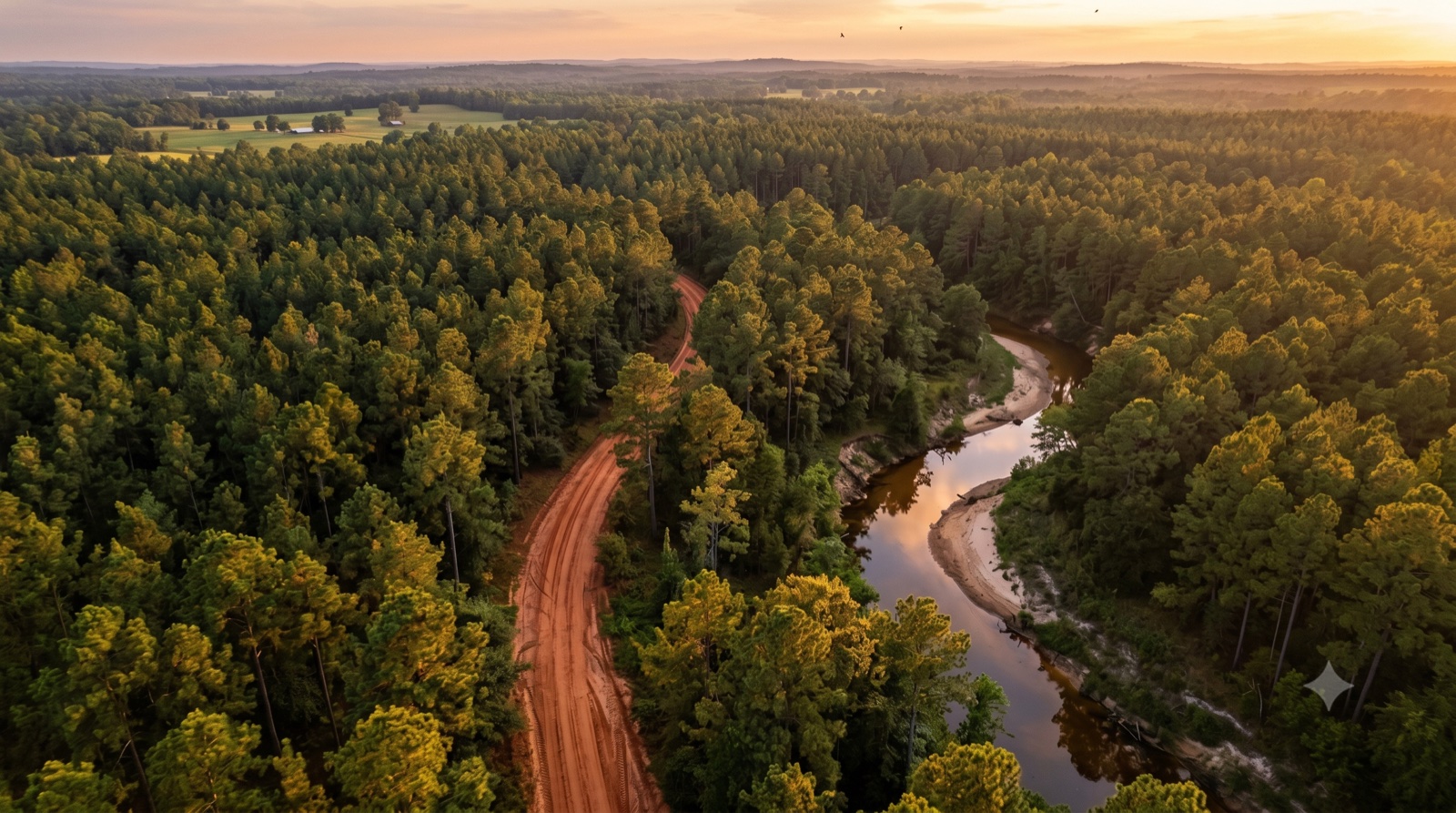
You can sell land in Wilkinson County by working with a closing attorney and title company to handle the title examination and deed preparation—a process shaped by Mississippi's $0.00 state transfer tax and the county's 15% vacant-land assessment. Selling land in Wilkinson County, Mississippi means navigating the state's title-examination and closing process, a property tax system that assesses vacant parcels at 15% of fair market value, and a rural real estate market shaped by the far southwest corner of the state — a landscape of steep loess hills, planted pine and hardwood ridges, and flat Mississippi River bottomland running down to the water.
Wilkinson County sits in the extreme southwest of Mississippi, with Woodville serving as the county seat and largest town. The county spans roughly 688 square miles and is bordered by Adams County to the north, Franklin County to the northeast, and Amite County to the east; the Mississippi River forms its entire western edge, across which lie Concordia Parish, Louisiana, and to the south the West and East Feliciana parishes. It is a landscape of dramatic wind-blown loess bluffs in the west that fall away to broad river-bottom hardwoods and cattle ground — some of the most storied timber and hunting country in the Deep South.
This guide covers the tax costs of holding vacant land in Wilkinson County, Mississippi's closing process, how the county compares to its neighbors, and your practical options for selling.
What Are the Tax Costs of Holding Land in Wilkinson County?
Mississippi's property tax system is built on a tiered assessment ratio that varies by property type. Owner-occupied residential property (Class I) is assessed at 10% of fair market value. All other real property (Class II) — including vacant land, timber tracts, and non-owner-occupied parcels — is assessed at 15% of fair market value, according to Mississippi State University Extension. That 50% differential means vacant land carries a structurally higher tax burden than a neighboring owner-occupied home of equivalent market value.
Wilkinson County's median effective property tax rate is approximately 1.98%, according to Ownwell — above the national median, and notably higher than several of the low-rate hill counties farther north. The actual millage rate combines county government levies, the Wilkinson County School District, municipal levies within Woodville, Centreville, or Gloster (if applicable), and any special taxing districts. Because the county's assessed base is small and its population is shrinking, the per-parcel rate carries more of the local funding load than it would in a growing county.
How the Tax Bill Compounds for Non-Productive Land
Even where individual assessments are modest, the tax bill on vacant land repeats every year. For land that generates no rental income, no harvested timber revenue, and no agricultural lease payment, that annual obligation is pure carrying cost — and it accumulates whether or not the parcel ever appreciates. For absentee owners holding inherited or long-idle acreage, those payments quietly erode whatever value the land represents.
Mississippi reassesses real property periodically; taxes attach on January 1 each year. The Tax Collector is responsible for collection. Delinquent accounts in Mississippi are offered at tax sale on the last Monday in August. Owners who do not redeem within two years of the tax sale risk losing the property. Out-of-state owners are particularly vulnerable to missing notices mailed to old addresses.
Beyond the tax bill, vacant land in Wilkinson County carries liability exposure, potential clearing and maintenance obligations, and the indirect cost of capital tied up in a non-income-producing asset. Mississippi's ag and forest use-value programs and the Reforestation Tax Credit can partially offset costs for landowners who actively manage timber or farmland — see the section below.
For land that has accumulated delinquent taxes, our guide on how to sell land with back taxes explains how to navigate that process.
What Zoning and Closing Rules Apply to Wilkinson County Land?
Mississippi handles real estate closings through title companies, but a licensed Mississippi attorney is commonly involved in — and in practice frequently conducts — the title examination and deed preparation, per The Mississippi Bar. Whether you use a real estate agent, sell directly, or work with a land buyer, expect a formal title search and a recorded deed before the sale is final.
The closing process follows a defined sequence:
- Title search: The closing attorney or title company searches land records filed with the Wilkinson County Chancery Clerk to identify any liens, easements, judgments, or encumbrances on the property
- Title certification and insurance: Title is certified as marketable; title insurance may be issued to protect the buyer from defects not discovered in the search
- Closing: Both parties (or their authorized representatives) execute the deed, any seller's affidavits, and the settlement statement
- Recording: After closing, the deed is recorded with the Wilkinson County Chancery Clerk, who maintains the county's land and deed records
The Wilkinson County Chancery Clerk, which records deeds and maintains the county's land records, is located at 525 Main Street (PO Box 516), Woodville, MS 39669, phone 601-430-1913. The Wilkinson County Tax Assessor/Collector is located at 532 Commercial Row (PO Box 695), Woodville, MS 39669, phone 601-888-4562.
Mississippi's $0.00 state transfer tax is a meaningful advantage for sellers, holding closing costs comparatively low relative to states that levy a deed or documentary tax. Deed recording carries only nominal statutory fees paid to the Chancery Clerk.
Zoning and Land Use in Wilkinson County
Wilkinson County is overwhelmingly rural, and most land outside the Woodville, Centreville, and Gloster municipal limits is subject to limited zoning regulation. Agricultural and timber uses generally proceed without county use permits. The county's geography matters at the boundaries: parcels along the Mississippi River bottoms can carry floodplain, levee-district, and access considerations, while steep loess-hill tracts raise erosion and buildable-area questions. Any manufactured-home placement, subdivision activity, or commercial development warrants direct inquiry with county government in Woodville, and river-bottom or bluff parcels warrant a careful look at deeded access and drainage before any sale.
Mississippi Ag/Forest Use-Value and the Reforestation Tax Credit
Mississippi assesses qualifying agricultural and forest land on its use value rather than full market value — determined under a schedule administered through the state — a significant break for working timber and farm tracts that keeps the assessed base low for land kept in qualifying use. On top of that, Mississippi offers one of the South's more accessible timber incentives. The Reforestation Tax Credit provides a Mississippi income tax credit equal to 50% of approved reforestation costs — site preparation, planting stock, and labor — with a lifetime limit of $75,000 per taxpayer, according to the Mississippi Forestry Commission and the Conservation Finance Center. Landowners must work with a Registered Forester to develop a reforestation plan. Federal deductions of up to $10,000 per year in reforestation expenses are also available, with amounts over $10,000 amortizable over 84 months. Standing timber in Mississippi is not subject to ad valorem tax until it is harvested, at which point a severance tax applies.
If your tract carries planted pine or natural hardwood — as most Wilkinson County land does — see our guide on how to sell timberland. And if you are working through the deed and legal-description paperwork, our guide on the paperwork needed to sell land walks through what the title search will look for.
How Does Wilkinson County Compare to Neighboring Mississippi Counties?
Wilkinson County's population has contracted sharply over the past fourteen years — from 9,878 in 2010 to 8,587 in 2020 to an estimated 7,820 in 2024, according to U.S. Census Bureau QuickFacts and World Population Review — a roughly 21% decline. With a small tax base and limited local employment, Wilkinson is a county whose land market is driven far more by timber, cattle, and river-country recreation than by residential growth.
| Factor | Wilkinson County | Adams County | Amite County | Franklin County |
|---|---|---|---|---|
| Population (2024 est.) | ~7,820 | ~28,000 | ~12,000 | ~7,600 |
| Population trend | Steeply declining | Declining | Declining | Declining |
| Effective tax rate | ~1.98% | Higher (Natchez metro) | Moderate | Moderate |
| County seat | Woodville | Natchez | Liberty | Meadville |
| Land character | Loess hills, river-bottom timber, cattle | Mississippi River bluffs, Natchez | Pine timber, pasture, hill country | Homochitto NF pine, timber |
| Key economic driver | Timber, cattle, hunting leases | Tourism, healthcare, river commerce | Timber, agriculture | Timber, oil/gas, forest |
Adams County to the north — home to Natchez on the Mississippi River bluffs — is the closest thing to a regional employment and services anchor, but its residential demand has not spilled meaningfully into Wilkinson's rural interior. Amite County to the east and Franklin County to the northeast share Wilkinson's timber-and-pasture profile, the Homochitto National Forest, and similarly thin, declining buyer pools. Across all four counties, the buyers for rural acreage are a narrow group of timber investors, cattlemen, hunters, and neighbors — not a broad residential market.
Economy and Major Employers
Wilkinson County's economy leans on timber and cattle. According to the USDA 2022 Census of Agriculture county profile, the county had 163 farms covering 121,506 acres — an average of 745 acres per farm — with sales weighted 81% toward livestock and only 19% toward crops. Cattle and calves alone accounted for roughly $6.0 million of the county's $7.4 million in agricultural product sales, a profile that fits the county's mix of pasture and forested terrain.
For land specifically, the dominant story is forest. Of the 121,506 acres in farms, woodland made up 68,106 acres — more than pastureland (38,127 acres) and far more than cropland (12,016 acres). Top crops by acreage were forage/hay (about 2,369 acres) and soybeans (about 1,960 acres), grown largely in the river bottoms. The picture is one of heavily wooded loess hills, cattle pasture, and a fringe of Mississippi River bottom row crop — affordable, low-basis acreage that families have often held for generations as long-term timber, cattle, and hunting ground.
For a statewide overview of the selling process, closing requirements, and other counties we buy in, see our guide on how to sell land in Mississippi. For county-level land analysis across the state, explore our blog. For help understanding what your land is worth before you list or accept an offer, see how much is my land worth.
What Are Your Options for Selling Land in Wilkinson County?
Wilkinson County landowners carrying vacant parcels face the same arithmetic that affects far southwest Mississippi broadly: land assessed at 15% of market value, annual tax obligations that compound quietly, and a thin local buyer pool in a county of fewer than 8,000 people that loses population every year. For absentee owners — those who inherited a timber tract, moved away, or simply stopped using a parcel in the hills or down in the river bottom — the question is often not whether to sell but how to do it without a drawn-out process. Southwest Mississippi timberland and hill ground can also sit on the market a long time, since serious buyers are a narrow group of timber investors, cattlemen, hunters, and neighbors.
Before listing or accepting any offer, verify your property records through the Wilkinson County Chancery Clerk (601-430-1913, 525 Main Street, Woodville). Confirm tax status through the Wilkinson County Tax Assessor/Collector (601-888-4562, 532 Commercial Row, Woodville). If the parcel carries planted pine or hardwood, engage a Mississippi Registered Forester for a timber cruise — standing timber value is not reflected in the assessed use value and can be significant on well-stocked tracts. If there are title questions from inheritance or old deeds, or access and drainage questions on a river-bottom or bluff parcel, the attorney or title company handling your closing will flag these during the title search.
Sellers have several paths. Listing with a Mississippi land-specialist agent exposes your property to a wider pool of recreational, timber, and investment buyers. Platforms like Land.com and LandWatch serve buyers specifically looking for rural Mississippi land — though southwest Mississippi timber and hill tracts can be slow to move. For landowners who want a written number quickly — without the uncertainty of extended market exposure — Jerez Land provides a parcel-specific, firm written cash offer for your land. Every offer is priced individually to the specific parcel. As a direct buyer, we absorb the carrying costs, marketing time, and resale risk that come with holding rural timberland. There are no agent commissions, and no state transfer tax to worry about (Mississippi charges none).
If your land sits far from where you live, our guide on how to sell land as an out-of-state owner covers handling the sale remotely. And if your tract is good hunting ground — as much of Wilkinson County is — see how to sell hunting land.
Frequently Asked Questions
How do I sell vacant land in Wilkinson County Mississippi?
Contact the Wilkinson County Chancery Clerk (601-430-1913) to verify your deed and legal description, and check your tax status through the Wilkinson County Tax Assessor/Collector at 601-888-4562 in Woodville. In Mississippi, a title company handles closing and a licensed attorney is commonly involved in the title examination and deed preparation. From there, you can list with a local land-specialist real estate agent, market through online land platforms, or request a direct cash offer from a land buyer.
I inherited vacant land in Wilkinson County—what's the annual property tax burden?
Wilkinson County has a median effective property tax rate of approximately 1.98%, according to Ownwell — above the national median. Vacant land is assessed at 15% of fair market value (Class II), compared to 10% for owner-occupied homes (Class I), under Mississippi's tiered assessment system per Mississippi State University Extension. Qualifying agricultural and forest land may be assessed on use value rather than full market value.
Does Mississippi charge a transfer tax on land sales?
No. Mississippi has a $0.00 state deed transfer tax. Sellers do not owe a state-level transfer tax on land sales, regardless of sale price. This makes Mississippi one of the lowest-closing-cost states for land transactions. The deed still must be recorded with the Wilkinson County Chancery Clerk, which carries only nominal statutory recording fees.
I'm an out-of-state owner—do I need to hire an attorney for the Wilkinson County closing?
Mississippi closes real estate through title companies, and a licensed Mississippi attorney is commonly involved in the title examination and deed preparation. After closing, the deed is recorded with the Wilkinson County Chancery Clerk at 525 Main Street (PO Box 516), Woodville, MS 39669, phone 601-430-1913. Using an experienced closing attorney or title company is strongly advisable to confirm marketable title, especially on inherited or long-held rural tracts.
My Wilkinson County land has timber on it—can I use the Reforestation Tax Credit?
The Mississippi Reforestation Tax Credit provides a state income tax credit equal to 50% of approved reforestation costs — including site preparation, seedlings, and planting labor — with a lifetime cap of $75,000 per taxpayer, according to the Mississippi Forestry Commission and the Conservation Finance Center. Landowners must be non-industrial private forest owners with a reforestation plan prepared by a Registered Forester. Federal deductions of up to $10,000 per year in reforestation expenses are also available. This is especially relevant in Wilkinson County, where woodland makes up the majority of the county's land in farms.
Is Wilkinson County Mississippi population growing or declining?
Wilkinson County's population has declined steeply: from 9,878 in 2010 to 8,587 in 2020 to an estimated 7,820 in 2024, according to U.S. Census Bureau QuickFacts and World Population Review — roughly a 21% drop in fourteen years. The decline reflects sustained outmigration across far southwest Mississippi, leaving a small and shrinking local buyer pool for rural land.
Disclaimer: This article is for informational purposes only and does not constitute legal, financial, or professional advice. Laws and regulations vary by jurisdiction and change over time. Always consult with qualified professionals before making land purchase decisions. Jerez Land is not responsible for actions taken based on this information.