
Sell My Land in Winston County MS - What Landowners Need to Know
Key Takeaways
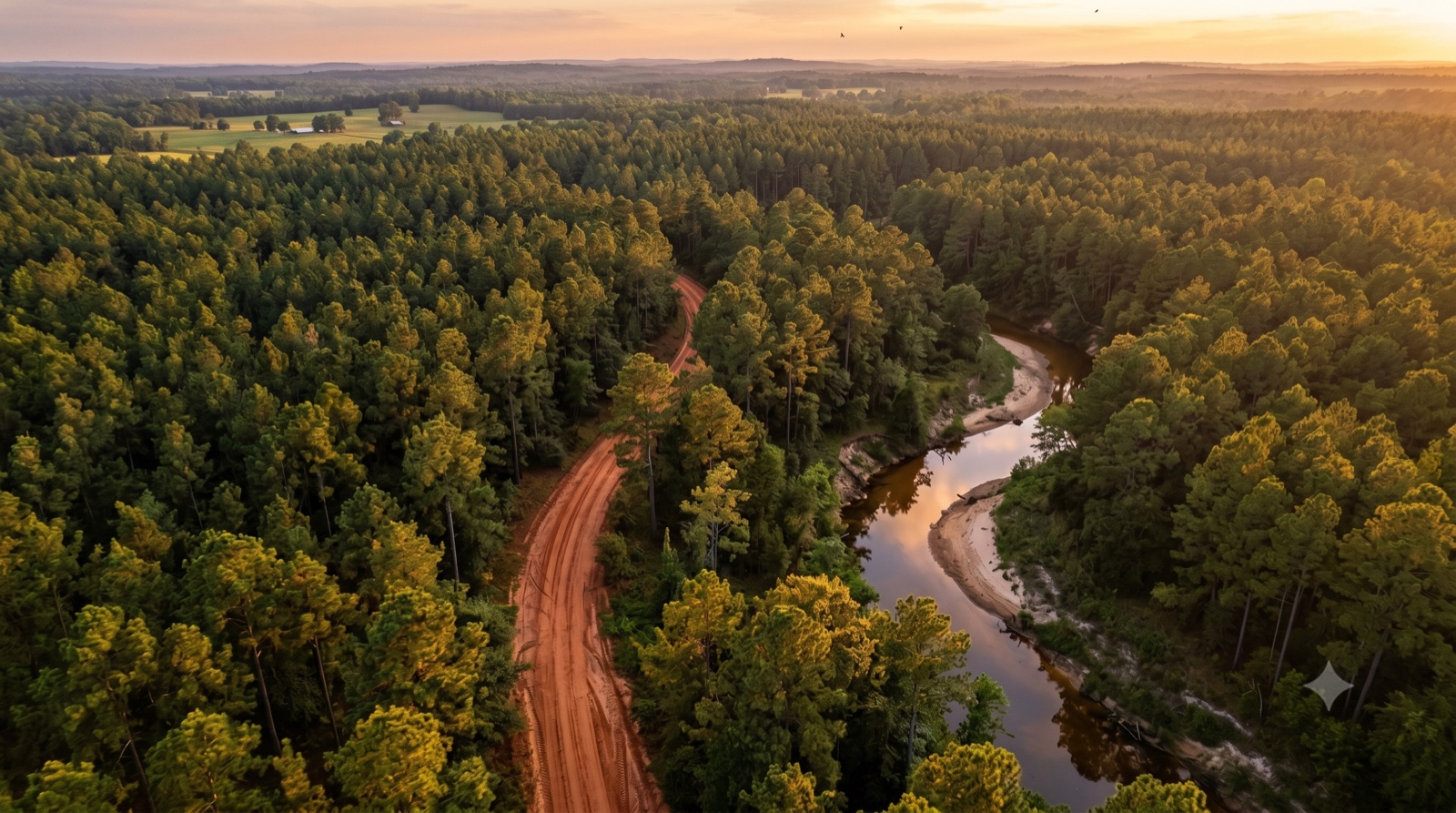
- Winston County is a timber county first: MSU Extension counts 288,665 acres of forestland here — roughly three-quarters of the county's 607 square miles — with 253,647 of those acres in private hands, and the forestry and forest-products sector supplying 583 jobs, about 7.9% of all county employment
- Poultry is 97% of farm sales, and crops are 3%: The USDA 2022 Census of Agriculture puts total agricultural sales at $88.9 million, of which poultry and eggs alone account for $82.6 million — this is not a row-crop market, and land here is valued for what grows on it or grazes on it
- Vacant land is assessed at 15%, and the effective rate is low: Mississippi's Class II ratio applies 15% to rural and vacant land versus 10% for owner-occupied homes, but Winston County's effective property tax rate of about 0.66% sits well under the national median, according to Ownwell
How Can You Sell Land in Winston County Mississippi?
You can sell land in Winston County through a Mississippi attorney-conducted closing, with no state deed transfer tax owed and the deed recorded with the Chancery Clerk in Louisville. What shapes your sale here is the county's heavily forested land base, a buyer pool dominated by timber and cattle interests rather than residential demand, and the 15% Class II assessment that applies to bare land every year you hold it.
Winston County sits in east-central Mississippi, covering 607 square miles with Louisville as the county seat, and was formed in 1833 following the Treaty of Dancing Rabbit Creek. Population has moved from 19,198 in 2010 to 17,714 in 2020 to an estimated 17,536 in 2024 — a decline of roughly 7.7% across the 2010s that has largely flattened since, with the most recent single year actually ticking slightly upward. Portions of the Tombigbee National Forest lie inside the county, along with Nanih Waiya, an ancient Woodland-period ceremonial mound of deep significance to the Choctaw people and now owned by the Mississippi Band of Choctaw Indians.
This guide covers the annual cost of holding land here, Mississippi's attorney-required closing process, how Winston stacks up against its neighbors, and the realistic paths to a sale.
What Are the Tax Costs of Holding Land in Winston County?
Winston County's effective property tax rate runs about 0.66%, compared with a national median near 1.02%, according to Ownwell — a low rate in absolute terms, but one applied to vacant land at a higher assessment ratio than a house receives. Under Mississippi's classification system, Class I owner-occupied residential property is assessed at 10% of true value, while Class II — all other real property, including rural land, timberland, and pasture — is assessed at 15%, per Mississippi State University Extension.
The specific millage rate that produces your bill depends on which county, school, municipal, and fire districts your parcel falls in, and local bodies reset it every year by September 15. We do not publish a millage figure we cannot trace to the county or to the Mississippi Department of Revenue's published rate tables, and neither should any site you are reading. Call the Winston County Tax Assessor and Collector at 662-773-3694 with your parcel number for the current rate.
How the Tax Bill Compounds on Non-Productive Land
A low effective rate still produces a bill every single year, and on land that generates nothing the bill is pure carrying cost. That is the quiet arithmetic that catches absentee and inherited-land owners: a modest annual payment, multiplied by fifteen or twenty years of holding, on a parcel nobody in the family has walked in a decade. Taxes attach on January 1 in Mississippi, delinquent parcels go to tax sale on the last Monday in August, and a two-year redemption period follows. Owners whose address on file is out of date are the ones who miss the notices.
Timber land has a partial answer to this, and it is worth understanding before you sell. Standing timber in Mississippi is not subject to ad valorem tax until it is harvested, at which point a severance tax applies — so a well-stocked tract is not being taxed on the value of what is standing on it. If your parcel has fallen behind on taxes, our guide on how to sell land with back taxes covers the sequence.
What Closing Requirements and Zoning Rules Apply in Winston County?
Mississippi requires a licensed attorney to examine and certify title before any real estate sale closes, according to The Mississippi Bar. This is a legal requirement, not a preference, and it applies whether you sell through an agent, to a neighbor, or to a direct land buyer.
The closing runs in this order:
- Title search: The attorney searches land records held by the Winston County Chancery Clerk for liens, easements, judgments, mineral reservations, and chain-of-title gaps
- Title certification: The attorney certifies marketable title; title insurance may be issued to cover defects the search did not reveal
- Closing: The parties execute the deed, seller's affidavits, and settlement statement
- Recording: The deed is recorded with the Chancery Clerk at $25.00 or $26.00 for the first five pages plus $1.00 per additional page under Miss. Code Ann. 25-7-9, per the Land Title Association of Mississippi
The Winston County Chancery Clerk, Rusty Foster, holds the county's land and deed records at 154 South Court Ave, Louisville, MS 39339, phone 662-773-3631. The Winston County Tax Assessor and Collector, Natasha Walker, can be reached at P.O. Box 765, Louisville, MS 39339, phone 662-773-3694.
Mississippi charges no state transfer or documentary tax on an ordinary land deed, which keeps total closing costs low relative to most states.
Zoning and Land Use in Winston County
Land outside the Louisville and Noxapater municipal limits is lightly regulated, and timber and agricultural uses generally proceed without county use permits. The exceptions worth checking before you market a parcel are manufactured-home placement, any division of a parent tract, and commercial use. Tracts adjoining the Tombigbee National Forest deserve particular attention to deeded access — a road that a family has used for forty years is not the same thing as a recorded easement, and that gap surfaces at the worst possible moment, during a buyer's title work.
Mississippi Ag and Forest Use-Value Assessment
Mississippi assesses qualifying agricultural and forest land on use value rather than market value, which is the most consequential tax provision available to a Winston County landowner given how much of this county is timber. The owner applies with the county tax assessor; once granted, the 15% Class II ratio is applied to the use value instead of market value, under Miss. Code Ann. 27-35-50. The assessor derives that use value from Department of Revenue appraisal manuals, soil productivity, and an income-capitalization method using a capitalization rate of not less than 10%. Timber production qualifies as an agricultural purpose.
If your land came through a family estate, our guide on how to sell inherited land with multiple heirs covers the Mississippi Chancery Court process. If the tract carries merchantable pine or hardwood, see our guide on how to sell timberland.
How Does Winston County Compare to Neighboring Mississippi Counties?
Winston is a mid-sized, heavily forested east-central county whose farm economy is almost entirely livestock. The USDA 2022 Census of Agriculture records 448 farms on 89,088 acres — land in farms down 17% since 2017 — with woodland at 41,259 acres and pastureland at 22,106 acres, against just 18,251 acres of cropland. Total agricultural sales came to $88.9 million, up 11% from 2017, but 97% of that is livestock and poultry, with poultry and eggs alone at $82.6 million. Cattle inventory stood at 9,946 head.
| Factor | Winston County | Choctaw County | Attala County | Neshoba County |
|---|---|---|---|---|
| Population (2020 Census) | 17,714 | 8,246 | 17,889 | 29,087 |
| Land area | 607 sq mi | 418 sq mi | 735 sq mi | 570 sq mi |
| County seat | Louisville | Ackerman | Kosciusko | Philadelphia |
| Land character | Heavily forested uplands, pasture, poultry operations | Pine plantation, Tombigbee National Forest hills | Big Black River corridor, mixed timber and farm | Choctaw reservation lands, resort economy, rural timber |
| Population trend | Declined through the 2010s, roughly flat since | Slowly declining | Slowly declining | Slowly declining |
What the Neighbors Tell You About Winston's Buyer Pool
Neshoba County to the south is the larger and more economically distinctive neighbor, home to the Mississippi Band of Choctaw Indians and the Pearl River Resort complex. Attala to the west is comparable in population to Winston across a much larger land area. Choctaw to the north is smaller and shares Winston's Tombigbee National Forest edge and pine-plantation character.
None of these counties is growing, and that is the honest read for a seller. Your likely buyer in Winston County is a timber investor, a poultry or cattle operator expanding a base of operations, a hunter, or an adjoining landowner. Forestry's weight in the local economy — 583 jobs and about 9.4% of county output, per MSU Extension — means there is genuine institutional interest in well-stocked timber ground. It also means a cutover tract with no merchantable standing volume competes for a much thinner set of buyers.
For a statewide overview of the process and the other counties we buy in, see our guide on how to sell land in Mississippi, or browse county analysis across the state on the blog. To think through valuation first, see how much is my land worth.
What Are Your Options for Selling Land in Winston County?
Winston County landowners work with a specific set of constraints: land assessed at 15% of value, a county that lost nearly 8% of its population across the 2010s, and a buyer pool concentrated in timber, poultry, cattle, and recreation rather than residential growth. For an owner who inherited a tract, moved away, or watched a family timber block sit idle for twenty years, the real question is how to exit without another year of carrying costs.
Start by verifying the facts at the source. Confirm your deed and legal description with the Winston County Chancery Clerk, Rusty Foster, at 662-773-3631 (154 South Court Ave, Louisville). Confirm tax status and ask whether the parcel is enrolled in agricultural use value with the Tax Assessor and Collector, Natasha Walker, at 662-773-3694. If the tract carries pine or hardwood, hire a Mississippi Registered Forester for a timber cruise before you discuss price with anyone — in a county this heavily forested, standing volume can be the majority of what the tract is actually worth, and it does not appear in your assessment. If the land came from an estate or the deed is decades old, or if access to the parcel has always run across a neighbor's ground, those issues surface during the attorney's title search and are far cheaper to address before you are under contract.
From there the routes are straightforward. A Mississippi land-specialist agent reaches the widest pool of timber and recreational buyers, and platforms like Land.com and LandWatch target buyers specifically looking for rural Mississippi acreage — though forested tracts in a thin market can take many months. Talking directly to adjoining landowners is worth doing early; in a county like this, the neighbor is frequently the most motivated buyer. And for an owner who wants a firm written number without extended market exposure, Jerez Land makes a parcel-specific cash offer for your land. We buy directly and absorb the carrying costs, marketing time, and resale risk ourselves. There are no agent commissions, Mississippi charges no transfer tax, and the attorney conducts the closing as state law requires.
If you are still deciding whether to involve an agent, our guide on whether you need a realtor to sell land works through the trade-offs. If the tract is good deer or turkey ground, see how to sell hunting land.
Frequently Asked Questions
I inherited a timber tract in Winston County and live out of state — can I sell it without traveling to Mississippi?
Usually yes. Mississippi requires a licensed attorney to examine title and conduct the closing, but it does not require you to appear in person; deeds can generally be signed remotely before a notary and returned for recording with the Winston County Chancery Clerk at 154 South Court Ave, Louisville (662-773-3631). If the land is still titled in a deceased relative's name, the estate must be addressed first, typically through Chancery Court, before clear title can pass. Get a timber cruise before evaluating any offer — standing volume is often the largest part of a wooded tract's value.
I own vacant acreage in Winston County — how much will I pay in property taxes each year?
Winston County's effective property tax rate is roughly 0.66%, below the national median of about 1.02%, according to Ownwell. Vacant and rural land is assessed at 15% of true value as Class II property, versus 10% for owner-occupied homes, per Mississippi State University Extension. Your actual bill depends on the millage set each September for your specific school, fire, and municipal districts, so call the Winston County Tax Assessor and Collector at 662-773-3694 for the current rate on your parcel rather than trusting a countywide average.
Does Mississippi charge a transfer tax when I sell land?
No. Mississippi imposes no state deed transfer tax or documentary stamp tax on an ordinary land sale, at any price. Your closing costs are the attorney's fee plus deed recording with the Chancery Clerk, which runs $25.00 or $26.00 for the first five pages plus $1.00 per additional page under Miss. Code Ann. 25-7-9. A separate narrow mineral documentary stamp tax applies to mineral deeds and leases, not to a normal surface land sale.
My Winston County land has been in the family for generations and is mostly woods — is it worth anything if we never cut it?
Very possibly, and the way to find out is a timber cruise by a Mississippi Registered Forester rather than a guess. Winston County holds 288,665 acres of forestland, 253,647 of it privately owned, according to MSU Extension, and the local forestry sector supports 583 jobs — so there is real institutional demand for well-stocked ground. Standing timber is not taxed in Mississippi until harvest, which is why long-held uncut tracts sometimes carry substantial value that never showed up on a tax bill.
Do I need an attorney to sell my land in Winston County?
Yes. Mississippi requires a licensed attorney to examine and certify title for real estate transactions, according to The Mississippi Bar. The attorney searches Chancery Clerk records, prepares the deed, and conducts the closing, whether you sell through an agent, to a neighbor, or to a cash buyer. After closing, the deed is recorded with the Winston County Chancery Clerk at 154 South Court Ave, Louisville, MS 39339.
Is Winston County's population growing or shrinking, and how does that affect my sale?
Winston County fell from 19,198 residents in 2010 to 17,714 in 2020 — about a 7.7% decline — and has been roughly flat since, at an estimated 17,536 in 2024. For a seller, the effect is on the buyer pool rather than on any single parcel: fewer local households means demand for rural acreage comes mainly from timber investors, cattle and poultry operators, hunters, and adjoining landowners. That is a narrow group, and it generally translates into longer marketing times than a growing county would see.
Disclaimer: This article is for informational purposes only and does not constitute legal, financial, or professional advice. Laws and regulations vary by jurisdiction and change over time. Always consult with qualified professionals before making land purchase decisions. Jerez Land is not responsible for actions taken based on this information.