
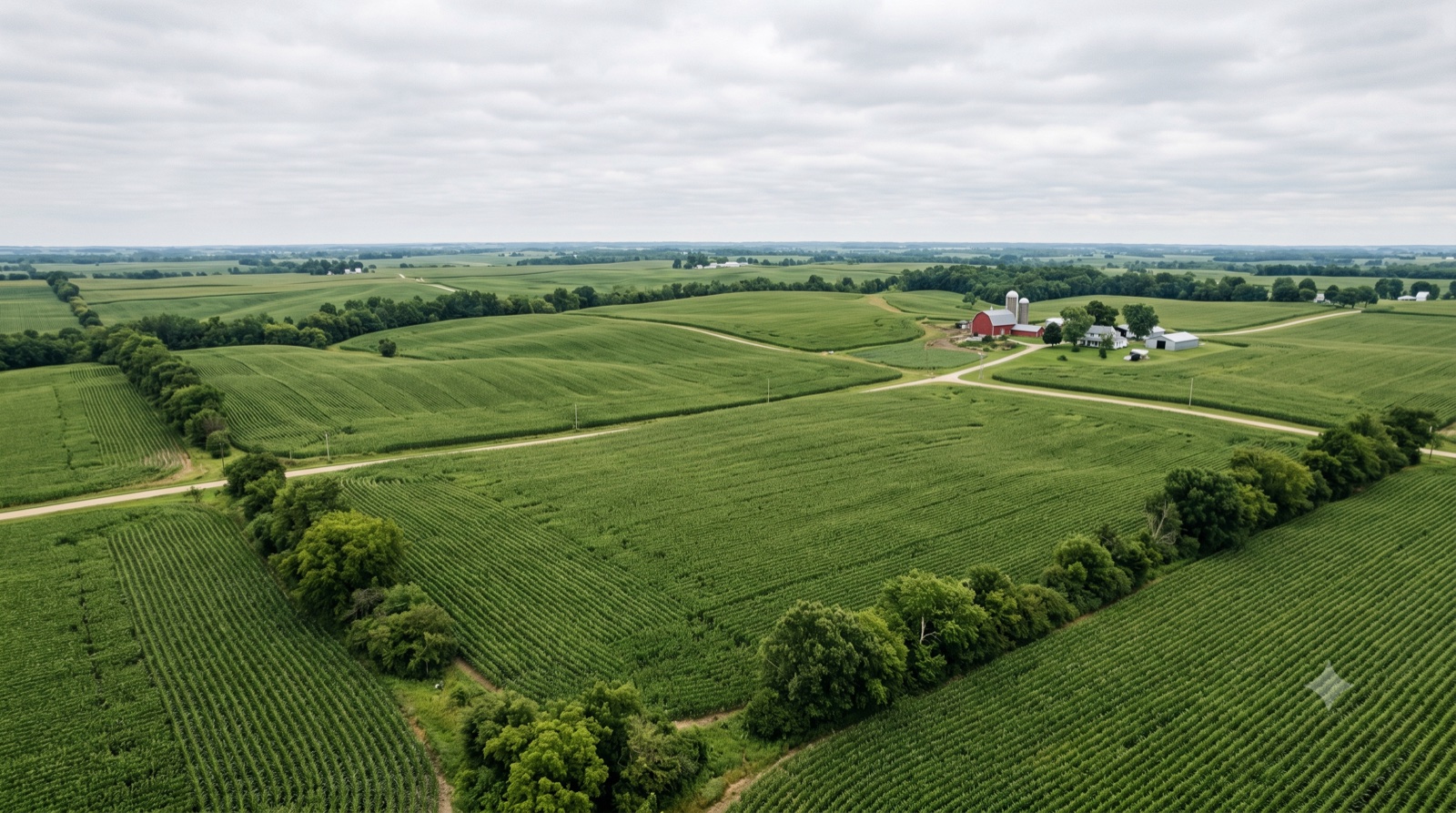
Selling an Orchard or Vineyard: How Buyers Value a Living, Aging Asset
Key Takeaways
- A working orchard or vineyard is two assets, not one: appraisers and county assessors treat the planting itself — the trees or vines — as a separate, depreciating "living improvement" from the bare land underneath, valued on age, variety, rootstock, and remaining productive life, according to the Napa County Assessor's office and Wine Business Analytics' reporting on vineyard appraisal
- Perennial plantings take years to earn their keep, and every one of those years needs work: UGA Extension puts pecans at 8 to 10 years before an economically significant crop, peach trees at their third year before real bearing begins, and the Agricultural Marketing Resource Center puts tart cherries at 3 to 5 years and sweet cherries at 4 to 7 — with irrigation, pruning, spraying, and fertilization required in every one of those years to protect the investment
- Neglect compounds fast: Mississippi State University Extension identifies pecan scab, phylloxera galls, accumulated dead wood, and declining nut production as the visible signs of a neglected orchard, and notes that severely neglected plantings are often better replaced than renovated — which narrows the buyer pool and shifts what a buyer is actually willing to pay for
How Is Selling an Orchard or Vineyard Different From Selling Bare Land?
Selling land planted in an orchard or vineyard means selling two assets at once — the ground itself and a living, aging planting that a buyer prices on its own terms: age, variety, rootstock, remaining productive years, and the trellis or irrigation infrastructure that keeps it producing. That is a fundamentally different valuation problem than bare cropland or standing timber, and it changes who buys, how fast a sale happens, and what a season of deferred maintenance actually costs you.
This guide is specifically about perennial plantings — pecan and peach orchards in Georgia, apple and cherry orchards in Michigan, muscadine vineyards in the Carolinas, and similar tree- or vine-based operations. It is not the same situation as selling farmland, where the crop is annual — corn, soybeans, hay — and resets every season with no standing capital asset for a buyer to value or maintain. It is also not the same as selling timberland, where the asset is a single eventual harvest that a forester cruises once and a buyer either waits on or takes. An orchard or vineyard is neither: it is a living asset that depreciates over a finite economic life, requires active annual maintenance to hold its value between now and any eventual harvest, and loses ground measurably fast when that maintenance stops. For more on the general land-selling process, see how much is my land worth and browse the blog for other land-type guides.
How Does a Buyer Value My Orchard or Vineyard Differently Than Raw Land?
A buyer values a working orchard or vineyard as two separate components — the bare land and the living planting on top of it — and prices the planting on its age, variety, rootstock, remaining productive life, and the trellis or irrigation system that supports it, the same way county assessors treat vines as a depreciating "living improvement" distinct from the ground beneath them, according to the Napa County Assessor's office. That two-part framing is the core difference from valuing an empty field.
Age, Variety, and Rootstock Set the Ceiling
Wine Business Analytics' reporting on vineyard appraisal describes appraisers weighing variety, rootstock, plant density, and production trends when valuing the living asset — with disease pressure (viruses, nematodes, Pierce's disease, phylloxera) working against value, and older vines on desirable rootstock sometimes commanding a premium for certain wine styles. The same logic carries across crops: a variety that's fallen out of commercial favor, or rootstock with known disease vulnerability, is worth less than an identical-age planting with a stronger pedigree — regardless of how healthy it looks from the road.
Years to Bearing Define How Much Runway Is Left
Every perennial crop needs years of unpaid establishment before it earns anything, and a buyer is implicitly paying for however many of those years are already behind the planting. UGA Extension puts pecan trees at 8 to 10 years before they reach an economically significant harvest, and describes peach trees bearing only a token crop in year two — not enough to justify management costs — with real production starting in the third leaf. The Agricultural Marketing Resource Center reports tart cherries typically begin producing in 3 to 5 years and sweet cherries in 4 to 7. Michigan State University Extension's 2025 apple cost-of-production analysis notes that high-density trellised systems bring production on meaningfully earlier than traditional semidwarf plantings, which is part of why the two systems are valued differently. A 15-year-old pecan block has already absorbed establishment years a buyer would otherwise wait through — that's part of what the buyer is paying for.
Infrastructure Is Part of the Asset, Not an Afterthought
Wine Business Analytics notes that trellis, irrigation, and frost-protection systems are valued as distinct "non-planted improvements" alongside the planting itself, with their share of total value proportionally larger on less expensive properties. NC State Extension's muscadine vineyard establishment guidance describes the trellis as needing to be built strong enough to support vigorous vine growth and occasional high winds — a structural requirement, not a cosmetic one. A functioning irrigation system, a sound trellis, and adequate frost protection are assets a buyer inherits and would otherwise build from scratch; a missing or failing one is a liability the buyer prices into the offer.
What Happens to the Value If My Orchard or Vineyard Has Been Neglected for a Season or More?
A season or more of deferred pruning, spraying, and irrigation measurably degrades an orchard or vineyard's value, because pests, disease, and overcrowding compound quickly on unmanaged trees or vines. Mississippi State University Extension identifies pecan scab, phylloxera galls on limbs, accumulated dead wood and broken branches, and declining nut production as the visible signs of a neglected pecan orchard — and the same category of problems (disease pressure, overcrowding, reduced airflow, and years of no fertility program) shows up across other perennial crops when maintenance lapses.
Renovation vs. Starting Over
Mississippi State's guidance frames the decision plainly: renovation of a neglected orchard is possible when trees are fundamentally sound but undermanaged, and it requires committing to multiple corrective steps together — irrigation, repeated fungicide applications, annual nitrogen fertilization, improved airflow through strategic tree removal, and sustained follow-through over several seasons, since "no single improvement will lead to better production." But for orchards that have gone without a fertility or disease-management program for years, or where the variety mix is unknown or undesirable, the same guidance says a better strategy may be to start over with new trees rather than restore the old ones.
That distinction matters directly to a seller: a buyer evaluating a neglected planting is not just discounting for lost production — they are pricing in whether the trees or vines are worth saving at all, or whether the realistic path is removal and a fresh start. An orchard that needs renovating is a narrower, more skeptical buyer pool than one that's been actively managed. An orchard past the point where renovation pencils out is effectively competing with bare land, minus the cost of clearing what's standing on it.
Who Actually Buys a Working Orchard or Vineyard?
Three buyer types realistically bid on a planted orchard or vineyard: a neighboring grower who adds your acreage to an existing operation, an investor or operator who intends to keep farming the planting (often by leasing it back to a grower), and a land buyer who will remove the trees or vines and sell or hold the ground as bare acreage. The third buyer type sets the practical floor under what your parcel is worth, because it represents the value of the land with the planting treated as a cost to remove rather than an asset to inherit.
The Neighboring or Expanding Grower
A grower who already operates adjacent acreage, or who is scaling an existing pecan, apple, or vineyard operation, is often the most motivated buyer for a well-maintained planting — they can absorb the acreage into existing equipment routes, labor scheduling, and processing or marketing relationships, and they know exactly what they're inheriting because they understand the crop. This buyer pays the closest thing to a premium for age, variety fit, and infrastructure condition, but they are also the pickiest about neglect, disease history, and variety mismatch with their existing operation.
The Buyer Who Keeps It in Production
A non-operating investor or an operator entering the crop for the first time may buy a planting specifically to keep it producing, either farming it directly or leasing it to a grower. This buyer needs the planting to be in reasonable condition and usually wants documentation — spray records, yield history, irrigation system condition — before committing, similar to the underwriting a buyer would want before taking on any income-producing agricultural asset.
The Buyer Who Removes the Planting
Some buyers — including direct cash land buyers — will price a parcel assuming the trees or vines come out and the land reverts to bare ground, whether because the planting is too neglected to be worth keeping, the variety or rootstock has no market, or the buyer simply wants unencumbered acreage for another use. This buyer type is important precisely because it does not require the planting to have any value at all: it sets a floor based on the land, independent of the crop's condition, which matters most for sellers whose orchard or vineyard has been neglected past the point where a grower or lease-back investor would be interested.
Can I Sell My Orchard or Vineyard With a Crop Still on the Trees or Vines?
Yes — orchards and vineyards are sold with a crop still on the trees or vines on a regular basis, but who owns that crop at closing has to be addressed explicitly in the purchase contract, because crop ownership does not automatically follow the land the way it would with an empty field. farmdoc daily (University of Illinois) covers this exact situation for farm sales generally: a standing crop can be sold together with the land to the same buyer, or the seller can reserve the right to harvest it under a separate contract, but the two approaches have different legal and tax consequences and need to be decided before closing, not assumed.
Selling the Crop With the Land
farmdoc daily notes that federal tax law (IRC §1231) provides favorable capital-gains treatment when unharvested crops and the underlying land are sold together, to the same buyer, at the same time — provided the seller has held the property for more than a year and does not retain any right to reacquire the land. For a seller who wants a clean, single closing and does not need to personally manage the current season's harvest, selling the standing crop along with the land is usually the simplest structure.
Reserving the Right to Harvest
Alternatively, farmdoc daily describes sellers structuring the transaction as two contracts — one for the land, one giving the seller (or their operator) the right to harvest and sell the standing crop before or after closing. This preserves the current season's crop income for the seller but adds coordination complexity: the buyer needs to agree to access terms, and the timing has to work around the closing date. Either structure is workable; what matters is that the contract says explicitly who owns the crop, rather than leaving it to be assumed or disputed after the fact. A tax advisor should review either structure before you sign, since the tax treatment differs materially between them.
How Does Current-Use or Agricultural Tax Valuation Work If I Sell My Orchard or Vineyard?
Most states that offer a current-use or agricultural-use property tax program extend it to orchards and vineyards on the same terms as row-crop and pasture land, and whether selling triggers a rollback tax generally depends on what the buyer does with the planting afterward, not on the sale itself. A sale to a buyer who keeps the orchard or vineyard in agricultural production is far less likely to trigger a change-of-use rollback than a sale to a buyer who clears the planting for a non-agricultural use — but the specific rules, lookback period, and interest calculation vary by state and by program (Current Use, CUVA, PUV, Clean & Green, Greenbelt, and similarly named programs).
Because the rollback exposure is triggered by the buyer's intended use rather than the crop type, an orchard or vineyard under current-use valuation carries the same rollback risk profile as any other agricultural land under the same program — see how property tax reassessment affects selling land for a broader walkthrough of reassessment and rollback mechanics. The National Agricultural Law Center maintains state-by-state resources on agricultural use valuation statutes, and your county assessor's office can confirm whether your specific parcel is currently classified under a current-use program and what the rollback exposure would be for a given buyer's intended use. Review this before pricing your orchard or vineyard, particularly if a buyer who intends to clear the planting is the one you're negotiating with.
How Does an Orchard or Vineyard Compare Across Condition — Mature, Neglected, or Cleared?
| Factor | Mature, Actively Maintained Planting | Neglected or Abandoned Planting | Cleared Bare Ground |
|---|---|---|---|
| Realistic buyer pool | Neighboring/expanding growers, lease-back investors, operators | Narrow — mainly cash buyers and buyers planning to remove the planting | Widest — any bare-land buyer, including non-agricultural uses |
| What the buyer is paying for | The land plus a living, depreciating asset with documented age, variety, and production history | Mostly the land, discounted further for removal cost and disease/pest risk inherited with the planting | The land only, on its own merits — location, access, size, zoning |
| Documentation that helps the sale | Spray/fertility records, yield history, irrigation and trellis condition, variety and rootstock ID | Same records if available — even partial history narrows the buyer's uncertainty discount | Survey, access, and utility information matter more than any crop history |
| Time to sell | Can move quickly to a motivated grower buyer who knows the crop | Often slower — buyer pool has to work through renovate-vs-remove uncertainty first | Comparable to any other bare rural parcel |
Want a Straightforward Cash Offer on Your Orchard or Vineyard?
If pruning, spraying, and harvest labor have become more than you want to keep managing — or you've inherited a planting you're not equipped to maintain from out of state — a direct cash sale removes the maintenance question entirely. Request a no-obligation cash offer from Jerez Land on your orchard or vineyard parcel in any condition, mature or neglected; we evaluate the land and the planting together and handle the closing paperwork. If the land came to you through an estate or inheritance, selling inherited land you think has no value walks through that situation specifically, and selling land as an out-of-state owner covers the logistics of closing without being able to visit.
Frequently Asked Questions
I inherited my grandfather's pecan orchard in Georgia, nobody has sprayed it in two years, and I live out of state — is it worth anything?
Yes, but not the same amount it would be worth if it had been actively maintained. Two years without a spray and fertility program is enough time for pecan scab, phylloxera, and dead wood to accumulate, according to Mississippi State University Extension's guidance on neglected pecan orchards — which shifts the realistic buyer pool away from growers who'd want to keep it producing and toward buyers who price the land with the trees treated as a removal cost rather than an asset. The land itself still has value independent of the orchard's condition. A cash buyer who evaluates both the land and the planting's actual condition can typically move faster than trying to find a grower willing to take on a renovation project sight unseen from out of state.
I have 15 acres of apple trees in Michigan that I'm too old to keep pruning and spraying every year — should I sell now or wait?
Selling sooner generally protects more value than waiting, because an actively maintained apple planting is worth more to a buyer than one that has started to decline from deferred care. Michigan State University Extension's cost-of-production research shows that apple orchard economics depend heavily on the planting being actively managed for yield; a season or two of reduced pruning and spraying starts eroding the production history and infrastructure condition that a grower buyer would otherwise pay for. If ongoing annual maintenance is the real obstacle, selling while the orchard is still in good condition — rather than after another year or two of decline — puts you in front of the buyer pool most willing to pay for a working planting.
My family's vineyard in the Carolinas has muscadine vines that are twenty years old — does that make it worth more or less?
It depends on the vines' condition and how they've been trained and maintained, not just their age. Appraisal practice for vineyards, as described by the Napa County Assessor's office and by Wine Business Analytics' reporting on vineyard appraisal, treats vines as a depreciating living improvement with a finite economic life — commonly cited around 25 to 30 years for well-maintained plantings in established wine regions — so a twenty-year-old block that has been consistently pruned and trellised can still carry real production value, while the same age under years of neglect would be discounted heavily for declining vigor and disease risk. Getting the trellis, irrigation, and pruning history in front of a buyer is what turns "old vines" into a documented asset instead of a question mark.
Do I need to get my orchard or vineyard appraised before I sell it?
An appraisal is not legally required to sell, but it can be useful if you want an independent basis for negotiating with a grower buyer or lender-financed buyer, since appraisers value the planting and the land as separate components using age, variety, rootstock, and infrastructure condition. See do you need an appraisal to sell vacant land for the general trade-offs. A direct cash buyer typically conducts their own evaluation of both the land and the planting and can make a written offer without requiring you to commission an appraisal first, which saves time and cost if your priority is a fast, certain closing rather than maximizing a competitive-bid sale.
What happens to my current-use tax valuation if I sell my orchard or vineyard to someone who's going to clear it?
A sale to a buyer who will remove the planting and use the land for something other than agriculture is the scenario most likely to trigger a rollback tax under a current-use or agricultural-use valuation program, if your parcel is enrolled in one. These programs — sometimes called Current Use, CUVA, PUV, Clean & Green, or Greenbelt depending on the state — generally recapture some number of prior years of tax savings when land exits agricultural use, and the specific lookback period and calculation vary by state. Confirm your parcel's current-use status and rollback exposure with your county assessor's office before finalizing a sale to a buyer whose plans include clearing the orchard or vineyard, so the rollback cost doesn't surprise you at closing.
Can I sell just part of my orchard or vineyard and keep the rest?
Often yes, if the parcel can be legally subdivided and the planting layout allows a clean split — rows and trellis runs typically make natural boundary lines easier to draw than they'd be on an unplanted field. Whether it makes sense depends on local subdivision and zoning rules, how the irrigation system is laid out (a shared well or pump station complicates splitting the parcel), and whether a partial sale still leaves you with a block you can realistically maintain on your own. A local land use attorney or your county planning office can confirm what's allowed before you market a partial sale, and a direct cash buyer can evaluate a partial parcel the same way they'd evaluate the whole property.
Disclaimer: This article is for informational purposes only and does not constitute legal, financial, or professional advice. Current-use valuation rules, rollback tax provisions, and crop-sale tax treatment vary significantly by state and jurisdiction. Always consult with a qualified attorney, tax advisor, and land professional before making orchard or vineyard sale decisions. Jerez Land is not responsible for actions taken based on this information.