
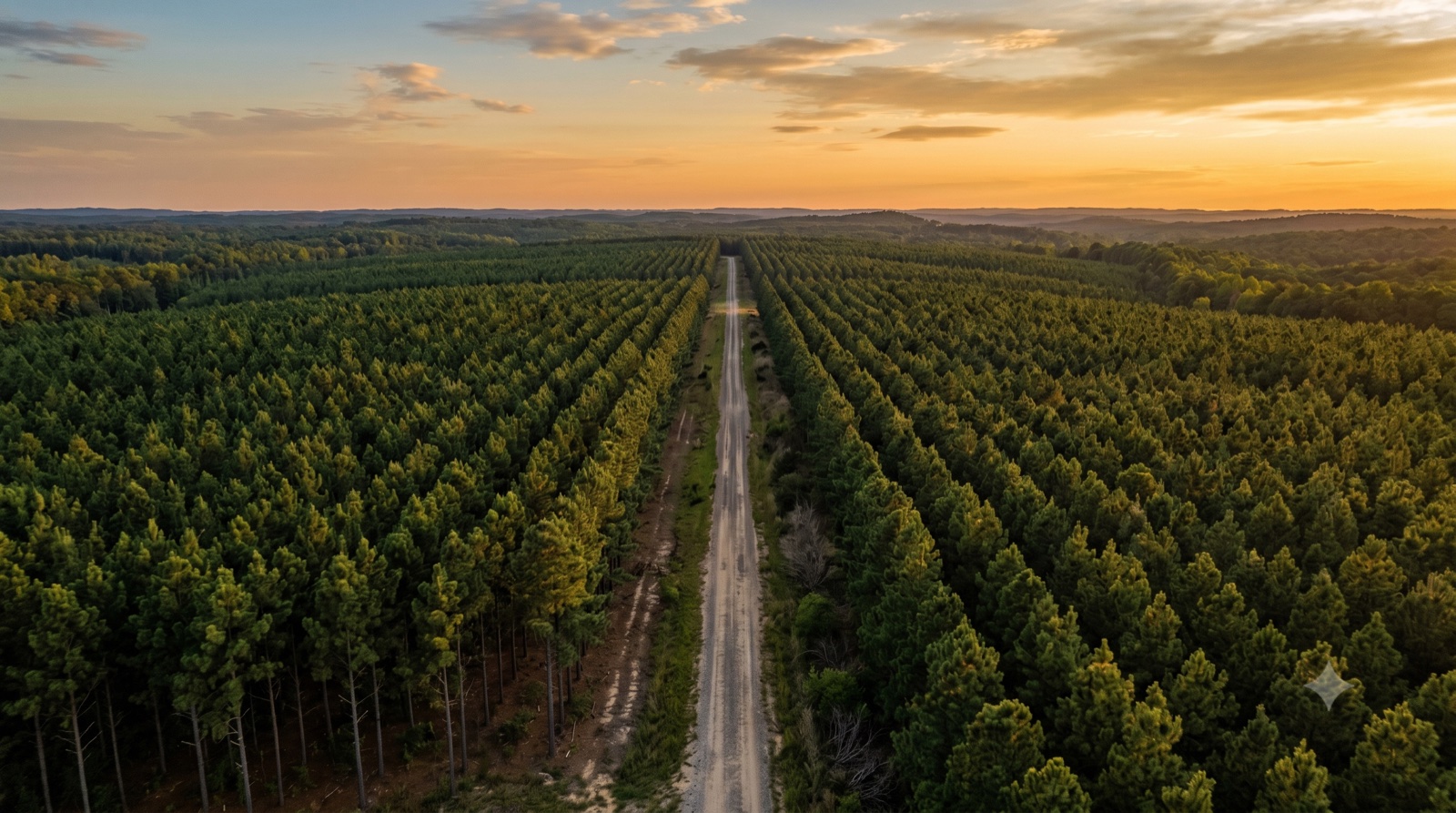
How to Sell a Cutover or Recently Logged Timber Tract
Key Takeaways
- A cutover tract sells for less than it did a year ago because the asset that carried the value — the standing timber — was just removed: What remains is bare or regenerating land with a long lag before the next income event, since southern pine typically isn't ready for a first commercial thinning until roughly 12 to 18 years and a final harvest until 30 to 40 years, according to USDA Forest Service silvics data and university extension guidance
- Reforestation is an improvement cost, not free value: Site preparation, seedlings, and planting for artificial pine regeneration commonly run a few hundred dollars per acre — Alabama Cooperative Extension reported mechanical site preparation averaging about $173 per acre and prescribed burning about $32 per acre in 2022 — and federal cost-share through EQIP can offset a share of those costs for the next owner
- Tax treatment after a harvest is its own decision: Timber basis, depletion, capital-gains eligibility on the timber proceeds, and the §194 reforestation deduction and amortization all interact, and they should be reviewed with a tax advisor — the USDA Forest Service publishes annual Tax Tips for Forest Landowners as a starting point
How Do You Sell a Cutover or Recently Logged Timber Tract?
You sell a cutover by pricing it for the underlying bare land value — site index and access — and targeting buyers prepared to wait for the next rotation: institutional timber investors, recreational buyers, adjacent landowners, or direct cash buyers willing to purchase as-is.
You already sold the timber. The logging crew has come and gone, the checks cleared, and now you are looking at a parcel covered in slash, stumps, rutted skid trails, and the first green flush of regeneration — or nothing but bare ground. The hard truth is that the thing that made the property valuable was just hauled off to the mill, and selling what's left is a different problem than selling a standing forest.
This is the post-harvest, or "cutover," condition. It is one of the toughest land types to move on the open market because the value driver is gone, the next income event is decades away, and the parcel often looks rough enough to scare off retail buyers. But cutover land does sell — to the right buyers, presented honestly, and priced for what it actually is rather than what it was before the cut.
This guide covers what "cutover" means and where it sits in the stand-age cycle, why a recently logged tract is harder to sell, how value is assessed without standing timber, the tax angles after a harvest, reforestation cost-share programs, who buys cutover land, and how to present one honestly. For the broader playbook on selling land that still has merchantable standing timber — timber cruises, mill-based valuation, and the full buyer landscape — see how to sell timberland. This article picks up where that one leaves off: after the cut.
What Is a Cutover Tract and Where Is It in the Stand-Age Cycle?
A "cutover" is land where the merchantable timber has recently been clear-cut or harvested, leaving behind a bare or regenerating site. Depending on what the landowner did after the harvest, a cutover falls into one of a few conditions: raw bare cutover with slash and stumps, a freshly site-prepped and replanted tract, or a young pre-merchantable stand a few years into the next rotation.
The Southern Pine Rotation, Start to Finish
Understanding why cutover land is a patient asset means understanding the rotation cycle. For loblolly pine — the dominant managed species across the Southeast — a typical sawtimber rotation runs something like this, according to USDA Forest Service silvics and university extension publications:
- Year 0: Site preparation (mechanical, chemical, or prescribed burn) and replanting, commonly around 500 to 600 seedlings per acre.
- Years 1–5: Establishment. Seedling survival is checked in the first year so bare spots can be replanted before surviving trees grow too large, per Mississippi State and Arkansas extension guidance. A precommercial thinning may occur in this window.
- Years 5–15 (pre-merchantable): The stand grows but produces no harvest income. This is the long, quiet middle of the investment.
- Years 12–18: First commercial thinning (mostly pulpwood and chip-n-saw).
- Years 22–30: Second thinning.
- Years 30–40+: Final harvest.
A recently logged tract sits at year zero of that cycle — or before it, if no replanting has happened yet. The next meaningful income is more than a decade out at best.
Bare Cutover vs. Replanted vs. Pre-Merchantable
These distinctions matter to buyers. A bare cutover that still needs site prep and planting carries an unfunded improvement cost for the next owner. A freshly replanted tract has that cost already spent but is at its highest-risk, lowest-visible-value stage. A pre-merchantable stand a few years in shows visible green and a shorter runway to the first thinning. Lumping them together as "timberland" misleads buyers and invites lowball assumptions.
What Is a Cutover Tract Worth After the Timber Is Gone?
Without standing timber to value, a cutover is assessed essentially as bare land — the underlying "timberland value" of the dirt itself, judged on its capacity to grow the next rotation and on any non-timber uses. The single biggest factor a timber-minded buyer looks at is site index: how fast trees grow on that particular soil. High-site-index ground that regenerates quickly is more attractive to a buyer planning the next rotation than slow-growing ground, even when both look equally bare after the cut. Access, parcel shape, road frontage, soil drainage, and any recreational value round out the picture.
This guide does not quote what cutover land sells for per acre — that figure depends entirely on the specific parcel, region, and market, and any blanket number would be misleading. For how land value is assessed generally, see how much is my land worth.
Why a Recently Logged Tract Is Harder to Sell
Several forces work against a fresh cutover:
- The value driver was just removed. The merchantable timber that anchored the property's worth is gone, so the seller is now marketing the residual land alone.
- The income lag is long. A buyer faces a decade-plus wait before the first thinning produces any return, which thins the pool of patient buyers willing to wait.
- The ground looks rough. Slash piles, stumps, rutted skid trails, churned-up landings, and erosion on steeper sites all make the parcel photograph and walk poorly — retail and recreational buyers often recoil at first impression.
- Reforestation is an unfunded cost. If the tract hasn't been replanted, the next owner inherits a site-prep-and-planting bill before the rotation clock even starts.
None of this means the land is worthless. It means it is a patient, lower-visibility asset that attracts a narrower set of buyers — and that the seller's expectations need to reset from the pre-harvest figure.
| Tract Condition | Primary Value Driver | Typical Buyer Pool | Time to Next Income | Typical Ground Condition |
|---|---|---|---|---|
| Recently cutover (bare) | Site index, access, soil | TIMOs, neighbors, cash buyers | 12–18+ years (after replant) | Slash, stumps, rutted skid trails |
| Pre-merchantable / replanted | Site index, stand health, years to first thin | Long-horizon investors, recreational buyers | ~12–18 years to first thin | Young stand, low visible volume |
| Mature standing timber | Merchantable volume, species, product class | Timber companies, TIMOs, investors | Immediate (harvest-ready) | Closed-canopy forest |
What Are the Tax Consequences of Selling After a Harvest?
Selling after a harvest layers a few tax questions on top of one another, and they should be reviewed with a qualified tax advisor — the rules are intricate and the dollars are real. The USDA Forest Service publishes annual Tax Tips for Forest Landowners as a plain-language starting point, and the IRS Instructions for Form T (Timber) govern how timber accounts are reported.
Timber Basis and Depletion
When you bought or inherited the property, part of its basis was attributable to the timber itself (a "timber account"). When that timber is cut and sold, you can recover the depletion — the portion of your basis allocated to the harvested volume — which reduces the taxable gain on the timber proceeds, according to IRS Form T instructions. Inherited timberland often carries a stepped-up basis as of the date of death, which can substantially reduce the taxable gain.
Capital Gains on the Timber Proceeds
At a high level, timber held for more than a year and disposed of under the qualifying provisions of the tax code (such as IRC §631) may be eligible for long-term capital gains treatment rather than ordinary income — a meaningful difference in rate. Whether your harvest qualifies depends on how title was held, the holding period, and how the sale was structured. This is a determination for a tax professional, not a rule of thumb.
Reforestation Deduction and Amortization (§194)
If you replant after the harvest, the federal tax code offers relief on those reforestation expenditures. Under IRC §194, a taxpayer may deduct up to $10,000 per qualified timber property per year of reforestation expenses and amortize the remainder over an 84-month period, according to the National Timber Tax project and the statute itself. There is a recapture catch: if you dispose of the property within ten years after claiming amortization, part of the gain may be recaptured as ordinary income. If you sell the cutover rather than replanting it yourself, these provisions instead matter to the buyer who reforests.
Because the timber-sale tax, the depletion, the basis adjustment, and the §194 election all interact, coordinate with a tax advisor before — not after — you structure a post-harvest sale.
Reforestation Cost-Share and Programs That Affect Cutover Value
For a cutover that hasn't been replanted, reforestation is the largest near-term improvement cost — and it is partly subsidized. Understanding the programs helps both sellers (who may complete some site prep to broaden the buyer pool) and buyers (who will factor available cost-share into what they'll pay).
What Reforestation Actually Costs
These are management and improvement costs from extension sources — not land prices. Alabama Cooperative Extension's Costs & Trends of Southern Forestry Practices 2022 reported mechanical site preparation averaging roughly $173 per acre and prescribed burning roughly $32 per acre. NC State Extension's reforestation economics work describes investment scenarios ranging from low-input planting up through comprehensive site preparation plus planting, on the order of a few hundred dollars per acre depending on intensity. Pine seedlings are commonly planted at roughly 500 to 600 per acre, and hand planting typically costs less than machine planting. These ranges vary by region, site, and contractor — they are improvement costs, not what the land sells for.
EQIP and State Cost-Share
The USDA Natural Resources Conservation Service administers the Environmental Quality Incentives Program (EQIP), which provides financial and technical assistance for forestry practices including tree planting, mechanical and chemical site preparation, prescribed burning, and forest stand improvement. EQIP generally pays a flat rate based on a percentage of average practice costs, and historically underserved producers may qualify for higher rates, per NRCS. Practices must follow a conservation plan approved through the local NRCS office. NC State Extension's Financial Incentives for Forest Management catalogs EQIP alongside state forestry commission cost-share programs, which vary considerably from state to state.
The USDA Forest Service Forest Stewardship Program provides technical assistance for multi-resource management plans on non-industrial private forest land, which can also help position a parcel. Note that program contracts attach to the landowner and property — disclose any existing EQIP contract, since obligations and potential penalties can pass to a buyer at closing.
Who Buys Cutover Land?
The buyer pool for a fresh cutover is narrower than for mature timber, but it is real. Knowing who is actually in the market helps a seller present the parcel to the people most likely to act.
Timber REITs, TIMOs, and Replanting Neighbors
Institutional timberland owners — timber REITs and timber investment management organizations (TIMOs) — buy post-harvest ground at a land-value basis specifically to grow the next rotation. They move at scale, run their own analysis, and want clean title and reliable access. Adjacent landowners are often the most motivated buyers of all: a neighbor already replanting their own cutover can fold yours into the same rotation, the same site-prep contract, and the same management plan. Family forest owners are a large slice of this market — USDA Forest Service Forest Inventory and Analysis data shows family and individual owners hold the largest share of U.S. forest land.
Recreational and Hunting Buyers
A cutover's rough appearance is exactly what some recreational buyers want. Early regeneration, brush, and edge habitat create excellent browse and cover for deer and bedding for quail — a young cutover can be prime hunting ground precisely because it isn't a closed-canopy forest. These buyers value the land's future recreational use, not its current timber. If that's your likely audience, see how to sell hunting land and how to sell recreational or off-grid land.
The Patient Cash Buyer
Direct cash buyers purchase cutover and post-harvest tracts in as-is condition — slash, stumps, ruts and all — without requiring the seller to replant first, clean up the landings, or wait for the institutional timber market to move. This is often the cleanest path for a seller who doesn't want to carry the property through another tax year or sink money into site prep just to make it marketable.
Selling a Cutover Without the Wait
A cutover is the definition of a patient-money asset on the open market: a thin buyer pool, a decade-plus runway to the next income, rough ground that shows poorly, and an unfunded replanting bill if you haven't reforested. Listing one can mean months of carrying costs, property taxes, and tire-kickers while you wait for a buyer willing to wait.
The alternative is a direct sale. Jerez Land buys cutover and recently logged tracts directly and makes a parcel-specific, firm written offer — a real number for your specific tract that absorbs the carrying cost, the marketing risk, and the resale risk of an asset that won't produce income for years. We buy as-is, so you don't replant, clear slash, or fix skid trails first.
Request a no-obligation cash offer on your cutover tract. We purchase post-harvest, pre-merchantable, and replanted land and can provide a written number without requiring you to reforest or clean up the site first.
For related situations, see why won't my land sell if a cutover has been sitting, selling land as an out-of-state owner, or selling land with an active timber or hunting lease if a lease is still attached. For more rural land guides, browse the blog or start at the homepage.
Frequently Asked Questions
Can I sell my land right after I had the timber logged?
Yes. You can sell a cutover tract immediately after a harvest — there is no required waiting period. The main adjustment is to your expectations: the merchantable timber that carried most of the value is gone, so the parcel now sells as bare or regenerating land. A direct cash buyer will purchase a fresh cutover as-is, slash and stumps included, often within a few weeks, without requiring you to replant first.
I just harvested the timber — is my land worth less now?
Almost always, yes. The standing timber was the value driver, and once it's been cut and sold, what remains is the underlying land — judged mainly on site index (how fast trees regrow there), access, and any recreational use. The next income event from the next rotation is more than a decade away, which narrows the buyer pool and reduces what most buyers will pay relative to the pre-harvest figure.
I have a cutover — who actually buys this kind of land?
The most active buyers are timber REITs and TIMOs growing the next rotation, neighboring landowners folding the tract into their own replanting plans, recreational and hunting buyers who want cheap young cover for deer and quail, and patient cash buyers who purchase as-is. The retail buyer pool is thin because the ground looks rough and produces no near-term income.
Do I have to replant before I sell a cutover?
No. You are not required to reforest before selling, and many sellers choose not to — replanting is a real improvement cost (site prep, seedlings, and planting commonly run a few hundred dollars per acre, per extension sources) that you may not recoup in a quick sale. A direct cash buyer purchases the tract unplanted and handles reforestation themselves, often using EQIP or state cost-share to offset the expense.
What are the tax consequences of selling after I harvested the timber?
After a harvest you may face tax on the timber proceeds, offset by depletion of your timber basis, and the proceeds may qualify for long-term capital gains treatment if you held and disposed of the timber under the qualifying rules. If you replant, IRC §194 allows a deduction and 84-month amortization of reforestation costs, with potential recapture if you sell within ten years. These interact in complex ways — review the USDA Forest Service Tax Tips for Forest Landowners and consult a tax advisor before structuring the sale.
How is my cutover different from standing timberland when selling?
Standing timberland is valued largely on its merchantable timber — measured by a forester's cruise — and attracts buyers ready to harvest now. A cutover has no merchantable timber, so it sells as bare or regenerating land on site quality and access alone, draws a narrower and more patient buyer pool, and faces a long lag to the next income. For the full process of selling land that still has standing timber, see how to sell timberland.
Disclaimer: This article is for informational purposes only and does not constitute legal, financial, or professional advice. Laws and regulations vary by jurisdiction and change over time. Timber taxation, reforestation cost-share programs, and forestry incentives differ significantly by state and over time. Always consult with a licensed forester, tax advisor, and attorney before making timber, reforestation, or land sale decisions. Jerez Land is not responsible for actions taken based on this information.