
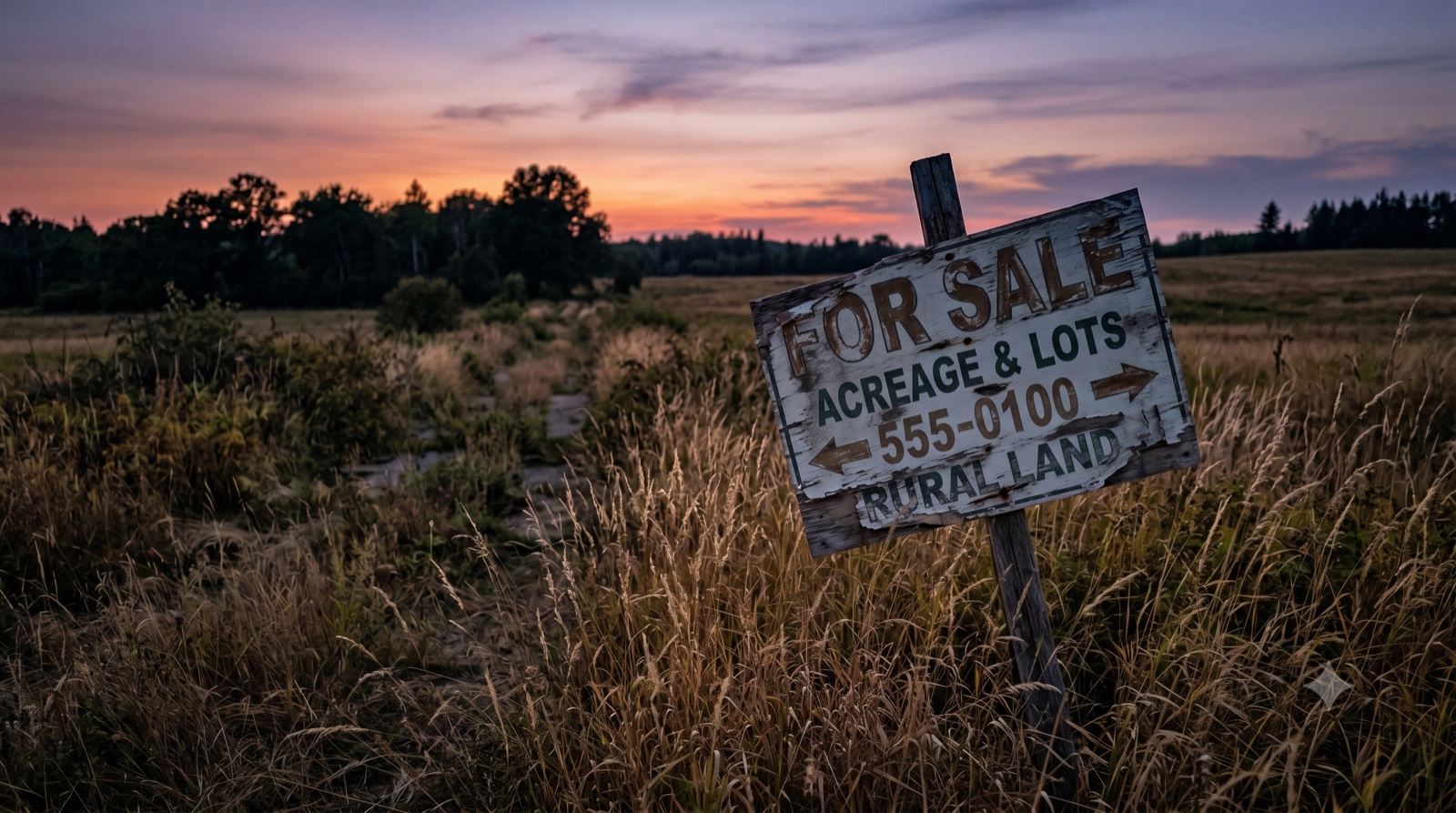
Should I Sell My Land or Keep It? A Decision Framework for Landowners
Key Takeaways
- Vacant land generates costs even when it sits idle. Property taxes, insurance, and the opportunity cost of tied-up capital add up every year you hold — with no rental income or yield to offset them, according to analysis from the Bradford Tax Institute and Nolo.
- Vacant land is one of the least liquid assets an individual can own. Selling typically takes 6–12 months or longer on the open market, with a thin buyer pool, limited financing options for buyers, and transaction complexity that makes a quick exit difficult, according to Land.com market data and LandBoss.
- The keep-vs-sell decision ultimately comes down to four variables: your liquidity needs, the realistic carrying cost relative to expected appreciation, your exposure to liability, and whether you have a defined plan for the parcel. When none of those four point toward holding, selling is usually the rational choice.
Should You Sell Your Land or Keep It?
Whether to sell or keep your land depends on four key variables: your liquidity needs, the realistic carrying costs relative to your expected appreciation, your exposure to liability, and whether you have a defined plan for the parcel. This is the question that lands in the back of every landowner's mind at some point — especially when a property tax bill arrives and the land is still sitting there, unused, producing nothing. The honest answer depends on your specific situation, not on a general rule about land being a "good investment." Some parcels are worth holding. Others are quietly draining value year after year.
This guide gives you a structured way to work through the decision. It covers the real carrying costs of holding land, the opportunity cost of tied-up capital, the liquidity constraints you'll face if you need to exit fast, the appreciation potential you'd be giving up by selling, and the liability exposure that comes with ownership. At the end is a side-by-side comparison table.
If you're looking for guidance on when market conditions favor selling, see when should you sell land. If you want to understand what your parcel might realistically be worth before deciding, how much is my land worth walks through the valuation process. When you're ready to explore what a cash offer looks like for your specific parcel, request one here — it's free, there's no obligation, and you'll have a firm number to work with.
More guides on every aspect of selling land are on the blog.
What Does It Actually Cost to Hold Vacant Land Each Year?
Most landowners think about holding costs in terms of property taxes. That's the most visible line item, but it's not the only one — and when you add everything up, the annual cost of holding vacant land can be meaningfully higher than most owners expect.
Property taxes are assessed on vacant land even when the land produces no income. The tax is calculated based on the county's assessed value and the local millage rate, which varies widely by state and county. For rural vacant parcels in lower-tax states, the annual tax bill may be a few hundred dollars. In higher-tax jurisdictions or on higher-assessed parcels, the bill can reach thousands of dollars annually. The IRS allows investors to deduct property taxes on investment land, but the tax liability remains a real cash outflow regardless of the deduction, according to Nolo.
Liability exposure is a carrying cost that rarely appears on a spreadsheet but can be significant. As the owner of record, you bear legal responsibility for conditions on the property. Under the attractive nuisance doctrine recognized in many states, a landowner can be held liable if a child is injured on the property even if they were trespassing, according to Forchelli Deegan Terrana Law. Insurance coverage for vacant land is available but adds another annual cost, and gaps in coverage can expose you to significant risk.
Maintenance and compliance costs vary by parcel. Some counties require that vacant lots be kept clear of invasive vegetation, debris, or structures that violate local code. Periodic mowing, brush clearing, or weed abatement — whether required by ordinance or done to protect property value — are real line items.
The opportunity cost of tied-up capital is the largest carrying cost that most landowners never see on a statement. It represents what your equity in the land could be earning if it were deployed elsewhere. If the land is owned free and clear and is worth $80,000, that $80,000 of equity is sitting in an illiquid, zero-income asset. The S&P 500 has historically returned approximately 10% annually over the long run, according to Fidelity. Treasury instruments have offered rates well above 4–5% in recent years. Every year the land sits, the capital tied up in it forgoes whatever those alternatives would have returned.
When you add property taxes, insurance, liability exposure, and opportunity cost together, the total annual cost of holding vacant land can easily reach 4–6% of the property's value or more — with no income stream to offset it.
How Illiquid Is Vacant Land, and Why Does That Matter?
Illiquidity means you cannot quickly convert the asset to cash without accepting a significant discount. By that definition, vacant land is one of the least liquid assets an individual can own, according to Investopedia.
The reasons are structural. The buyer pool for vacant land is much smaller than for homes. Most potential buyers are investors, developers, or neighboring landowners — a narrow universe. Financing is harder to obtain: lenders view raw land as higher risk than improved property, often requiring larger down payments and shorter terms when they lend at all. This restricts the field of qualified buyers further.
The result is that vacant land commonly sits on the market for 6–12 months or longer before finding a buyer at full asking price, according to Land.com market data. LandBoss research covering recent market conditions confirms that rural vacant parcels in particular can take well over a year to sell through traditional listing channels. During that entire period, you continue to pay taxes and absorb opportunity cost — with no certainty the deal will close.
The illiquidity risk becomes acute when you need cash quickly. A medical expense, a business opportunity, a divorce, or estate settlement can create sudden liquidity pressure. At that point, selling land on your own timeline at a market price is no longer an option. Accepting a significant discount — or selling to a cash buyer who can close in weeks rather than months — becomes necessary. Understanding this constraint before the need arises is part of making a sound hold-or-sell decision.
For a detailed look at the full range of timelines across different selling paths, see how long does it take to sell land.
What's the Realistic Appreciation Potential You'd Be Giving Up?
The case for holding land is almost always an appreciation argument: land values rise over time, and you want to capture that gain. This is worth taking seriously — but it should be evaluated against the carrying costs you're paying to wait.
Land does appreciate, but the rate varies enormously by location, land type, and economic conditions. Farmland in high-demand agricultural regions has shown stronger appreciation than rural recreational or timber land in depressed markets. Infill parcels in growing metros can appreciate dramatically — but so can the tax assessments and carrying costs that come with rising valuations. Land in rural counties with flat or declining population may appreciate at rates far below broader national benchmarks.
The honest framing is this: appreciation potential is real but uncertain, location-specific, and not guaranteed on any timeline. Carrying costs, by contrast, are certain and recurring. The longer the appreciation timeline, the longer you absorb those certain costs in exchange for an uncertain gain.
Two additional factors shape this calculus. First, if you eventually sell at a gain after holding more than one year, long-term capital gains tax rates apply — 0%, 15%, or 20% depending on your income level, according to Kiplinger and IRS guidance. That's more favorable than ordinary income rates, which is a genuine benefit of a longer hold. Second, the gain must be large enough to cover the cumulative carrying costs and the foregone returns on your capital before the hold adds net value over a sale today.
The question is not whether land can appreciate. It can. The question is whether the specific parcel you own, in the specific market it sits in, is likely to appreciate enough over a realistic timeframe to justify the carrying cost burden and liquidity constraints of holding it. That's an empirical question, not a philosophical one.
For a realistic valuation of your specific parcel, see how much is my land worth. For guidance on common factors that reduce realized prices when you do eventually sell, what to consider when selling land covers the practical landscape.
What Other Factors Should Weigh Into the Decision?
Beyond the financial calculus, several practical considerations often tip the balance.
Do you have a defined plan for the parcel? The clearest case for holding is when you have a specific, time-bounded plan: you intend to build on the land within the next three years, or a neighboring development is under contract and you expect access improvements to increase the value materially. A defined plan with a defined timeline justifies carrying costs. An indefinite hold with no development path is a different calculation.
How does this land fit your overall financial picture? If the land represents a large share of your net worth, it is concentrating your financial risk in a single illiquid asset. Diversification — converting the land to liquid capital that can be deployed across multiple assets — has real financial value, particularly as you approach retirement or face other large financial goals.
Are you the sole owner, or is this a shared situation? Inherited land held among multiple heirs creates additional complexity. Co-owners may have differing opinions on the hold-or-sell question, and in some cases a partition action can force a sale through the courts. Resolving a co-ownership situation on your own terms, before disagreement escalates, is often preferable to waiting.
What is the land actually costing you in time and attention? Even passive ownership involves some management: reviewing tax bills, monitoring for trespass or dumping, keeping insurance current, responding to county notices. For a parcel that produces no income, this is overhead with no return.
Keep the Land vs. Sell Now: A Side-by-Side Comparison
| Dimension | Keep the Land | Sell Now |
|---|---|---|
| Carrying cost | Ongoing: property taxes, insurance, liability exposure, maintenance — certain annual outflows | Eliminated immediately upon closing |
| Liquidity | Illiquid; converting to cash takes months and may require accepting a lower price under time pressure | Full liquidity; proceeds deploy into any asset class |
| Opportunity cost | Capital remains locked in a zero-income asset, forgoing alternative returns | Freed capital can be invested in income-producing or higher-return alternatives |
| Appreciation upside | Retained; you capture any future gain in value | Forfeited; the buyer captures future appreciation |
| Risk exposure | Ongoing: market risk, tax assessment increases, liability, zoning changes, title disputes | Eliminated at closing; risk transfers to buyer |
| Effort | Requires ongoing management: taxes, insurance, compliance, monitoring | One-time transaction effort; then done |
| Tax treatment on gain | Long-term capital gains rates (0–20%) after one year of holding; deferred until sale | Tax event triggered at sale; same long-term rates apply if held more than one year |
| Capital structure flexibility | None; equity is locked until sale | High; proceeds can diversify, pay down debt, or fund other goals |
| Best fit for | Owners with a specific development plan, a short expected appreciation window, and no near-term liquidity needs | Owners without a defined plan, facing carrying cost pressure, needing liquidity, or holding a non-strategic parcel |
How to Use This Framework for Your Decision
Work through these four questions in order:
- Do you have a defined plan for this parcel within a realistic timeframe? If no, carrying costs are paying for an open-ended option with no expiration date.
- Can you afford the annual carrying costs without financial strain — indefinitely? If no, a forced sale at a discount later is worse than a voluntary sale at a fair price now.
- Do you need or want liquidity from this asset in the next one to three years? If yes, the illiquidity of land makes it the wrong place to park capital.
- Is the expected appreciation on this specific parcel, in this specific market, likely to outpace your carrying costs and the returns available on alternative investments? If you cannot answer this with real data, the honest answer is probably no.
If your answers to two or more of these questions point toward selling, a cash offer gives you a firm number to evaluate against the hold scenario with no obligation. Jerez Land reviews the specific parcel, presents a written offer, and handles the closing through a licensed title company — no listing period, no commission, no financing contingency.
Request your no-obligation cash offer — you'll have a real number in hand within a few business days. For guidance on how a cash sale compares to other paths, see best way to sell land and owner financing vs. cash offer.
Frequently Asked Questions
I'm holding vacant land — is it a good investment?
It depends on the specific parcel and your situation. Land can appreciate, especially in markets with growing demand, and long-term capital gains tax treatment after one year of holding is favorable. But vacant land generates no income, carries ongoing costs (taxes, insurance, liability exposure), and is among the least liquid assets you can own. Whether holding is a good investment requires weighing the expected appreciation on your specific parcel against those certain carrying costs — and having a realistic exit plan and timeline. For many owners of rural or non-strategic parcels, the math favors selling over an indefinite hold.
What costs am I actually paying each year to hold my vacant land?
Property taxes are the most visible cost, but the largest carrying cost is often the opportunity cost of tied-up capital — what your equity in the land could be earning elsewhere. The S&P 500 has historically returned around 10% annually over the long run, according to Fidelity. If your land equity is $60,000 sitting idle with no appreciation, that's a significant annual cost even if you never write a check for it. Liability exposure — particularly under the attractive nuisance doctrine in states that hold owners responsible for injuries on their property — is another cost that rarely appears on a spreadsheet until it does.
If I keep my land now but change my mind later, how fast can I sell it?
On the open market through a traditional listing, vacant land typically takes 6–12 months or longer to sell, according to Land.com and LandBoss research. The buyer pool is thin, buyer financing is harder to obtain than for improved residential property, and due diligence timelines are longer. If you need to sell quickly under time or financial pressure, you will likely face a choice between accepting a significant discount or waiting. A cash buyer can typically close in weeks rather than months — but that option is available on your terms now as well as later.
If I sell my land, will I owe capital gains tax?
If you sell at a gain, yes — but the rate depends on how long you've held the parcel. Land held for more than one year qualifies for long-term capital gains rates of 0%, 15%, or 20% depending on your taxable income, according to Kiplinger and IRS guidance. These rates are significantly more favorable than ordinary income rates. If you've held the land for less than one year, the gain is taxed as ordinary income. Consult a tax professional about your specific situation — the interaction of your basis, depreciation, and state taxes matters. See also capital gains tax when selling land for a detailed walkthrough.
Does it make sense to sell land I inherited even if the family has owned it for generations?
Sentimental value is real, and it's worth naming it honestly in the decision. But it is separate from the financial case for holding. Inherited land that has been in a family for decades may have appreciated significantly, which means the capital tied up in it is also significant — and potentially generating meaningful opportunity cost. Inherited parcels held among multiple heirs also create coordination and legal complexity over time. If the land serves no functional or financial purpose for current owners, selling it — and deploying the proceeds toward goals that actually matter to the heirs today — is often the financially sound choice. For an overview of the selling process and what to expect, see best way to sell land.
Should I get a cash offer before deciding whether to keep or sell?
Yes — it costs nothing and gives you a real number to anchor the decision. Without a firm offer in hand, the keep-vs-sell comparison is abstract: you're weighing certain carrying costs against an estimated sale price. With an offer in hand, you can compare a specific dollar amount you'd receive today against the specific carrying costs you'd pay to hold, and make the decision with actual numbers. Requesting an offer creates no obligation to sell.
Disclaimer: This article is for informational purposes only and does not constitute legal, financial, or professional advice. Laws, regulations, title practices, and market conditions vary by jurisdiction and change over time. Always consult a licensed real estate professional, title company, or attorney before making decisions about selling property. Jerez Land is not responsible for actions taken based on this information.