
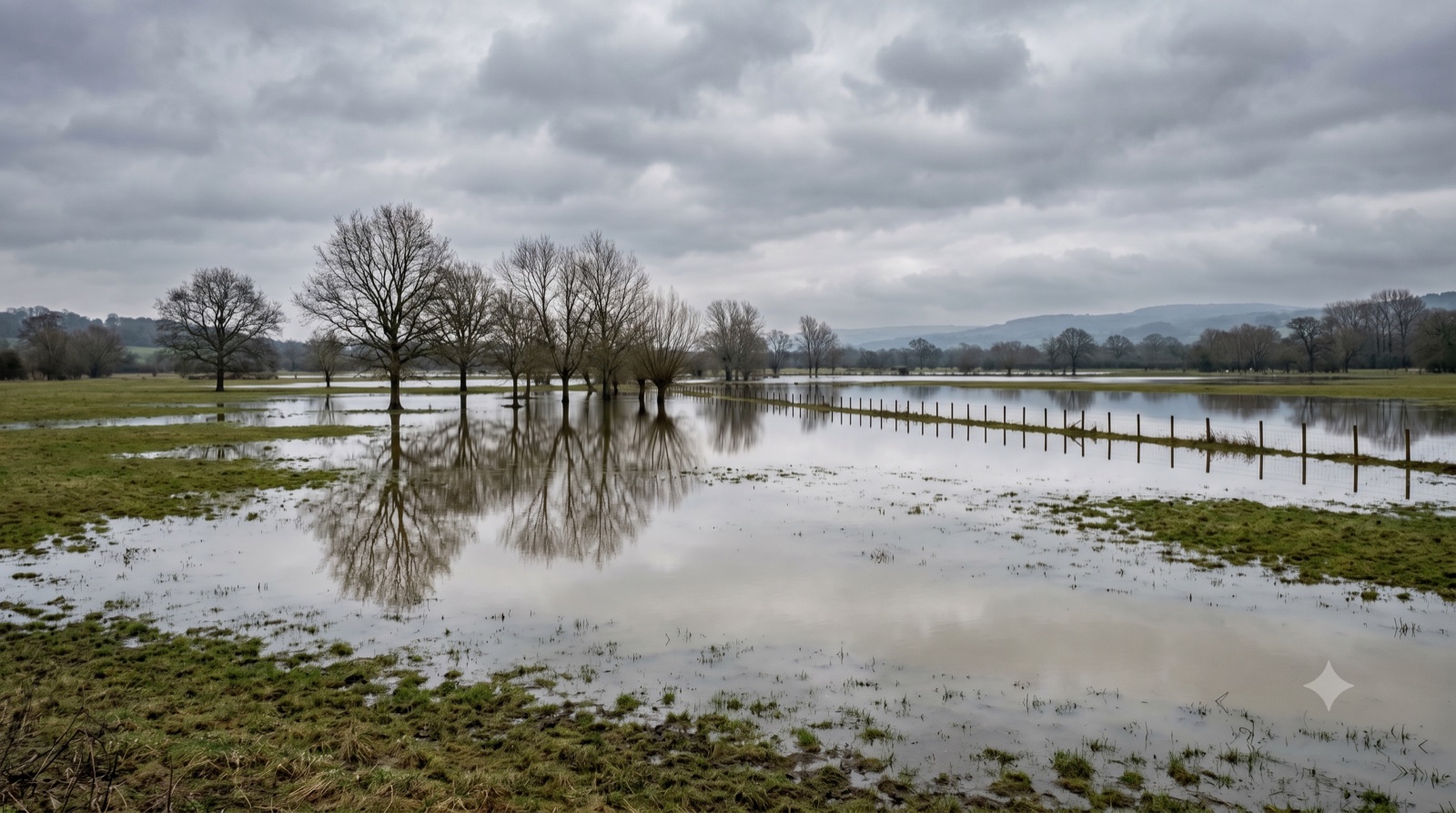
Selling Land After a Wildfire, Hurricane, or Other Natural Disaster
Key Takeaways
- Your casualty-loss deduction is limited by basis, not by what the timber was worth: The deductible loss is the lesser of your adjusted basis in the timber block or the decrease in fair market value, per IRS guidance — so an owner with zero basis in naturally regenerated timber may have no deduction at all despite a devastating loss
- Debris on private land is generally the owner's responsibility: FEMA's Public Assistance program treats private property debris removal as ineligible except in narrow circumstances requiring a local government sponsor and a right-of-entry agreement
- Salvage timber has a closing window measured in months, not years: Blue-stain fungus commonly degrades fire-killed and storm-downed pine within 6 to 10 months, and can begin within weeks during the growing season — and after a regional event, every landowner is competing for the same limited pool of loggers
What Should You Do With Land After a Wildfire or Storm Destroys It?
After a fire, hurricane, tornado, or flood damages your land, three decisions come first: whether to salvage the merchantable timber before it degrades, what your tax basis actually allows you to deduct, and who is responsible for the debris and hazard trees left behind. Land remains sellable in every one of these situations — but the sequence in which you handle them determines how much value survives.
This guide is about post-event damage, not about flood-zone designation. If your question is about a FEMA flood zone on the map rather than water that has already come through, see our guide on selling land in a flood zone.
How Long Do You Have to Salvage Fire-Killed or Storm-Downed Timber?
Less time than most landowners expect, and the window varies sharply by species and season. Fire-killed and blown-down timber begins deteriorating almost immediately. Bark beetles spread blue-stain fungus, which commonly appears in pines within roughly 6 to 10 months and can begin within weeks if the damage occurs during the growing season. By the second season after the event, staining has typically spread into the heartwood and degraded the lumber grade — the wood is not structurally different, but its grade and therefore its marketability change.
Because the range is genuinely wide, treat any single number you see as a rule of thumb rather than a deadline. Oregon State University Extension publishes a landowner decision guide, To salvage or not to salvage after wildfire?, that walks through the tradeoffs including site disturbance and erosion risk, which sometimes argue against salvage. State forestry agencies publish their own regional guidance — the North Carolina Forest Service, for instance, maintains storm-damage guidance for forest landowners.
The practical constraint after a large regional event is not biology but capacity. Hurricanes and large fire complexes damage tens of thousands of acres simultaneously, and every affected landowner needs a logger, a hauler, and a mill at the same moment. That surge is a well-understood feature of timber markets after catastrophic disturbance, and it means the realistic question is often not "should I salvage" but "can I get anyone out here before the window closes."
Can You Deduct a Timber Loss From a Wildfire on Your Taxes?
You can, but the deduction is limited by your adjusted basis in the timber — not by the market value of what burned. This is the single most misunderstood point in post-disaster forestry, and it disappoints many landowners.
The deductible casualty loss is the lesser of (a) your adjusted basis in the timber block, or (b) the decrease in fair market value caused by the casualty, per IRS guidance on timber casualty losses. If your adjusted basis is zero — common for naturally regenerated timber, ground held for decades without a harvest, or reforestation costs already fully amortized — then no deduction is available regardless of how much timber was destroyed.
Several other rules shape the calculation:
- The unit of measure is the timber block, not the burned trees. For timber, the "single identifiable property" is your own depletion block, and the loss is computed against the entire block using basis from undamaged timber in the same block. The IRS reversed its earlier per-unit position in Rev. Rul. 99-56. Block boundaries cannot be redrawn after the fact to enlarge a deduction.
- Personal-use property requires a federally declared disaster. For tax years 2018 through 2025, casualty losses on property held for personal use are deductible only if attributable to a federally declared disaster, per IRS Publication 547. Timber held as an investment or in a trade or business is not subject to that restriction. Personal-use losses are further reduced by $100 per event and by 10% of adjusted gross income.
- Salvage income does not cancel the casualty loss. You do not have to complete a salvage sale to claim the loss, and salvage proceeds are not treated as compensation that reduces it.
- Salvage gain can often be deferred. A salvage sale is treated as an involuntary conversion, and gain can be deferred under IRC § 1033 by reinvesting the proceeds in qualifying replacement property — timber, timberland, or reforestation costs — generally within two years after the close of the first tax year in which gain is realized. In a federally declared disaster area, § 1033(h) broadens what counts as similar replacement property for business or investment holdings.
- You may be able to choose the tax year. In a federally declared disaster area, the loss can be claimed on the current-year return or on an amended prior-year return.
This is an area where a forestry-literate CPA earns their fee. The IRS publishes an audit techniques guide showing exactly how examiners evaluate these claims, and Mississippi State University Extension and the UGA Warnell School both publish landowner-facing walkthroughs. Establishing basis is usually the hard part, and it needs documentation.
Who Pays to Clean Up the Debris on Your Land?
You do, in the general case. FEMA's Public Assistance program treats debris removal on private property as ineligible for federal reimbursement as a baseline rule. The exception is narrow: a local or state applicant must demonstrate that removal is in the public interest because of a health or safety threat, that it has the legal authority to act, and that it has obtained right-of-entry and hold-harmless agreements from each affected property owner.
In practice, after a major declared disaster, right-of-entry programs are often stood up — frequently administered through the U.S. Army Corps of Engineers — allowing owners to opt in and have eligible debris and hazardous material removed. Opting in does not affect eligibility for other FEMA assistance. Opting out shifts all permitting, inspection, and removal cost back to you.
These programs commonly run in two phases: Phase 1 removes hazardous materials — visible asbestos, household hazardous waste, propane and pressurized cylinders, batteries — at no cost to the owner; Phase 2 removes general debris, ash, and structures, and does not begin until Phase 1 is complete.
The hazards matter for liability as well as cost. EPA guidance notes that structures built before 1975 may contain significant asbestos, that wetting structures during demolition reduces airborne asbestos migration, and that asbestos-containing debris must go to a landfill permitted to accept it. Ash and debris from burned structures can contain heavy metals and other hazardous material. Burned vehicles, fuel and oil, and agricultural or pool chemicals are all treated as priority hazardous-waste categories in post-fire cleanup.
What Disaster Assistance Programs Exist for Landowners?
Three federal programs are the ones most rural landowners will encounter, and each has a different eligibility gate.
| Program | Agency | Who it covers | What it does |
|---|---|---|---|
| EFRP — Emergency Forest Restoration Program | USDA FSA | Owners of non-industrial private forest land | Debris removal from forestland, site prep, planting, stand improvement, restoring forest roads and stream crossings. Cost-share stated at up to 75% |
| ECP — Emergency Conservation Program | USDA FSA | Farmland owners and operators | Debris removal from farmland, restoring permanent fences, grading and shaping land, restoring conservation structures. Up to 75%, or up to 90% for limited-resource, socially disadvantaged, and beginning producers |
| EWP — Emergency Watershed Protection | USDA NRCS | Generally requires an eligible sponsor (city, county, conservation district, tribe) | Debris removal from stream channels, damaged culverts and bridges, floodplain impairment. No presidential disaster declaration required |
A few mechanics worth knowing. EFRP requires that the landowner has already incurred qualifying restoration costs, and signup windows are announced per-disaster rather than running continuously. ECP practices generally cannot begin before FSA approval and inspection, though FSA has waived that in specific disasters. EWP is the one where private owners usually cannot apply directly — the exception is the floodplain easement component, where a private owner can apply through the local NRCS office.
Funding for these programs is subject to annual appropriations, and cost-share figures and caps can change. Confirm current terms with your county FSA or NRCS office rather than relying on any published summary, including this one.
Does Insurance Cover Timber or Vacant Land Damage?
Usually not, and this surprises people. Standard vacant-land policies are liability coverage for the landowner — they do not insure the timber itself, even when marketed under a "timberland insurance" label. Protecting standing timber value requires separate, specialized standing-timber coverage, which is uncommon among small and individual landowners. If you are actively harvesting or running a forestry operation, a basic vacant-land policy typically will not apply at all and a dedicated forestry liability policy is needed.
The practical consequence for most rural landowners is that there is no insurance recovery for the timber loss. The casualty-loss deduction and the USDA cost-share programs above are the financial levers that actually exist, not an insurance claim.
What Do You Have to Disclose When Selling Damaged Land?
Disclosure duties for vacant land are genuinely different from those for a house, and they vary by state — so this is a question to answer for your specific state rather than from a general rule.
Many state residential seller-disclosure statutes are written for "residential real property" and have been interpreted not to reach vacant land. Texas is a clear example: Texas Property Code § 5.008 applies to residential real property and has been held not to apply to sales of vacant land. But that is a state-specific answer, not a national one, and you should not assume vacant land is exempt in your state. Some states extend disclosure to unimproved land, and flood-risk disclosure in particular is a patchwork — roughly 29 states impose some form of flood-risk disclosure requirement and about 21 do not, with no uniform federal flood-history disclosure mandate.
Separately from any statutory form, sellers generally remain obligated under common law not to actively conceal or misrepresent known material defects. The specific standard is state law, so confirm it locally.
Beyond the statute, three physical conditions after a disaster are worth disclosing because they are both material and hazardous:
- Standing dead timber. Post-fire snags are the textbook case in premises-liability law. A landowner with notice that a tree is visibly dead, dying, or hazardous can be held liable if it falls and injures someone or damages a neighbor's property. NRCS publishes a hazard-tree removal guide specifically for post-fire landowners. This is a live liability while you still own the land, not only a disclosure item.
- Damaged access. Washed-out roads, failed culverts, and destroyed bridges affect whether a buyer can reach the property at all.
- Erosion. Fire-scorched slopes are vulnerable to erosion and downstream flooding, and that condition can worsen between listing and closing.
Do You Have to Replant Before You Can Sell?
No — we found no federal or state requirement that burned land be reforested before a sale can close. Reforestation obligations in state forest practices acts are generally triggered by a timber harvest, which is a different event from an uncontrolled fire. If you salvage-log the tract, that harvest may itself trigger a replanting duty under your state's forest practices act, so check that before you salvage rather than after.
Whether to replant at all is a management and economic decision. Extension guidance recommends stabilizing fire-scorched slopes with native grass seeding, water-management features, and erosion-control blankets regardless of the replanting decision. Lower-severity burns may regenerate naturally; higher-severity burns generally need active planting. And there is a bottleneck here too: after a large regional fire, demand for seedlings and planting crews can far exceed supply, pushing active reforestation out to as much as two to five years — well beyond the normal one-to-two-year replanting window.
For a seller, that timeline is often the deciding factor. Holding a burned tract for five years to replant it means five more years of property taxes, liability exposure from standing snags, and erosion, before the replanted stand is worth anything close to mature timber.
What Are Your Options for Selling Damaged Land?
Salvage first, then sell makes sense when merchantable timber remains, a contractor is actually available inside the window, and salvage will not trigger a replanting obligation you do not want. Run the § 1033 deferral question past a CPA before the sale closes, not after.
Sell as-is without salvaging is often the more realistic path when the window has closed, no logger is available, or the volume does not justify a harvest. Damaged land does sell — the buyer pool narrows to those comfortable with cleanup, snag removal, and a long regeneration horizon.
Listing with an agent who has genuine timberland experience helps reach buyers who can price a damaged tract, though expect a longer timeline and commissions in the 5–6% range.
Working with a direct cash buyer like Jerez Land means the debris, the hazard trees, the access repair, and the regeneration timeline become our diligence problem rather than obstacles a retail buyer's lender and inspector have to be talked through. We make parcel-specific, firm written offers based on a full review of the property in its actual condition, and we absorb the carrying costs, cleanup, marketing expense, and resale risk. Our offers are not formulas. Request a cash offer for your land.
For related situations, see our guides on selling timberland, selling a cutover or recently logged timber tract, and selling land as an out-of-state owner. For county-level land analysis, explore our blog.
Frequently Asked Questions
A wildfire burned 80 acres of my timber last fall and I live three states away — is the land worth anything now or should I just sell it?
The land itself still has value; what changed is the timber and the near-term carrying burden. Your first two calls should be to a consulting forester about whether merchantable salvage remains inside the degradation window — commonly 6 to 10 months for pine before blue stain sets in — and to your county FSA office about the Emergency Forest Restoration Program, which cost-shares debris removal, site prep, and replanting on non-industrial private forest land. If you are an absentee owner facing five or more years to regeneration plus taxes, liability from standing snags, and erosion, selling as-is is a legitimate and common decision.
My hurricane insurance didn't cover the timber loss on my hunting land — can I actually deduct anything on my taxes, or is that money just gone?
It depends entirely on your adjusted basis in the timber, not on what the timber was worth. The deductible casualty loss is the lesser of your adjusted basis in the timber block or the decrease in fair market value, per IRS guidance. If you inherited naturally regenerated timber or have held the tract for decades without establishing basis, your basis may be zero and no deduction is available. If the land is held for personal use rather than investment or business, the loss is also only deductible if it is attributable to a federally declared disaster, per IRS Publication 547. Talk to a CPA who handles timber before assuming either way.
There's burned-out debris and a couple of dead vehicles on my late father's property after the wildfire — am I on the hook to clean that up myself before I can sell?
Generally yes, the cleanup is the property owner's responsibility — FEMA treats private property debris removal as ineligible for federal reimbursement except in narrow circumstances requiring a local government sponsor and right-of-entry agreements. After major declared disasters, opt-in right-of-entry programs are often available and typically remove hazardous materials such as asbestos, propane cylinders, batteries, and burned vehicles at no cost in a first phase. Check whether one is running in your county. You are not required to clean up before selling, but an as-is sale accounts for the condition.
I've got standing dead trees all over 40 acres after last year's fire and I'm worried about liability if one falls on a neighbor — do I have to deal with that before I list it?
You are not legally required to remove them before listing, but the liability is real while you still own the land. Under general premises-liability principles, a landowner who has notice that a tree is visibly dead, dying, or hazardous can be held responsible if it falls and causes injury or damage — and post-fire snags are the clearest possible case of notice. NRCS publishes a hazard-tree removal guide for post-fire landowners. Disclose the snags to any buyer, and understand that continuing to hold the property is itself the risk-carrying choice.
If I sell my burned timberland now instead of waiting to replant, am I leaving money on the table?
Not necessarily, because the replanting timeline is long and expensive to carry. After a large regional fire, seedling and planting-crew shortages can push active reforestation out two to five years, and a replanted stand then needs decades to reach merchantable size. In the meantime you carry property taxes, snag liability, and erosion risk. Federal cost-share through EFRP can offset some replanting cost if you want to keep the land. The decision usually turns on whether you intend to hold the tract for a full rotation — if not, waiting rarely pays.
A tornado flattened half the timber on my property and loggers in my area are backed up for months — should I wait for a salvage sale or sell the raw land as-is?
Weigh the degradation clock against contractor availability, because they often conflict. Blown-down timber degrades on roughly the same schedule as fire-killed timber, with blue stain commonly appearing in pine within 6 to 10 months and faster in the growing season, so a backlog measured in months can consume most of the salvage window. Get a consulting forester's realistic estimate of when a crew could actually reach you and what volume would still be merchantable then. If that answer falls outside the window, selling as-is avoids paying to hold a tract whose salvage value is expiring anyway.
Disclaimer: This article is for informational purposes only and does not constitute legal, financial, or professional advice. Laws and regulations vary by jurisdiction and change over time. Always consult with qualified professionals before making land purchase decisions. Jerez Land is not responsible for actions taken based on this information.