
Selling Land in a Conservation Easement or CRP Contract: How Each Transfers
Key Takeaways
- A CRP contract and a conservation easement are two very different encumbrances that transfer in opposite ways — a CRP contract is a 10-to-15-year USDA rental agreement that the buyer must formally succeed to or it gets terminated, while a conservation easement is a recorded restriction that runs with the land and conveys automatically, according to USDA FSA and Cornell Law School LII
- Selling CRP land without succession can trigger a refund — if a buyer does not assume the contract within the window FSA allows after a sale, the seller can be required to refund prior payments with interest plus liquidated damages, per Iowa State University's Center for Agricultural Law and Taxation and 7 CFR Part 1410
- A cash buyer evaluates whichever encumbrance applies and buys as-is — an experienced land buyer reads the CRP contract or the recorded easement, decides whether to continue the CRP rental or accept the permanent restriction, and reflects all of it in a firm written cash offer on your specific parcel rather than walking away the way a retail buyer often does
Can You Sell Land That's in a Conservation Easement or CRP Contract?
Yes — land enrolled in a USDA Conservation Reserve Program (CRP) contract or protected by a conservation easement can be sold, and in most cases nothing has to be "removed" before closing, though the way each transfer is handled differs fundamentally. But these two encumbrances are frequently confused, and they transfer in completely different ways. A CRP contract is a temporary federal rental agreement that pays you to keep environmentally sensitive cropland out of production; on a sale it either passes to the buyer through a formal succession or it ends. A conservation easement is a recorded, usually permanent restriction on how the land can be developed; it stays attached to the parcel and binds every future owner automatically. The real question isn't whether you can sell — it's which one you have and what the buyer inherits.
This guide explains what a CRP contract is and what happens to it when the land changes hands (succession versus termination and refund), what a conservation easement is and why it runs with the land permanently, how to find and confirm each one during due diligence, how each affects value and marketability — with a side-by-side comparison table — and why a direct cash buyer is often better positioned than a retail buyer to purchase conserved or CRP-enrolled land. If you're dealing with the broader category of easements — access rights, prescriptive paths, right-of-way strips — start with our general guide on selling land with an easement; this post drills specifically into the two government and conservation encumbrances that show up on cropland and rural acreage. For more guides on selling land in less-than-perfect situations, visit our blog.
What Is a CRP Contract, and What Happens to It When You Sell?
The Conservation Reserve Program is a voluntary USDA Farm Service Agency program in which a landowner agrees to take environmentally sensitive cropland out of agricultural production and establish a long-term resource-conserving cover — native grasses, trees, or buffers — in exchange for an annual rental payment from the government, according to USDA FSA. CRP contracts generally run 10 to 15 years, and the payment is a rental for keeping the land in cover, not a measure of what the dirt is worth. It is income to the owner during the contract term, and it ends when the contract expires.
The key thing to understand is that a CRP contract does not automatically follow the land like a recorded easement does. When CRP-enrolled land is sold, the contract has to be dealt with at the FSA office, and there are two paths:
- Succession (the buyer assumes the contract). FSA allows the new owner a defined window after the sale — commonly 60 days — to succeed to the existing CRP contract and continue receiving the annual rental for the remaining term, according to Iowa State University's Center for Agricultural Law and Taxation and the program rules in 7 CFR Part 1410. The buyer steps into the seller's shoes and agrees to keep the conservation cover in place. The land restrictions continue to apply to the new owner for the rest of the term.
- Termination (no one succeeds). If the buyer does not succeed to the contract within the window, the contract is terminated early. In that case the participant generally must refund the CRP payments received for the contract — including annual rental, cost-share, and incentive payments — with interest, plus liquidated damages, per CALT and 7 CFR Part 1410. Liquidated damages are commonly calculated as a percentage of the annual rental payment on the affected acres.
That refund exposure is why CRP enrollment matters so much on a sale: a seller who doesn't line up a successor — or doesn't account for the payback — can be surprised at the FSA counter. The practical question for any sale is whether the buyer wants the CRP income and is willing to assume the contract, or whether the deal is structured to handle an early termination. This program is built around agricultural land, so if you're selling working ground generally, our guide on selling farmland covers the broader picture.
What Is a Conservation Easement, and Why Does It Run With the Land?
A conservation easement is a different animal entirely. It is a recorded, legally binding restriction in which a landowner permanently gives up certain development rights — typically the right to subdivide, build, mine, or otherwise convert the land — and a qualified holder (a land trust or a government agency) is given the perpetual right to enforce those restrictions, according to the Land Trust Alliance and Cornell Law School LII. Most are permanent (in perpetuity), though some are term easements limited to a set number of years or the maximum duration state law allows.
Unlike a CRP contract, a conservation easement runs with the land. It is recorded at the county so that all future owners and lenders learn about the restrictions when they obtain title, and it binds the original owner and every subsequent owner alike, per the Land Trust Alliance. When you sell, the easement conveys automatically with the deed — there is no succession step and no option to leave it behind. A new owner cannot simply remove it. The land trust or agency continues to monitor the property, typically once a year, to confirm it stays in the condition the easement requires.
Conservation easements arrive on a parcel in a few common ways:
- Donated easements tied to a federal income-tax deduction. Under the tax code's qualified-conservation-contribution rules, a landowner who donates a perpetual conservation restriction to a qualified organization may claim a charitable deduction, but the conservation purpose must be protected in perpetuity, according to the e-CFR rule on qualified conservation contributions hosted by Cornell Law LII. The permanence isn't optional — it's a condition of the deduction.
- Purchased easements through programs like NRCS ACEP (the Agricultural Conservation Easement Program) and its Agricultural Land Easement component, where a land trust, agency, or government pays the owner for the development rights to keep farms and ranches in agriculture. Under ACEP, agricultural land easements are held in perpetuity or for the maximum duration state law allows, per USDA NRCS.
- State and local PACE programs that purchase agricultural conservation easements for the same purpose.
Because the restriction is permanent and recorded, a conservation easement is best understood as a settled, durable feature of the title — not something a current owner can negotiate away. If wetlands are part of your restriction picture, see our guide on selling wetlands, and for forested ground under a stewardship or easement program, selling timberland.
How Do You Find Out Which One Your Land Has?
The two encumbrances surface through different channels during due diligence, and the distinction matters because one shows up on title and one usually doesn't.
A conservation easement is recorded in the public record, so it appears the same way any other encumbrance does. The cleanest source is a title commitment: when a buyer or title company searches the county records, the commitment lists every recorded easement, restriction, lien, and right-of-way under Schedule B — the exceptions to coverage — according to the American Land Title Association's overview of how a title search works. The recorded easement deed itself spells out exactly what is and isn't allowed. A current survey or plat may also show the protected area.
A CRP contract, by contrast, is an FSA record — not always reflected on the title. The annual rental contract lives with the Farm Service Agency, not necessarily in the county deed records, so a buyer can close on land without ever seeing it on a title commitment unless the seller discloses it. That makes disclosure essential: a seller should confirm CRP enrollment directly with the local FSA office, pull the contract and its remaining term, and tell the buyer up front so the succession-or-termination question gets handled before closing rather than after. Practical ways to confirm each:
- For a conservation easement — order or review the title commitment and read Schedule B; pull the recorded easement deed at the county recorder; identify the holding land trust or agency named in the deed.
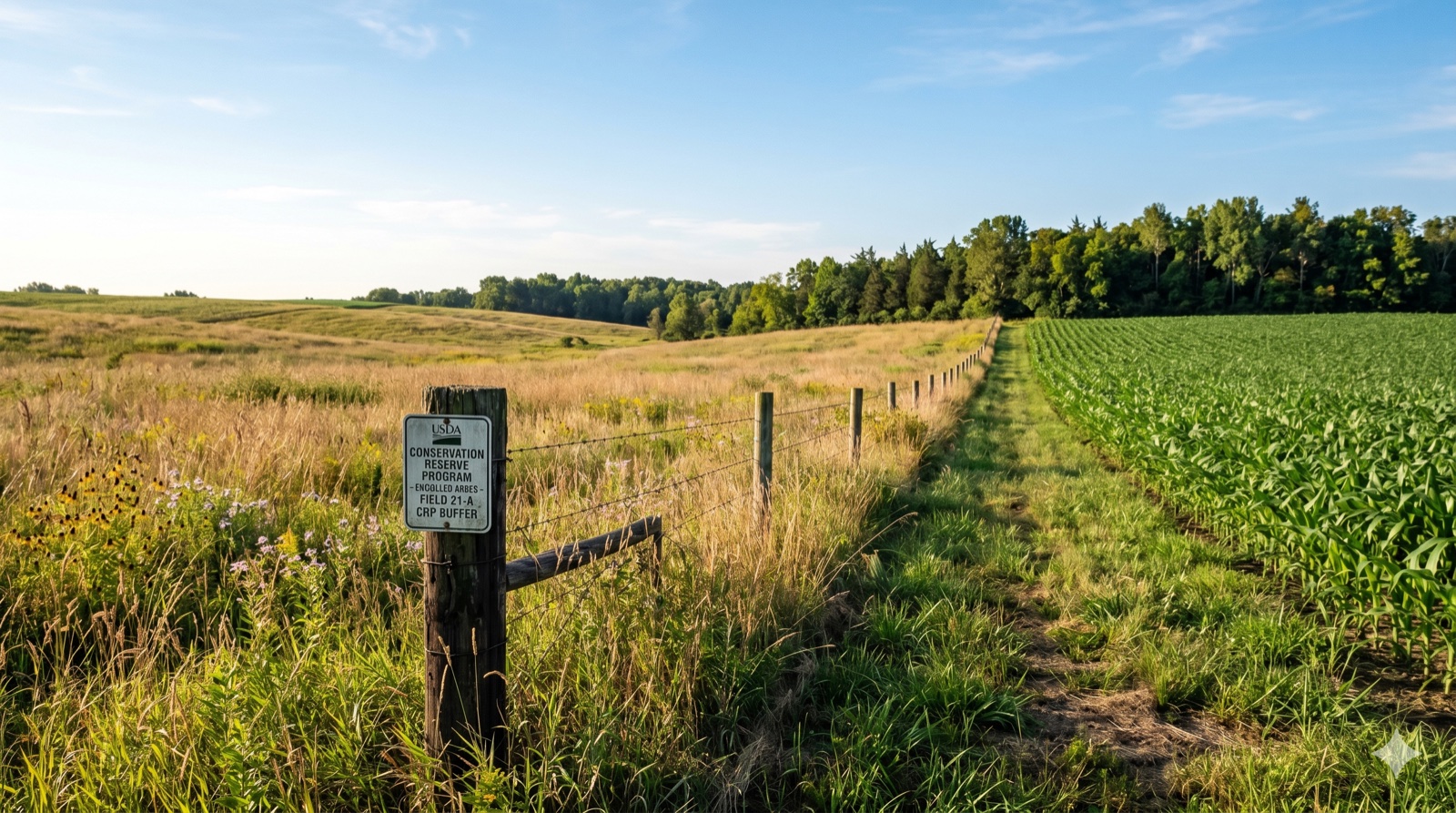
- For a CRP contract — contact the local FSA office to confirm enrollment, the practice, the acres, the annual rental, the contract start and expiration dates, and the succession process; visible native-grass cover or buffer strips and conservation marker posts are physical clues.
Once you know which encumbrance applies — and many parcels have neither, one, or even both — you can evaluate the parcel correctly. The paperwork that supports either situation is covered in our guide on the paperwork needed to sell land.
How Does Each Affect Value and Marketability?
The two encumbrances pull in different directions. A CRP contract can actually be an asset to the right buyer — it carries a contractual stream of annual rental income for the remaining term, and some buyers specifically want that cash flow or the wildlife and habitat character that CRP cover creates (which appeals to certain hunting-land buyers). The flip side is the succession requirement and the refund-plus-liquidated-damages exposure if no one assumes the contract — that's friction a casual buyer may not want to navigate.
A conservation easement generally limits development potential by design. Because it permanently removes subdivision and building rights across the protected area, it shrinks the pool of buyers who want to develop — but it also draws buyers who specifically value conserved, protected land that will stay open. It cannot be removed, so it follows the parcel forever.
| CRP Contract | Conservation Easement | |
|---|---|---|
| How long | Temporary — typically a 10-to-15-year contract | Usually permanent (in perpetuity); some term easements |
| Transfers on sale? | No automatic transfer — buyer must succeed to it at FSA, or it terminates | Yes — recorded and runs with the land; conveys automatically |
| Can a new owner remove it? | It ends at contract expiration (or early termination) | No — a new owner cannot remove a recorded permanent easement |
| Income to owner | Yes — annual government rental payment during the term | No ongoing rent; any benefit was a prior tax deduction or purchase payment |
| Buildable impact | Restricts production/use during the term; reverts at expiration | Permanently limits development rights across the protected area |
| Where it shows up | FSA record — often NOT on the title commitment; disclose it | Recorded — appears on the title commitment (Schedule B) |
There's also a property-tax angle: land that is enrolled in conservation or carries a recorded easement often qualifies for use-value or reduced assessment under state present-use or land-use programs, so the parcel may already be taxed on its conserved or agricultural use rather than its full market value. That can lower the carrying cost of holding the land, but it varies by state and county. None of this is a precise discount or a market-price formula — it's a set of features a careful buyer reads and prices on the specific parcel, the way our guide on how much your land is worth frames any encumbrance: as a feature that affects realistic use, not a number you plug into a formula.
Why Retail Buyers Sometimes Walk
Retail buyers — especially those financing a purchase and represented by an agent — often expect a clean, unencumbered, build-anything blank slate. When a title commitment's Schedule B lists a permanent conservation easement, or when a seller discloses a CRP contract with a refund question attached, the reaction can be hesitation, renegotiation, or walking away. A parcel with a perfectly normal CRP enrollment or recorded easement can sit on the market longer or fall out of contract. This is the same dynamic that affects other problem parcels — the land isn't unsellable, the conventional buyer pool just shrinks.
A Cash Buyer Buys It As-Is
A direct cash buyer approaches both encumbrances differently. Instead of expecting flawless, unrestricted title, the buyer reads the CRP contract or the recorded easement, decides whether to assume the CRP rental or accept the permanent restriction, and purchases the land as-is. There's nothing for you to remove, terminate, or litigate. The buyer absorbs the carrying costs, the marketing effort, and the resale risk that come with a restricted or contracted parcel — including the FSA succession logistics or the smaller development-buyer pool on the back end — and reflects all of that in a firm written cash offer on your specific parcel.
What Are Your Options for Selling Conserved or CRP-Enrolled Land?
If your parcel is enrolled in CRP or protected by a conservation easement, you have three main paths:
Option 1: List it and disclose the encumbrance. Put the property on the open market and disclose the CRP contract or the recorded easement up front. This works well when the land is otherwise attractive and you can find a buyer who wants the CRP income or values the conserved character — but be prepared for some retail buyers to hesitate, and for the CRP succession or refund question to need handling before closing.
Option 2: Resolve the CRP question first. For CRP land specifically, you can coordinate with the local FSA office and a willing buyer to arrange a clean succession so the contract continues — or plan for the refund and liquidated damages if the contract will be terminated early. (A permanent conservation easement, by contrast, generally cannot be removed and isn't a "resolve it first" situation — it conveys as-is.)
Option 3: Sell directly to a cash buyer. If you want speed and certainty, a direct cash buyer like Jerez Land purchases conserved or CRP-enrolled land as-is. We read the CRP contract or the recorded easement, work through the FSA succession or accept the permanent restriction, factor it into our underwriting, and present a firm written cash offer on your specific parcel — no formulas, no guessing, and no expectation of perfect, unrestricted title.
Request a no-obligation cash offer and we'll review your property and its CRP contract or easement together. There are no commissions or listing fees, and we can often move faster than a traditional sale — even when an FSA contract or a permanent restriction is attached to the land.
Dealing with related complications? Our guides on selling land with an easement (the general overview), selling farmland, and selling land with back taxes cover situations that often appear alongside conserved and CRP-enrolled ground. For more guides on selling land in less-than-perfect situations, visit our blog.
Frequently Asked Questions
I've got land in a CRP contract — can I still sell it?
Yes. You can sell land that's in a Conservation Reserve Program contract, but the contract doesn't automatically transfer with the deed the way a recorded easement does. When the land is sold, the buyer generally has a window — commonly 60 days — to succeed to the existing CRP contract at the FSA office and continue the annual rental for the remaining term. If no one succeeds to the contract, it's terminated early, and the participant can be required to refund prior CRP payments with interest plus liquidated damages. The practical step is to confirm enrollment with your local FSA office and decide with the buyer whether the contract will be assumed or terminated.
Does a conservation easement transfer to the new owner when I sell?
Yes — automatically. A conservation easement is recorded against the property and runs with the land, so it conveys to the buyer along with the deed and binds every future owner. There's no succession step and no way to leave it behind. The land trust or government agency that holds the easement keeps the right to enforce the restrictions and typically monitors the property each year. Because it's recorded, it shows up on a title commitment's Schedule B, and the buyer takes title subject to it.
I'm buying land with a conservation easement — can I remove it?
Generally no. Most conservation easements are permanent (granted in perpetuity), and a new owner cannot simply remove or cancel one. For donated easements tied to a federal tax deduction, perpetual protection is a legal requirement of the deduction, and for purchased easements like NRCS ACEP agricultural land easements, the protection is held in perpetuity or for the maximum duration state law allows. The easement is a settled, durable feature of the title that the buyer inherits — not something a current owner can negotiate away before selling.
I'm selling land before my CRP contract ends — do I lose the payments?
It depends on whether the buyer succeeds to the contract. If the buyer assumes the CRP contract within the window FSA allows after the sale, the annual rental continues to the new owner for the remaining term and there's no payback. If no one succeeds to the contract, it terminates early, and the participant generally must refund the CRP payments received — annual rental, cost-share, and incentives — with interest, plus liquidated damages calculated as a percentage of the annual rental on the affected acres. Confirm the exact figures with your local FSA office before closing.
How do I find out if my land has a conservation easement or CRP contract?
They show up through different channels. A conservation easement is recorded, so it appears on a title commitment under Schedule B and in the county deed records; you can pull the recorded easement deed to see exactly what it restricts and which land trust or agency holds it. A CRP contract is an FSA record and is often NOT on the title commitment, so you confirm it directly with the local Farm Service Agency office — ask for the practice, acres, annual rental, start and expiration dates, and the succession process. Because CRP may not appear on title, disclosing it to the buyer up front is essential.
I have a CRP contract or easement on my land — will a cash buyer still purchase it?
Many experienced cash land buyers — including Jerez Land — purchase conserved or CRP-enrolled land as-is. We read the CRP contract or the recorded easement, work through the FSA succession or accept the permanent restriction, and factor it into a firm written cash offer on your specific parcel. There's nothing for you to remove or litigate, and we absorb the carrying and resale risk that comes with a restricted or contracted parcel — including the succession logistics on CRP land and the smaller development-buyer pool on eased land.
Disclaimer: This article is for informational purposes only and does not constitute legal, financial, or professional advice. Laws and regulations vary by jurisdiction and change over time. Always consult a licensed real estate attorney, a tax professional, and your local USDA Farm Service Agency or NRCS office before making decisions about CRP contracts, conservation easements, or property transactions. Jerez Land is not responsible for actions taken based on this information.