
Can I Sell Land With an Old Dump or Buried Waste on It?
Key Takeaways
- Current ownership alone can trigger federal cleanup liability. Under CERCLA, 42 U.S.C. § 9607(a), "the owner and operator" of a facility where hazardous substances were released is liable "notwithstanding any other provision or rule of law" — a rule that can reach a current owner regardless of who actually did the dumping, according to the statutory text on Cornell Law School's Legal Information Institute.
- The main liability shield belongs to the buyer, not the seller. The bona fide prospective purchaser (BFPP) defense (42 U.S.C. §§ 9601(40), 9607(r)) protects a buyer only if the buyer completed "all appropriate inquiries" — in practice, a Phase I Environmental Site Assessment meeting EPA's All Appropriate Inquiries rule at 40 CFR Part 312 — before closing, per EPA and the Federal Register's December 2022 final rule recognizing ASTM E1527-21.
- That timing rule is why environmentally uncertain land naturally sells to diligence-minded buyers. Because a buyer's own pre-purchase inquiry is what earns their legal protection, a seller cannot do that work for them — which is also why financing and buyer pools shrink once a site's history includes buried waste, according to the same statutory framework.
Can I Sell Land With an Old Dump or Buried Waste on It?
Yes, you can sell land with an old dump or buried waste on it — nothing in federal or state law blocks the sale itself. What changes is who bears the legal exposure and how the deal gets structured, because under the Comprehensive Environmental Response, Compensation, and Liability Act (CERCLA), 42 U.S.C. § 9607(a), the current owner of a property can be liable for cleanup costs simply by owning it when hazardous substances are found there — regardless of whether you, a prior owner, a tenant, or your grandparent put anything in the ground. That is a real, federally codified rule, not a scare tactic, and it is the reason this situation gets treated differently than ordinary land sales.
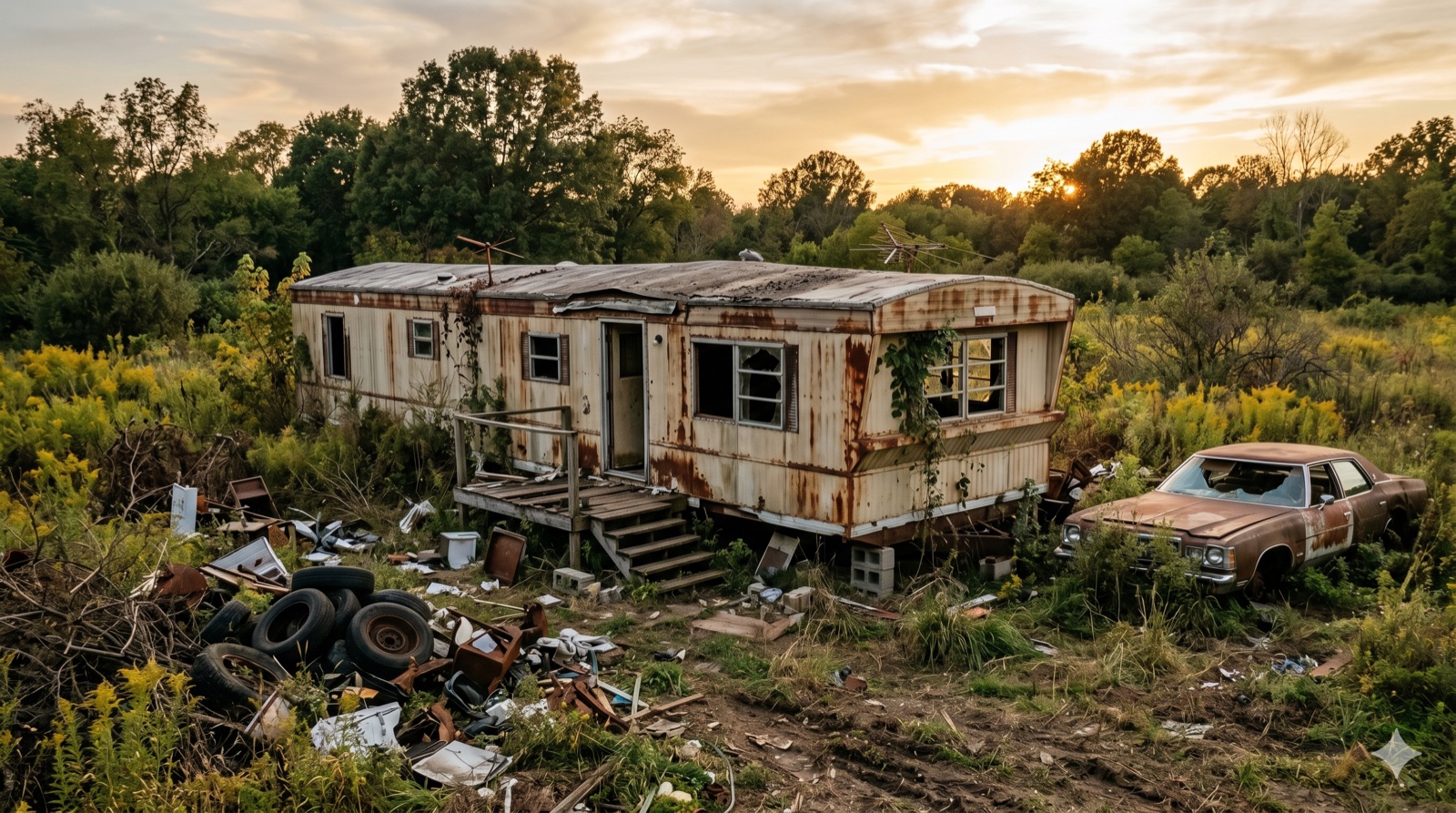
This is a different problem than visible debris you can price and remove. If your land has an abandoned mobile home, scattered trash, or a collapsed structure sitting on top of the ground, that is a cleanup-cost question with a knowable number attached — see our guide on selling land with an old mobile home or junk to remove. Storm or fire damage is its own category too, covered in selling land after a wildfire or natural disaster. What this article covers — buried household waste, farm chemicals, drums, or an unpermitted dump — is an unknown-extent legal liability question, not a bid for hauling and disposal. You don't know what's down there, how much it will cost to characterize, or who else might have a legal claim to it, and that uncertainty is what shapes everything else in this guide. For more situations like this, see the Jerez Land blog.
What Is My Liability as the Current Owner If Someone Else Buried the Waste Decades Ago?
You can be a legally responsible party under CERCLA simply because you currently own the land, even if the dumping happened before you ever held title. Section 107(a) of CERCLA, codified at 42 U.S.C. § 9607(a), makes "the owner and operator of a vessel or a facility" liable for the costs of removal or remedial action "notwithstanding any other provision or rule of law" once a hazardous substance has been released or threatens to be released there. Courts and EPA have consistently read that language to reach current owners regardless of fault — CERCLA is a strict-liability statute for this category of party, meaning the government doesn't have to prove you caused the contamination, only that you own the facility where it exists.
This is the fact that frightens landowners when they learn about it, and it should be taken seriously rather than softened. It does not mean every rusted drum or old dump site turns into a federal case — EPA's Superfund enforcement resources are finite and typically aimed at sites with actual or threatened releases significant enough to warrant a response action, not every rural parcel with old debris. But the legal exposure exists on the books, attaches to ownership rather than conduct, and is the single fact that makes this situation different from ordinary land with a title problem or a code violation.
Two other categories of parties can also be liable under CERCLA § 107(a): whoever owned or operated the facility at the time of disposal, and anyone who generated or transported the hazardous substances there. Selling the land transfers your position as "current owner" to the buyer going forward — it does not automatically erase liability you may have already accrued as an owner during your own period of ownership, particularly if a federal or state response action has already been triggered. If you have any reason to believe an agency is already aware of the site, that changes the analysis and is worth a conversation with an environmental attorney before you do anything else.
What Is the Bona Fide Prospective Purchaser Defense, and Why Does It Matter Even Though I'm the Seller?
The bona fide prospective purchaser (BFPP) defense is the main tool a buyer uses to acquire contaminated or potentially contaminated land without inheriting CERCLA liability for contamination that existed before they bought it — and understanding it explains why this kind of land naturally sells to buyers who do their own homework. Under 42 U.S.C. § 9601(40), to qualify as a BFPP a purchaser generally must show: all disposal of hazardous substances occurred before they acquired the property; they made "all appropriate inquiries" into the property's previous ownership and uses before closing; they are not affiliated with anyone potentially liable for the contamination; and they acquired the property after January 11, 2002.
The phrase "all appropriate inquiries" (AAI) is not a vague standard — it's defined by a federal regulation, EPA's AAI rule at 40 CFR Part 312, and satisfied in practice by a Phase I Environmental Site Assessment performed to a recognized ASTM standard before the purchase closes. As of EPA's December 2022 final rule (effective February 13, 2023), the current standard for most commercial and industrial property is ASTM E1527-21; EPA sunset its recognition of the prior E1527-13 standard one year later, on February 13, 2024, so E1527-21 is the version that currently satisfies AAI. Notably for rural acreage specifically, EPA separately amended the AAI rule in 2024 to recognize ASTM E2247-23, "Standard Practice for Environmental Site Assessments: Phase I Environmental Site Assessment Process for Forestland or Rural Property" — a version of the Phase I process tailored to exactly the kind of undeveloped land Jerez Land buys, with the prior E2247-16 version's recognition phased out roughly a year later.
Here is the insight that matters for you as a seller: the BFPP defense protects the person who does the inquiry, and that inquiry has to happen before the sale closes. You cannot complete a Phase I assessment on the buyer's behalf and hand them your own legal protection — the statute requires the buyer's own pre-acquisition diligence. That single structural fact is why land with any environmental uncertainty naturally routes toward buyers who are set up to do that diligence quickly and factor it into how they underwrite a deal, rather than buyers who expect a seller to hand them a clean bill of health. It is not a claim that any particular buyer offers a better price — it's a description of how the legal framework allocates the work and the protection.
What Are the Innocent Landowner and Contiguous Property Owner Defenses — and What Are "Continuing Obligations"?
Two related but narrower CERCLA defenses can apply depending on your specific situation, and both come with the same catch as the BFPP defense: a defense is not a free pass, and each one imposes ongoing duties after it applies.
The innocent landowner defense, addressed within 42 U.S.C. § 9601(35), can protect an owner who did not know and had no reason to know that hazardous substances were on the property at the time they acquired it — provided they also carried out all appropriate inquiries into the property's previous ownership and uses before acquiring it, using the same AAI standard described above. This defense is most relevant to people who acquired land without any indication of a problem, including through inheritance in some circumstances, though inherited property raises its own fact-specific questions about what inquiry was practically possible.
The contiguous property owner defense, at 42 U.S.C. § 9607(q), is different again: it protects an owner whose land became contaminated solely by contamination migrating from a neighboring parcel they don't own — for example, groundwater contamination moving onto your property from an old dump site next door. To qualify, the owner must show they didn't cause, contribute to, or consent to the release; aren't affiliated with whoever is responsible; conducted appropriate inquiries; and took reasonable steps in response once they learned about it.
All three defenses — BFPP, innocent landowner, and contiguous property owner — share a set of continuing obligations once they apply, spelled out largely in 42 U.S.C. § 9607(r): the owner must take reasonable steps to stop any continuing release, prevent any threatened future release, and prevent or limit exposure to previously released hazardous substances; provide full cooperation and access to anyone authorized to conduct a response action or natural resource restoration; and comply with any land use restrictions or institutional controls established at the site. Qualifying for one of these defenses is not a one-time event — it's an ongoing legal posture that has to be maintained.
What Happens During a Phase I Environmental Site Assessment, and What Is a "Recognized Environmental Condition"?
A Phase I Environmental Site Assessment is a records-and-observation review, not a soil or groundwater test — it's built from historical aerial photos, chain-of-title and government-records searches, interviews with past owners or occupants, and a visual site walk, all aimed at identifying "recognized environmental conditions" (RECs) on the property. A REC, in plain language, is anything the environmental professional finds — a stained area, old drums, a documented prior land use like a dump, junkyard, or chemical storage operation — that indicates a hazardous substance has been released, or threatens to be released, on the property. Finding a REC doesn't prove contamination exists; it means the site can't be ruled out without more investigation.
That's when a Phase II Environmental Site Assessment comes in: unlike Phase I, Phase II involves actual sampling — soil borings, groundwater monitoring wells, or surface samples — specifically targeted at the REC(s) identified in Phase I, to determine whether contamination is actually present and, if so, its type and extent. Phase I doesn't automatically trigger Phase II; it's a judgment call based on how serious and how well-documented the suspected REC is. An old, unpermitted dump with visible drums or documented dumping is the kind of finding that commonly pushes a deal from Phase I into Phase II, because it's exactly the fact pattern the ASTM standards are designed to flag.
Does My State Run a Program That Could Help With This?
Most of the nine states Jerez Land operates in run some form of voluntary cleanup or brownfields program, administered by the state environmental agency rather than EPA directly, and each is a possible resource — but none of them require you to clean up land before you're legally allowed to sell it as a private transaction. Verify current program details directly with the agency before relying on any of this for a specific deal, since program rules and funding change.
| State | Agency | Program | Statutory / Regulatory Basis |
|---|---|---|---|
| Alabama | ADEM (Alabama Dept. of Environmental Management) | Brownfield Redevelopment and Voluntary Cleanup Program | Ala. Code §§ 22-30E-1 to -13; ADEM Admin. Code Division 15 |
| Georgia | Georgia EPD (Environmental Protection Division) | Voluntary Remediation Program / Georgia Brownfield Act | Ties to the Hazardous Site Response Act framework |
| Mississippi | MDEQ (Mississippi Dept. of Environmental Quality) | Brownfields Voluntary Cleanup and Redevelopment Program | Mississippi Brownfields Voluntary Cleanup and Redevelopment Act, effective July 1, 1998 |
| Michigan | EGLE (Dept. of Environment, Great Lakes, and Energy) | Part 201 cleanup program (NREPA) + Brownfield Redevelopment Program | Part 201 of the Natural Resources and Environmental Protection Act |
| North Carolina | NC DEQ, Superfund Section | Inactive Hazardous Sites Program (Voluntary Cleanup Program), running since 1987; separate Brownfields Redevelopment Section for non-responsible parties | State program administered under NC DEQ waste management authority |
| Oklahoma | Oklahoma DEQ | Voluntary Cleanup Program (VCP), with an option to move into the Brownfields Program | State program administered by DEQ's Land Protection Division |
| Pennsylvania | PA DEP | Land Recycling Program ("Act 2") | Acts 2, 3, and 4 of 1995 |
| South Carolina | SC DES (formerly DHEC) | Brownfields/Voluntary Cleanup Program, with a voluntary-cleanup tax credit for non-responsible parties | S.C. Code § 12-6-3550 (credit generally described as a percentage of cleanup costs, subject to an annual statutory cap) |
| Tennessee | TDEC (Dept. of Environment and Conservation) | Voluntary Cleanup, Oversight and Assistance Program (VOAP) | Created by Tennessee statute in 2001 |
These programs exist mainly to give a redeveloper — often the eventual buyer — a structured path to investigate, remediate to a state-approved standard, and receive a liability release or "no further action" determination. As the seller, you're generally not required to enroll in one before marketing the land, though disclosing that a program exists and could apply is a reasonable thing to raise with a buyer.
What Do I Actually Have to Tell a Buyer About the Dump or Buried Waste?
This is the area where you should be the most careful, because the answer genuinely varies by state and by whether the property is vacant land at all. Many states' statutory seller-disclosure forms are written to apply specifically to residential real property with dwelling units — North Carolina's Residential Property Disclosure Act, for example, applies only to transfers of residential real property consisting of one to four dwelling units, so a vacant lot with none typically falls outside that statute's mandatory disclosure form, according to guidance published by NC REALTORS. Whether your state's statutory disclosure obligations reach unimproved land, and what exactly they'd require you to state if they do, depends entirely on that state's specific statute — this is not something to assume one way or the other, and you should confirm it with a real estate attorney licensed in the state where the land sits before you sign anything.
What doesn't depend on any disclosure statute is common-law fraud and concealment exposure, which exists independently of whatever statutory form does or doesn't apply to your transaction. If you have actual knowledge of buried waste or an old dump on the property and you affirmatively misrepresent that fact, or take steps to conceal it, you can face liability for fraud or concealment under ordinary common-law principles regardless of whether a state disclosure statute technically covered vacant land. The safest, simplest practice is straightforward: if you know about it, say so, in writing, to whoever you're selling to — a statutory exemption for vacant land is not the same thing as legal cover for actively hiding a known problem.
Will This Actually Sell, and What Should I Realistically Expect?
Yes, land with buried waste or an old dump sells — but expect a thinner buyer pool, a longer process, and a buyer who prices in the cost and uncertainty of their own diligence rather than taking the property at face value. Because the BFPP defense only protects a buyer who completes AAI before closing, and because Phase I (and possibly Phase II) assessments take real time and real money, most conventional retail buyers and most conventional lenders won't touch a parcel with a known or suspected REC — a federally insured lender can technically still finance a property outside NFIP-style restrictions, but many lenders treat unresolved environmental uncertainty the same way they treat any other unquantified risk: as a reason to decline or require terms most individual buyers can't meet. That pushes this kind of land toward cash buyers who evaluate the situation directly rather than through a mortgage underwriter.
Option 1: Get your own environmental read before marketing the land. You're not required to commission a Phase I yourself, and doing so doesn't create or transfer any legal defense to you — but knowing roughly what a buyer's own assessment is likely to find lets you set realistic expectations and answer questions honestly instead of guessing.
Option 2: Disclose what you know, in writing, regardless of whether your state's statute technically requires it. This protects you from fraud exposure and tends to produce more serious buyers, since a buyer who finds out about a known issue after the fact is far more likely to walk or litigate than one who priced it in from the start.
Option 3: Sell directly to a cash buyer who underwrites environmental uncertainty as part of the deal. A direct buyer like Jerez Land can factor a known or suspected dump site into a firm written cash offer without requiring you to complete remediation, enroll in a state cleanup program, or wait out a financed buyer's due-diligence period.
Request a no-obligation cash offer and we'll talk through what you know about the site, what it does and doesn't change about the sale, and what a straightforward, honest cash transaction looks like for your specific parcel. For more guides on selling land in complicated situations, visit the Jerez Land blog.
Frequently Asked Questions
I just found rusted drums and what looks like an old dump on my property that I know I didn't put there — am I legally responsible for cleaning it up?
Potentially, yes. Under CERCLA, 42 U.S.C. § 9607(a), the current owner of a property can be liable for cleanup costs simply by owning the land where a hazardous substance was released, regardless of who actually caused it. That doesn't mean every old dump site becomes a federal enforcement case, but the legal exposure is real and attaches to ownership rather than fault, so it's worth taking seriously and discussing with an environmental attorney rather than ignoring.
If I sell my land now, does the environmental liability transfer to the buyer, or do I still own the problem after closing?
Selling transfers your position as "current owner" going forward, and your buyer becomes the party who holds that status after closing. However, selling doesn't automatically erase liability you may have already accrued as owner during your own period of ownership — particularly if a response action was already underway or an agency was already aware of the site before you sold. If you have any reason to think that's the case, talk to an environmental attorney before you list the property.
I'm about to sell inherited land in Michigan with an old buried-waste site from my grandfather's era — do I have to get it tested before I can sell?
No, you're not legally required to commission your own environmental testing before selling. Michigan's cleanup framework, Part 201 of the state's Natural Resources and Environmental Protection Act, is administered by EGLE and offers a voluntary path for whoever wants to investigate and remediate — it doesn't require a private seller to test or clean the land as a precondition of a lawful sale. What you should do is disclose what you actually know, in writing, to any buyer.
Does Pennsylvania's Act 2 program (or my state's cleanup program) mean I'm required to clean this up before I can sell my land?
No. Pennsylvania's Land Recycling Program, known as Act 2, is a voluntary framework administered by the PA Department of Environmental Protection that gives a party — often the buyer or a future redeveloper — a structured path to investigate, remediate to a state-approved standard, and receive liability protection. It is not a precondition for a private land sale, and a similar answer applies to the comparable voluntary programs run by the other states Jerez Land operates in.
What do I legally have to tell a buyer about buried waste or an old dump I know about on my land?
It depends on your state's specific disclosure statute and, in some states, on whether the property even qualifies as the kind of property that statute covers — several states' statutory disclosure forms apply only to residential property with dwelling units and don't reach vacant land at all. What's consistent regardless of which statute applies is common-law fraud and concealment exposure: if you know about a problem and misrepresent or conceal it, you can face liability for that independent of any disclosure form. Confirm your state's specific rule with a real estate attorney, and when in doubt, disclose what you know in writing.
I have an old mobile home and some visible junk on my land, and I've also heard there's a buried dump from decades ago — is that the same kind of problem?
No, and the distinction matters for how you approach a sale. An old mobile home or scattered surface junk is a cleanup-cost problem — you can generally get a hauling quote and know roughly what it costs to clear, covered in our guide on selling land with an old mobile home or junk to remove. A buried, unpermitted dump is an unknown-extent legal liability question under CERCLA that isn't solved by a hauling quote — it can require environmental assessment to even understand its scope. Both can exist on the same property, and both should be disclosed, but they're different problems with different solutions.
Disclaimer: This article is for informational purposes only and does not constitute legal, financial, or professional advice. Laws and regulations vary by jurisdiction and change over time. Always consult a licensed real estate attorney or environmental professional before making decisions about environmental liability, disclosure obligations, or property transactions. Jerez Land is not responsible for actions taken based on this information.