
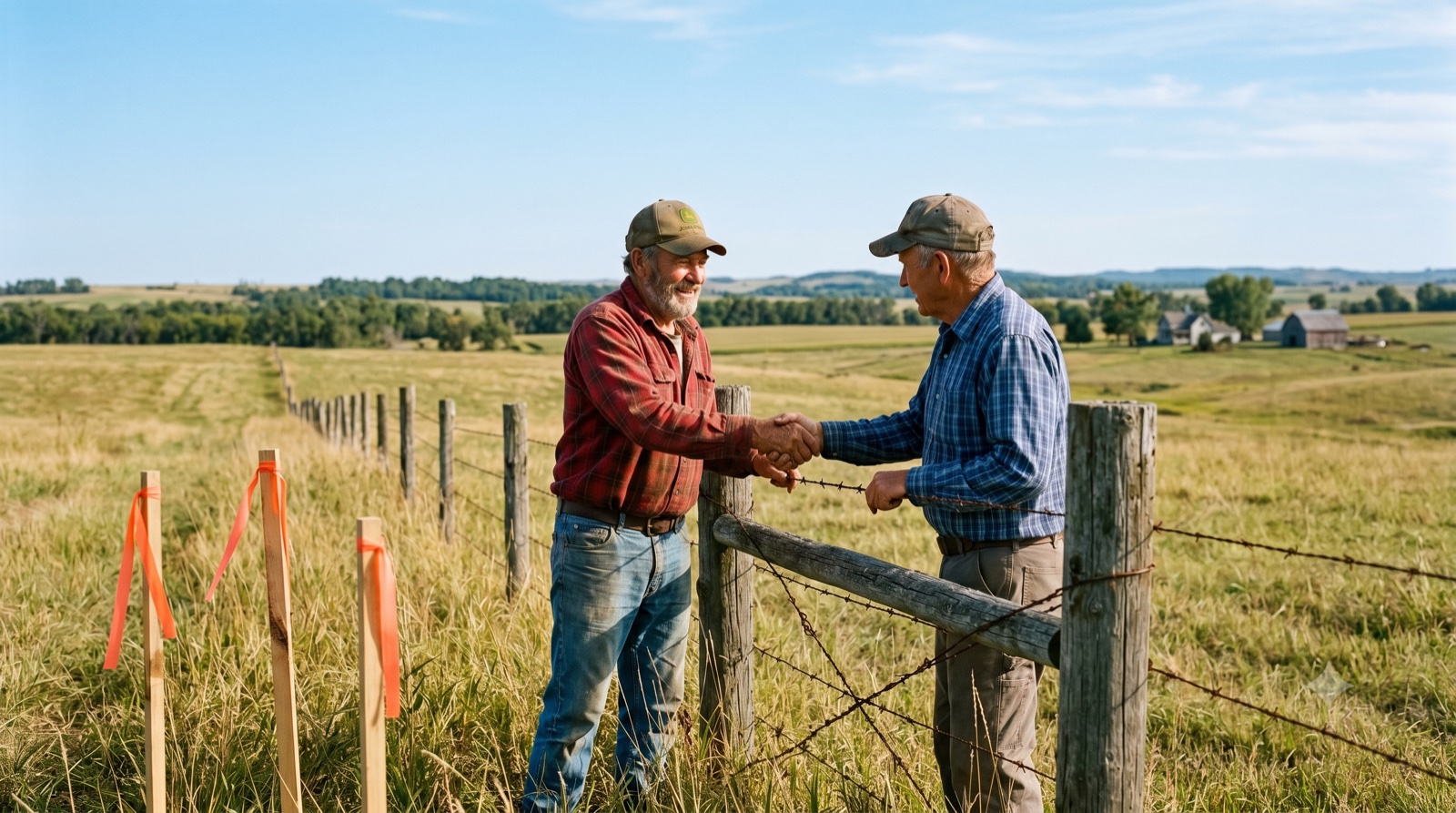
Can I Sell Farmland If USDA Says Part of It Is a Wetland Under Swampbuster?
Key Takeaways
- A Swampbuster wetland determination is a compliance condition, not a lien, lease, or easement — it puts USDA farm-program eligibility at risk, not the land itself. Under 7 CFR § 12.4, producing a crop on a "converted wetland" makes a person ineligible for commodity program payments, conservation program payments, FSA farm loans, and federal crop insurance premium subsidies — the regulation never touches title or restricts a sale.
- USDA just moved to lock in the certification status of older wetland determinations. An interim rule published in the Federal Register on July 29, 2026 (Docket NRCS-2026-0067) confirms that wetland determinations issued after November 28, 1990 are certified — and therefore controlling — if the affected person was notified and given appeal rights at the time, resolving inconsistent treatment of determinations made between 1990 and 1996.
- Disputing the map is a real, documented fight, not a formality. A South Dakota farmer spent over a decade contesting USDA's determination that a 0.8-acre depression in a 44-acre field was a wetland — a dispute over whether the water was a natural feature or an artificial puddle caused by a 1936 tree belt, with his ARC/PLC payments and crop insurance premium assistance on the line — according to DTN Progressive Farmer's coverage of Foster v. USDA.
Can I Sell Farmland If USDA Says Part of It Is a Wetland Under Swampbuster?
Yes — a Swampbuster wetland determination, even a disputed one, does not stop you from selling the farm, because it is not a lien, a lease, or a recorded restriction on the land. It is a compliance condition under the Food Security Act of 1985's wetland conservation provisions that determines whether whoever farms the affected acres stays eligible for USDA program benefits, so the thing you actually need to sort out before closing isn't a title problem — it's what you tell a buyer about which acres are involved and what's disputed about them.
That distinction matters because this situation gets confused with two others that sound similar but work completely differently. If your land is enrolled in a Conservation Reserve Program contract or protected by a conservation easement, that's a voluntary, paid enrollment with a defined term (or a permanent recorded restriction) — see our guide on selling land in a conservation easement or CRP contract for how those specifically transfer on a sale. Swampbuster imposes no easement, no lease, and no payment to you at all — it's a condition attached to program eligibility, not a restriction attached to the deed. And if what's actually on your land is a federally protected species or its critical habitat, that's a different statute administered by a different agency entirely — the Endangered Species Act and the U.S. Fish & Wildlife Service, not the Farm Bill and USDA's Natural Resources Conservation Service (NRCS) — covered in selling land with endangered species or critical habitat. Confusing the three means disclosing the wrong thing to the wrong buyer. For more guides on selling land in complicated situations, see the Jerez Land blog.
What Does It Actually Mean That USDA Has "Swampbuster" Determined Part of My Farm Is a Wetland?
It means NRCS has made a formal determination that a specific area of your farm meets the regulatory definition of a wetland — or a "converted wetland" if it was previously altered to allow crop production — and that determination controls whether producing a crop on that acreage keeps you eligible for USDA program benefits. Swampbuster is the common name for the wetland conservation (WC) provisions in Title XII of the Food Security Act of 1985, implemented at 7 CFR Part 12: after December 23, 1985, a program participant who produces an agricultural commodity on a converted wetland is ineligible for certain USDA program benefits, and after November 28, 1990, converting a new wetland to make crop production possible carries the same consequence, according to the Federal Register's own history-and-background summary of the provisions.
The regulatory definition at 7 CFR § 12.2 defines "wetland" as land that has a predominance of hydric soils, is inundated or saturated enough to support hydrophytic (water-loving) vegetation, and under normal circumstances actually supports that vegetation — three criteria NRCS evaluates together, not a single wet-looking spot. A "converted wetland" is one that was drained, dredged, filled, leveled, or otherwise manipulated for the purpose of making crop production possible, on land that was wetland (or farmed wetland) before the manipulation. Nothing in that definition, or in 7 CFR Part 12 generally, creates a lien, records an easement, or restricts how the parcel can be conveyed — the consequence runs to program eligibility, not to title.
How Does NRCS Actually Decide an Area Is a Wetland, and What Makes a Determination "Certified"?
NRCS reaches a wetland determination after a producer files USDA's HELC and WC self-certification form (AD-1026), which flags any planned or completed activity — clearing, leveling, draining — that could convert a wetland, and once NRCS issues that determination and properly notifies the affected person of their appeal rights, the determination becomes "certified" and generally stays valid until the affected person requests NRCS review it again. According to USDA's Farm Service Agency, producers use AD-1026 "to certify compliance with the highly erodible land and wetland conservation provisions as a condition of eligibility for certain USDA programs," and if the form flags a land-altering activity, the request is referred to NRCS to evaluate whether a certified determination is needed. NRCS certifies determinations on a field or subfield basis, meaning the determination attaches to the specific mapped acreage of the farm tract, not to the person who happened to own it at the time.
This is exactly the area USDA moved on most recently. An interim rule NRCS published in the Federal Register on July 29, 2026 (Docket ID NRCS-2026-0067, effective on publication, with public comments open through late September 2026) confirms that wetland determinations issued after November 28, 1990 are certified — and therefore controlling on future eligibility questions — as long as the affected person was notified of the determination and informed of their appeal rights at the time it was made. USDA issued the rule to resolve years of inconsistent treatment of determinations made between 1990 and 1996, after a February 2024 federal court decision (National Wildlife Federation v. Lohr) found NRCS had changed its certification policy without adequately explaining why, per the rule's own background section and DTN Progressive Farmer's coverage of the announcement. The practical upshot for a seller: if a determination on your farm's file was properly issued and you were given appeal rights at the time, USDA now treats that determination as settled and binding going forward — which is exactly why a dispute over accuracy has to be raised through the appeal process, not simply asserted at closing.
My Family (or a Prior Tenant) Thinks the Mapped Wetland Is Wrong — Can We Still Challenge the Determination?
Yes, but the challenge has to go through USDA's formal appeal process, not a re-argument with the buyer or a private surveyor's letter — a certified wetland determination stays controlling until it is successfully appealed or the affected person requests NRCS review it. The regulations governing USDA's National Appeals Division (NAD) require a participant to request a hearing not later than 30 days after first receiving notice of the adverse decision, and if the NAD hearing officer rules against the participant, a further request for Director Review must be filed within 30 days of receiving that determination, according to Cornell Law School's Legal Information Institute's text of 7 CFR §§ 11.6 and 11.9. Before escalating to a formal NAD hearing, producers typically request NRCS review the determination directly and provide new evidence or an additional field visit, which is often the faster and more practical first step.
This isn't a hypothetical fight. South Dakota farmer Arlen Foster disputed a USDA determination that a 0.8-acre depression inside a 44-acre field was a wetland for more than a decade, arguing the water was an artificial feature caused by a tree belt his father planted in 1936, not a natural wetland — a case that reached the Eighth Circuit and the Supreme Court after USDA declined to reconsider its 2011 determination, according to DTN Progressive Farmer's coverage of the litigation. What was actually on the line in that case was never the land's value or title — it was Foster's eligibility for ARC/PLC commodity payments, crop insurance premium assistance, and other USDA program benefits if he farmed the disputed acreage. If your family or a prior tenant is in a live dispute like this, the acreage in question, the current appeal status, and whether an appeal deadline has already passed are the specific facts a buyer — or your own attorney — will need before you sign anything.
What's Actually at Stake Here if the Determination Stands — What Do We Lose?
What's at risk is farm-program eligibility for whoever farms the affected acreage, not the market value of the land or its ability to be sold. Under 7 CFR § 12.4(d), a person who produces an agricultural commodity on a converted wetland can lose eligibility for Commodity Credit Corporation program payments and price support, FSA farm ownership and operating loans, Environmental Quality Incentives Program (EQIP) and other conservation program payments, Agricultural Credit Act assistance, USDA watershed protection and flood prevention program benefits, and federal crop insurance premium subsidies — a package of benefits tied directly to farming that acreage, listed in the regulation itself.
That's a meaningfully different risk than what shows up in most "problem parcel" situations, and it's worth being precise about it with a buyer:
- It does not create a lien or judgment against the land.
- It does not restrict how the parcel can be subdivided, developed, or used for a non-farm purpose.
- It does not attach to the buyer personally — it attaches to whoever chooses to produce a crop on the specific mapped acreage while participating in USDA programs.
- A buyer who has no intention of farming those specific acres, or who doesn't participate in USDA commodity, conservation, or crop-insurance programs at all, is not affected by the determination in any way that touches ownership or use of the rest of the parcel.
How Is This Different From a Conservation Easement, a CRP Contract, or an Endangered Species Issue?
The three situations get lumped together because they all involve a federal environmental angle on farmland, but the legal mechanism, the agency, and what's actually restricted are different in each case, and disclosing the wrong one to a buyer creates real confusion.
| Swampbuster Wetland Determination | CRP Contract / Conservation Easement | ESA Critical Habitat / Take Prohibition | |
|---|---|---|---|
| Governing law | Food Security Act of 1985 (Title XII), 7 CFR Part 12 | Same Farm Bill family (CRP) or state/federal easement law | Endangered Species Act, 16 U.S.C. § 1531 et seq. |
| Lead agency | USDA / NRCS, FSA | USDA / FSA (CRP) or a land trust/NRCS (easements) | U.S. Fish & Wildlife Service (or NMFS) |
| Voluntary or imposed? | Not voluntary — a compliance condition tied to program participation | Voluntary, paid enrollment (CRP) or voluntary permanent grant (easement) | Not voluntary — applies regardless of enrollment |
| What's restricted | Farm-program eligibility if the mapped acres are cropped | Land use per the contract/easement terms; CRP pays annual rental | Federal agency actions (critical habitat) and private "take" of a listed species (Section 9), regardless of designation |
| Runs with the land or the deal? | Attached to the field/subfield on NRCS's farm-tract record | CRP requires buyer succession or it terminates; an easement runs with the land permanently and is recorded | Attaches to the land's habitat and species presence, independent of any contract |
| Recorded on title? | No — lives in the farm's NRCS/FSA compliance file, tied to the AD-1026 and farm tract | CRP: no, an FSA record. Easement: yes, recorded and appears on a title commitment | No — a matter of federal wildlife law, not a title encumbrance |
| Payment to the owner? | None | CRP pays annual rental during the term; easements are sometimes purchased | None |
The short version: a CRP contract or conservation easement is something the owner enrolled in for a payment or a tax benefit, with a defined term or a permanent recorded restriction — see selling land in a conservation easement or CRP contract. A Swampbuster determination is not enrollment in anything; it's USDA's factual finding about the ground itself, which only matters to a buyer who wants USDA program benefits while farming it. And an endangered-species issue is a completely different federal law aimed at protecting a species or its habitat, not at farm-program eligibility — see selling land with endangered species or critical habitat for how that one actually works, including the separate "take" prohibition that applies whether or not land carries a critical-habitat designation.
Does a Swampbuster Determination Show Up on the Title, and What Do I Actually Need to Tell a Buyer?
A wetland determination is not a recorded document in the county deed records the way a conservation easement is — it lives in the farm's NRCS/FSA compliance file, tied to the AD-1026 certification and the specific farm and tract numbers, so a buyer's title commitment will not surface it the way it would surface a recorded easement. That makes disclosure your responsibility rather than something a title search catches automatically, and it's the same practical gap the CRP side of a conservation easement transaction has — the encumbrance simply isn't in the public record.
What's worth pulling together before you list: the certified wetland determination map or letter for the affected field, whether the determination has ever been formally appealed and the current status of that appeal, whether a minimal-effect or prior-converted-cropland exemption has ever been requested or granted for the acreage (per the National Agricultural Law Center's overview of Swampbuster's exemptions, NRCS can find a conversion has only a "minimal effect" on the wetland's hydrological and biological value, and separately, wetlands converted before the provisions applied are generally treated as prior-converted cropland going forward), and a copy of the AD-1026 on file. Your local USDA Service Center can pull the farm's NRCS/FSA record — use the USDA Service Center Locator to find your county office. None of this needs to be resolved before you sell; it needs to be accurate before you disclose.
Should This Change How I Market the Parcel — Row-Crop Buyer or Recreational Buyer?
Yes, because the determination only matters to a buyer who wants to farm the specific mapped acres under USDA programs, so knowing which acreage is affected should shape who you market to and what you tell them. A buyer looking to keep the ground in row-crop production and collect commodity, conservation, or crop-insurance program benefits needs the determination status, the appeal history, and the exempt-or-not status of the affected acreage before they can underwrite the farm correctly — for that buyer, an unresolved dispute is a real diligence item, not a footnote. A buyer purchasing the land for hunting, recreation, or another non-farm use — see our guide on selling hunting land — is generally unaffected by the determination in any practical sense, since they aren't seeking USDA farm-program eligibility on those acres in the first place. Either way, the parcel itself is fully sellable; the determination changes what a farming buyer needs to underwrite, not whether the land can change hands. For the broader set of documents any farmland sale requires, see paperwork needed to sell land.
What Are Your Options for Selling Farmland With a Disputed Swampbuster Determination?
You generally have three paths. Option 1: List it and disclose the determination and its status. This works well when the affected acreage is a small share of the farm or the dispute is well documented, and you can find a row-crop buyer willing to underwrite around it or a non-farm buyer for whom it's irrelevant. Option 2: Pursue the appeal before you sell. If you believe the mapped acreage is inaccurate and the appeal window under 7 CFR §§ 11.6 and 11.9 hasn't closed, resolving the dispute first — or at least getting a documented NRCS reconsideration underway — gives a buyer more certainty and can widen your buyer pool to include commodity farmers who need clean program eligibility. Option 3: Sell directly to a cash buyer. A direct buyer can evaluate the determination, the disputed acreage, and its farm-program implications as part of underwriting the parcel as-is, without requiring the compliance question resolved first.
Request a no-obligation cash offer and we'll work through what you actually know about the wetland determination — which acres are affected, whether it's ever been appealed, and whether the rest of the farm is unaffected — as part of evaluating your specific parcel. For more on selling farmland with other complications, see our guides on selling farmland and selling farmland with a USDA FSA farm loan lien. For more guides on selling land in less-than-perfect situations, visit the Jerez Land blog.
Frequently Asked Questions
My family's cropland has 12 acres that NRCS mapped as a wetland decades ago, and our old tenant always said the determination was wrong — can we still sell the farm?
Yes. A Swampbuster wetland determination is not a lien, lease, or title restriction, so it doesn't block a sale in any way — it only affects eligibility for USDA farm-program benefits on the specific mapped acreage if someone farms it. Pull the certified determination and any appeal history for those 12 acres from your local USDA Service Center before you list, disclose the status to buyers, and if the tenant's objection was never formally appealed, note that the determination is likely still controlling under USDA's current rules. The land itself remains fully sellable regardless of how that question resolves.
I inherited farmland and just found out part of it is a "converted wetland" under some USDA rule I'd never heard of — what does that actually mean for me?
It means USDA determined that area was manipulated at some point to make crop production possible on land that was previously a wetland, and under 7 CFR § 12.4, producing a crop there now would make whoever farms it ineligible for certain USDA program benefits, including commodity payments, conservation program payments, and crop insurance premium subsidies. It does not affect your ability to hold, sell, or otherwise use the land in ways that don't involve claiming those specific USDA program benefits. Pull the AD-1026 and any certified determination on file at your county USDA Service Center to understand exactly which acres are affected.
Our buyer's lender wants to know if there's an easement or lien tied to a wetland issue on our farm — is there one?
No — a Swampbuster wetland determination is not an easement, lien, or any other title encumbrance; it's a USDA compliance condition tied to farm-program eligibility, and it will not appear in a title search or title commitment the way a recorded conservation easement would. You can tell the lender directly that no easement or lien exists from this issue, while still disclosing the determination and its status as a farm-program compliance matter separate from title. If the buyer plans to farm the affected acres and wants USDA program benefits, that's the piece worth flagging for their own underwriting.
What's the difference between Swampbuster and my neighbor's CRP contract — aren't they both USDA wetland programs?
They're both administered in the Farm Bill's conservation framework, but they work in opposite directions. A CRP contract is a voluntary program your neighbor enrolled in and gets paid an annual rental for, with a defined 10-to-15-year term that a buyer must formally succeed to or the contract terminates. Swampbuster involves no enrollment and no payment at all — it's a mandatory compliance condition that determines program eligibility if cropland includes a wetland or converted wetland, and it applies whether or not anyone ever signed up for anything. See our guide on selling land in a conservation easement or CRP contract for how CRP specifically transfers on a sale.
I think NRCS got the mapping wrong on our farm's wetland determination — how do I actually appeal it?
Start by requesting NRCS review the determination directly, which can include submitting new evidence or requesting an additional field visit. If that doesn't resolve it, a formal appeal goes to USDA's National Appeals Division, and the request for a hearing must be filed within 30 days of first receiving notice of the adverse decision; if the hearing officer rules against you, a further request for Director Review must be filed within 30 days of that determination, under 7 CFR §§ 11.6 and 11.9. Because a certified determination generally stays controlling until it's successfully appealed, missing these windows can leave an inaccurate map in place indefinitely.
Does a disputed wetland determination scare off cash buyers the way a flood zone or environmental contamination would?
Not in the same way, because it isn't a physical hazard, a contamination issue, or a restriction on the land itself — it's a paperwork-and-eligibility question that only bears on farm-program benefits for whoever farms the specific mapped acreage. A cash buyer who understands the distinction can evaluate the determination, the disputed acreage, and the appeal status as part of underwriting the parcel, the same way they'd evaluate any other documented fact about the property. It's a very different risk profile than land sitting in a mapped flood zone — see our guide on selling land in a flood zone for how that kind of physical hazard is evaluated instead.
Disclaimer: This article is for informational purposes only and does not constitute legal, financial, or professional advice. Laws, regulations, and USDA/NRCS wetland conservation policy vary and change over time. Always consult a real estate attorney and your local USDA Service Center or NRCS office before making decisions about a wetland determination, an appeal, or the sale of affected farmland. Jerez Land is not responsible for actions taken based on this information.