
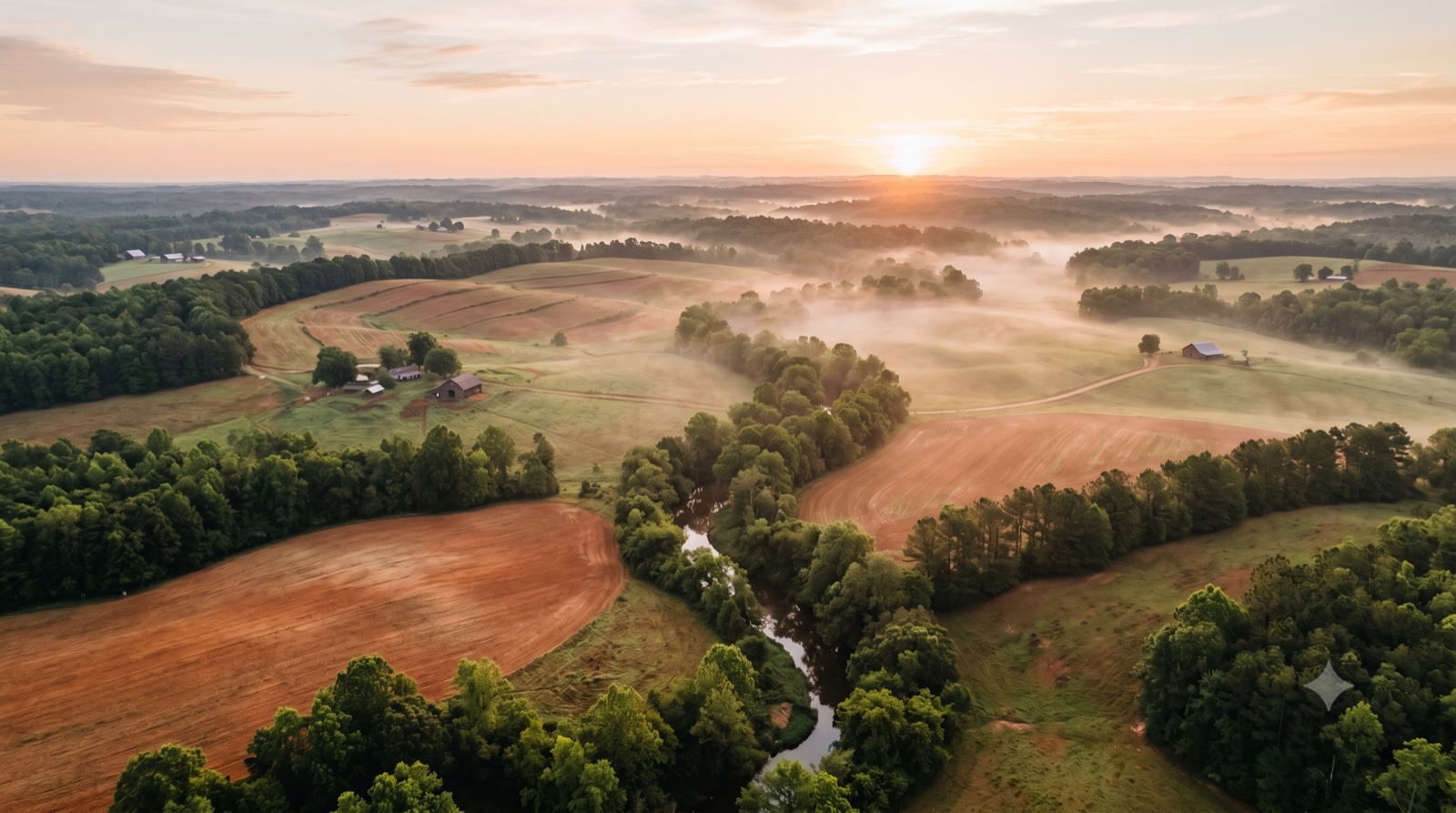
Sell My Land in Ben Hill County GA - What Landowners Need to Know
Key Takeaways
- Only about a quarter of Ben Hill County is in farms: The county holds roughly 160,000 acres of land, but the USDA 2022 Census of Agriculture counts just 40,197 acres in farms — a far smaller agricultural footprint than the surrounding south Georgia farm belt suggests
- The farm base contracted 23% in five years: Farm count fell from its 2017 level by 23% to 167 farms, land in farms fell 23%, and average farm size barely moved at 241 acres — acreage leaving agriculture rather than consolidating into larger operations
- Georgia assesses all real property at 40% of fair market value and charges $1 per $1,000 in transfer tax: A CUVA or FLPA conservation covenant can sharply reduce the taxable value on qualifying land, but breaching one triggers a penalty of twice the accumulated tax savings plus interest
How Can You Sell Land in Ben Hill County Georgia?
You can sell land in Ben Hill County through Georgia's attorney-supervised closing process, with a transfer tax of $1 per $1,000 of consideration and deeds recorded at the Clerk of Superior Court in Fitzgerald — the item most likely to complicate your sale is a CUVA or FLPA conservation covenant sitting on the parcel, which carries a real penalty if it is breached at closing. Ben Hill County covers roughly 250 square miles of land in south-central Georgia, holding about 17,194 residents at a density near 69 people per square mile.
Ben Hill County borders Wilcox County to the north, Telfair County to the northeast, Coffee County to the east, Irwin County to the south, and Turner County to the west. The county was created in 1906 from parts of Irwin and Wilcox counties and named for Benjamin Harvey Hill.
This guide covers Georgia's property tax structure for vacant land, the CUVA and FLPA covenants that shape sale timelines, the attorney-managed closing process, how Ben Hill compares to its neighbors, and your practical options for selling.
What Are the Tax Costs of Holding Land in Ben Hill County?
Georgia applies a uniform 40% assessment ratio to the fair market value of all real property, including vacant land, and there is no separate lower ratio for owner-occupied housing the way several neighboring states use. The Board of Assessors sets fair market value and the Tax Commissioner applies the millage rate to the resulting assessed value.
We do not publish a Ben Hill County millage or effective tax rate here. The Georgia Department of Revenue's own county property tax page for Ben Hill routes visitors to the local Tax Commissioner and Assessor rather than publishing a current rate, and undated third-party estimates are unreliable. For the figure that governs your parcel, call the Tax Commissioner's office directly using the contact information below.
CUVA and FLPA: The Covenants That Actually Decide Your Timeline
Georgia's Conservation Use Valuation Assessment (CUVA) lets qualifying agricultural and conservation land be taxed on its current-use value rather than its fair market value, in exchange for a 10-year covenant committing the owner to keep the land in that use. That break is substantial in a county like Ben Hill, and enrollment is common — which is exactly why it catches sellers off guard.
If the property sells and the buyer will not assume the covenant, or if the use changes, the covenant is breached. The breach penalty is twice the difference between what was paid under current-use assessment and what would have been owed at fair market value, for each year of the covenant, plus interest — a figure set out in O.C.G.A. § 48-5-7.4 and repeated consistently across Georgia county assessor guidance and Georgia Farm Bureau's explainer. There is a narrow exception: a family-owned farm entity that breaches after year three, where a partner or shareholder is 65 or older and has held a beneficial interest for 13 years or more, may repay only the current year's savings rather than the doubled penalty.
The Forest Land Protection Act (FLPA) works similarly for larger forest tracts. Per the Georgia Department of Revenue, FLPA covers forest land of at least 200 acres in aggregate, with at least 100 acres in any single county where a tract spans county lines, under a 10-year covenant with the local board of assessors. Property already under CUVA or another preferential assessment can convert to an FLPA covenant one time without penalty.
If your parcel carries an active covenant, you have three realistic options: sell with the covenant assigned to a buyer willing to assume it, breach and pay the penalty out of proceeds, or wait for the covenant to expire. Verify covenant status with the Board of Assessors before you list — discovering it during closing is how deals die. If your land also carries back taxes, see how to sell land with back taxes.
Beyond taxes, vacant land here carries the ordinary carrying costs: liability exposure, brush and firebreak maintenance on timbered tracts, and an annual bill that accrues whether or not the land earns a dollar.
What Closing Requirements and Zoning Rules Apply in Ben Hill County?
Georgia law requires a licensed Georgia attorney to supervise every real estate closing, including a cash sale of vacant land between private parties. The attorney conducts the title examination, prepares the deed, disburses funds, and records the deed with the Clerk of Superior Court.
A vacant-land sale typically runs:
- Contract execution: Buyer and seller agree on terms in writing
- Title examination: The attorney searches Superior Court deed records for a period sufficient to establish marketable title, checking liens, encumbrances, judgments, and — critically here — CUVA or FLPA covenant status
- Closing: The parties sign the deed and settlement statement; the attorney disburses funds and collects the transfer tax
- Recording: The attorney records the deed. Georgia's transfer tax of $1 per $1,000 of consideration, or fraction thereof, is paid at recording
Deed transfers are recorded through the Ben Hill County Clerk of Superior Court, Kimberly M. Newell, at 115 South Sheridan Street (mailing: PO Box 1104), Fitzgerald, GA 31750, phone (229) 426-5135 — confirmed against both the county's own directory and the Georgia Superior Court Clerks' Cooperative Authority. The Ben Hill County Tax Commissioner, Barry Foster, is at 324 East Pine Street, Fitzgerald, GA 31750, phone (229) 426-5144. Note that (229) 426-5100 is the county administration switchboard rather than a direct line to either office — a distinction third-party directories routinely blur.
Georgia's transfer tax is among the lower state-level rates in the Southeast, and there is no additional county-level transfer tax in Ben Hill County.
Zoning and Land Use
Land inside the Fitzgerald city limits is subject to municipal ordinances, while unincorporated acreage — the great majority of the county's rural land — falls under county land-use regulation. For a zoning classification or setback question on a specific parcel, start with the Board of Assessors, which can route you to the appropriate county planning contact. Manufactured-home placement, subdivision, and commercial development all warrant a direct call before you market the property.
If your land came through an estate, see selling inherited land with multiple heirs; if you live elsewhere, see selling land as an out-of-state owner.
How Does Ben Hill County Compare to Neighboring Georgia Counties?
Ben Hill County is unusually compact for a rural Georgia county — about 250 square miles holding just over 17,000 people, which makes it denser than most of its neighbors while remaining firmly rural. Its population has drifted slightly downward, from 17,634 in the 2010 Census to 17,194 in 2020 and an estimated 17,128 in 2023.
| Factor | Ben Hill County | Coffee County | Irwin County | Turner County |
|---|---|---|---|---|
| Population (2020 Census) | 17,194 | 43,092 | 9,666 | 9,006 |
| Land area | 250 sq mi | 575 sq mi | 354 sq mi | 285 sq mi |
| County seat | Fitzgerald | Douglas | Ocilla | Ashburn |
| Assessment ratio | 40% of FMV | 40% of FMV | 40% of FMV | 40% of FMV |
| Position | Center | East | South | West |
| Land character | Cotton, peanuts, pecans, pine woodland | Larger, more diversified | Irrigated row crop and pine | Row crop, pecan, pine |
Coffee County to the east is more than twice Ben Hill's size in both land and population, with Douglas serving as the regional center. Irwin County to the south and Turner County to the west are each smaller in population but larger in land area — meaning both are more thinly settled than Ben Hill. See our guides to selling land in Irwin County, GA, Turner County, and Wilcox County to the north.
Fitzgerald itself is a genuine regional service center with an unusual history. The city was founded in 1896 by Philander H. Fitzgerald, a Union Army veteran and pension attorney, as a planned colony deliberately mixing Union and Confederate veterans — earning it the nickname "Colony City" — and it became the county seat when Ben Hill County was created in 1906, according to the New Georgia Encyclopedia. Under Mayor Gerald Thompson from 1968 to 2011 the city attracted roughly 30 industries and what is now Wiregrass Georgia Technical College. Fitzgerald is also known for its free-roaming Red Junglefowl — the "Burmese chickens" descended from a wildlife restocking release — and hosts an annual Wild Chicken Festival, per Explore Georgia.
The Land Data Tells a Sharper Story Than the Population Line
The USDA 2022 Census of Agriculture reports 167 farms in Ben Hill County working 40,197 acres, at an average size of 241 acres. Set that against the county's roughly 160,000 total acres and the striking fact emerges: only about a quarter of Ben Hill County is in farms at all — a much smaller agricultural footprint than its Coastal Plain neighbors.
The five-year trend is sharper still. Farm count fell 23% and land in farms fell 23%, while average farm size moved just −1%. When operator count and acreage fall together and farm size stays flat, land is leaving agriculture outright rather than being absorbed by larger neighbors — a different and more difficult pattern for a seller than ordinary consolidation.
The remaining farm economy is real but narrow. Total market value of products sold reached $21.9 million, up 5%, split 69% crops to 31% livestock, with poultry and eggs at roughly $6.19 million leading the livestock side. Top crops by acreage are cotton at 4,515 acres, peanuts at 3,941 acres, corn for grain at 2,095 acres, and pecans at 1,122 acres, with 7,235 acres — 18% of land in farms — under irrigation. Land in farms breaks out as 16,503 acres of cropland, 19,760 acres of woodland, 1,467 acres of pastureland, and 2,467 acres of other uses, meaning woodland actually exceeds cropland here.
One more figure matters to anyone timing a sale: of the county's 253 producers, 129 are 65 or older — better than half. That is an aging operator base, and it points to a wave of succession-driven turnover that will put more land on the market, not less. For a statewide overview see how to sell land in Georgia; for timbered tracts see selling timberland; for row-crop ground see our farmland selling guide; and for county-level analysis across the state, explore our blog.
What Are Your Options for Selling Land in Ben Hill County?
Ben Hill County landowners face a specific combination: a 40% assessment ratio with no vacant-land relief absent a covenant, a covenant regime that penalizes breaking it, a farm base that shrank nearly a quarter in five years, and an operator population more than half of which is past 65. None of that makes a parcel unsellable — it makes the preparation matter more.
Before listing or accepting any offer, confirm your legal description and check for any active CUVA or FLPA covenant through the Ben Hill County Clerk of Superior Court at (229) 426-5135 and the Board of Assessors. Verify your tax status with the Tax Commissioner at (229) 426-5144 and confirm no delinquent taxes exist. If your land carries merchantable pine — and with woodland exceeding cropland countywide, many tracts do — a certified forester's timber cruise will establish standing wood value independent of the dirt. If you are unsure where to begin, see how much is my land worth.
Sellers have several paths. Listing with a Georgia land-specialist agent exposes the property to row-crop, recreational, and timber buyers across south-central Georgia. Online land platforms reach buyers hunting rural acreage specifically, though tracts without irrigation or a clear recreational draw can take time. For landowners who want a firm written number without extended market exposure, Jerez Land provides a parcel-specific cash offer for your land. As a direct buyer we absorb the carrying costs, the marketing time, and the resale risk on a parcel that may wait for the right buyer — and the Georgia attorney closing process is handled from our side.
If you are weighing whether to involve an agent, see whether you need a realtor to sell land. If the tract is good deer or quail ground, see how to sell hunting land.
Frequently Asked Questions
My Ben Hill County land is in CUVA and I want to sell — what happens to the covenant?
You have three options: sell to a buyer who agrees to assume the remaining covenant term, breach it and pay the penalty from your proceeds, or wait until the 10-year covenant expires. Breaching costs twice the difference between the tax you paid under current-use assessment and what you would have owed at fair market value, for each year of the covenant, plus interest, under O.C.G.A. § 48-5-7.4. Confirm your covenant status with the Ben Hill County Board of Assessors before you list, because discovering it at the closing table is how these sales fall apart.
I inherited land in Ben Hill County and live out of state — can I sell it without traveling to Georgia?
Yes, in most cases. Start by confirming the legal description and covenant status with the Ben Hill County Clerk of Superior Court at (229) 426-5135, and your tax status with the Tax Commissioner at (229) 426-5144. Georgia requires a licensed attorney to supervise the closing, conduct the title examination, and prepare the deed, and that attorney can typically arrange remote signing through a notary in your home state. If the property passed through an estate with multiple heirs, everyone holding an interest will need to sign.
What transfer taxes will I pay when I sell land in Georgia?
Georgia levies a real estate transfer tax of $1 per $1,000 of consideration, or fraction thereof, paid at closing when the deed is recorded with the Clerk of Superior Court. On a $100,000 parcel the tax is $100. The seller typically pays it, and there is no separate county transfer tax in Ben Hill County. Georgia's rate is among the lower state-level transfer taxes in the Southeast.
I have farmland in Ben Hill County that isn't drawing interest — what's going on locally?
The county's farm base contracted sharply. Between 2017 and 2022, farm count fell 23% to 167 farms and land in farms fell 23% to 40,197 acres, while average farm size barely changed at 241 acres, per the USDA 2022 Census of Agriculture. When acreage and operator count drop together without farm size rising, land is exiting agriculture rather than being bought up by expanding neighbors. Only about a quarter of the county's roughly 160,000 acres is in farms at all, and more than half its 253 producers are 65 or older — so the local buyer pool for working ground is both small and aging.
Do I need to hire a lawyer to close a land sale in Ben Hill County?
Yes. Georgia law requires a licensed Georgia attorney to supervise real estate closings, conduct the title examination, prepare the deed, disburse funds, and record the deed with the Clerk of Superior Court at 115 South Sheridan Street, Fitzgerald, GA 31750. This applies to every land transaction, including private-party and cash sales. The attorney is also the person most likely to catch a CUVA or FLPA covenant before it becomes a problem.
Does my Ben Hill County timber tract qualify for FLPA instead of CUVA?
Only if it meets the acreage threshold. Per the Georgia Department of Revenue, the Forest Land Protection Act covers forest land of at least 200 acres in aggregate, with at least 100 acres in any single county when a tract crosses county lines, under a 10-year covenant with the local board of assessors. Property already enrolled in CUVA or another preferential assessment may convert to an FLPA covenant one time without penalty. Below 200 acres, CUVA is the applicable program — and with woodland exceeding cropland across Ben Hill County, this distinction affects a lot of local tracts.
Disclaimer: This article is for informational purposes only and does not constitute legal, financial, or professional advice. Laws and regulations vary by jurisdiction and change over time. Always consult with qualified professionals before making land selling or purchasing decisions. Jerez Land is not responsible for actions taken based on this information.