
Sell My Land in Calhoun County MS - What Landowners Need to Know
Key Takeaways
- Mississippi charges no real estate transfer tax, so a Calhoun County seller's closing costs are limited to recording fees (roughly $25 for the first five pages, $1 per page after), attorney fees, and any prorated property taxes
- Calhoun County's agricultural economy is 96% crops and only 4% livestock, per the USDA 2022 Census of Agriculture (cp28013) — the vegetables, melons, and sweet potatoes category alone sold $48.6 million and ranks #1 in Mississippi, driven by Vardaman, which has called itself the Sweet Potato Capital of the World since 1974
- Population has declined steadily for a quarter century — 15,069 in 2000, 14,962 in 2010, 13,266 in 2020, and roughly 12,643 by 2025 estimate — thinning an already small local buyer pool
How Can You Sell Land in Calhoun County Mississippi?
Selling land in Calhoun County, Mississippi is mechanically simpler than in most states — Mississippi levies no transfer tax, and your recording costs run about $25 plus a dollar per page past the fifth. What complicates it is the market: a county of roughly 12,600 people that has lost about 16% of its population since 2000, where the buyer pool for rural acreage is genuinely thin.
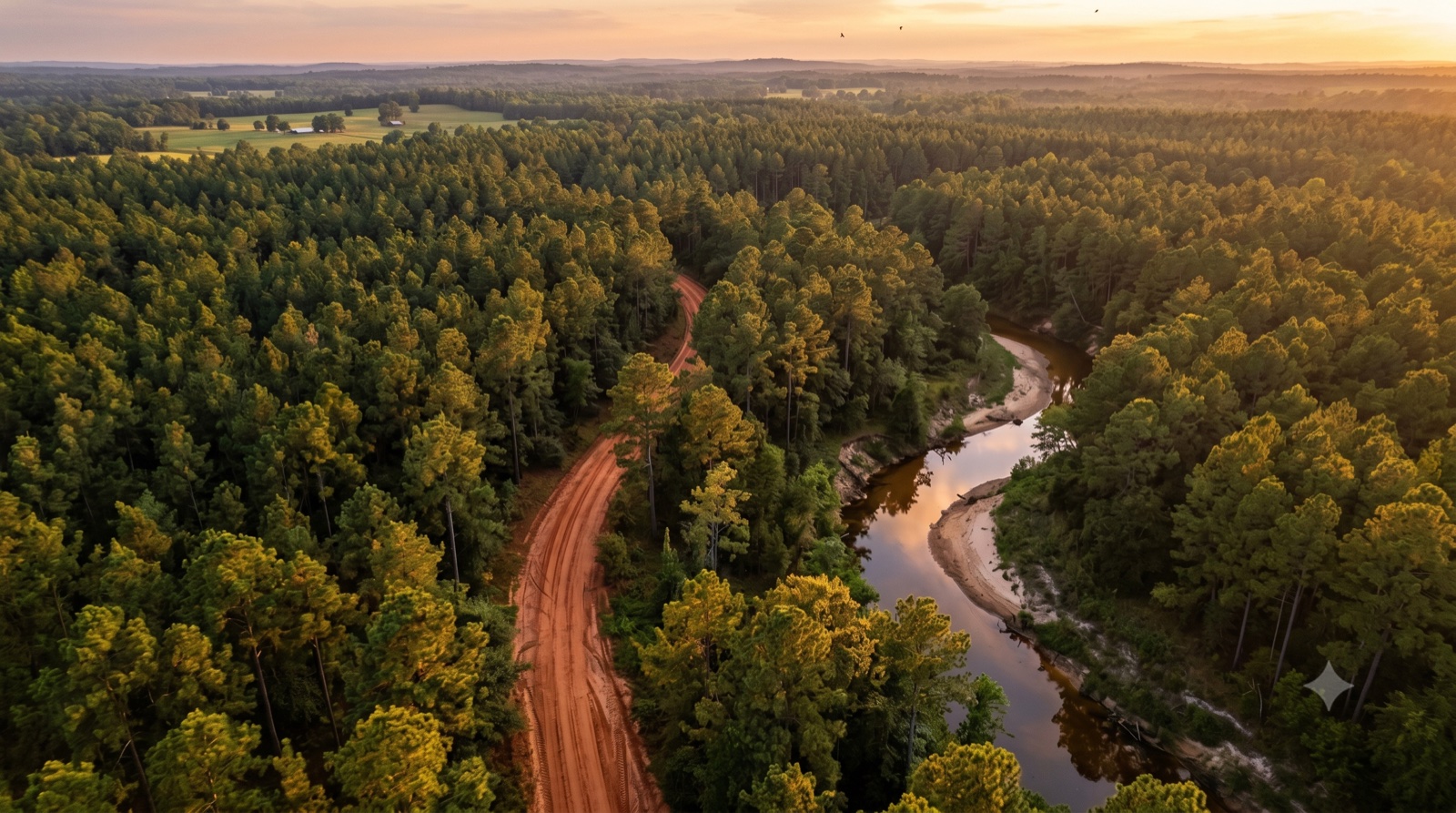
Calhoun County sits in the red clay hills of north-central Mississippi. Pittsboro is the county seat, though Bruce is the larger town, with Calhoun City, Derma, and Vardaman rounding out the municipalities. The county covers about 587 square miles. The terrain is rolling upland cut by creek and river bottoms — and those bottoms are the reason this county's land economy looks nothing like the pine-and-cattle counties around it.
This guide covers Calhoun County's property tax mechanics, Mississippi's use-value assessment and timber severance rules, the Chancery Clerk's role in land records, how the county compares to its neighbors, and your practical options for selling. For the statewide picture, start with our Mississippi land selling guide, or browse our full land selling library.
What Are the Tax Costs of Holding Land in Calhoun County?
Calhoun County's effective property tax rate is reported between 0.72% and 1.11%, and the two main sources disagree by more than 50%. Tax-Rates.org reports a 0.72% effective rate with a median annual bill of about $440 on a $60,700 median home value, and notes Calhoun has the second-lowest median property tax dollar amount of any Mississippi county. Ownwell reports a 1.11% effective rate with a median bill near $693 on a $55,574 median value.
Do not average those. They rest on different valuation bases and vintages. The reliable takeaway is that Calhoun County's absolute tax dollars are low by national standards either way — which is precisely why owners hold vacant parcels here for decades without feeling much pressure, and why the eventual decision to sell is usually driven by something other than the tax bill.
Mississippi's assessment ratios are set constitutionally, and they matter more than the headline rate. Per Mississippi State University Extension:
- Class I (owner-occupied residential): assessed at 10% of true value
- Class II (all other real property, which includes most vacant land): assessed at 15% of true value
- Class III (business personal property): 15%
- Class IV (public utility): 30%
Your vacant land is Class II. It is assessed at 15% of its true value, and millage is applied to that assessed figure.
Use-Value Assessment: How Mississippi Values Farm and Timber Ground
Mississippi does not tax agricultural and timber land on market value. Under Miss. Code § 27-35-50, county assessors must appraise qualifying agricultural and timber land at its use value, derived from soil productivity using the Department of Revenue's land appraisal manuals. The method is income capitalization with a capitalization rate of not less than 10%, applied to a moving average of income years — a window that ramps from four years in 2022 up to ten years by 2028, with timberland treated on its own separate moving average.
Once the use value is established, the land is still assessed at the Class II ratio of 15% of that use value. The practical effect is a substantially lower tax bill than market-value assessment would produce on productive ground.
One honest caveat: no source consulted confirmed whether Mississippi imposes a rollback or recapture tax when use-value land converts to another use. Several states do, and it is a large number when it applies. We are not going to tell you Mississippi has no rollback, because we could not verify that either way. Ask the Calhoun County Tax Assessor or a Mississippi closing attorney directly before you assume anything about it.
Timber Severance Tax
If you harvest before selling, Mississippi's timber severance tax applies, administered by the Department of Revenue. Published rates include pine and other softwood lumber at $1.00 per thousand board feet or $0.12 per ton; hardwood lumber at $0.75 per thousand board feet or $0.08 per ton; pine pulpwood at $0.30 per cord; and poles, piling, and posts at $3.60 per hundred cubic feet.
If your parcel is primarily wooded, our guide on selling timberland covers what buyers evaluate, and if you are weighing a harvest first, see selling a cutover or recently logged timber tract.
What Closing Requirements and Zoning Rules Apply in Calhoun County?
Mississippi treats real estate closings as the practice of law, so attorney involvement is standard and expected on a Calhoun County land sale. Title companies participate, but they work with or through attorneys rather than independently performing tasks that would constitute the unauthorized practice of law. In practice, plan on an attorney preparing the deed and overseeing the closing.
Mississippi charges no real estate transfer tax and no deed tax. That is a genuine cost advantage over neighboring states — Michigan sellers pay about 0.86% of the price, Tennessee 0.37%. In Mississippi you pay recording fees: about $25.00 for the first five pages and $1.00 per additional page, with some counties adding a small archiving fee and a possible extra charge for a nonconforming document.
Land records in Mississippi are held by the Chancery Clerk, not a Register of Deeds. The Calhoun County Chancery Clerk, Kathy Weeks Poynor, is at 103 West Main Street (mailing: P.O. Box 8), Pittsboro, MS 38951, phone (662) 412-3117. This is where deeds, liens, and the land record index live.
The Calhoun County Tax Assessor and Tax Collector, Bill Malone, is at 103 W. Main Street (mailing: P.O. Box 6), Pittsboro, MS 38951, phone (662) 412-3140. This is the office to call about your assessed value, your Class II classification, use-value enrollment, and any delinquent taxes.
Zoning and Land Use
Calhoun County is a rural Mississippi county without the comprehensive zoning regimes common in metropolitan counties, and most rural acreage carries no use restriction beyond state and federal environmental rules and any private covenants recorded against the parcel. Recorded restrictions, easements, and rights-of-way survive a sale and should be pulled from the Chancery Clerk before you market the land. Bottomland parcels along the Skuna and Yalobusha drainages can carry floodplain considerations that affect buildability — see our guide on selling land in a flood zone if that applies to your tract.
If you are handling this from out of state, our guide on selling land as an out-of-state owner covers remote-closing logistics.
How Does Calhoun County Compare to Neighboring Mississippi Counties?
Calhoun County has lost population in every decennial count since 2000, and the trend is unambiguous even though the exact current figure is not. The county went from 15,069 residents in 2000 to 14,962 in 2010, then dropped sharply to 13,266 in 2020, with a 2025 estimate near 12,643. Median age is about 44.9 years — an aging county as well as a shrinking one.
| Factor | Calhoun County | Grenada County | Webster County | Yalobusha County |
|---|---|---|---|---|
| County seat | Pittsboro (Bruce is largest town) | Grenada | Walthall | Water Valley / Coffeeville |
| Effective tax rate | 0.72%–1.11% (sources differ) | ~0.73%–0.80% | 0.56%–0.96% (sources differ) | ~0.82% |
| Land economy | Row crops and sweet potatoes; #1 in MS for vegetables/potatoes | Grenada Lake recreational and lake-adjacent demand | Mixed farming and timber, rolling hills to flatter ground south | River-bottom hunting ground near Grenada Lake |
| Transfer tax | None (statewide) | None | None | None |
| Assessment ratio (vacant land) | 15% Class II | 15% Class II | 15% Class II | 15% Class II |
We have deliberately left population figures out of the neighbor columns. Clean current numbers for Grenada, Webster, and Yalobusha were not verifiable in this research pass, and a plausible-looking estimate is worse than an honest gap. Confirm those with Census QuickFacts if the comparison matters to your decision.
What Actually Grows Here — and Why It Matters to a Buyer
Calhoun County is not a timber-and-cattle county, and any buyer who tells you otherwise has not read the data. The USDA 2022 Census of Agriculture (cp28013) reports 531 farms working 180,673 acres, up 22% since 2017, at an average of 340 acres. Total agricultural sales were $97.2 million, up 57% since 2017 — and 96% of that was crops, only 4% livestock.
Within farm ground, cropland (97,479 acres) more than doubles woodland (45,960 acres) and more than triples pastureland (28,703 acres). The largest single crop by acreage is soybeans at 38,641 acres, followed by all vegetables harvested at 14,425 acres and sweet potatoes specifically at 14,127 acres. Corn takes 12,357 acres and cotton 10,623.
The headline is the vegetables, melons, potatoes and sweet potatoes category: $48.6 million in sales, ranked #1 among all Mississippi counties. Vardaman has billed itself the Sweet Potato Capital of the World since the first Vardaman Sweet Potato Festival in 1974, and the Ag Census confirms the branding is backed by real production. Grains and oilseeds add $33.4 million (#15 in the state), cotton $8.1 million, and cattle a distant $3.8 million.
Here is the part that matters for a landowner. Land in farms is roughly 48% of the county's total acreage — just under half. That means a large share of Calhoun County's private land sits entirely outside the Ag Census: upland timber, recreational tracts, and cutover ground that never appears in agricultural statistics at all. So both stories are true. The bottoms and better soils are a nationally significant row-crop and sweet-potato district. The uplands are ordinary north Mississippi hill timber. Which one your parcel is determines who your buyer is.
For help understanding what drives value on your specific tract, see how much is my land worth, and if you are weighing whether to list at all, see do you need a realtor to sell land.
What Are Your Options for Selling Land in Calhoun County?
The most common Calhoun County seller is an heir or long-time owner holding upland acreage that produces nothing, costs a few hundred dollars a year, and has no obvious buyer. The signals are familiar: the parcel came through an estate and is now split among relatives who live elsewhere, nobody has walked the boundary in a decade, the timber was cut years ago and never replanted, or you simply want the asset converted to cash while the paperwork is still manageable.
Before accepting any offer, do these things. Confirm your assessed value and Class II classification with the Tax Assessor at (662) 412-3140, and ask specifically whether the parcel is enrolled in use-value assessment and what happens if it comes out. Pull your deed and check for recorded easements, rights-of-way, and mineral reservations with the Chancery Clerk at (662) 412-3117. Check whether any taxes are delinquent. And if the tract has merchantable timber, get a forester's opinion before you price it, because standing timber and bare ground are two different products with two different buyer pools.
Sellers here have real choices. Listing with a Mississippi land broker reaches farm buyers and hunting-lease investors through platforms like Lands of America and LandWatch, but commissions apply and rural Mississippi acreage can sit for a long time in a county losing population. For owners who want a specific number without an open-ended marketing period, Jerez Land makes a direct, parcel-specific written cash offer for your land. We buy for cash and carry the taxes, marketing expense, and resale risk ourselves, so our offer reflects the certainty and speed we provide rather than a retail listing price. No commissions, no listing period, and a closing driven by when title is clear.
Frequently Asked Questions
I inherited land in Calhoun County and live out of state — what's the process for selling it?
Start with the Chancery Clerk at (662) 412-3117 to pull the deed and confirm how title is currently held, since inherited Mississippi land often needs an estate matter resolved before it can convey cleanly. Confirm the tax status with the Tax Assessor at (662) 412-3140. Mississippi treats closings as the practice of law, so you will work with an attorney, but you do not need to appear in person — remote signing and wired funds are routine. Mississippi charges no transfer tax, so your closing costs are recording fees, attorney fees, and prorated taxes.
My Calhoun County parcel just sits there — how much will I pay in property taxes each year?
Reported effective rates for Calhoun County range from 0.72% (Tax-Rates.org) to 1.11% (Ownwell), with median annual bills of roughly $440 and $693 respectively. The sources use different valuation bases and should not be averaged. Vacant land is Class II property, assessed at 15% of true value under Mississippi's constitutional ratios, with millage applied to that assessed figure. If the land qualifies as agricultural or timber, it is appraised at use value rather than market value under Miss. Code § 27-35-50, which lowers the bill further.
Does Mississippi charge a transfer tax on land sales?
No. Mississippi charges no real estate transfer tax and no deed tax, which makes it cheaper to convey land here than in most neighboring states. You will pay recording fees to the Chancery Clerk — roughly $25.00 for the first five pages and $1.00 per additional page, with some counties adding a small archiving fee. A deed that does not meet formatting requirements can incur an additional charge. Attorney fees and prorated property taxes are the other closing costs to plan for.
My Calhoun County land is in use-value assessment — will I owe a rollback if it's sold for another use?
We cannot tell you with confidence, and you should not accept a confident answer from anyone who has not checked. Mississippi appraises qualifying agricultural and timber land at use value under Miss. Code § 27-35-50, but no source we consulted confirmed whether a rollback or recapture tax applies when that land converts to another use. Several states impose one and it can be substantial. Call the Calhoun County Tax Assessor at (662) 412-3140 or a Mississippi closing attorney and get the answer in writing before you agree to a price.
Do I need to hire an attorney to sell my land in Calhoun County?
In practice, yes. Mississippi treats real estate closings as the practice of law, so deed preparation and closing oversight are handled by a licensed Mississippi attorney. Title companies participate in transactions but cannot independently perform work that would constitute unauthorized practice of law. This is different from title-company states like Michigan or Oklahoma. Budget for attorney fees as a normal part of a Mississippi land closing, and expect the attorney to run the title search and prepare the deed.
Is Calhoun County Mississippi's population growing or declining?
Declining, steadily, for at least twenty-five years. The county recorded 15,069 residents in 2000, 14,962 in 2010, 13,266 in 2020, and roughly 12,643 by a 2025 estimate — a loss of about 16% since 2000, with the sharpest drop between 2010 and 2020. Median age is approximately 44.9 years. For a landowner, the practical consequence is a small and shrinking pool of local buyers for rural acreage, which is why marketing periods here tend to run long and why out-of-county and cash buyers matter more than they would in a growing market.
Disclaimer: This article is for informational purposes only and does not constitute legal, financial, or professional advice. Laws and regulations vary by jurisdiction and change over time. Always consult with qualified professionals before making land purchase decisions. Jerez Land is not responsible for actions taken based on this information.