
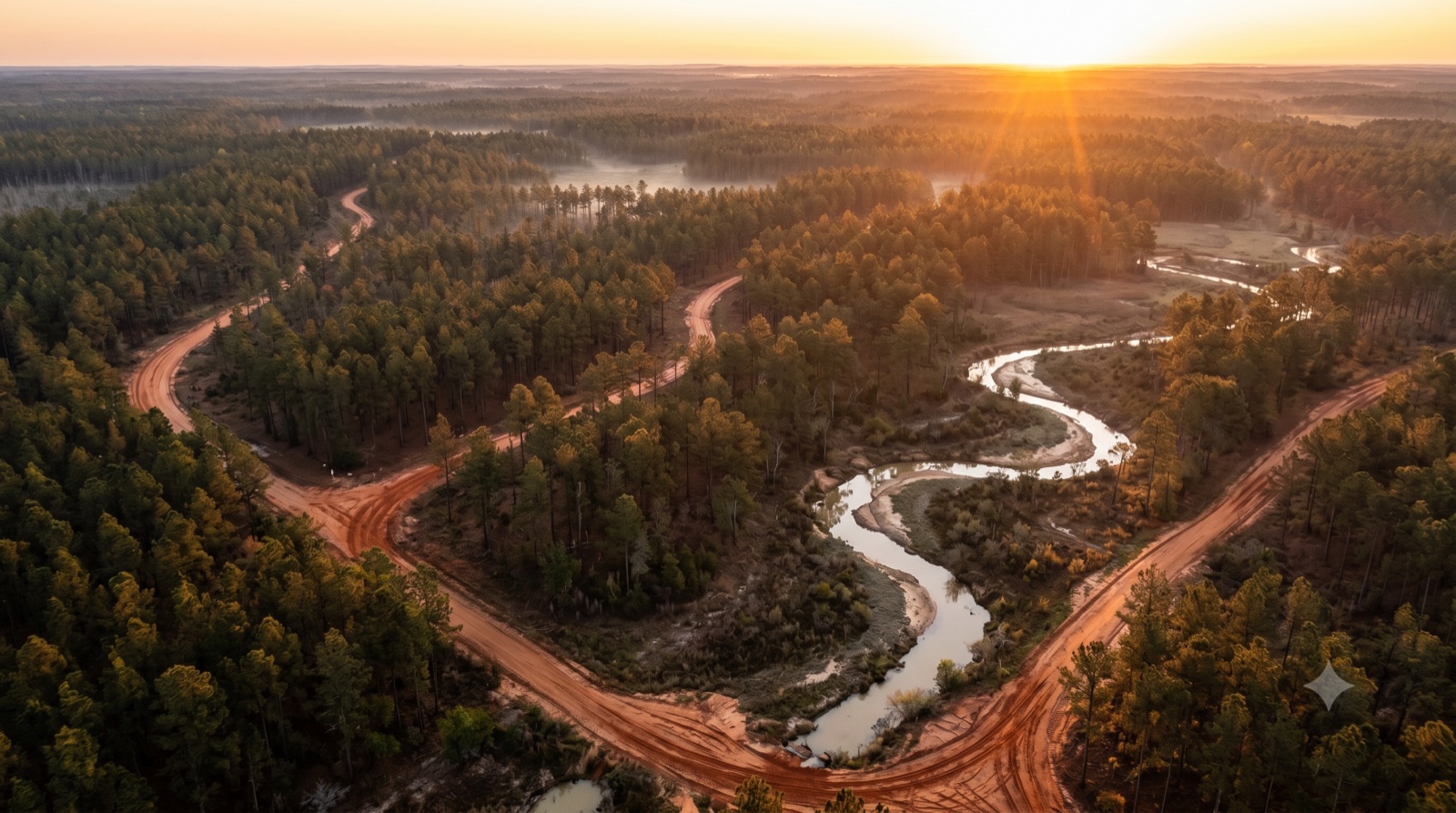
Sell My Land in Cleburne County AL - What Landowners Need to Know
Key Takeaways
- Cleburne County is broiler country before it is timber country: Poultry and eggs generated $127.5 million of the county's $136.0 million in total agricultural sales in 2022 — 94% of everything the county's farms sell — with cattle a distant second at $5.1 million, per the USDA 2022 Census of Agriculture county profile
- Only about 47,000 of the county's roughly 358,000 acres are in farms: A very large share of Cleburne County is Talladega National Forest, Cheaha State Park, and non-farm private timberland, which thins the pool of private tracts that actually trade
- Alabama's deed recording tax is $0.50 per $500 of value: One of the lowest in the Southeast, roughly $100 per $100,000 of sale price, and qualifying Class III land can be assessed on current use rather than market value
How Can You Sell Land in Cleburne County Alabama?
You can sell land in Cleburne County through a licensed Alabama attorney who prepares the deed and records it with the Probate Office in Heflin, paying a deed recording tax of $0.50 per $500 of value. The factors that most shape a Cleburne County sale are a land base heavily constrained by the Talladega National Forest, a farm economy built on broiler houses rather than timber tracts, and Alabama's current-use assessment program for qualifying land.
Cleburne County covers roughly 560 square miles in east Alabama on the Georgia line, seated at Heflin. Cheaha Mountain — at 2,407 feet, Alabama's highest point — sits within the county, and the western portion of Cleburne lies inside the Talladega National Forest, according to the Encyclopedia of Alabama.
This guide covers Alabama's property tax classification system and current-use program, the state's attorney-required closing process, how Cleburne compares to its neighbors, and your practical options for selling.
What Are the Tax Costs of Holding Land in Cleburne County?
Cleburne County has one of the lowest effective property tax rates in the country, running approximately 0.37% to 0.38%. Tax-Rates.org reports 0.38% with a median annual bill of $337; Ownwell reports 0.37% with a median annual bill of $453. The rates agree closely — the difference in dollar figures reflects different median home-value baselines rather than a disagreement about the rate.
Alabama classifies property for assessment purposes under Ala. Code § 40-8-1. Class III — which includes agricultural, forest, and residential property — is assessed at 10% of value. Class II, covering all property not otherwise classified, is assessed at 20%. Which class your parcel falls into materially changes the bill, and it is worth confirming with the Revenue Commissioner rather than assuming.
How Alabama's Current-Use Valuation Works
Alabama lets owners of qualifying Class III agricultural and forest land elect current use valuation, so the parcel is assessed on its productive use rather than market value. The election is filed with the county assessing official between October 1 and January 1.
The Alabama Department of Revenue publishes the current-use schedules annually. Under the CU-2026 directive issued October 1, 2025, timberland current-use values run $837 per acre for good soil productivity, $638 average, $454 poor, and $364 non-productive. Pastureland and row-crop land run $532, $443, $310, and $110 across the same productivity groups.
To be explicit about what those numbers are: these are tax-assessment figures set by the state revenue department, not market prices and not what land trades for. They are multiplied by the 10% Class III assessment ratio and then by the local millage to produce the actual tax. They are useful for understanding your carrying cost, and for nothing else.
Even at Cleburne County's low rate, the bill repeats annually, and on land producing no timber income, no lease payment, and no rent, it is pure carrying cost. For land carrying unpaid taxes, see our guide on how to sell land with back taxes.
What Closing Requirements and Zoning Rules Apply in Cleburne County?
Alabama is an attorney-closing state. Under Ala. Code § 34-3-6(c), a licensed Alabama attorney must prepare and review the legal documents in a real estate transaction — the deed, the title opinion, and the closing statement. Unlike states where title companies close independently, the attorney requirement applies to all real property conveyances.
The typical Alabama land closing runs:
- Title search: The attorney searches records held by the Cleburne County Probate Office for liens, easements, judgments, and encumbrances
- Title opinion: The attorney issues a written opinion certifying marketability of title
- Deed preparation: The attorney prepares the warranty deed and settlement statement
- Closing: All parties execute
- Recording: The attorney records the deed with the Probate Office and the deed tax of $0.50 per $500 of value is paid
Alabama records land deeds in the Probate Office, not a register of deeds or county clerk. The Cleburne County Probate Office, Judge Lane Kilgore, is at 120 Vickery Street, Suite 101, Heflin, AL 36264, phone 256-463-5655. The Cleburne County Revenue Commissioner, Joyce R. Fuller, is at 120 Vickery Street, Suite 102, Heflin, AL 36264, phone 256-463-2873, with the appraisal office direct at 256-463-5419.
Alabama's $0.50-per-$500 deed tax is among the lowest in the Southeast — roughly $100 per $100,000 of sale price, according to ListWithClever — which keeps Alabama closing costs comparatively modest.
Zoning, National Forest, and Access in Cleburne County
Cleburne County is rural, and agricultural and timber uses on most tracts proceed without county use permits. The land-use factor that matters far more here than zoning is the Talladega National Forest, which covers the western portion of the county.
Federal ownership shapes a private-land market in ways sellers should understand. Tracts bordering or surrounded by national forest can have access that depends on a forest road, an old logging road, or an easement whose legal status was never properly documented. Cheaha State Park adds another block of public land. If your parcel touches the forest boundary, confirming deeded, recorded legal access before you market it is the single highest-value thing you can do — a buyer's attorney will find an access problem during title work, and finding it yourself first is far better than having a contract fall apart over it.
If your land is inherited, our guide on how to sell inherited land covers the steps. If your tract carries planted pine or hardwood, see how to sell timberland. If access is the issue, see selling landlocked land.
How Does Cleburne County Compare to Neighboring Alabama Counties?
Cleburne County has grown slowly but consistently — from 14,123 residents in 2000 to 14,972 in 2010 to 15,056 in 2020, with recent estimates ranging from roughly 15,400 to 16,000 depending on source and vintage. Unlike much of rural Alabama, this is not a depopulating county, though the growth is modest enough that it has not produced meaningful residential land demand in the county's interior.
| Factor | Cleburne County | Calhoun County | Talladega County | Randolph County |
|---|---|---|---|---|
| Population (2020 Census) | 15,056 | 116,441 | 82,149 | 21,967 |
| Population trend | Slowly growing | Roughly flat | Slowly declining | Slowly growing |
| Effective tax rate | ~0.37–0.38% | ~0.41% | ~0.39% | ~0.34% |
| County seat | Heflin | Anniston | Talladega | Wedowee |
| Land character | National forest, pasture, poultry | Anniston metro, foothills | Foothills, lake, forest | Farm, timber, Lake Wedowee |
| Key economic driver | Broiler poultry, forest recreation | Regional metro, manufacturing | Manufacturing, motorsports | Agriculture, lake recreation |
Calhoun County to the north, anchored by Anniston, is the regional employment center. Randolph County to the south shares Cleburne's small-county agricultural profile with the addition of Lake Wedowee frontage — a very different land market where waterfront exists.
Note that neighboring-county effective rates vary by several tenths of a point across sources; treat the table as indicative and confirm any specific county's rate with its revenue office.
What the Farm Data Actually Says
Cleburne County's agricultural economy is a broiler economy, and the numbers are not close.
The USDA 2022 Census of Agriculture county profile shows total market value of agricultural products sold at $136.0 million, of which poultry and eggs account for $127.5 million — 94%. Cattle and calves come in at $5.1 million. Livestock and poultry together are 98% of sales; crops are 2%. The county's broiler inventory stood at roughly 3.35 million birds. This is the modern expression of an identity that goes back decades: the Encyclopedia of Alabama notes Cleburne was branded the "Broiler Capital of Alabama" in the mid-1950s.
The land picture is equally distinctive. The county has 268 farms covering 46,919 acres — cropland 8,363 acres, pastureland 18,989 acres, and woodland within farms 17,212 acres. Against a county land area of roughly 358,000 acres, that means only about 13% of Cleburne County is captured as "land in farms" at all. The remainder is Talladega National Forest, Cheaha State Park, non-farm private timberland, and developed land.
We are not going to publish a precise figure for how much of the county is federal forest, because no official source states one that we could verify. What is verifiable is the direction: this is a county with a comparatively small private working-land base wrapped around a large block of public land, which is the structural reason the private tract market here is thin.
For a statewide overview of the selling process and other counties we buy in, see our guide on how to sell land in Alabama. For county-level analysis across the region, explore our blog. For help understanding value, see how much is my land worth.
What Are Your Options for Selling Land in Cleburne County?
Cleburne County sellers deal with a specific set of frictions: a private land base squeezed by federal forest, access questions on tracts near the forest boundary, a buyer pool concentrated among hunters, timber owners, poultry operators, and adjoining landowners rather than broad residential demand, and an attorney-required closing process.
Before listing or accepting any offer, verify your legal description and deed through the Cleburne County Probate Office, Judge Lane Kilgore, at 256-463-5655, 120 Vickery Street, Suite 101, Heflin. Confirm your tax status and current-use election through the Revenue Commissioner, Joyce R. Fuller, at 256-463-2873, Suite 102 at the same address, or the appraisal office at 256-463-5419. If your tract carries merchantable pine or hardwood, an Alabama Registered Forester's cruise will tell you something the current-use assessment cannot — standing timber value is not reflected in a current-use figure.
Sellers have several paths. Listing with an agent who knows east Alabama recreational and timber land reaches hunters, timber investors, and adjoining owners; commissions typically run 5–6%, and remote or access-constrained tracts can sit for many months in a county this size. For Sale By Owner on Land.com, LandWatch, or LandAndFarm reaches active land buyers directly but puts the burden of documenting boundaries, access, and timber on you — see how to sell land by owner. Working with a direct cash buyer like Jerez Land skips the listing period, commissions, and financing contingencies. We make parcel-specific, firm written offers based on a full review of your property — location, access, terrain, encumbrances, timber, and use designations — and we absorb the carrying costs, marketing expense, and resale risk. Our offers are not formulas. Request a cash offer for your land.
If you are weighing whether to involve an agent, see whether you need a realtor to sell land. If you live outside Alabama, see our guide for the out-of-state land owner.
Frequently Asked Questions
My family's 60 acres in Cleburne County backs up to the Talladega National Forest and I'm not sure we have legal access — can I still sell it?
Yes, but resolve the access question before you market it rather than after. Tracts bordering or surrounded by the Talladega National Forest frequently depend on old logging roads or forest roads whose legal status was never recorded, and a buyer's attorney will surface that during the title opinion. Start with the Cleburne County Probate Office at 256-463-5655 to pull your deed and any recorded easements. If access turns out to be undocumented, a parcel can still sell — access-constrained land has a real buyer pool — but you want to know that going in, not discover it two weeks before closing.
I inherited land near Heflin and live in another state — do I have to come to Alabama to sell it?
No. Alabama requires a licensed Alabama attorney to prepare and review the deed, title opinion, and closing documents under Ala. Code § 34-3-6(c), but that attorney can work with you remotely and the deed can be executed and notarized where you live. Begin by confirming your legal description with the Cleburne County Probate Office at 256-463-5655 and your tax status with the Revenue Commissioner at 256-463-2873. Alabama's deed recording tax of $0.50 per $500 of value is paid at recording.
I'm holding 40 acres in Cleburne County that I never use — what am I paying in property taxes every year?
Very low by national standards — approximately 0.37% to 0.38% effective, with Tax-Rates.org reporting a median annual bill of $337 and Ownwell reporting $453 (the gap reflects different home-value baselines, not a rate disagreement). Under Ala. Code § 40-8-1, Class III property including agricultural and forest land is assessed at 10% of value while Class II is assessed at 20%. Qualifying Class III land can elect current-use valuation, filed with the county assessing official between October 1 and January 1.
Is Cleburne County actually timber country, or is that just what it looks like?
It looks like timber country and a lot of it is forested, but the farm economy is overwhelmingly poultry. The USDA 2022 Census of Agriculture county profile shows poultry and eggs at $127.5 million of $136.0 million in total agricultural sales — 94% — with cattle at $5.1 million and crops at just 2% of sales. Woodland within farms covers 17,212 acres. The heavily forested appearance largely reflects the Talladega National Forest and non-farm private timberland rather than a commercial timber economy showing up in farm sales data.
Is Cheaha Mountain in Cleburne County?
Yes. Cheaha Mountain, at 2,407 feet the highest natural point in Alabama, is located in Cleburne County and serves as the centerpiece of Cheaha State Park, according to the Encyclopedia of Alabama and Census-sourced county references. The state park's acreage straddles the Cleburne–Clay county line, but the summit itself is in Cleburne. For landowners, the practical relevance is that the park and the surrounding Talladega National Forest represent a substantial block of public land that shapes what private acreage is available nearby.
Is Cleburne County growing or shrinking?
Growing slowly, which makes it unusual among rural Alabama counties. Population moved from 14,123 in 2000 to 14,972 in 2010 to 15,056 in 2020, with recent estimates in the 15,400 to 16,000 range depending on source and vintage — we are not stating a single current figure because the available estimates differ. The growth is real but modest, and it has not translated into strong residential demand for rural acreage in the county's interior, where the buyer pool remains concentrated among recreational and timber buyers.
Disclaimer: This article is for informational purposes only and does not constitute legal, financial, or professional advice. Laws and regulations vary by jurisdiction and change over time. Always consult with qualified professionals before making land purchase decisions. Jerez Land is not responsible for actions taken based on this information.