
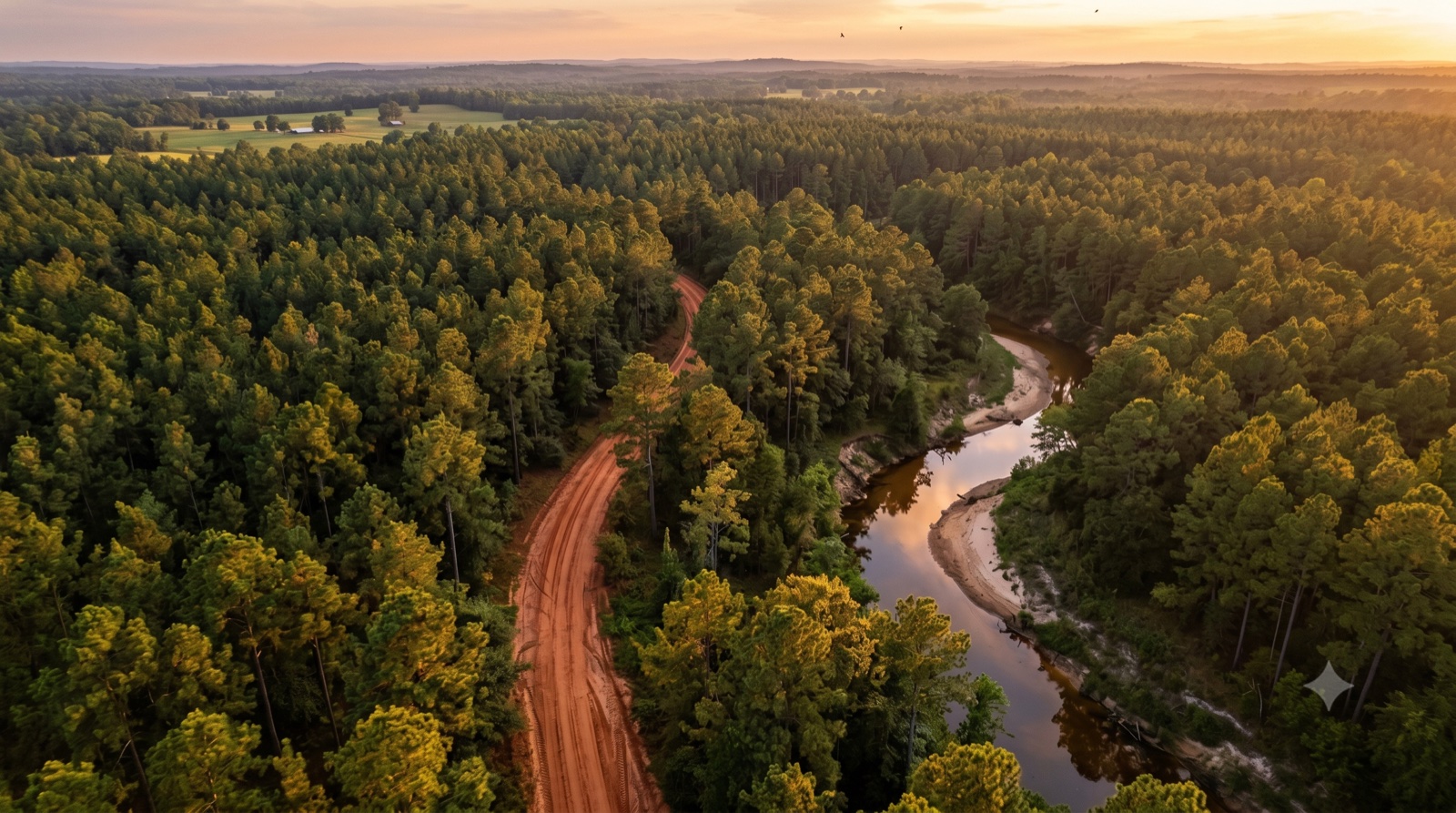
Sell My Land in Leake County MS - What Landowners Need to Know
Key Takeaways
- Mississippi charges $0.00 in state deed transfer tax: Leake County landowners pay no state-level transfer tax at closing, making Mississippi one of the most cost-effective states to complete a land sale
- Vacant land is assessed at 15% of fair market value: Mississippi's 15% assessment ratio for non-owner-occupied property — including bare land, pasture, and timber tracts — is 50% higher than the 10% ratio for owner-occupied homes, meaning vacant landholders carry a disproportionate annual tax burden
- Leake County's population has stabilized after a sharp decline: It fell from 23,805 in 2010 to 21,275 in 2020, then edged up to roughly 21,319 by 2024, according to U.S. Census Bureau and Data USA figures — a leveling-off after a decade of loss, in a county whose economy runs on poultry and timber rather than residential growth
How Can You Sell Land in Leake County Mississippi?
You can sell land in Leake County through a licensed attorney-required closing, with no state transfer tax and minimal transaction costs — the main factors shaping your sale are vacant land assessment at 15% of fair market value and a farm economy dominated by poultry production. Selling land in Leake County, Mississippi means navigating the state's attorney-required closing process, a property tax system that assesses vacant parcels at 15% of fair market value, and a rural real estate market shaped by central Mississippi's poultry-and-timber belt — pastureland, broiler houses, and hardwood bottoms along the Pearl River watershed.
Leake County sits in the geographic center of Mississippi, with Carthage serving as the county seat. The county borders Attala County to the north, Winston County to the northeast, Neshoba County to the east, Newton County to the southeast, Scott County to the south, and Madison County to the west — placing it at the heart of a region where the Mississippi Band of Choctaw Indians holds reservation trust land across several east-central Mississippi counties, including portions of Leake.
This guide covers the tax costs of holding vacant land in Leake County, the state's attorney-required closing process, how the county compares to its neighbors, and your practical options for selling.
What Are the Tax Costs of Holding Land in Leake County?
Mississippi's property tax system is built on a tiered assessment ratio that varies by property type. Owner-occupied residential properties are assessed at 10% of fair market value. All other real property — including vacant land, timber tracts, and non-owner-occupied parcels — is assessed at 15% of fair market value, according to Mississippi State University Extension. That 50% differential means vacant land carries a structurally higher tax burden than a neighboring owner-occupied home of equivalent market value.
Leake County's effective property tax rate is approximately 0.86%, according to Ownwell — modestly below the national median of 1.02%, but noticeably higher than several neighboring rural Mississippi counties. The actual millage rate combines county government levies, the Leake County School District, the Town of Carthage or other municipal levies (if applicable), and any special taxing districts for fire protection or hospitals.
How the Tax Bill Compounds for Non-Productive Land
Even at a moderate effective rate, the tax bill on vacant land repeats every year. For land that generates no rental income, no harvested timber revenue, and no agricultural lease payment, that annual obligation is pure carrying cost — and it accumulates whether or not the parcel ever appreciates. For absentee owners holding inherited or long-idle acreage, those payments quietly erode whatever value the land represents.
Mississippi reassesses real property periodically; taxes attach on January 1 each year. The Tax Collector is responsible for collection. Delinquent accounts in Mississippi are offered at tax sale on the last Monday in August. Owners who do not redeem within two years of the tax sale risk losing the property. Out-of-state owners are particularly vulnerable to missing notices mailed to old addresses.
Beyond the tax bill, vacant land in Leake County carries liability exposure, potential clearing and maintenance obligations, and the indirect cost of capital tied up in a non-income-producing asset. Mississippi's ag and forest use-value programs and the Reforestation Tax Credit can partially offset costs for landowners who actively manage timber or farmland — see the section below.
For land that has accumulated delinquent taxes, our guide on how to sell land with back taxes explains how to navigate that process.
What Closing Requirements and Zoning Rules Apply in Leake County?
Mississippi is an attorney-state for real estate closings. A licensed Mississippi attorney must examine and certify the title before a real estate sale can close, per The Mississippi Bar. This is a legal requirement — not optional — regardless of whether you use a real estate agent, sell directly, or work with a land buyer.
The closing process follows a defined sequence:
- Title search: The attorney searches land records filed with the Leake County Chancery Clerk to identify any liens, easements, judgments, or encumbrances on the property
- Title certification and insurance: The attorney certifies that title is marketable; title insurance may be issued to protect the buyer from defects not discovered in the search
- Closing: Both parties (or their authorized representatives) execute the deed, any seller's affidavits, and the settlement statement
- Recording: After closing, the deed is recorded with the Leake County Chancery Clerk
The Leake County Chancery Clerk, Dot Merchant, maintains the county's land and deed records at 101 Court Square #309, Carthage, MS 39051 (mailing: PO Box 72, Carthage, MS 39051), phone (601) 267-7371. The Leake County Tax Assessor/Collector, Lucas Brown, is located at 219 W Main Street, Carthage, MS 39051, phone (601) 267-3021.
Mississippi's $0.00 state transfer tax is a meaningful advantage for sellers, holding closing costs comparatively low relative to states that levy a deed or documentary tax.
Zoning, Choctaw Trust Land, and Land Use in Leake County
Leake County is overwhelmingly rural, and most land outside the Carthage municipal limits is subject to limited county zoning regulation. Agricultural, poultry, and timber uses generally proceed without county use permits. The Mississippi Band of Choctaw Indians holds reservation trust land across several east-central Mississippi counties, and portions of that trust land sit within Leake County — including the Red Water and Standing Pine communities, where the tribe operates its own elementary schools. That trust status applies specifically to land held by the tribe or its members in federal trust; it has no bearing on privately owned, fee-simple tracts elsewhere in the county, which are bought, sold, and taxed like any other Mississippi land. If you are unsure whether your parcel borders or overlaps trust land, confirm the boundary with the Chancery Clerk's records and your closing attorney before listing. Any manufactured home placement, subdivision activity, or commercial development elsewhere in the county warrants direct inquiry with county government in Carthage.
Mississippi Ag/Forest Use-Value and the Reforestation Tax Credit
Mississippi assesses qualifying agricultural and forest land on its use value rather than full market value — a significant break for working timber and farm tracts that keeps the assessed base low for land kept in qualifying use. On top of that, Mississippi offers one of the South's more accessible timber incentives. The Reforestation Tax Credit provides a Mississippi income tax credit equal to 50% of approved reforestation costs — site preparation, planting stock, and labor — with a lifetime limit of $75,000 per taxpayer, according to the Mississippi Forestry Commission and the Conservation Finance Center. Landowners must work with a Registered Forester to develop a reforestation plan. Federal deductions of up to $10,000 per year in reforestation expenses are also available, with amounts over $10,000 amortizable over 84 months. Standing timber in Mississippi is not subject to ad valorem tax until it is harvested, at which point a severance tax applies.
If your land is inherited or title is clouded, our guide on how to sell inherited land with multiple heirs covers the steps for Mississippi, including heirs' property and Chancery Court processes. If your tract carries planted pine or natural hardwood, see our guide on how to sell timberland.
How Does Leake County Compare to Neighboring Mississippi Counties?
Leake County's population dropped sharply over the 2010s — from 23,805 in 2010 to 21,275 in 2020 — before leveling off to an estimated 21,319 by 2024, according to U.S. Census Bureau QuickFacts and Data USA. With a median household income around $50,700 and a land base spread across roughly 583 square miles, Leake is a mid-sized central Mississippi county whose land market is driven far more by poultry production and timber than by residential growth.
| Factor | Leake County | Neshoba County | Attala County | Scott County |
|---|---|---|---|---|
| Population (2020 census) | 21,275 | 29,087 | 17,889 | 27,990 |
| Population trend | Declined, then leveled off | Slightly declining | Declining | Slightly declining |
| Effective tax rate | ~0.86% | Moderate | Moderate | Moderate |
| County seat | Carthage | Philadelphia | Kosciusko | Forest |
| Land character | Poultry farms, pasture, Pearl River bottoms | Choctaw reservation core, poultry, gaming/tourism | Hill-country timber and pasture | Poultry processing hub, pasture, timber |
| Key economic driver | Poultry, timber, agriculture | Poultry, Choctaw tribal government/gaming, manufacturing | Timber, agriculture | Poultry processing (Koch Foods), manufacturing |
Neshoba County to the east is home to Philadelphia and the headquarters of the Mississippi Band of Choctaw Indians, whose reservation and tribal government presence extends into Leake's eastern communities. Scott County to the south is one of Mississippi's most concentrated poultry-processing centers, anchored by Forest — a market dynamic that mirrors Leake's own farm economy. Attala County to the north is a quieter, more purely timber-and-pasture hill county with a smaller and more steadily declining population.
Economy and Major Employers
Leake County's economy is dominated by poultry. According to the USDA 2022 Census of Agriculture county profile, the county had 481 farms covering 85,196 acres, with an average farm size of 177 acres. Poultry and eggs alone accounted for roughly $412.5 million of the county's $421.4 million in total agricultural product sales — about 98% of all farm sales — with a December 2022 broiler inventory of over 10.7 million birds, ranking Leake County first in the state for poultry sales. Of the county's farmland, woodland covers 36,335 acres, pastureland 22,861 acres, and cropland 21,003 acres — a landscape built around broiler houses, hay and pasture ground, and hardwood and pine timber tracts.
For land specifically, that means most rural acreage in Leake County is either actively farmed or leased for poultry and cattle operations, planted or naturally regenerated timberland, or long-held family tracts near the Pearl River and its tributaries. Buyers tend to be neighboring farmers, poultry integrators' growers, timber investors, and hunters rather than residential developers.
For a statewide overview of the selling process, closing requirements, and other counties we buy in, see our guide on how to sell land in Mississippi. For county-level land analysis across the state, explore our blog. For help understanding what your land is worth before you list or accept an offer, see how much is my land worth.
What Are Your Options for Selling Land in Leake County?
Leake County landowners carrying vacant parcels face the same arithmetic that affects rural central Mississippi broadly: land assessed at 15% of market value, annual tax obligations that compound quietly, and a buyer pool concentrated among farmers, timber investors, and hunters rather than residential buyers. For absentee owners — those who inherited a family tract, moved away, or simply stopped using a parcel near the Pearl River or the Choctaw reservation boundary — the question is often not whether to sell but how to do it without a drawn-out process. Farm and timberland here can also sit on the market a long time, since serious buyers are a narrow group with specific land uses in mind.
Before listing or accepting any offer, verify your property records through the Leake County Chancery Clerk (601-267-7371, 101 Court Square #309, Carthage). Confirm tax status through the Leake County Tax Assessor/Collector (601-267-3021, 219 W Main Street, Carthage). If the parcel carries planted pine or hardwood, engage a Mississippi Registered Forester for a timber cruise — standing timber value is not reflected in the assessed use value and can be significant on well-stocked tracts. If there are title questions from inheritance or old deeds, or boundary questions near Choctaw trust land, the attorney handling your closing will flag these during the title search.
Sellers have several paths. Listing with a Mississippi land-specialist agent exposes your property to a wider pool of recreational, timber, and agricultural buyers. Platforms like Land.com and LandWatch serve buyers specifically looking for rural Mississippi land — though farm and timber tracts can be slow to move. For landowners who want a written number quickly — without the uncertainty of extended market exposure — Jerez Land provides a parcel-specific, firm written cash offer for your land. As a direct buyer, we absorb the carrying costs, marketing time, and resale risk that come with holding rural acreage. There are no agent commissions, no transfer tax to worry about (Mississippi charges none), and the attorney manages the closing as required by state law.
If you are weighing whether to involve an agent at all, our guide on whether you need a realtor to sell land walks through the trade-offs for rural parcels. And if your tract is good hunting ground, see how to sell hunting land. If your acreage is currently in agricultural use, our guide on how to sell farmland covers the specific steps.
Frequently Asked Questions
I inherited land in Leake County and want to sell it — what's the process?
Contact the Leake County Chancery Clerk (601-267-7371) to verify your deed and legal description, and check your tax status through the Leake County Tax Assessor/Collector at 601-267-3021 in Carthage. Mississippi requires a licensed attorney to handle the title examination, deed preparation, and closing. From there, you can list with a local land-specialist real estate agent, market through online land platforms, or request a direct cash offer from a land buyer.
I inherited vacant timberland near Carthage and my family has never used it — how much will I owe in property taxes each year?
Leake County has an effective property tax rate of approximately 0.86%, according to Ownwell — modestly below the national median of 1.02%. Vacant land is assessed at 15% of fair market value, compared to 10% for owner-occupied homes, under Mississippi's tiered assessment system per Mississippi State University Extension. Qualifying agricultural and forest land may be assessed on use value rather than full market value.
Does Mississippi charge a transfer tax on land sales?
No. Mississippi has a $0.00 state deed transfer tax. Sellers do not owe a state-level transfer tax on land sales, regardless of sale price. This makes Mississippi one of the lowest-closing-cost states for land transactions. A licensed Mississippi attorney still handles the title work and recording, which carries its own fees.
Do I need to hire an attorney to sell my land in Leake County?
Yes. Mississippi requires a licensed attorney to examine and certify the title for real estate transactions. The attorney prepares the deed and oversees the closing. After closing, the deed is recorded with the Leake County Chancery Clerk at 101 Court Square #309, Carthage, MS 39051 (PO Box 72, Carthage, MS 39051), phone (601) 267-7371.
I have land near the Choctaw Reservation in Leake County — does that affect selling it?
It depends on whether your specific parcel is held in federal trust status. The Mississippi Band of Choctaw Indians holds reservation trust land across several east-central Mississippi counties, including portions of Leake near the Red Water and Standing Pine communities. Trust status applies only to tribally held land — privately owned, fee-simple tracts elsewhere in the county are bought and sold under normal Mississippi title and closing procedures. Confirm your parcel's status with the Chancery Clerk's records and your closing attorney before listing.
Is Leake County Mississippi population growing or declining?
Leake County's population declined from 23,805 in 2010 to 21,275 in 2020, then edged up slightly to an estimated 21,319 by 2024, according to U.S. Census Bureau QuickFacts and Data USA. That marks a leveling-off after a decade of loss, though the county's overall growth remains flat compared to faster-growing parts of the state.
Disclaimer: This article is for informational purposes only and does not constitute legal, financial, or professional advice. Laws and regulations vary by jurisdiction and change over time. Always consult with qualified professionals before making land purchase decisions. Jerez Land is not responsible for actions taken based on this information.