
Sell My Land in Overton County TN - What Landowners Need to Know
Key Takeaways
- Tennessee assesses vacant land at 25% of appraised value: All real property in Tennessee—residential, farm, and vacant alike—falls under a uniform 25% assessment ratio set by state law, but farm and forest land enrolled in the Greenbelt program is assessed on its current-use value instead, substantially lowering the tax bill
- Overton County's county property tax rate is $1.3373 per $100 of assessed value: Following the 2025 countywide reappraisal, the commission set the certified rate at $1.3373—down from the $1.9706 rate in place from 2020 through 2024—yielding an effective rate of approximately 0.56%, well below the national median of roughly 1.02%, according to Ownwell
- Population grew modestly from 22,511 in 2020 to roughly 23,065 in 2024: After rising from 22,083 in 2010, Overton County has posted steady, low-single-digit growth, according to U.S. Census Bureau and Data USA estimates
How Can You Sell Land in Overton County Tennessee?
Selling land in Overton County, Tennessee is shaped by three forces: a state property tax system that taxes all real property at 25% of appraised value, a realty transfer tax of $0.37 per $100 of consideration, and the Agricultural, Forest and Open Space Land Act—the "Greenbelt Law"—that offers significant tax relief for qualifying farm, forest, and open space land. When Greenbelt-enrolled property is sold, the buyer or seller may face rollback taxes stretching back three to five years, depending on the land's classification.
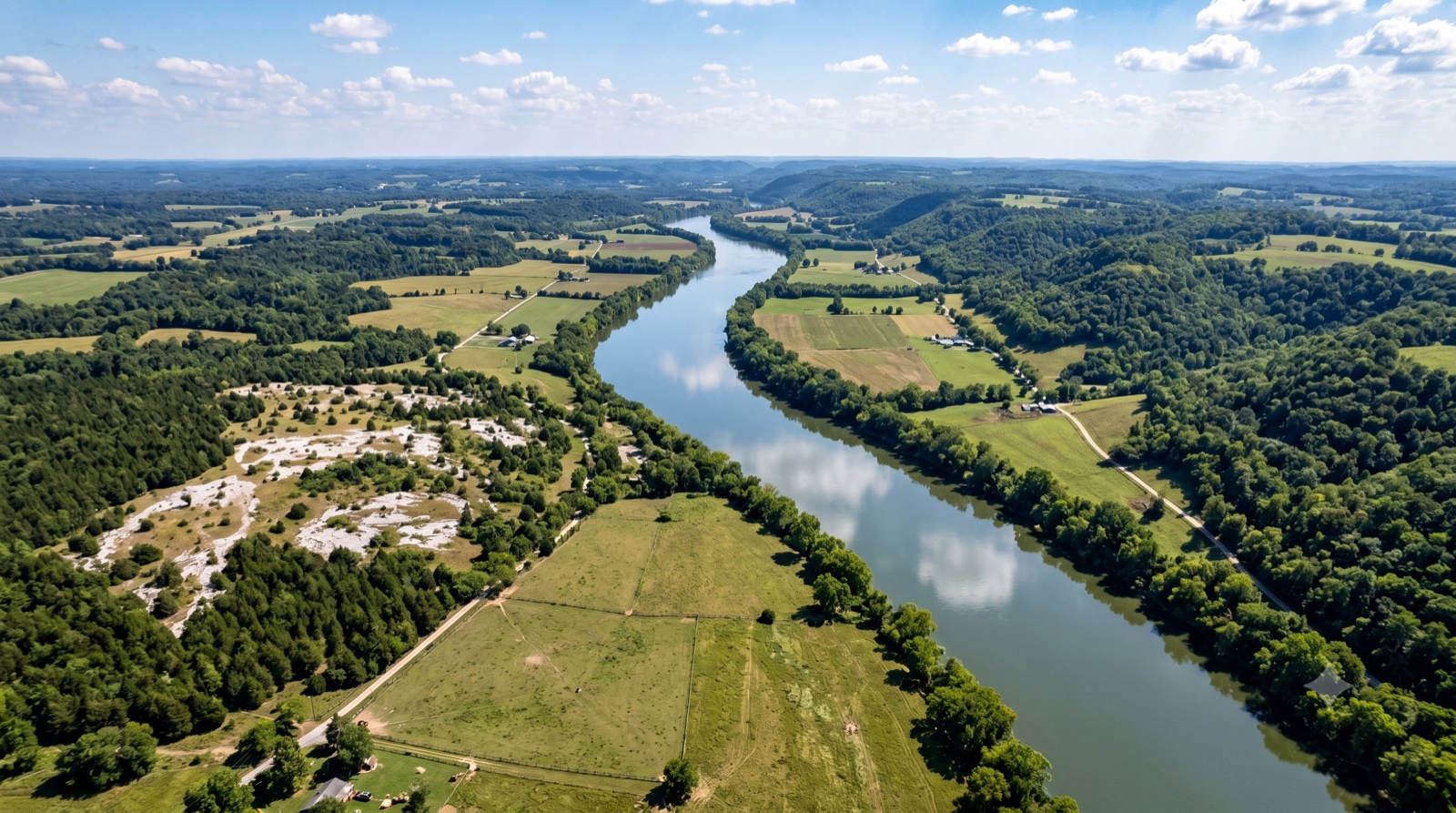
Overton County sits in the Upper Cumberland region of Middle Tennessee, on the western edge of the Cumberland Plateau, bordered by Pickett, Fentress, Putnam, Jackson, and Clay counties. The landscape is a mix of wooded ridges and hollows giving way to open cattle pasture and hay ground in the valleys, with Standing Stone State Park and State Forest anchoring the northern part of the county. Livingston serves as the county seat, roughly 90 miles east of Nashville and about 20 miles north of Cookeville. Much of the county's rural land is a working blend of ridge timber, grazing pasture, and recreational woodland in a small, slow-moving rural market.
For landowners considering a sale, this guide walks through the county's carrying costs, the closing process, how Overton County stacks up against its neighbors, and your practical options for exiting a parcel. For the statewide picture first, see our Tennessee land selling guide.
What Are the Tax Costs of Holding Land in Overton County?
Tennessee uses a uniform 25% assessment ratio for all real property categories, which differs from states like Mississippi that apply separate ratios to owner-occupied versus vacant land. The assessed value equals 25% of the county assessor's appraised value. Tax rates are then applied to that assessed figure.
Following the 2025 countywide reappraisal, Overton County's certified property tax rate is $1.3373 per $100 of assessed value, according to the Overton County News—down from the $1.9706 rate that had been in place from 2020 through 2024, a reset that typically follows a reappraisal that raises appraised values. The resulting effective property tax rate across the county is approximately 0.56%, based on data from Ownwell—comfortably below the national median of roughly 1.02%.
For a parcel with an appraised value of $100,000, the assessed value is $25,000. At the county rate of $1.3373 per $100 assessed, the annual county tax would be approximately $334. That figure is modest in absolute terms but adds up year after year for rural pasture, hay ground, or timbered land producing no income.
The Greenbelt Program: Lower Taxes, Deferred Liability
Tennessee's Greenbelt Law—formally the Agricultural, Forest and Open Space Land Act of 1976—allows qualifying land to be assessed on its current-use value rather than fair market value. To qualify:
- Agricultural land: At least 15 acres of actual farm use, or as few as 10 acres if the farm produces $1,500 or more in annual gross farm income
- Forest land: At least 15 acres of managed timber
- Open space land: Requires a written agreement with a state or local government
The tax savings can be substantial on the Upper Cumberland's grazing and hay ground and its wooded ridges, where market value can exceed agricultural productivity—and both farm and forest enrollment are common on Overton County's working tracts. However, when Greenbelt land is sold or converted to a non-qualifying use, the new or former owner owes rollback taxes—the difference between taxes actually paid and taxes that would have been owed at full assessment—for up to three years on agricultural and forest land or five years on open space land, according to the UT County Technical Assistance Service. Rollback taxes can be a surprise cost for buyers unaware of the existing classification, so always verify Greenbelt status before closing.
Overton County's Assessor of Property is Cara Boone, located at the courthouse, 306 W. Main St., Rm. 124, Livingston, TN 38570, phone (931) 823-1651.
If you're carrying land with delinquent taxes, see our guide on how to sell land with back taxes.
What Closing Requirements and Zoning Rules Apply in Overton County?
Tennessee does not require an attorney to be present at real estate closings—transactions may be handled by title companies or closing agents. In practice, many rural land closings in the Upper Cumberland are completed by title companies or real estate attorneys acting as closing agents. The deed is recorded with the Overton County Register of Deeds, Jimmy Conner, at 306 W. Main St., Rm. 139, Livingston, phone (931) 823-4011.
Tennessee's Realty Transfer Tax
Tennessee charges a realty transfer tax of $0.37 per $100 of consideration (the purchase price, or the fair market value if higher), per Tenn. Code Ann. § 67-4-409, according to the UT County Technical Assistance Service. On a $50,000 land sale, that's $185 in transfer tax. Certain transfers are exempt—including transfers between spouses, certain corporate reorganizations, and gifts—but arm's-length land sales to third parties are fully taxable.
The tax is generally paid at closing and recorded alongside the deed. No separate county transfer tax applies in Overton County.
Zoning and Land Use
Overton County is a largely rural county with limited municipal zoning outside Livingston and Monterey. The county does not operate a comprehensive zoning ordinance across all unincorporated areas. Building permits are required for new construction. Buyers and sellers should contact Overton County's planning or building authorities to confirm specific requirements for their parcel's location, particularly if the property abuts Standing Stone State Park or State Forest, the Alpine Mountain or Jackson Swamp wildlife management areas, or other state land.
The Upper Cumberland location means many parcels have terrain constraints—steep wooded slopes, rock ledges, sinkholes, and seasonal streams feeding the hollows—that may affect buildability regardless of zoning classification. Just as important on the plateau's edge, legal road access is far from guaranteed: many timbered interior tracts are reached only by old farm and logging roads, easements across neighboring property, or no recorded access at all. Buyers interested in development or even reliable entry should confirm a legal access route and obtain a soil and site evaluation before purchase.
If you've inherited the property and are unsure about title, our guide on how to sell inherited land walks through the process. And if multiple family members share ownership, our guide on selling inherited land with multiple heirs covers how to reach agreement.
How Does Overton County Compare to Neighboring Tennessee Counties?
Overton County's population of approximately 23,065 (2024 estimate) reflects steady, modest growth from 22,511 at the 2020 census, after rising from 22,083 in 2010. The county spans about 433 square miles of land on the western edge of the Cumberland Plateau, with State Route 111 and U.S. 111 threading through Livingston and connecting south toward Interstate 40 at Cookeville in Putnam County.
| Factor | Overton County | Fentress County | Putnam County | Clay County |
|---|---|---|---|---|
| Population (2024 est.) | ~23,065 | ~20,100 | ~84,900 | ~7,670 |
| Population trend | Stable / slight growth | Stable | Growing | Declining |
| Effective tax rate | ~0.56% | ~0.34% | ~0.62% | ~0.65% |
| Distance to Nashville | ~90 mi | ~115 mi | ~80 mi | ~110 mi |
| Key economic driver | Agriculture, manufacturing, healthcare | Manufacturing, agriculture | Higher education (Tennessee Tech), retail, healthcare | Agriculture, small manufacturing |
| Closing attorney required | No | No | No | No |
Overton County's economy rests on a foundation of agriculture—especially cattle and hay production—alongside light manufacturing and healthcare centered on Livingston. Neighboring Putnam County, home to Cookeville and Tennessee Tech University, is the regional hub, drawing commuters and services from across the Upper Cumberland. To the north and west, Clay County is smaller and slower, while Fentress County to the east shares the plateau's timber-and-farm character.
Cattle, Hay, and Ridge Timber
Overton County is genuine working farm country. According to the USDA 2022 Census of Agriculture profile for Overton County (FIPS 47133), the county had 922 farms covering 155,629 acres, at an average of 169 acres per farm—a farm base that actually grew in acreage since 2017. Cattle and calves are the dominant commodity, generating $17.5 million in sales and ranking Overton 10th among all Tennessee counties for cattle. Forage—hay and haylage—is the top crop at nearly 25,000 acres, underscoring how much of the county's open ground feeds the cattle operations. Woodland accounts for roughly 66,000 of the acres in farms, reflecting the ridge timber woven through the pasture.
Agricultural and Timber Land
That agricultural profile shapes what sells and how. Much of Overton County's rural acreage is a working blend of pasture, hay ground, and wooded ridge, and many parcels carry existing Greenbelt classifications for agricultural or forest use. Standing Stone State Park and State Forest add a recreational draw in the north of the county, and hunting and cabin-retreat demand touches the more remote timbered tracts.
If your tract is farm or timber ground, our guides on selling farmland, selling timberland, and selling hunting land cover what agricultural, timber, and recreational buyers look for. For the full picture of what drives land values, our land valuation guide explains the factors assessors and buyers weigh.
What Are Your Options for Selling Land in Overton County?
Overton County landowners sit at a crossroads familiar across the Upper Cumberland: pasture, hay ground, or wooded ridge that may have been in the family for generations, Greenbelt classifications that made holding cheap for years, and a thin, slow-moving local market for rural tracts. Add the wrinkles common to plateau-edge farm country—old farm-road access, terrain that limits buildable area, and occasional severed minerals—and a given parcel can sit unsold for a long time. If you own the land from out of state, those frictions multiply.
Before listing or accepting any offer, take these steps. Verify your deed and legal description through the Overton County Register of Deeds (Jimmy Conner, 931-823-4011). Confirm the property's Greenbelt status and calculate potential rollback tax liability with the Overton County Assessor (Cara Boone, 931-823-1651). Confirm there is a legal, recorded access route to the parcel—critical on ridge and hollow ground. If the land has merchantable timber, a timber cruise from a registered forester will quantify the standing value. Check for any delinquent tax balance through the Overton County Trustee (Peggy Clark Smith, 931-823-6220).
Sellers have several paths. Listing with a land-specialist agent gives exposure to farm, timber, and recreational buyers across the Upper Cumberland, but agent commissions of 5–6% plus the $0.37/$100 transfer tax reduce your net proceeds—and access or terrain issues can stall a listing for months. (Our guide on whether you need a realtor to sell land weighs that trade-off.) Online platforms—LandWatch, Lands of America—reach buyers hunting for farm ground and recreational land near Standing Stone. For landowners who want a firm number fast, without months of showings and uncertain closing timelines, Jerez Land provides a direct cash offer for your land. Each offer is parcel-specific and made in writing; as the buyer, we absorb the carrying costs, marketing, terrain risk, and resale timeline—so the number you see is one number, with no commissions and a closing timeline measured in weeks, not months.
A direct cash sale will not be the highest theoretical price a perfectly marketed parcel might eventually fetch. What it offers instead is certainty and speed on land that is otherwise hard to move. If you need to understand the paperwork involved before you commit to any path, our guide on the paperwork needed to sell land and our blog cover what to expect at each stage.
Frequently Asked Questions
I inherited vacant land in Overton County TN and have never even seen it — how do I sell it?
Confirm your legal description and any existing Greenbelt enrollment with the Overton County Assessor (931-823-1651) and verify clean title and legal access through the Register of Deeds (931-823-4011). Tennessee does not require an attorney at closing—a title company or closing agent can handle the transaction. You can list with a local agent, use online platforms like LandWatch, or request a direct cash offer from a land buyer like Jerez Land.
I'm trying to understand my annual holding costs in Overton County — what is the property tax rate?
Following the 2025 countywide reappraisal, Overton County's certified property tax rate is $1.3373 per $100 of assessed value, down from the $1.9706 rate in place from 2020 through 2024, according to the Overton County News. All real property in Tennessee is assessed at 25% of appraised value, yielding an effective tax rate of approximately 0.56%, according to Ownwell—below the national median of roughly 1.02%. Land enrolled in Tennessee's Greenbelt program is assessed on current-use value instead, producing a significantly lower tax bill.
My Overton County acreage is enrolled in Greenbelt — what is Tennessee's Greenbelt program and how does it affect my land sale?
Tennessee's Greenbelt Law (1976) allows agricultural land (15+ acres, or 10+ acres with $1,500+ in annual farm income), forest land (15+ acres), and open space land to be assessed at current-use value rather than fair market value. When Greenbelt land is sold or disqualified, rollback taxes are owed for up to three years (agricultural/forest) or five years (open space)—covering the gap between what was paid and what full-assessment taxes would have been, according to the UT County Technical Assistance Service. Always verify Greenbelt status before closing.
I'm closing on my Overton County sale — does Tennessee charge a transfer tax I need to budget for?
Yes. Tennessee charges $0.37 per $100 of consideration on all publicly recorded realty transfers, per Tenn. Code Ann. § 67-4-409. On a $100,000 sale, the transfer tax is $370. Certain transfers—gifts, spousal transfers, corporate reorganizations—may qualify for exemptions. Overton County does not levy an additional county-level transfer tax.
I'm selling my Overton County land directly to a cash buyer — is an attorney required to close a land sale in Tennessee?
No. Tennessee does not require a licensed attorney to be present at a real estate closing. Closings may be handled by title companies, closing agents, or attorneys. The deed is recorded with the Overton County Register of Deeds after closing. Working with a title company that specializes in rural Upper Cumberland transactions is advisable given the prevalence of Greenbelt classifications, farm-road access questions, and occasional severed mineral rights on Overton County's ridge and pasture tracts.
Is Overton County Tennessee population growing or declining?
Overton County's population has grown modestly, rising from 22,083 in 2010 to 22,511 at the 2020 census and to approximately 23,065 as of 2024, according to U.S. Census Bureau and Data USA estimates. The steady, low-single-digit growth reflects the county's agricultural base, its proximity to the Cookeville–Tennessee Tech hub in neighboring Putnam County, and a low cost of living relative to Middle Tennessee.
Disclaimer: This article is for informational purposes only and does not constitute legal, financial, or professional advice. Laws and regulations vary by jurisdiction and change over time. Always consult with qualified professionals before making land purchase decisions. Jerez Land is not responsible for actions taken based on this information.