
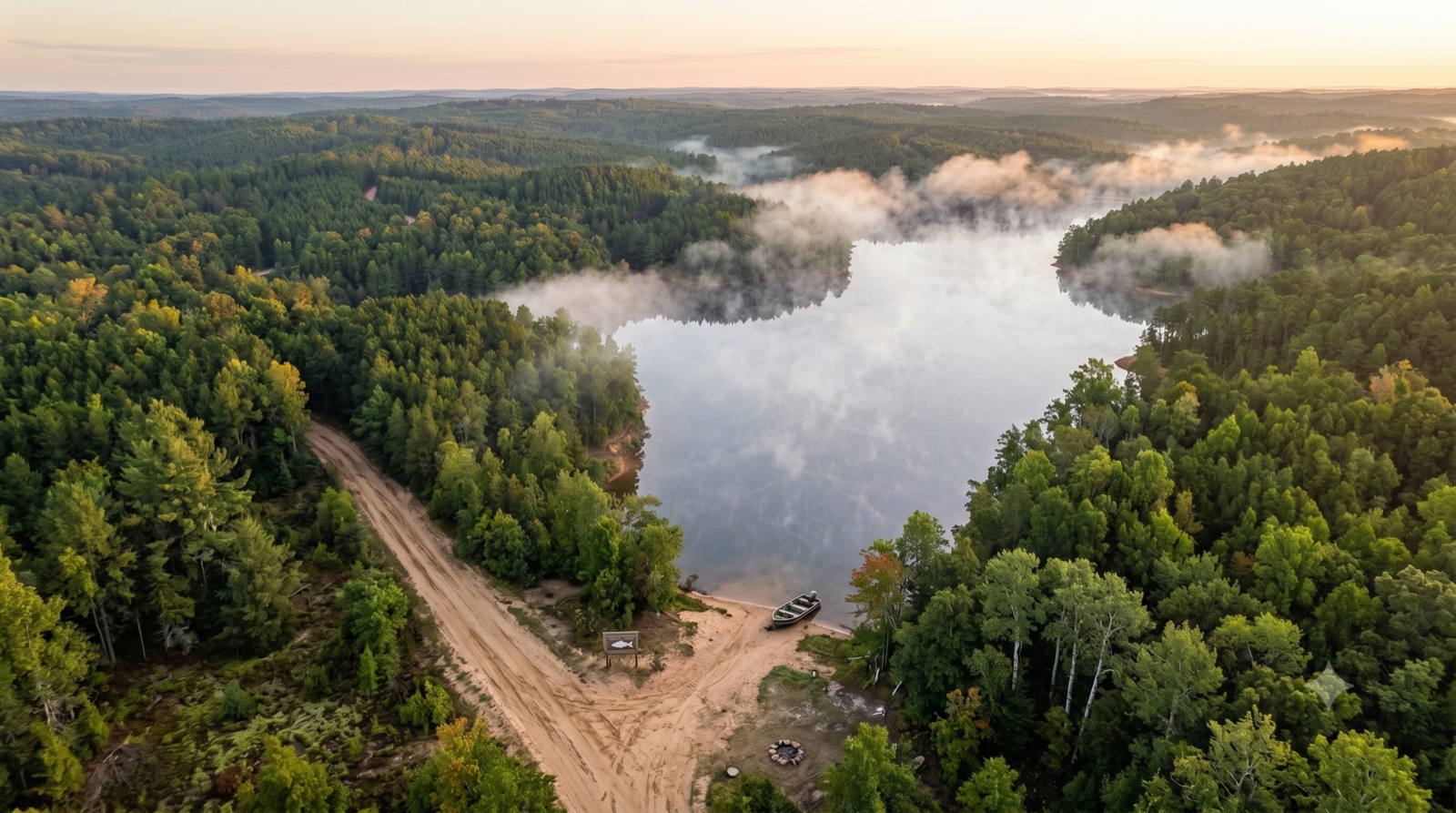
Sell My Land in Roscommon County MI - What Landowners Need to Know
Key Takeaways
- Roscommon County's median age is 57.7 years: According to Michigan-Demographics.com, Roscommon County has one of the oldest median ages in Michigan — a signal of seasonal and absentee ownership, with landowners who bought decades ago increasingly motivated to simplify their estates
- Michigan's transfer tax totals $4.30 per $500 of sale price: The state levies $3.75 per $500 and each county adds $0.55 per $500, for a combined rate of $4.30 per $500 — customarily paid by the seller — under MCL 207.521 and MCL 207.501, according to Ottawa County and Lenawee County official transfer tax guides
- Roscommon County's population has declined steadily: From 24,449 in 2010 to 23,459 in 2020, a loss of roughly 1,000 residents over the decade, according to U.S. Census Bureau data — reducing the pool of local buyers for rural parcels
How Can You Sell Land in Roscommon County Michigan?
To sell land in Roscommon County, you work with a Michigan-licensed title company that conducts the title search, prepares the deed, collects Michigan's combined state-and-county transfer tax, and records the transfer with the Roscommon County Register of Deeds — no attorney is required. Selling land in Roscommon County involves navigating a process shaped by the state's title company-managed closings, a combined state-and-county transfer tax, and a rural market where seasonal and recreational ownership is the norm. Roscommon County covers 521 square miles of northern Michigan pine and hardwood forest anchored by Houghton Lake — the largest inland lake in Michigan — and Higgins Lake, widely cited as one of the most scenic inland lakes in the country.
With only 34 farms and $737,000 in total agricultural sales, according to the 2022 USDA Census of Agriculture, the county's land market is almost entirely recreational and residential rather than agricultural. This creates a specific buyer profile — hunters, anglers, cabin-seekers, and out-of-state families — and affects how long vacant parcels typically sit on the market.
This guide covers Michigan's property tax system and how it affects Roscommon County landowners, the county's zoning framework, how the closing process works, and how the county compares to its neighbors.
What Are the Tax Costs of Holding Land in Roscommon County?
Michigan's property tax system uses two separate values — State Equalized Value (SEV) and Taxable Value — that affect how much you owe each year. Under the Michigan Constitution, all property must be assessed annually at 50% of true cash (market) value; that 50% figure is the SEV. Your Taxable Value starts at or below SEV when you purchase a parcel, and Proposal A caps annual Taxable Value increases at 5% or the rate of inflation, whichever is lower. When a property sells, Taxable Value "uncaps" and resets to match the current SEV, according to Michigan's State Tax Commission.
For vacant land that is not adjacent to your homestead, Michigan's non-homestead school millage applies — adding approximately 18 operating mills that homestead properties do not pay, according to the Michigan Department of Treasury. This makes holding cost meaningfully higher for out-of-state owners of recreational parcels than for local owner-occupants.
Roscommon County's median effective tax rate is approximately 0.50%, according to PropertyTax101.org — below both Michigan's median rate and the national median of 1.02%. However, rates vary considerably by township. Based on millage rate data compiled by Ken Carlson Realty, total non-homestead millage across Roscommon County townships ranges from approximately 38 mills (Nester Township) to approximately 42 mills (Higgins Township), applying to Taxable Value. The county-levied portion alone is approximately 4.7 mills for non-homestead property, according to Roscommon County's 2024-2025 millage rate schedule.
How Tax Bills Add Up for Vacant Land Owners
For a vacant parcel with a Taxable Value of $40,000, applying a combined non-homestead millage of 40 mills produces an annual tax bill of approximately $1,600. This is a recurring fixed cost for land that may generate no income — and it compounds alongside liability, weed control, and access maintenance obligations.
Michigan tax payments are split into summer (July 1) and winter (December 1) billings. Delinquent taxes are turned over to the county treasurer on March 1 of the year following delinquency. Under Michigan's General Property Tax Act (MCL 211.78), property enters forfeiture after one year of delinquency and is subject to foreclosure in the third year of delinquency — a process that catches out-of-state landowners by surprise if their mailing address is outdated.
If your land qualifies as productive forest, Michigan's Qualified Forest Program (QFP) can exempt enrolled parcels from up to 18 mills of school operating taxes annually, according to the Michigan Department of Agriculture and Rural Development. Parcels of 20–39.99 acres must be at least 80% productive forest; parcels of 40+ acres must be at least 50% productive forest. The program enrolls land in perpetuity, so removal has consequences. For owners carrying back taxes or considering a sale, see our guide to selling land with back taxes for context on how delinquency affects a transaction.
What Zoning Rules and Closing Requirements Apply in Roscommon County?
Roscommon County is governed largely at the township level under Michigan's zoning enabling legislation, the Michigan Zoning Enabling Act (PA 110 of 2006). Each of the county's 12 townships maintains its own zoning ordinance and planning commission. Roscommon Township, which includes much of the Houghton Lake area, operates under Zoning Ordinance #86, most recently updated in July 2025, and can be reached at (989) 422-4116 at 8555 Knapp Road, Houghton Lake, MI 48629. Other townships — including Gerrish, Higgins, and Lyon — each maintain separate zoning rules governing setbacks, lot minimums, permitted uses, and shoreline development.
For buyers considering recreational cabins or manufactured homes, Michigan's Manufactured Housing Act and local township ordinances typically require a permanent foundation, utility connections, and proper permitting before occupancy. Vacant parcels near Houghton Lake or Higgins Lake often carry shoreline setback requirements of 25–50 feet under township ordinance and Michigan Part 303 (Wetlands Protection). Verify all zoning directly with the relevant township before marketing a parcel.
For proper deed and ownership research, understanding the paperwork needed to sell land is a helpful starting point before you begin the process.
Michigan's Title Company Closing Process
Unlike Mississippi, Michigan does not require an attorney to close real estate transactions. Closings are routinely handled by title companies, which conduct the title search, issue title insurance, prepare the deed and settlement statement, collect transfer taxes, and record the deed with the county Register of Deeds, according to Hirzel Law. An attorney may be engaged optionally, but it is not a statutory requirement for land sales.
Michigan's closing process for a land sale works as follows:
- Purchase agreement: Both parties execute a written purchase agreement specifying price, contingencies, and closing date
- Title search: The title company examines Roscommon County Register of Deeds records to confirm clear title with no liens, back taxes, or encumbrances
- Title insurance: Owner's policy protects the buyer; lender's policy protects any mortgage lender
- Transfer tax collection: The seller pays Michigan's combined real estate transfer tax at closing — $3.75 per $500 (state) plus $0.55 per $500 (county) = $4.30 per $500 of purchase price, under MCL 207.521 and MCL 207.501, according to Ottawa County's official transfer tax guide
- Deed preparation and signing: Warranty or covenant deed signed and notarized by the seller
- Recording: The title company records the deed with the Roscommon County Register of Deeds (500 Lake Street, Roscommon, MI 48653; 989-275-5931), which imparts constructive notice of the ownership transfer
For a $100,000 land sale, the combined transfer tax equals $860 ($750 state + $110 county). Seller closing costs — including title insurance, recording fees, and transfer taxes — typically total 1.5%–2.5% of sale price before any agent commissions.
To request a no-obligation written cash offer on your Roscommon County parcel, visit our offer page — the process takes under two minutes with no listing or marketing costs involved.
How Does Roscommon County Compare to Neighboring Michigan Counties?
Roscommon County's population has declined from 24,449 in 2010 to 23,459 in 2020 and stands at approximately 23,737 as of 2024, according to Michigan-Demographics.com — a net loss of roughly 700 residents over 14 years. The county's median age of 57.7 years is exceptionally high, reflecting the large share of seasonal cabin owners and retirees who purchased land decades ago. The median household income of $55,246 (2024) sits close to the Michigan average, while 9.3% of families live below the poverty line, according to Michigan-Demographics.com.
The county's economy is driven almost entirely by recreation and healthcare. Houghton Lake draws visitors for Tip-Up Town, Michigan's largest and longest-running ice fishing festival. Summer activity concentrates around both Houghton Lake and Higgins Lake. The largest employment sectors in the Houghton Lake area are health care and social assistance, retail trade, and manufacturing, according to Data USA.
| Factor | Roscommon County | Ogemaw County | Missaukee County | Crawford County |
|---|---|---|---|---|
| Population (2020 Census) | 23,459 | 20,770 | 15,052 | 13,959 |
| Population trend (2010–2020) | Declining (-4.1%) | Declining | Stable/slight gain | Declining |
| Median age | 57.7 years | ~52 years | ~44 years | ~52 years |
| Effective tax rate (approx.) | ~0.50% | ~0.65% | ~0.60% | ~0.55% |
| Primary land use | Recreational/Lakes | Recreational/Timber | Agriculture/Timber | State Forest/Timber |
| LandWatch active listings | ~176 | ~130 | ~100 | ~90 |
| Distance to Gaylord | ~40 min | ~35 min | ~55 min | ~20 min |
| Key selling challenge | Aging/seasonal owner base | Limited buyer pool | Agricultural only | Remote/low population |
Roscommon County's roughly 176 active land listings on LandWatch — more than any of its immediate neighbors — reflects a deep but competitive recreational market. Sellers of waterfront parcels face a different market than sellers of interior timber tracts; buyers seeking Houghton Lake or Higgins Lake frontage may be numerous, but landlocked wooded parcels of under 10 acres can sit for 12–24 months without the right buyer.
The USDA 2022 Census of Agriculture reported only 34 farms covering limited acreage in Roscommon County, with $737,000 in total agricultural sales — confirming that the land market here is recreational, not agricultural. This means your parcel will compete for hunting, camping, and cabin buyers rather than farmers.
For a deeper look at what drives land values generally, our guide on how much your land is worth explains the factors appraisers and cash buyers use.
For more county-level land analysis across Michigan and the Midwest, explore our blog.
What Are Your Options for Selling Land in Roscommon County?
Roscommon County landowners have four main selling paths: listing with an agent experienced in northern Michigan recreational land, selling by owner on platforms like LandWatch, selling inherited land through proper title documentation, or requesting a direct cash offer from a land buyer. With a median owner age approaching 60, a population that has declined steadily for over a decade, and a land market dominated by seasonal recreational buyers, Roscommon County landowners holding non-waterfront parcels need to consider: how long are you willing to absorb carrying costs while waiting for the right buyer to appear?
Before selling, take these steps. Verify your parcel description through the Roscommon County Register of Deeds (500 Lake Street, Roscommon, MI 48653; 989-275-5931). Check your tax status with the Equalization Department (500 Lake Street, Roscommon, MI 48653; 989-275-8121) to confirm there are no delinquent taxes that could complicate title. Verify township-level zoning with the relevant township office to confirm permitted uses and any shoreline setbacks. If you believe your parcel may have timber value, a consulting forester can provide a timber cruise at low cost.
Roscommon County landowners have several selling paths:
Real estate agent with land experience: An agent familiar with northern Michigan recreational land can list your parcel on MLS and land-specific platforms. Commission costs typically run 5%–7% for vacant land, and average days-on-market for landlocked recreational parcels can extend well past six months.
FSBO and land platforms: Listing on LandWatch, Land.com, and LandSearch without an agent saves commission but requires you to manage inquiries, due diligence requests, and contract negotiations yourself. Our guide on how to sell land by owner covers the process in detail.
Inherited land: If you received this parcel through an estate, our guide on how to sell inherited land covers the specific title and probate considerations that apply.
Direct cash buyer: Companies like Jerez Land provide firm, written cash offers priced to the individual parcel — based on location, access, timber, legal description, and resale path. The buyer absorbs carrying costs, marketing time, and resale risk. Closings are handled through a licensed title company, typically within 2–4 weeks. There are no commissions, listing fees, or repair requirements. If a straightforward timeline and certainty of close matter to you, request a cash offer here.
Frequently Asked Questions
I own vacant land in Roscommon County MI — how do I sell it?
Verify your parcel description and tax status through the Roscommon County Register of Deeds and Equalization Department. Michigan does not require an attorney — a licensed title company handles the title search, deed preparation, transfer tax collection, and recording. You can list with an agent, sell by owner on platforms like LandWatch, or request a direct cash offer from a land buyer.
I own land in Roscommon County MI — what are my annual property taxes?
Roscommon County's median effective tax rate is approximately 0.50%, according to PropertyTax101.org — below both Michigan's median and the national average of 1.02%. For non-homestead vacant land, total millage across Roscommon County townships ranges from roughly 38 to 42 mills applied to Taxable Value (which starts at 50% of market value). Rates vary by township; verify the specific township millage through the Roscommon County Equalization Department.
Does Michigan charge a transfer tax on land sales?
Yes. Michigan levies a state real estate transfer tax of $3.75 per $500 of sale price (MCL 207.521) plus a county transfer tax of $0.55 per $500 (MCL 207.501), for a combined rate of $4.30 per $500. On a $100,000 sale, the total transfer tax is $860. The tax is customarily paid by the seller and collected at closing by the title company, according to Ottawa County's official transfer tax guide.
I'm closing a land sale in Michigan — do I need to hire an attorney?
No. Michigan does not require an attorney for real estate closings. Title companies routinely handle the full process — title search, title insurance, deed preparation, transfer tax collection, and recording with the county Register of Deeds — according to Hirzel Law. An attorney may be engaged optionally, particularly for complex title issues or estate-related transfers.
I think my Roscommon County land might be productive forest — what are the tax benefits?
Michigan's Qualified Forest Program (QFP), administered by the Michigan Department of Agriculture and Rural Development, exempts enrolled parcels from up to 18 mills of school operating taxes annually. To qualify, parcels of 20–39.99 acres must be at least 80% productive forest; 40+ acre parcels must be at least 50% forest. Enrollment is perpetual. A QFP designation affects taxable value at transfer, which can influence a buyer's analysis, according to MSU Extension.
Is Roscommon County Michigan population growing or declining?
Roscommon County's population declined from 24,449 in 2010 to 23,459 in 2020, a loss of roughly 1,000 residents over the decade, according to U.S. Census Bureau data. More recent estimates place the 2024 population at approximately 23,737, suggesting a partial stabilization. The county's median age of 57.7 years reflects heavy seasonal and retirement-age ownership across the land base.
Disclaimer: This article is for informational purposes only and does not constitute legal, financial, or professional advice. Laws and regulations vary by jurisdiction and change over time. Always consult with qualified professionals before making land sale decisions. Jerez Land is not responsible for actions taken based on this information.