
Sell My Land in Wayne County PA - What Landowners Need to Know
Key Takeaways
- Wayne County's population has held roughly flat over the past decade: The county edged down from 52,822 in the 2010 Census to 51,155 in the 2020 Census, and current estimates place it near 51,262 as of 2024 — a modest dip of about 1,600 residents since 2010 that leaves this Pocono and Endless Mountains county far more stable than the shrinking counties along Pennsylvania's northern tier
- The effective property tax rate runs around 1.11% of market value: Wayne County collects, on average, approximately 1.11% of a property's fair market value in property tax, according to PropertyTax101 — but on a relatively high median home value near $173,600, meaning the median bill still runs close to $1,929 a year, and carrying costs accumulate on parcels that produce no income
- Lake, hardwood, and recreational tracts define the local land market: Wayne County sits on the glaciated Pocono plateau where the Endless Mountains meet the Lake Region, and much of the acreage that changes hands is wooded hunting land, back-lot timber, and lakefront or lake-access recreational parcels held by out-of-state families — a slow, thin rural market where the right buyer can take time to find
How Can You Sell Land in Wayne County Pennsylvania?
Selling land in Wayne County, Pennsylvania means listing your legal description and tax status with the county, then closing through a title company or settlement agent — no attorney is legally required. You can list with a local agent, sell it yourself, or request a no-obligation cash offer from a direct buyer. For a statewide overview, start with our guide on how to sell land in Pennsylvania, or browse more county guides on our blog.
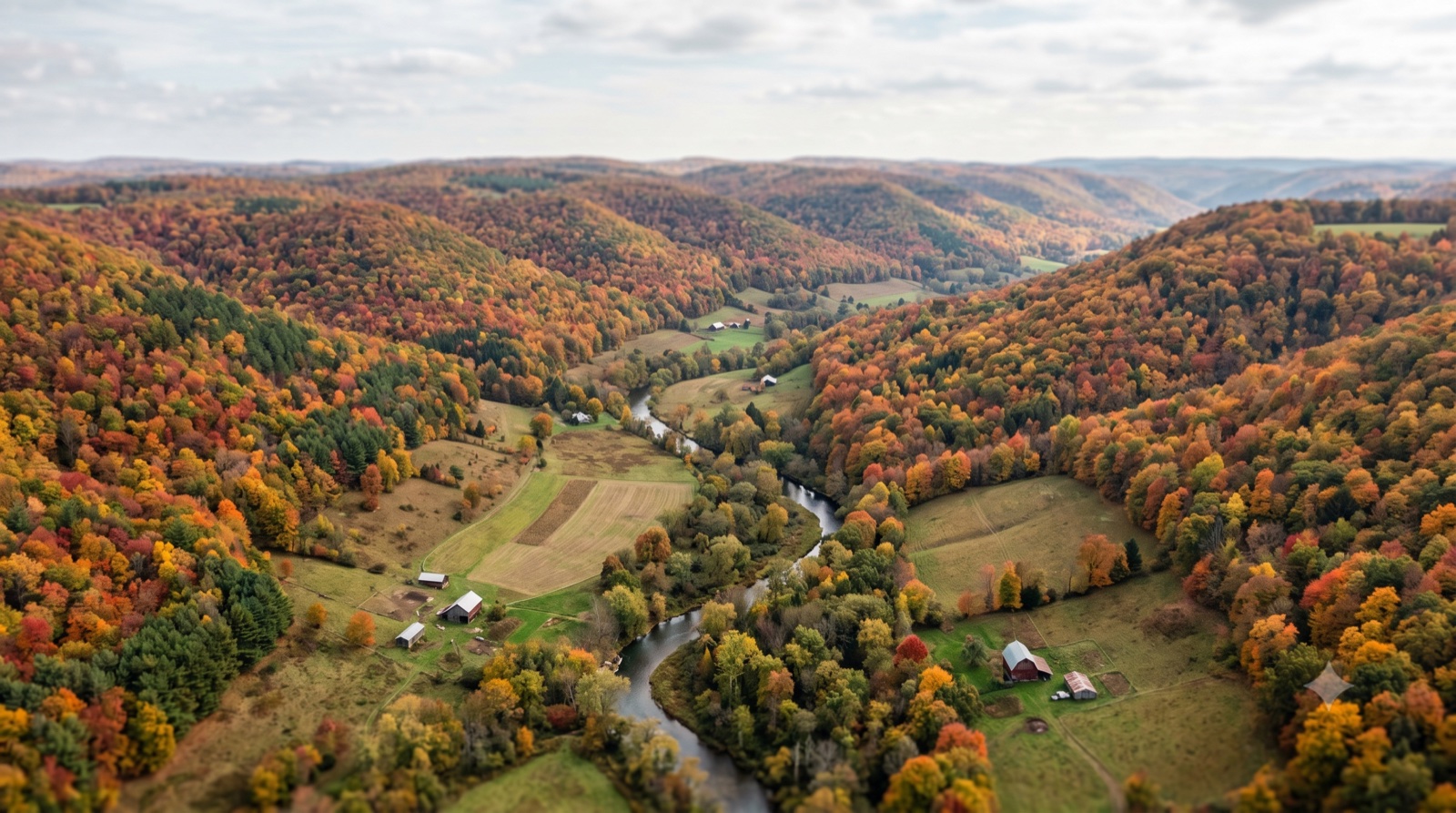
Wayne County covers roughly 751 square miles in the far northeast corner of Pennsylvania, where the Pocono plateau rises into the Endless Mountains along the Delaware River and the New York border, anchored by the borough and county seat of Honesdale. Glacial lakes, northern-hardwood forest, and scattered farms define the landscape, and much of the rural acreage that trades here is recreational — hunting camps, wooded lots, and lake-region parcels rather than active cropland.
Understanding how Pennsylvania's property tax system, realty transfer tax, and title closing requirements interact will help you set realistic expectations, whether you plan to list on the open market, sell by owner, or take a direct cash offer. This guide covers Wayne County's property tax mechanics, the Pennsylvania closing process and realty transfer tax, how Wayne County compares to neighboring counties, and the practical options available to landowners ready to sell.
What Are the Tax Costs of Holding Vacant Land in Wayne County?
Pennsylvania does not use a uniform statewide assessment ratio the way some states do — each county maintains its own assessed values based on periodic reassessments. Wayne County has been working toward a countywide reassessment, but its current assessed values still rest on older base-year market data. The State Tax Equalization Board publishes an annual Common Level Ratio (CLR) that captures the relationship between assessed values and current market values. According to Evans Estate Law Resources, Wayne County's CLR factor for documents accepted July 1, 2025 through June 30, 2026 is 1.38 — meaning assessed values average roughly 72% of current market levels in the county.
Wayne County's effective property tax rate is approximately 1.11% of fair market value, according to PropertyTax101 — a lower percentage than many northern-tier counties, but applied to a higher median home value near $173,600, so the median property tax bill still runs about $1,929 a year. Total effective rates vary by municipality and school district, as each taxing authority applies its own millage on top of the county rate.
How Property Tax Bills Add Up for Vacant Land
Pennsylvania does not impose a separate higher assessment ratio on vacant land the way some states do — all real property is assessed under the same framework. However, vacant land that produces no income generates a recurring tax obligation with no offset. A parcel carrying a county market value of $50,000 at an effective rate of 1.11% produces an annual tax bill of roughly $555; properties in school districts with above-average millage, or lake-region parcels carrying higher assessed values, will face larger combined bills. Over a decade of holding, those payments compound into thousands of dollars on land that may not appreciate fast enough to offset them.
Pennsylvania property tax payments are typically split into installments with deadlines set by each taxing authority — often with a discount period, a face period, and a penalty period. Delinquent taxes are collected by the Wayne County Tax Claim Bureau at the Wayne County Courthouse in Honesdale. Properties with two or more years of delinquent taxes become eligible for the county's annual Upset Tax Sale, held at a starting bid equal to the total delinquent taxes, costs, and municipal liens. Properties unsold at the Upset Sale proceed to a Judicial Sale, where the minimum bid drops to costs only and most liens are exonerated.
Beyond taxes, vacant landowners in Wayne County face liability insurance costs, potential boundary and access maintenance expenses, and the carrying cost of holding an illiquid asset in a thin rural market. If you've inherited land with an unclear title or unpaid taxes, our guide on how to sell inherited land walks through the process. For landowners who are already behind on taxes, selling land with back taxes explains your options before the Tax Claim Bureau schedules a sale.
Clean and Green Act 319 Preferential Assessment
Landowners with parcels of at least 10 acres devoted to agricultural use, open space, or forest reserve can apply for Pennsylvania's Clean and Green program (Act 319), which taxes land based on use value rather than fair market value — ordinarily producing significant tax savings, according to the Pennsylvania Department of Agriculture. Given how much of Wayne County is woodland, the forest-reserve category is especially relevant here. Enrolled parcels must remain in qualifying use; withdrawing from the program triggers a rollback tax equal to seven years of the difference between market-value taxes and use-value taxes, plus 6% interest per year. Applications run through the Wayne County Tax Assessment Office (570-253-5970, ext. 4010). If your parcel is enrolled, factor the rollback exposure into your net proceeds before agreeing to a sale price.
What Zoning, Access, and Closing Requirements Apply in Wayne County?
Wayne County is predominantly unzoned outside its boroughs and larger municipalities. Township-level zoning in Pennsylvania is handled at the municipal level, so land use requirements vary significantly depending on which township your parcel sits in — and lake-region parcels can carry additional considerations around shoreline, private-community, or homeowners-association rules. For zoning and permitting questions, contact the relevant township supervisors for the municipality where your land is located, or the county's planning staff at the Wayne County Courthouse (925 Court Street, Honesdale, PA 18431).
For current deed information, legal descriptions, and recorded easements, contact the Wayne County Recorder of Deeds (925 Court Street, Honesdale, PA 18431, 570-253-5970, ext. 4040, Mon–Fri 8:30 a.m. – 4:30 p.m., no recordings accepted after 4:00 p.m.). This office records deeds, mortgages, and related land documents that make up the public chain of title.
A Note on Access, Easements, and Lake Rights
Much of Wayne County's rural land is wooded back-lot acreage and lake-region parcels, and two title details matter most here. First, legal access: some interior timber and hunting tracts are reached only by a right-of-way across a neighbor's land, and a buyer will want that access confirmed in the record. Second, lake and shoreline rights: parcels marketed as "lake access" or lakefront may depend on easements, private-community memberships, or association rules rather than direct ownership of the water frontage. Before you sell, a title search through the Recorder of Deeds will confirm exactly what your deed conveys, what easements run with the land, and whether any community or association obligations attach. Our guide on selling recreational or off-grid land with no utilities covers what drives value — and buyer hesitation — on parcels like these.
Pennsylvania's Title Company Closing Process
Pennsylvania does not require a licensed attorney to conduct real estate closings. Most land transactions in the state are handled by a title company or settlement agent, which coordinates the title search, prepares closing documents, disburses funds, and records the deed with the county recorder. Attorneys are often involved but are not legally required for the closing itself.
The closing process for land in Wayne County typically works as follows:
- Title search: The title company searches public land records through the Wayne County Recorder of Deeds to verify clear title — no outstanding liens, unpaid taxes, or unresolved encumbrances, and to confirm access easements and any lake or community rights
- Title insurance: A lender's or owner's title insurance policy protects against defects not found in the standard search
- Closing: Buyer, seller, and agents execute the deed and settlement statement; the title company or settlement agent oversees the signing
- Recording: After closing, the deed is recorded with the Wayne County Recorder of Deeds, making the transfer part of the public record
For more detail on what documents are needed to complete a Pennsylvania land sale, our guide on paperwork needed to sell land covers the full checklist.
Pennsylvania Realty Transfer Tax
Pennsylvania imposes a 1% state realty transfer tax on all real property transfers, according to the Pennsylvania Department of Revenue. In addition, a local realty transfer tax of typically 1% applies, split between the municipality and school district — bringing the combined total to 2% in most of Wayne County. Some municipalities may charge a slightly different local rate.
By custom and in most transactions, the tax is split equally between buyer and seller — each paying 1% of the sale price — though the allocation can be negotiated. Cash buyers who advertise "no closing costs to seller" typically absorb both sides of the transfer tax as part of the offer terms. The deed must be recorded with the Recorder of Deeds in the county where the property is located.
How Does Wayne County Compare to Neighboring Pennsylvania Counties?
Wayne County's population of approximately 51,262 (2024 estimate) has edged down only slightly from the 2010 Census count of 52,822, according to U.S. Census Bureau data — a dip of about 1,600 residents in roughly 14 years, leaving the county nearly flat while much of the northern tier has shrunk faster. The county's median age is approximately 49 years, one of the older in the state, and median household income of approximately $62,381 runs modestly below the state and national medians (Data USA). A high homeownership rate near 80% reflects the county's settled, rural, second-home-and-retirement character.
Wayne County borders New York to the north and east and is surrounded by other Pocono, Lake Region, and Endless Mountains counties. Out-of-state landowners who purchased hunting, timber, or lake-region parcels decades ago represent a common seller profile here, as generational transitions and rising carrying costs motivate liquidation. Access-limited interior tracts and lake parcels with community or easement obligations further complicate many of these older holdings.
| Factor | Wayne County | Pike County | Lackawanna County | Susquehanna County |
|---|---|---|---|---|
| Population (2024 est.) | ~51,262 | ~60,600 | ~216,500 | ~38,100 |
| Population trend | Roughly flat | Slowly growing | Slowly declining | Declining |
| Effective tax rate | ~1.11% | ~1.34% | ~1.53% | ~1.44% |
| Median property tax | ~$1,929 | ~$2,911 | ~$2,200 | ~$1,791 |
| Median home value | ~$173,600 | ~$217,900 | ~$135,600 | ~$124,400 |
| Defining feature | Pocono Lake Region, hardwood timber, Honesdale | Pocono resort county, Delaware Water Gap | Scranton metro, most populous neighbor | Marcellus gas, Endless Mountains |
Agriculture is a smaller part of Wayne County's rural economy than in the farm counties to the west, but working farms and woodlots persist, documented in the 2022 USDA Census of Agriculture. The county retains a base of hay ground, pasture, and forest reserve alongside its extensive recreational and timber acreage. Much of the rural land that changes hands here is not active cropland but wooded hunting tracts, back-lot timber, and lake-region parcels. If your land falls into those categories, our guides on selling timberland and selling recreational or off-grid land with no utilities cover what drives value for rural parcels.
For landowners weighing a sale from a distance, our guide on selling land as an out-of-state owner walks through how to close a Pennsylvania transaction without traveling to the county.
What Are Your Options for Selling Land in Wayne County?
With a roughly flat population, a thin rural buyer pool, an effective tax rate near 1.11% applied to relatively high assessed values, and land that may have been held by out-of-state families for decades, Wayne County landowners face a clear carrying-cost equation: annual property taxes, insurance, and maintenance accumulate every year a parcel sits unsold. Understanding what your land is actually worth — and confirming your access and lake or easement rights — is the logical first step. Our guide on how much is my land worth explains the factors that drive valuation for rural parcels.
Before pursuing any sale path, verify your property's legal description, access easements, and any lake or community rights through the Wayne County Recorder of Deeds (925 Court Street, Honesdale, 570-253-5970, ext. 4040). Confirm property tax status and any Clean and Green enrollment with the Wayne County Tax Assessment Office (570-253-5970, ext. 4010) to ensure no delinquent amounts or rollback exposure could complicate closing.
Wayne County landowners have several selling paths:
Listing with a local real estate agent familiar with Pocono Lake Region and recreational land offers market exposure to buyers searching for hunting, timber, camp, or lakefront properties. However, agent commissions of approximately 5–6%, combined with Pennsylvania's 2% transfer tax and title company fees, reduce net proceeds. And in a thin rural market, carrying costs continue accumulating through a listing period that can stretch for many months. Whether an agent makes sense depends on your timeline — our guide on whether you need a realtor to sell land weighs the tradeoffs.
Selling by owner (FSBO) eliminates agent commissions but requires the seller to handle marketing, disclosures, access and easement research, and coordinating the title company. Online platforms provide some exposure to out-of-state recreational buyers, but landlocked or access-limited interior parcels — and lake lots with community obligations — can be especially hard to move on your own; see our guide on selling landlocked land if that describes your tract.
For landowners who want to avoid extended timelines and ongoing carrying costs, companies like Jerez Land provide direct cash offers priced individually to the parcel — a firm written number, not a range or a formula. We absorb the carrying costs, marketing risk, and resale uncertainty, and we close in weeks rather than months. There are no agent commissions, and the title company closing process that Pennsylvania uses applies equally. Request a cash offer to see what your parcel is worth to a direct buyer.
Frequently Asked Questions
I inherited a wooded lake lot in Wayne County PA but live in New Jersey — can I sell it without coming up to the Poconos?
Yes. Pennsylvania land sales close through a title company or settlement agent, and out-of-state sellers routinely close remotely by signing a notarized deed and having documents couriered or handled electronically. Start by verifying your legal description, access, and any lake or community rights through the Wayne County Recorder of Deeds (925 Court Street, Honesdale, 570-253-5970, ext. 4040), then confirm tax status with the Tax Assessment Office. You can list with a local agent, sell it yourself, or take a direct cash offer — all without traveling to the county.
What is the property tax rate in Wayne County PA?
Wayne County's effective property tax rate is approximately 1.11% of fair market value, according to PropertyTax101 — a lower percentage than many northern-tier counties, but applied to a higher median home value near $173,600, so the median bill still runs about $1,929 a year. Total taxes vary by municipality and school district, as each applies additional millage on top of the county rate. The State Tax Equalization Board publishes an annual Common Level Ratio (CLR) factor; Wayne County's factor is 1.38 for July 2025 through June 2026, reflecting assessed values that average roughly 72% of current market value.
My Wayne County parcel is marketed as "lake access" — how do I confirm what I actually own before I sell?
Order a title search through the Wayne County Recorder of Deeds. "Lake access" can mean direct lakefront ownership, a recorded easement to the water, or a membership right in a private community or association — and each conveys very differently to a buyer. The title search will show exactly what your deed grants, what easements run with the land, and whether any community or homeowners-association obligations attach. Sorting this out before listing prevents a deal from falling apart at closing when a buyer's title company flags an unclear right.
Does Pennsylvania charge a transfer tax on land sales?
Yes. Pennsylvania imposes a 1% state realty transfer tax on all property transfers, plus a local tax that is typically 1% in most of Wayne County — bringing the combined rate to approximately 2% of sale price, according to the Pennsylvania Department of Revenue. By custom, this tax is split equally between buyer and seller (each paying 1%), though the split can be negotiated. Cash buyers sometimes cover both sides as part of their offer terms.
I'm selling my Wayne County land myself without a realtor — is a title company required to close a land sale in Pennsylvania?
Pennsylvania does not require a licensed attorney for real estate closings, unlike some states. Most transactions use a title company or settlement agent to conduct the title search, prepare the deed, disburse funds, and record the transfer with the county Recorder of Deeds. An attorney may be retained by either party but is not legally mandated by the state, which keeps FSBO closings straightforward as long as the title is clear.
Is Wayne County PA population growing or declining?
Wayne County's population has held roughly flat, edging from 52,822 in the 2010 Census to 51,155 in the 2020 Census, to an estimated 51,262 as of 2024, according to U.S. Census Bureau data — a dip of only about 1,600 residents since 2010. The county is rural and settled, anchored by the county seat of Honesdale, sits on the Pocono and Endless Mountains plateau in Pennsylvania's far northeast, and is more stable in population than many of the shrinking counties along the state's northern tier.
Disclaimer: This article is for informational purposes only and does not constitute legal, financial, or professional advice. Laws and regulations vary by jurisdiction and change over time. Always consult with qualified professionals before making land purchase decisions. Jerez Land is not responsible for actions taken based on this information.