
Sell My Land in Snyder County PA - What Landowners Need to Know
Key Takeaways
- Snyder County's population has been roughly flat for a decade: The county recorded 39,702 residents in the 2010 Census and 39,736 in the 2020 Census — an essentially unchanged count — with recent U.S. Census Bureau and state estimates putting the population near 39,668 as of 2024, a very slight downward drift rather than a steep decline. Even so, the rural vacant-land market here is thin, and back-of-the-valley tracts can take many months to sell
- The effective property tax rate runs around 1.17% of market value: Snyder County collects, on average, approximately 1.17% of a property's fair market value in property tax, according to PropertyTax101 — below the Pennsylvania state average of about 1.33%, but still a recurring cost that accumulates on land that produces no income
- Farming defines the working landscape: The county's 792 farms span roughly 85,547 acres, with 58,493 acres of cropland and about 14,641 acres of woodland, and livestock and poultry account for roughly 88% of agricultural sales, according to the 2022 USDA Census of Agriculture — a landscape shaped by ridge-and-valley farmland, hardwood woodlots, and a substantial Plain-sect farming presence
How Can You Sell Land in Snyder County Pennsylvania?
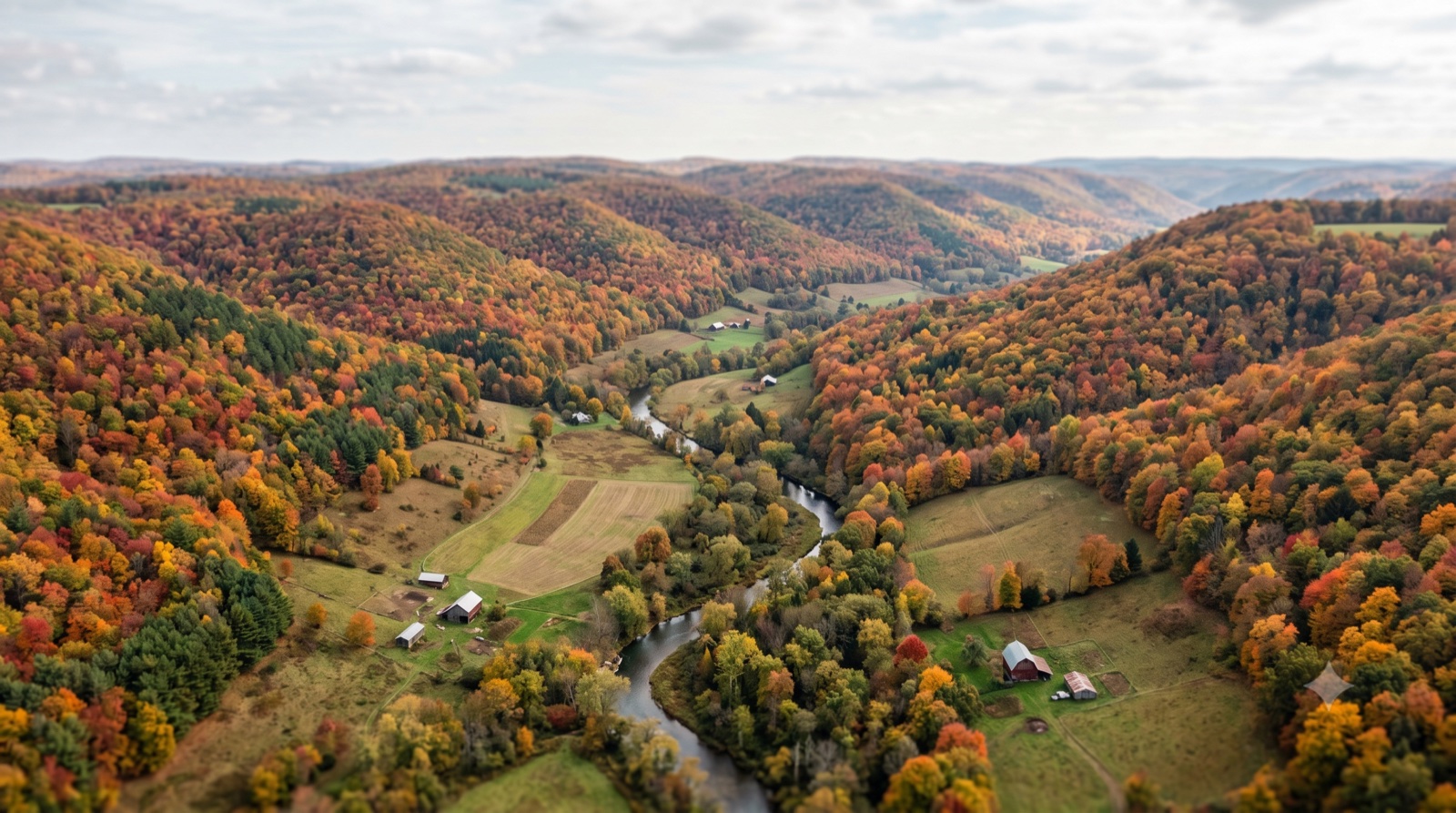
You can sell land in Snyder County through a local real estate agent, as a for-sale-by-owner (FSBO), or by requesting a direct cash offer. All sales close through a title company and involve a combined 2% realty transfer tax, recorded with the Snyder County Register & Recorder. Selling land in Snyder County, Pennsylvania means navigating a small, rural central-Pennsylvania market shaped by ridge-and-valley farmland, hardwood woodlots, a title company-centered closing process, and a thin buyer pool for vacant tracts. Snyder County covers roughly 329 square miles in the Susquehanna Valley of central Pennsylvania, just west of the Susquehanna River across from Selinsgrove, anchored by the borough of Middleburg as the county seat. The landscape alternates between productive farm valleys and wooded ridges, with state forest and game lands adding to the county's rural character.
Understanding how Pennsylvania's property tax system, realty transfer tax, and title closing requirements interact — and how Clean and Green enrollment factors into a sale — will help you set realistic expectations, whether you plan to list on the open market, sell by owner, or request a no-obligation cash offer from a direct buyer. For a statewide overview, start with our guide on how to sell land in Pennsylvania.
This guide covers Snyder County's property tax mechanics, the Pennsylvania closing process and realty transfer tax, how Snyder County compares to neighboring counties, and the practical options available to landowners ready to sell.
What Are the Tax Costs of Holding Vacant Land in Snyder County?
Pennsylvania does not use a uniform statewide assessment ratio the way some states do — each county maintains its own assessed values based on periodic reassessments. Snyder County has not conducted a recent countywide reassessment, which means its assessed values are based on a very old base-year market data set. The State Tax Equalization Board publishes an annual Common Level Ratio (CLR) that captures the relationship between assessed values and current market values. According to Evans Estate Law Resources, Snyder County's CLR factor for documents accepted July 1, 2025 through June 30, 2026 is 10.15 — meaning assessed values average only about 10% of current market levels in the county, one of the widest gaps in Pennsylvania.
Snyder County's effective property tax rate is approximately 1.17% of fair market value, according to PropertyTax101 — below the Pennsylvania state average of roughly 1.33% and near the national average around 1.08%. The median property tax bill in Snyder County runs about $1,438 on a median home value near $122,900. Total effective rates vary by municipality and school district, as each taxing authority applies its own millage on top of the county rate.
How Property Tax Bills Add Up for Vacant Land
Pennsylvania does not impose a separate higher assessment ratio on vacant land the way some states do — all real property is assessed under the same framework. However, vacant land that produces no income generates a recurring tax obligation with no offset. A parcel carrying a county market value of $50,000 at an effective rate of 1.17% produces an annual tax bill of roughly $585; properties in school districts with above-average millage will face higher combined bills. Over a decade of holding, those payments compound into thousands of dollars on land that may not appreciate fast enough to offset them.
Pennsylvania property tax payments are typically split into installments with deadlines set by each taxing authority — often with a discount period, a face period, and a penalty period. Delinquent taxes are collected by the Snyder County Tax Claim Bureau (9 West Market Street, Middleburg, PA 17842, 570-837-4220). Properties with two or more years of delinquent taxes become eligible for the county's annual Upset Tax Sale, held at a starting bid equal to the total delinquent taxes, costs, and municipal liens. Properties unsold at the Upset Sale proceed to a Judicial Sale, where the minimum bid drops to costs only and most liens are exonerated.
Beyond taxes, vacant landowners in Snyder County face liability insurance costs, potential fence and boundary maintenance expenses, and the carrying cost of holding an illiquid asset in a thin rural market. If you've inherited land with an unclear title or multiple heirs, our guide on selling inherited land with multiple heirs walks through the process. For landowners who are already behind on taxes, selling land with back taxes explains your options before the Tax Claim Bureau schedules a sale.
Clean and Green Act 319 Preferential Assessment
Landowners with parcels of at least 10 acres devoted to agricultural use, open space, or forest reserve can apply for Pennsylvania's Clean and Green program (Act 319), which taxes land based on use value rather than fair market value — ordinarily producing significant tax savings, according to the Pennsylvania Department of Agriculture. Given how much of Snyder County is active farmland and woodland, both the agricultural-use and forest-reserve categories are relevant here. It is important to note that any Clean and Green use-value figure is a tax-assessment value, not a market price. Enrolled parcels must remain in qualifying use; withdrawing from the program triggers a rollback tax equal to seven years of the difference between market-value taxes and use-value taxes, plus 6% interest per year. Applications run through the Snyder County Assessment Office (570-837-4220). If your parcel is enrolled, factor the rollback exposure into your net proceeds before agreeing to a sale price.
What Zoning and Closing Requirements Apply in Snyder County?
Snyder County is predominantly rural, and land use in Pennsylvania is regulated at the municipal level rather than the county level. Zoning and permitting requirements therefore vary significantly depending on which township or borough your parcel sits in. For zoning and permitting questions, contact the relevant township supervisors for the municipality where your land is located, or the Snyder County offices at the courthouse complex in Middleburg for guidance on which municipal authority applies.
For current deed information, legal descriptions, and recorded easements, contact the Snyder County Register & Recorder (9 West Market Street, Middleburg, PA 17842, 570-837-4205, Mon–Fri 8:30 a.m. – 4:00 p.m.). The Recorder of Deeds maintains the official record of every deed, mortgage, and easement affecting land in the county.
A Note on Ridge-and-Valley Land Character
Snyder County's terrain is classic Pennsylvania ridge-and-valley country: fertile farm valleys separated by long, forested ridges of hardwood woodlot. Much of the tillable acreage is worked by a substantial Plain-sect Amish and Mennonite farming community, and the wooded ridges support timber, hunting, and recreational use, with state forest and game lands nearby. Before you sell, it is worth confirming through a title search exactly what your deed conveys — the full parcel boundary, any recorded rights-of-way, and whether any easements or access agreements run across the land. This affects what you actually own, what a buyer is paying for, and how quickly a sale can close. If your tract is wooded, our guide on selling timberland covers what drives value for hardwood and recreational parcels.
Pennsylvania's Title Company Closing Process
Pennsylvania does not require a licensed attorney to conduct real estate closings. Most land transactions in the state are handled by a title company or settlement agent, which coordinates the title search, prepares closing documents, disburses funds, and records the deed with the county recorder. Attorneys are often involved but are not legally required for the closing itself.
The closing process for land in Snyder County typically works as follows:
- Title search: The title company searches public land records through the Snyder County Register & Recorder to verify clear title — no outstanding liens, unpaid taxes, or unresolved encumbrances, and to identify any recorded easements
- Title insurance: A lender's or owner's title insurance policy protects against defects not found in the standard search
- Closing: Buyer, seller, and agents execute the deed and settlement statement; the title company or settlement agent oversees the signing
- Recording: After closing, the deed is recorded with the Snyder County Register & Recorder, making the transfer part of the public record
For more detail on what documents are needed to complete a Pennsylvania land sale, our guide on paperwork needed to sell land covers the full checklist.
Pennsylvania Realty Transfer Tax
Pennsylvania imposes a 1% state realty transfer tax on all real property transfers, according to the Pennsylvania Department of Revenue. In addition, a local realty transfer tax of typically 1% applies, split between the municipality and school district — bringing the combined total to 2% in most of Snyder County. Some municipalities may charge a slightly different local rate.
By custom and in most transactions, the tax is split equally between buyer and seller — each paying 1% of the sale price — though the allocation can be negotiated. Cash buyers who advertise "no closing costs to seller" typically absorb both sides of the transfer tax as part of the offer terms. The deed must be recorded with the Register & Recorder in the county where the property is located.
How Does Snyder County Compare to Neighboring Pennsylvania Counties?
Snyder County's population of approximately 39,668 (2024 estimate) has held nearly steady from the 2010 Census count of 39,702 and the 2020 Census count of 39,736, according to U.S. Census Bureau and state data — a small, slow drift rather than the steep decline seen in some northern-tier counties. The county's median age is approximately 41 years, and the poverty rate sits near 9.4%, below the Pennsylvania rate of about 11.7% (Data USA). Median household income of approximately $66,876 runs roughly in line with the state median.
Snyder County borders Union County to the north, Northumberland County to the east across the Susquehanna River, and Juniata and Mifflin counties to the south and west. Farm families making generational transitions, along with out-of-area owners of woodlot and recreational tracts, represent common seller profiles here, as rising carrying costs and estate situations motivate liquidation of land that no longer fits an owner's plans.
| Factor | Snyder County | Union County | Northumberland County | Juniata County |
|---|---|---|---|---|
| Population (2024 est.) | ~39,668 | ~42,159 | ~90,700 | ~23,379 |
| Population trend | Roughly flat | Roughly flat | Slowly declining | Roughly flat |
| Effective tax rate | ~1.17% | ~1.14% | ~1.10% | ~0.99% |
| Median household income | ~$66,876 | ~$70,000 | ~$60,000 | ~$66,318 |
| Poverty rate | ~9.4% | ~12% | ~13% | ~11% |
| Defining feature | Ridge-and-valley farmland, hardwood woodlots | Bucknell University, Buffalo Valley | Susquehanna River, coal-region towns | Rural Juniata Valley farmland |
Snyder County's economy employs roughly 19,256 people, according to Data USA (2024). The three largest sectors by employment are Manufacturing (about 3,124), Health Care & Social Assistance (about 2,836), and Retail Trade (about 2,819). U.S. Route 11 and U.S. Route 522 are the primary through-routes, and the county has no interstate highway of its own — factors that reinforce its rural, agricultural character and keep the vacant-land market slow-moving.
Snyder County's working landscape is documented in the 2022 USDA Census of Agriculture, which counted 792 farms across roughly 85,547 acres, averaging about 108 acres each. Cropland accounts for 58,493 acres and woodland for about 14,641 acres, with livestock and poultry driving roughly 88% of agricultural sales — corn, soybeans, and hay lead the crop acreage. Much of the rural acreage that changes hands here is farm ground, wooded ridge, and back-of-the-valley recreational tracts rather than development land. If your land falls into those categories, our guides on selling farmland and selling hunting land cover what drives value for rural parcels.
For a broader view of land markets across the region, explore our blog.
What Are Your Options for Selling Land in Snyder County?
With a roughly flat population, a thin rural buyer pool, an effective tax rate near 1.17%, and land that may have been held in the same farm family for generations, Snyder County landowners face a clear carrying-cost equation: annual property taxes, insurance, and maintenance accumulate every year a parcel sits unsold. Understanding what your land is actually worth is the logical first step. Our guide on how much is my land worth explains the factors that drive valuation for rural parcels.
Before pursuing any sale path, verify your property's legal description and boundary through the Snyder County Register & Recorder (570-837-4205, 9 West Market Street, Middleburg). Confirm property tax status with the Tax Claim Bureau (570-837-4220) to ensure no delinquent amounts could complicate closing. If your parcel is enrolled in Clean and Green, understand the rollback tax exposure before agreeing to a sale price.
Snyder County landowners have several selling paths:
Listing with a local real estate agent familiar with central-Pennsylvania farm and recreational land offers market exposure to buyers searching for tillable ground, woodlots, or hunting camps. However, agent commissions of approximately 5–6%, combined with Pennsylvania's 2% transfer tax and title company fees, reduce net proceeds. And in a thin rural market, carrying costs continue accumulating through a listing period that can stretch for many months. Whether an agent makes sense depends on your timeline — our guide on whether you need a realtor to sell land weighs the tradeoffs.
Selling by owner (FSBO) eliminates agent commissions but requires the seller to handle marketing, disclosures, boundary research, and coordinating the title company. This can be especially challenging for out-of-state owners who cannot easily visit the property, or for owners of parcels enrolled in a conservation program — see our guide on selling land in a conservation easement or CRP contract if that describes your tract.
For landowners who want to avoid extended timelines and ongoing carrying costs, companies like Jerez Land provide direct cash offers priced individually to the parcel — a firm written number, not a range or a formula. We absorb the carrying costs, marketing risk, and resale uncertainty, and we close in weeks rather than months. There are no agent commissions, and the title company closing process that Pennsylvania uses applies equally. Request a cash offer to see what your parcel is worth to a direct buyer.
Frequently Asked Questions
I own vacant land in Snyder County PA — what's the best way to sell it?
Verify your property description and boundary through the Snyder County Register & Recorder (570-837-4205, 9 West Market Street, Middleburg) and confirm tax status with the Tax Claim Bureau. Pennsylvania land sales close through a title company or settlement agent — no attorney is legally required. You can list with a local agent, sell by owner, or request a direct cash offer from a land buyer.
I'm holding vacant land in Snyder County PA — how much annual property tax will I owe?
Snyder County's effective property tax rate is approximately 1.17% of fair market value, according to PropertyTax101 — below the Pennsylvania state average of about 1.33%. Total taxes vary by municipality and school district, as each applies additional millage on top of the county rate. The State Tax Equalization Board publishes an annual Common Level Ratio (CLR) factor; Snyder County's factor is 10.15 for July 2025 through June 2026, reflecting assessed values that average only about 10% of current market value.
I'm thinking about selling land in Snyder County PA — is the market growing or declining?
Snyder County's population has been essentially flat, moving from 39,702 in the 2010 Census to 39,736 in the 2020 Census, with recent estimates near 39,668 as of 2024, according to U.S. Census Bureau and state data — a very slight downward drift rather than a steep decline. The county is rural, anchored by the county seat of Middleburg, and ranks among the smaller of Pennsylvania's 67 counties by population.
When I sell my land in Pennsylvania, what transfer tax will I owe?
Yes. Pennsylvania imposes a 1% state realty transfer tax on all property transfers, plus a local tax that is typically 1% in most of Snyder County — bringing the combined rate to approximately 2% of sale price, according to the Pennsylvania Department of Revenue. By custom, this tax is split equally between buyer and seller (each paying 1%), though the split can be negotiated. Cash buyers sometimes cover both sides as part of their offer terms.
Is a title company required to close a land sale in Pennsylvania?
Pennsylvania does not require a licensed attorney for real estate closings, unlike some states. Most transactions use a title company or settlement agent to conduct the title search, prepare the deed, disburse funds, and record the transfer with the county Register & Recorder. An attorney may be retained by either party but is not legally mandated by the state.
What is Clean and Green and how does it affect selling my Snyder County land?
Clean and Green (Act 319) is a Pennsylvania program that taxes qualifying agricultural, open-space, or forest-reserve land of at least 10 acres on its use value rather than its market value — a tax-assessment figure, not a market price. Much of Snyder County's farmland and woodland qualifies. If your parcel is enrolled and you change its use or sell it out of qualifying use, a rollback tax equal to seven years of tax savings plus 6% annual interest can apply, so confirm your enrollment status with the Assessment Office before agreeing to a sale price.
Disclaimer: This article is for informational purposes only and does not constitute legal, financial, or professional advice. Laws and regulations vary by jurisdiction and change over time. Always consult with qualified professionals before making land purchase decisions. Jerez Land is not responsible for actions taken based on this information.