
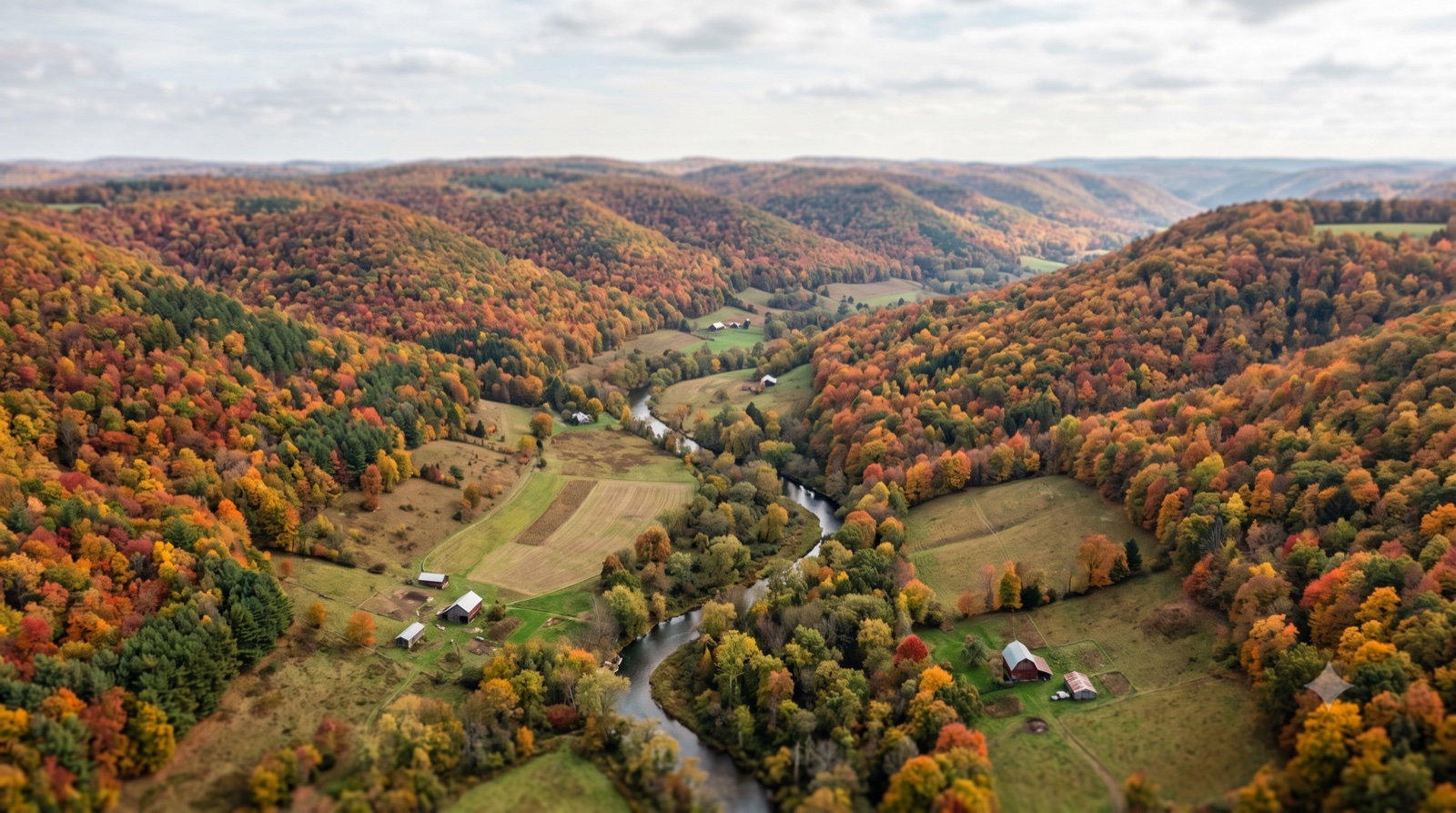
How to Sell Land in Pennsylvania: A Landowner's Guide
Key Takeaways
- Pennsylvania's realty transfer tax totals 2% — typically split between buyer and seller: The Commonwealth imposes a 1% state tax on the value of every real estate transfer, and local governments add their own 1% (or more in some municipalities), with the combined 2% customarily split so each party pays 1%, according to the Pennsylvania Department of Revenue
- Title companies close land transactions — no attorney required by state law: Pennsylvania does not mandate attorney involvement at a land closing; title insurance companies handle title examination, deed preparation, escrow, and recording for most rural land sales in Potter, Tioga, and similar counties
- Clean and Green (Act 319) can defer taxes on agricultural and forest land: Pennsylvania's Act 319 program taxes enrolled parcels at use value rather than fair market value — potentially cutting assessed value in half — but exiting the program triggers a rollback of deferred taxes for up to seven years
How Do You Sell Land in Pennsylvania?
To sell land in Pennsylvania, you work with a title company, pay a 2% realty transfer tax (typically split evenly with the buyer), and either list traditionally (six months to over a year) or pursue a direct cash sale (2–4 weeks).
Selling vacant land in Pennsylvania is shaped by a moderate realty transfer tax, title company-led closings, county-level assessment ratios that vary widely across the state's 67 counties, and a rural land market where the Pennsylvania Wilds region — including Potter and Tioga counties — routinely sees listings sit for six months to well over a year. Whether your parcel is timber acreage along Pine Creek Gorge or agricultural ground in the Northern Tier, the legal framework and carrying costs are consistent statewide.
This guide covers Pennsylvania's closing process, transfer tax obligations and typical seller costs, how long rural land takes to sell and the structural reasons why, and how to convert your parcel to cash without waiting out a long marketing period.
Who Handles a Land Closing in Pennsylvania?
Pennsylvania is a title company closing state for most residential and land transactions. State law does not require a licensed attorney to be present at a real estate closing, and the majority of rural land sales in northern and central Pennsylvania are handled by title companies acting as settlement agents.
The process from executed agreement of sale to recording works as follows:
- Agreement of sale signed — Buyer and seller sign a written purchase agreement specifying the parcel, legal description, price, earnest money deposit, contingencies, and closing date
- Title search ordered — The title company searches the county Recorder of Deeds and courthouse records to verify that the seller holds marketable title and identify any open liens, mortgages, judgments, back taxes, or easements
- Title commitment issued — The title company issues a commitment to insure, listing any requirements (payoff of existing lien, survey gap endorsement, etc.) and exceptions to coverage
- Closing conducted — Seller signs the deed; buyer signs any financing documents. The title company collects and disburses funds, pays any prorations, and collects realty transfer tax
- Deed and tax certificates recorded — The title company records the deed with the county Recorder of Deeds and files the Realty Transfer Tax Statement of Value (Form REV-183) with the state, completing the transfer
Pennsylvania uses a warranty deed or special warranty deed for most arms-length land sales. Cash sales with no title company on hand sometimes use a simple deed recorded directly at the county courthouse, but title insurance provides important buyer protection and is standard in commercial and arms-length transactions.
For a complete overview of the paperwork involved, see our guide on paperwork needed to sell land.
What Are the Transfer Taxes and Seller Closing Costs in Pennsylvania?
Pennsylvania imposes a realty transfer tax (RTT) on every deed transfer:
| Component | Rate | Cost on $100,000 sale |
|---|---|---|
| Commonwealth (state) portion | 1% | $1,000 |
| Local (municipal/school) portion | 1% (typical) | $1,000 |
| Common total | 2% | $2,000 |
The 1% state portion goes to the Commonwealth; the local portion goes to the municipality and school district where the property is located. By statute, both the buyer and seller are jointly and severally liable for the full tax — meaning the state can collect from either party if the tax goes unpaid. In practice, purchase agreements customarily split the RTT evenly: seller pays 1% and buyer pays 1%, according to the Pennsylvania Department of Revenue.
Important exceptions: Philadelphia charges 3.278% to the city plus 1% to the Commonwealth (4.278% combined). Pittsburgh's combined rate is 5%. For rural land in Potter, Tioga, and similar northern tier counties, the standard 2% combined rate applies.
Pennsylvania does not have a statewide standard for how counties assess property for tax purposes. Instead, each county sets a common level ratio (CLR) — the ratio of assessed value to current market value — which the State Tax Equalization Board publishes annually. In older, rural counties that have not reassessed in decades, the CLR can be well below 50%, meaning assessed values are a fraction of true market value. When you sell, the deed transfer triggers the county to update the property's assessed value, which can meaningfully increase the new owner's annual tax burden.
Beyond the transfer tax, typical Pennsylvania seller closing costs for a rural land sale include a title/settlement fee, deed preparation, and prorated property tax. Owner's title insurance is customarily a buyer expense; recording fees vary by county but are modest (typically $75–$150 for a deed).
If your land is enrolled in Clean and Green (Act 319), there is a critical cost to understand before selling: see the section below.
Pennsylvania's Clean and Green (Act 319) Program
The Pennsylvania Farmland and Forest Land Assessment Act, known as Clean and Green (Act 319), allows owners of qualifying land to have their property taxed at its use value rather than fair market value. As of the Pennsylvania Department of Agriculture's most recent report, 217,603 parcels covering more than 10.9 million acres are enrolled statewide.
Eligibility: A parcel must be at least 10 acres in Agricultural Use, Agricultural Reserve, or Forest Reserve — or less than 10 acres if the agricultural operation generates at least $2,000 in annual farm income. Applications are due by June 1 of the year before the preferential assessment takes effect.
Tax benefit: Enrolled land is taxed on use value rather than fair market value, which county assessors report typically reduces assessed values by an average of 50%.
Rollback taxes on sale: If the property is sold and removed from the program, the new owner — or in some agreements the seller — owes rollback taxes equal to the deferred tax for the current year and the preceding seven years (or the number of years enrolled, whichever is less), plus simple interest. For a parcel that has been enrolled for 10 or more years, this rollback can amount to a substantial sum and must be addressed at closing. Confirm with the county assessor whether your parcel is enrolled and what the rollback obligation would be before listing.
For context on how land value is determined before you sell, see our guide on how much your land is worth.
How Long Does Vacant Land Take to Sell in Pennsylvania — and Why?
Rural vacant land in Pennsylvania typically takes six months to well over a year to sell through a traditional listing, according to LandBoss data on Pennsylvania land markets. In the Pennsylvania Wilds — the 13-county region that includes Potter and Tioga — timelines can extend beyond 18 months for remote parcels.
Several factors drive this extended timeline:
Limited local buyer pool. In rural northern Pennsylvania counties with declining or stable populations, almost no local buyers are acquiring raw land speculatively. The buyer pool is dominated by out-of-state hunters, timber investors, cabin seekers, and recreational land funds — a group that must be reached through targeted marketing.
Financing constraints. Raw land loans require higher down payments (often 25–35%) and carry higher interest rates than residential mortgages. Buyers who cannot pay cash must find specialty lenders familiar with rural land, which reduces the pool and lengthens the search.
Remote access and infrastructure gaps. Many Potter and Tioga County parcels lack road frontage, utilities, or a permitted well and septic system. Buyers must budget for a private right-of-way or driveway, percolation testing, and possibly power extension — all of which reduce net value and limit buyer appetite.
Seasonal demand cycles. Hunting land in northern Pennsylvania sees its strongest buyer interest in late summer and early fall ahead of deer and turkey seasons. A parcel listed in December may wait until the following September for serious inquiries.
Counties We Buy Land In Across Pennsylvania
Jerez Land purchases vacant land in northern and central Pennsylvania, including the Pennsylvania Wilds region where timber and recreational parcels are most prevalent. We make cash offers on timber acreage, landlocked parcels, tax-delinquent land, and rural lots of all sizes.
Crawford County, PA — A northwestern Pennsylvania county around the seat of Meadville, where working dairy farms, hay ground, and hardwood woodlots around Conneaut Lake trade in a rural land market whose population has kept declining from 2010 levels. Learn more about selling land in Crawford County →
Mifflin County, PA — A central Pennsylvania ridge-and-valley county around the seat of Lewistown, where dairy, poultry, and hog farms in the Kishacoquillas "Big Valley" sit beneath ridges that leave more than 65% of the county in woodland, most of it privately held, in a flat-population rural land market well outside Marcellus shale country. Learn more about selling land in Mifflin County →
Greene County, PA — Pennsylvania's southwestern-corner county around the seat of Waynesburg, where Appalachian hardwood timber, cattle and hay farmland, and coal and Marcellus/Utica gas country trade in a declining rural land market, frequently with severed coal, oil, or gas rights underlying the surface. Learn more about selling land in Greene County →
Somerset County, PA — A southwestern Pennsylvania Laurel Highlands county around the seat of Somerset, where hardwood timber, farmland, and wind-farm country trade in a slow rural Appalachian land market, frequently with severed coal, oil, or gas rights underlying the surface. Learn more about selling land in Somerset County →
Bedford County, PA — A south-central Pennsylvania ridge-and-valley county around the seat of Bedford, where hardwood timber and farmland trade in a slow rural Appalachian land market. Learn more about selling land in Bedford County →
Wayne County, PA — A northeastern Pennsylvania county around the seat of Honesdale in the Pocono and Endless Mountains region, where hardwood timber and lake and recreational tracts trade in a slow rural land market. Learn more about selling land in Wayne County →
Bradford County, PA — A northeastern Pennsylvania county around the seat of Towanda in the Endless Mountains, where farmland and hardwood woodlots trade in the heart of Marcellus Shale gas country, frequently with severed or leased gas rights underlying the surface. Learn more about selling land in Bradford County →
Huntingdon County, PA — A central Pennsylvania ridge-and-valley county around the seat of Huntingdon, where hardwood timber, farmland, and Rothrock State Forest and Raystown Lake recreational tracts trade in a slow, steadily declining Appalachian land market. Learn more about selling land in Huntingdon County →
Snyder County, PA — A central Pennsylvania ridge-and-valley county around the seat of Middleburg in the Susquehanna Valley, where farmland, hardwood woodlots, and small Plain-sect farms trade in a small, slow rural land market. Learn more about selling land in Snyder County →
Venango County, PA — A northwestern Pennsylvania county around the seat of Franklin in the historic Oil Region, where Allegheny-plateau hardwood timber and former oil-and-gas land trade in a declining market, frequently with severed oil and gas rights underlying the surface. Learn more about selling land in Venango County →
Juniata County, PA — A rural central Pennsylvania ridge-and-valley county around the seat of Mifflintown, where hardwood woodlots, hay and cattle ground, and small poultry and dairy farms trade in a slow, steadily declining Appalachian land market. Learn more about selling land in Juniata County →
Fulton County, PA — One of Pennsylvania's smallest, most rural counties around the seat of McConnellsburg, where ridge-and-valley farmland, hardwood woodlots, and hay and cattle ground trade in a slow Appalachian land market. Learn more about selling land in Fulton County →
Clarion County, PA — A western Allegheny Plateau county around the seat of Clarion, where extensive hardwood timber, hunting land, and Clarion River forest country define a slow rural land market, with severed or leased oil and gas rights commonly underlying the surface. Learn more about selling land in Clarion County →
Wyoming County, PA — A small Endless Mountains county around the seat of Tunkhannock, farm valleys along the North Branch of the Susquehanna and hardwood-timbered ridges deep in northeastern Pennsylvania's Marcellus gas country, where leased and severed gas rights are common. Learn more about selling land in Wyoming County →
Clearfield County, PA — A western Allegheny Plateau county around Clearfield on the West Branch Susquehanna, where extensive hardwood timber, hunting camps, and Moshannon State Forest country define a slow rural land market, with severed coal, oil, and gas rights commonly underlying the surface. Learn more about selling land in Clearfield County →
Susquehanna County, PA — A northern-tier Endless Mountains county around Montrose where hardwood timber, dairy pasture, and Marcellus shale gas country define a land market driven largely by out-of-state buyers, where severed or leased natural-gas rights commonly underlie the surface. Learn more about selling land in Susquehanna County →
Potter County, PA — Potter County is one of Pennsylvania's most sparsely populated counties, covering nearly 1,100 square miles of the northern tier with the Susquehannock State Forest as a central feature. Parcels range from small hunting lots to several-hundred-acre timber tracts. The county seat of Coudersport is the hub for county recording and assessment. Learn more about selling land in Potter County →
Tioga County, PA — Tioga County borders New York State to the north and is anchored by the Pine Creek Gorge (Pennsylvania's "Grand Canyon") and the Tioga State Forest. Hunting and recreational land are the dominant parcel types, with strong demand from out-of-state buyers — but still a lengthy average marketing period for unlisted acreage. Learn more about selling land in Tioga County →
Forest County, PA — Pennsylvania's least-populous county, Forest is dominated by the Allegheny National Forest — almost pure timber and recreational land, with classic landlocked national-forest inholdings. Learn more about selling land in Forest County →
McKean County, PA — An Allegheny-plateau "Pennsylvania Wilds" county around Smethport and Bradford with deep oil-and-gas and timber heritage, where severed oil/gas rights often underlie recreational timberland. Learn more about selling land in McKean County →
Cameron County, PA — Pennsylvania's least-populous county around Emporium, almost entirely Elk State Forest timber, where severed oil-and-gas rights commonly underlie remote recreational tracts. Learn more about selling land in Cameron County →
Elk County, PA — Home to Pennsylvania's only free-roaming elk herd, Elk State Forest timber, and Allegheny National Forest inholdings where severed subsurface mineral rights persist beneath federal surface land. Learn more about selling land in Elk County →
Sullivan County, PA — Pennsylvania's second-least-populous county, covering 450 square miles of Endless Mountains hardwood forest anchored by Loyalsock State Forest and World's End State Park near Laporte, with active Marcellus shale gas drilling and a land market driven almost entirely by out-of-state hunting and timber buyers. Learn more about selling land in Sullivan County →
Clinton County, PA — A West Branch Susquehanna River county around Lock Haven dominated by the vast Sproul State Forest, where hardwood timber tracts, remote hunting camps, and severed oil-and-gas rights define a thin Pennsylvania Wilds land market. Learn more about selling land in Clinton County →
Warren County, PA — A northwestern Pennsylvania county around Warren in the Allegheny National Forest and the nation's first oil region, where hardwood timber, hunting camps, Kinzua/Allegheny Reservoir frontage, and commonly severed oil-and-gas rights define a declining, out-of-area-buyer land market. Learn more about selling land in Warren County →
Jefferson County, PA — A western Pennsylvania Wilds county around Brookville and Punxsutawney in the bituminous coal belt, where Cook Forest old-growth pine, hardwood hunting tracts, and commonly severed coal, oil, and gas rights define a declining, out-of-area-buyer land market. Learn more about selling land in Jefferson County →
Wayne County, PA — A northeastern Pennsylvania Pocono and Endless Mountains county around Honesdale where glacial-lake frontage, hardwood timber, and recreational tracts define a slow rural land market with a large seasonal and out-of-area buyer pool. Learn more about selling land in Wayne County →
Fayette County, PA — Southwestern Pennsylvania's post-coal county around Uniontown, where river-valley foothills give way to the forested Laurel Highlands, coal and mineral rights are frequently severed from the surface, and a population falling since the 1950s coal bust has shaped a slow rural land market. Learn more about selling land in Fayette County →
Schuylkill County, PA — A central-eastern Pennsylvania anthracite coal county around Pottsville, where mixed farmland, hardwood woodlots, and reclaimed coal-region acreage trade in a market that just absorbed the county's first property reassessment since 1996. Learn more about selling land in Schuylkill County →
Cambria County, PA — A west-central Pennsylvania Allegheny Plateau county around Ebensburg and the city of Johnstown, where a steep post-industrial population decline and severed coal, oil, and gas rights beneath hardwood timberland define a shrinking rural land market. Learn more about selling land in Cambria County →
Armstrong County, PA — A western Pennsylvania county along the Allegheny River around Kittanning, where forested ridges above the Marcellus Shale, hunting camps with commonly severed oil-and-gas rights, and a decade of population decline define a thin, out-of-area-buyer land market. Learn more about selling land in Armstrong County →
Mercer County, PA — A northwestern Pennsylvania county around the borough of Mercer in the Shenango Valley, where a long post-industrial population decline tied to the Sharon and Hermitage steel corridor meets a genuine mixed farm-and-woodlot land base of row crops, hay, cattle, and hardwood tracts. Learn more about selling land in Mercer County →
Indiana County, PA — A west-central Pennsylvania county on the Allegheny Plateau around the seat of Indiana, where timber, hunting tracts, small farms, and former Christmas-tree acreage trade in a market thinned by four decades of post-industrial population decline, frequently with coal or gas rights severed from the surface. Learn more about selling land in Indiana County →
Lawrence County, PA — A westernmost Pennsylvania county on the Ohio line around the seat of New Castle, a Rust Belt steel and manufacturing city surrounded by a genuine, currently growing base of working farmland and second-growth hardwood woodlots, in a market shaped by a decades-long population decline tied to the city's industrial contraction. Learn more about selling land in Lawrence County →
Northumberland County, PA — A Susquehanna Valley county seated at Sunbury, where former anthracite coal patch towns and a shrinking farm base meet a wide gap between assessed and market value in a soft, long-declining rural land market. Learn more about selling land in Northumberland County →
Browse all of our buying areas on the blog.
Get a Cash Offer for Your Pennsylvania Land
A traditional listing in rural Pennsylvania can consume a year or more of your time while you pay property taxes, maintain liability insurance, and field inquiries from unqualified buyers. A direct cash sale eliminates that wait. Jerez Land reviews your parcel — legal description, county records, tax status, access, and any Clean and Green rollback obligations — and provides a firm written cash offer specific to your property.
If your land has delinquent taxes, we can navigate that process. See our guide on how to sell land with back taxes.
Request a cash offer for your Pennsylvania land — no commissions, no listing period, no obligation.
Frequently Asked Questions
I need to sell my Pennsylvania land fast — what's my quickest option?
The fastest option is a direct cash sale to a land buyer, which typically closes in 2–4 weeks in Pennsylvania once title is clear. Traditional agent listings for rural land take six months to over a year on average. A cash buyer eliminates financing contingencies, long negotiation periods, and the need to manage showings on a remote parcel.
I'm selling 30 acres in Pennsylvania and I don't have a lawyer — do I need one to close?
Pennsylvania does not require a licensed attorney at a land closing. Title companies serve as settlement agents for the majority of rural land transactions in the state. If your sale involves a complex title defect, estate issues, or Clean and Green rollback negotiations, consulting a real estate attorney is advisable — but not legally required.
When I sell, will I pay the transfer tax or does the buyer?
The Pennsylvania realty transfer tax (1% state + 1% local = 2% total) is a joint obligation of buyer and seller. By custom in most Pennsylvania purchase agreements, the tax is split evenly: seller pays 1% and buyer pays 1%. The parties can agree to a different allocation, but the standard convention for rural land sales is a 50/50 split.
Can I sell Pennsylvania land without a realtor?
Yes. Pennsylvania law does not require a licensed real estate agent to sell land. You can list FSBO on Land.com, LandWatch, or similar platforms, or sell directly to a cash buyer without any agent involvement. Selling without an agent avoids a commission of roughly 5–6%, though the seller must handle marketing, buyer screening, and coordination with the title company.
How long will my Pennsylvania land sit on the market before it sells?
Rural vacant land in Pennsylvania typically takes six months to over a year to sell through a traditional listing, with remote parcels in the Pennsylvania Wilds sometimes exceeding 18 months, according to LandBoss market data. Cash sales to direct buyers close in 2–4 weeks.
My Pennsylvania land is enrolled in Clean and Green — what happens to that when I sell?
Clean and Green (Act 319) is Pennsylvania's preferential assessment program that taxes qualifying agricultural and forest land at use value rather than fair market value — a reduction that can average 50% of the normal assessed value. If your land is enrolled and you sell, the buyer (or seller, depending on the agreement) owes rollback taxes equal to up to seven years of deferred taxes plus interest. Always confirm enrollment status and rollback amounts with your county assessor before closing.
Why would my property's tax assessment increase after I sell it?
Pennsylvania's common level ratio (CLR) is the county-level ratio of assessed value to current market value, published annually by the State Tax Equalization Board. In rural counties that have not reassessed in many years, the CLR can be well below 50%, meaning the county's assessed value is a fraction of what your land would sell for. When the property transfers, the county may update the assessed value, which can significantly increase the buyer's annual tax bill.
Disclaimer: This article is for informational purposes only and does not constitute legal, financial, or professional advice. Laws and regulations vary by jurisdiction and change over time. Always consult with qualified professionals before making land purchase decisions. Jerez Land is not responsible for actions taken based on this information.