
Cash Buyer or Land Auction: Which One Nets You More?
Key Takeaways
- A cash buyer gives you a firm number before you commit; an auction never does until the gavel falls. A direct cash offer is a written, parcel-specific figure with no buyer's premium and no seller commission, while an auction's result is unknown until sale day — and an absolute auction obligates you to accept the high bid no matter how low it lands, according to Ranch and Farm Auctions.
- Auction fees come out of your net from multiple directions — sometimes even if nothing sells. Buyers commonly pay a 5%–10% buyer's premium (a 10% premium is typical) that tends to suppress hammer bids, while sellers may owe a 1%–10% commission plus marketing fees, and listing or lot fees are typically non-refundable even if the item goes unsold, according to Prime Land Buyers and Central Auction Group.
- Both routes can be fast, but only one is certain. A typical real estate auction runs roughly 45 days from listing to sale day, per Wiregrass Auction Group, while a cash close hinges only on title work and due diligence — and unlike an auction, the cash outcome is guaranteed before you sign.
Cash Buyer or Land Auction: Which One Nets You More?
Neither route consistently nets more — it depends entirely on whether your specific parcel attracts competitive bidding at auction and how much auction fees slice from the gross price. A cash buyer offers a firm, fee-free written number; an auction offers a chance at a bidding-war price, but with buyer's premiums (5%–10%), seller commissions (1%–10%), and non-refundable marketing fees that can erase the advantage entirely. The honest answer is that it depends on whether you're optimizing for the highest possible number or the most certain one. A land auction can occasionally beat a cash offer when several motivated bidders fight over a genuinely desirable tract. But after the buyer's premium, seller fees, marketing costs, and the very real chance of a low result or a no-sale, the auction's net proceeds are far less predictable than the headline hammer price suggests. A direct cash buyer trades the slim chance of a bidding-war bump for a firm written number, zero seller fees, and an outcome you know in advance.
This guide is a head-to-head on the two things that actually matter when you're deciding: net proceeds (what lands in your pocket after every fee) and certainty of close (whether the sale actually happens, and at what price). It does not re-explain auction mechanics from scratch — for the full how-it-works walkthrough, see our guide on whether you should sell land at auction. If you're weighing routes more broadly, start with the best way to sell land, and for more guides visit our blog.
How Does Each Route Actually Pay You?
The two paths get money into your hands in completely different ways, and the difference shows up in your net.
The Cash Buyer Path
A direct cash buyer — an investor or a company like Jerez Land — evaluates your specific parcel and presents a firm written offer using funds already in hand. There's no lender, no appraisal contingency, and no public bidding. You see one concrete number, you accept or decline, and if you accept, a title company or closing attorney disburses the agreed amount to you in full on closing day. There is no buyer's premium added on top that the buyer mentally subtracts from their offer, and there is no seller commission carved out of your proceeds. What you agree to is, barring title issues you'd face in any sale, what you receive.
The trade-off is straightforward: the number is set by negotiation, not by competing bidders, so you forgo the possibility of a bidding war driving the price above expectations. In exchange, you get certainty — the offer is firm, and the buyer absorbs the carrying costs, marketing expense, and resale risk that they take on when they buy and hold the land themselves.
The Auction Path
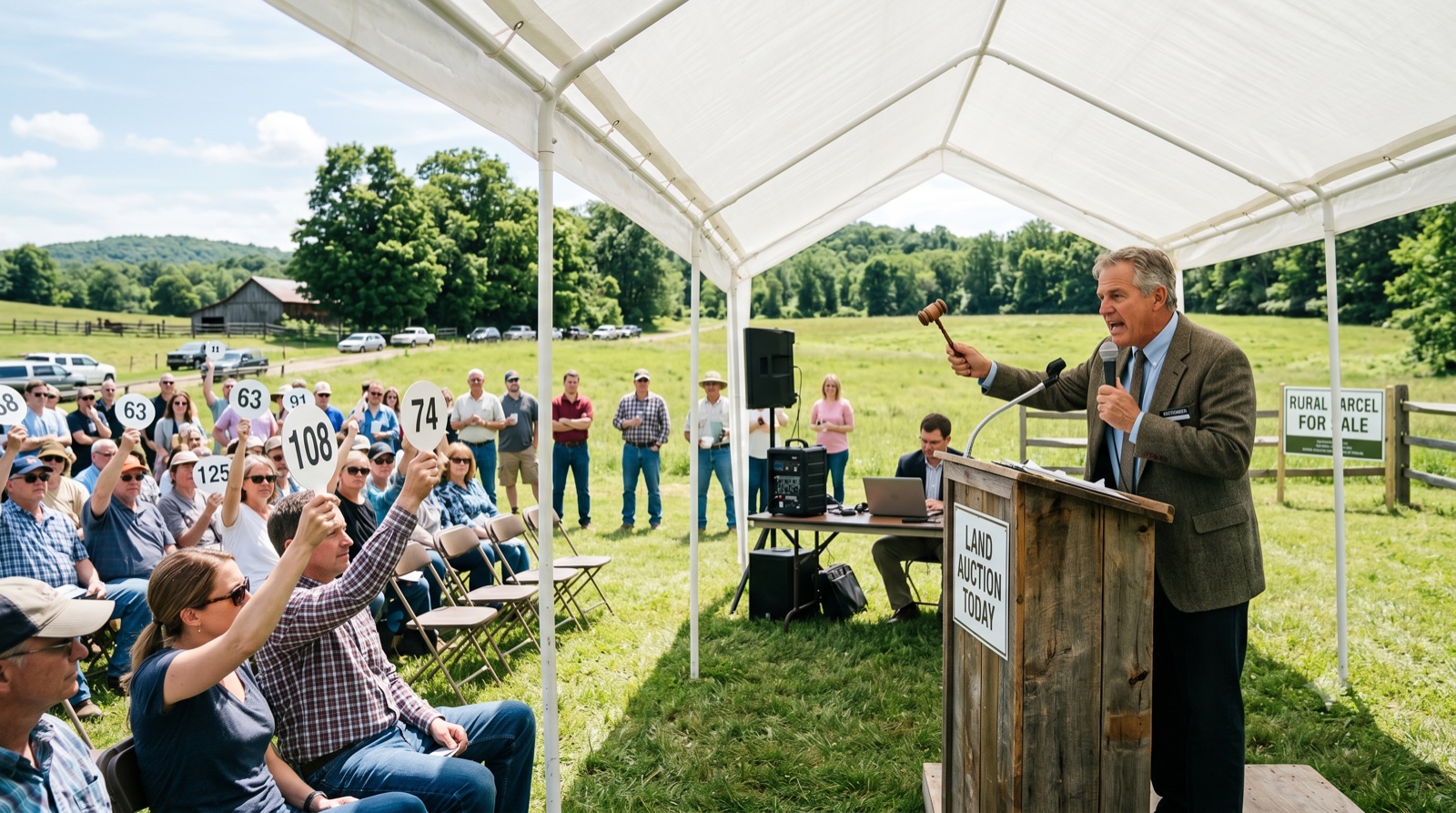
At auction, an auctioneer markets your land for a defined period and then runs a competitive bidding event ending on a scheduled sale date. The gross "price" is whatever the top bid reaches — but your net is that hammer price minus the seller's costs, and the buyer's premium sits on top of the bid rather than flowing to you. Because bidders know they'll owe that premium, they tend to bid somewhat lower than they otherwise would, which quietly pulls down the very hammer price you're counting on, according to Ranch and Farm Auctions.
For sellers of rural or irregular parcels, the auction's central assumption — that enough motivated buyers will show up to compete — is the part that most often fails. Auctions rely on turnout, and lower-quality or oddly shaped parcels can face a slower market with fewer bidders, raising the risk the land sells for less than expected, according to Hansen Land and 2CR2.
What Comes Out of Your Net at Auction?
This is where the headline number and the take-home number diverge. An auction's fee structure is the single biggest reason a strong-sounding sale price can net less than a quieter cash offer.
The Buyer's Premium (5%–10%)
In most land and real estate auctions, the buyer pays a buyer's premium — an extra percentage added on top of the winning bid, commonly in the 5%–10% range, with a 10% premium being typical, according to Ranch and Farm Auctions and Wikipedia. It doesn't come out of your check directly, but it shapes your proceeds anyway: a bidder willing to spend $110,000 total will only bid $100,000 if they owe a 10% premium, so the premium effectively caps how high the bid you actually receive can climb.
Seller Commission and Marketing Fees
The premium doesn't always mean the seller pays nothing. Depending on the company and contract, sellers may face:
- A seller commission — some land auctioneers charge roughly 1%–10% of the sale price in addition to the buyer's premium, according to Prime Land Buyers.
- Marketing expenses — auctioneers commonly require the seller to fund the advertising campaign (signage, online listings, mailers, email and social ads), and these are often a non-refundable upfront fee. AuctionWriter describes proposals pairing a seller commission with a separate marketing fee paid up front by the seller.
- Listing or lot fees — typically non-refundable even if the item does not sell, according to Central Auction Group.
The Cost That Hurts Most: Fees on a No-Sale
Here's the part many sellers miss. In a reserve auction, you can still owe the marketing and listing fees even if the property doesn't sell, according to Central Auction Group. A no-sale means you paid to advertise the land, generated public bidding that landed below your reserve, and walked away with no closing and a bill. For more on why some parcels struggle to draw buyers at all, see our guide on why your land won't sell.
A direct cash buyer carries none of this structure: no buyer's premium suppressing the number, no seller commission, no marketing fee, and nothing owed if you decide the offer isn't for you.
Who Controls the Price — and the Risk?
The deepest difference between the two routes is who bears the uncertainty, and that comes down to the auction format you choose.
Absolute vs. Reserve: A Choice With No Free Option
In an absolute (no-reserve) auction, the land sells to the highest bidder regardless of price — there is no minimum and you cannot reject the high bid, according to Ranch and Farm Auctions. Absolute auctions draw the most bidders precisely because the sale is guaranteed, but they hand the seller the full risk of a disappointing result. As the National Auction Association frames it, the risk of an absolute auction is selling below value, while the risk of a reserve auction is potentially not selling at all.
A reserve auction lets you set an undisclosed minimum and confirm or decline the high bid, which protects you from a low sale — but trades that protection for the possibility of a no-sale (and the marketing bill that survives it), according to Auction Section. There is no version of an auction where you keep both the bidder-attracting power of a guaranteed sale and full price protection. You pick which risk to carry.
With a cash buyer, neither risk exists. You hold the price control by simply deciding whether the firm written number works for you. There's no scenario where you're forced to accept a low bid, and no scenario where you pay to market a sale that never happens.
Head-to-Head: Cash Buyer vs. Land Auction
| Factor | Direct Cash Buyer | Land Auction |
|---|---|---|
| Timeline | As fast as title work and due diligence allow; you set the close date | ~45 days listing to sale day, plus a closing period after, per Wiregrass Auction Group |
| Up-front cost to you | None | Often a non-refundable marketing/listing fee paid before sale day |
| Seller fees | None — no commission, no premium | Possible 1%–10% seller commission; buyer pays a 5%–10% buyer's premium that tends to suppress your bid |
| Certainty of close | Firm written offer; outcome known before you sign | Unknown until the gavel falls; reserve auctions can end in a no-sale |
| Who controls the price | You — accept or decline a known number | The bidder pool; absolute auctions force you to take the high bid no matter how low |
| Risk of a low result | None — you decline if the number doesn't work | Real, especially in thin rural markets with few bidders |
| Best-fit seller | Wants certainty, no fees, a clean and predictable close | Has a unique/high-demand tract, multiple motivated bidders likely, and wants a hard public sale date |
When Does an Auction Actually Net More?
An honest comparison has to admit the auction can win — under specific conditions. An auction tends to out-net a cash offer when several genuinely motivated bidders compete for a desirable, in-demand tract. Even in softer rural conditions, competitive bidding continues where land offers strong soils, good drainage, and solid local interest, according to Whitetail Properties. When demand is real and concentrated, the head-to-head bidding on sale day can push the price higher than a single negotiated number — enough to overcome the premium and fees.
An auction may also be the better fit when you specifically need a hard, public sale date — for an estate settlement, a court-ordered sale, or a partnership dissolution where a transparent, deadline-driven process is the priority and the exact price is secondary.
But those conditions are the exception for typical rural land. For an ordinary parcel in a thin market — where bidder turnout is the whole gamble — the auction's fee stack and no-sale risk usually make the expected net less attractive than a firm cash number, even if the auction's best case is higher. The question isn't "could an auction beat a cash offer?" It's "how likely is this specific parcel to attract a competitive crowd?" If you can't answer that with confidence, certainty is worth a great deal. For realistic timelines across every route, see how long it takes to sell land and how to sell land fast.
How to Compare Your Own Numbers Before You Decide
The cleanest way to settle the question for your specific parcel is to put a real number on the table and compare it against the auction's expected net — not its best-case hammer price. Here's a fair way to do that:
- Get a firm cash offer first. It costs nothing and gives you a concrete, written figure to anchor against. Request a no-obligation cash offer and you'll know your certain number before committing to anything.
- Estimate the auction's realistic net. Take a plausible hammer price for your tract, then subtract any seller commission and the up-front, non-refundable marketing fee — and weigh the odds of a low result or a no-sale in a thin market.
- Compare net to net, with certainty in the picture. The cash number is guaranteed; the auction number is a probability-weighted guess. A higher possible auction result isn't the same as a higher likely one.
Because Jerez Land buys and holds the property ourselves, we absorb the carrying, marketing, and resale risk — there's no buyer's premium, no seller commission, no marketing bill, and no chance the property "fails to sell" on the day. To understand valuation before you compare, see how much your land is worth and who pays closing costs when selling land. For more on cash-sale routes, see companies that buy land for cash and how to sell your land for cash.
Frequently Asked Questions
Does a land auction net more than a cash buyer?
Sometimes, but not reliably. An auction can out-net a cash offer when several motivated bidders compete over a genuinely desirable tract and drive the hammer price up. But your auction net is the hammer price minus a possible 1%–10% seller commission and non-refundable marketing fees, while the buyer's 5%–10% premium tends to suppress bids in the first place. For an ordinary rural parcel in a thin market, the auction's expected net is often less attractive than a firm cash number once you account for fees and the risk of a low result or no-sale.
Who pays the fees — the cash buyer route or the auction route?
With a direct cash buyer, the seller pays no commission and no buyer's premium; the offer is a firm written number. At auction, the buyer pays a buyer's premium (commonly 5%–10% of the bid), and the seller may owe a 1%–10% commission plus marketing and listing fees — some of which are charged up front and are non-refundable even if the property doesn't sell, according to auction-industry sources.
What if my land doesn't sell at auction — do I still owe fees?
In a reserve auction, you can still owe the marketing and listing fees even when the property doesn't sell, according to auction-industry sources. A "no-sale" means you paid to advertise the land and ran public bidding but have no closing to show for it — and a publicly failed auction can make the parcel harder to sell afterward. A cash offer carries no such risk: if you decline, you owe nothing.
I'm deciding between absolute and reserve auction — which is safer for me?
Neither is universally "safer" — they trade one risk for another. An absolute (no-reserve) auction guarantees a sale and attracts the most bidders, but you must accept the high bid no matter how low it lands. A reserve auction protects you from selling too low, but it can end with no sale at all, leaving you with the marketing bill. As the National Auction Association puts it, the absolute auction risks selling below value while the reserve auction risks not selling.
I need to sell quickly — is a cash close faster than auction?
A typical real estate auction runs about 45 days from listing to sale day, per Wiregrass Auction Group, with a closing period of roughly 30–45 days after that. A cash sale's timeline depends mainly on title work and any due diligence the buyer wants, and you generally set the closing date. The bigger difference isn't raw speed — it's certainty: the cash outcome is known before you sign, while the auction result isn't known until the gavel falls.
When should I choose an auction over a cash buyer?
Choose an auction when your tract is unique or in genuinely high demand, you expect multiple motivated bidders to compete, and you specifically want a hard, public sale date — for example, an estate or court-ordered sale where a transparent deadline matters more than a guaranteed price. If your parcel sits in a thin rural market where bidder turnout is uncertain, or if you value a known net over a possible-but-unguaranteed higher one, a firm cash offer is usually the better trade.
Disclaimer: This article is for informational purposes only and does not constitute legal, financial, or professional advice. Auction terms, fees, and laws vary by company, platform, and jurisdiction and change over time. Always review any auction contract carefully and consult a licensed professional before making decisions about selling your property. Jerez Land is not responsible for actions taken based on this information.