
Sell My Land in Mifflin County PA - What Landowners Need to Know
Key Takeaways
- Mifflin County's population has been flat for 25 years, not falling off a cliff: The county counted 46,486 residents in 2000, 46,682 in 2010, and 46,143 in 2020, with recent estimates near 46,041–46,127 — a swing of roughly 1% across a quarter century. The honest description is long-term stagnation rather than the steep depopulation seen in many rural land markets
- This is dairy, poultry, and hog country — not a crop county: Livestock, poultry, and their products account for about 85% of Mifflin County's $135,845,000 in 2022 agricultural sales, led by milk at $43,264,000, poultry and eggs at $35,405,000, and hogs and pigs at $29,014,000 — the last ranking 10th among Pennsylvania's 67 counties, according to the USDA 2022 Census of Agriculture
- Woodland covers more than 65% of the county, and most of it is privately owned: Only about 36% of Mifflin County's woodland is in public hands, meaning roughly two-thirds of the county's forest is held by private landowners, according to the Juniata and Mifflin Counties Greenway and Open Space Plan. Farms occupy just 64,994 acres — under a quarter of the county's land area
How Can You Sell Land in Mifflin County Pennsylvania?
You can sell land in Mifflin County through a title company or settlement agent — Pennsylvania does not require an attorney at closing — by listing with a local agent, selling by owner, or requesting a direct cash offer. Start by confirming your legal description at the Mifflin County Recorder of Deeds and checking whether the parcel is enrolled in Clean and Green, because that program's rollback can take seven years of back taxes plus interest out of your proceeds.
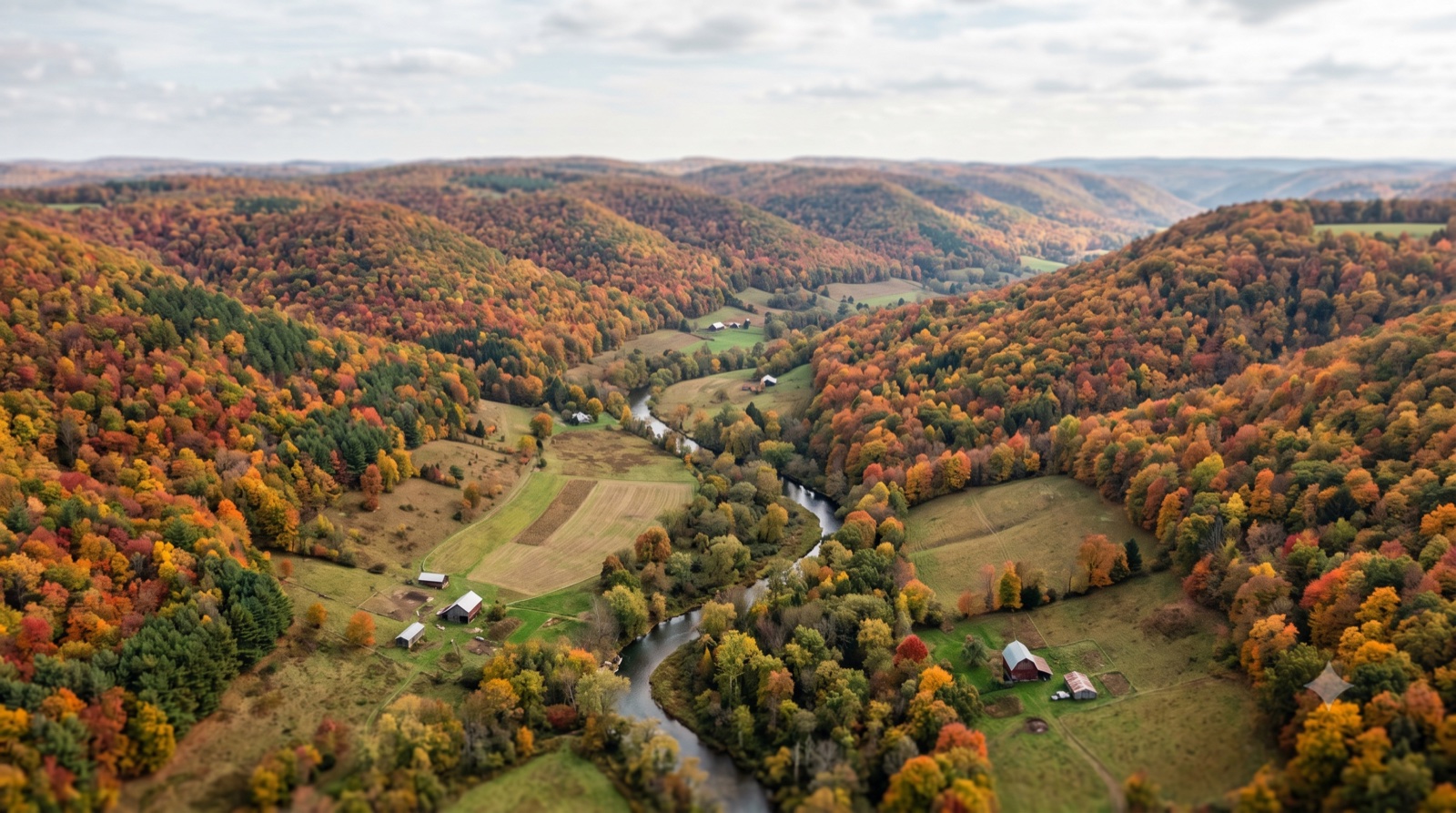
Mifflin County covers roughly 415 square miles of ridge-and-valley central Pennsylvania, with the Juniata River running through the lower county and the Kishacoquillas Valley — "Big Valley" — cutting a long, narrow farming corridor between ridges. Lewistown is the county seat. Big Valley is home to the third-oldest continuous Amish settlement in the United States, founded in 1791, and agriculture remains the valley's defining industry.
This guide covers Mifflin County's property tax mechanics and Clean and Green exposure, the Pennsylvania closing process and realty transfer tax, why the county's gas-rights picture differs from what most people assume about Pennsylvania, how Mifflin compares to its neighbors, and your practical options. For the statewide overview, start with how to sell land in Pennsylvania, and explore our blog for more.
What Are the Tax Costs of Holding Vacant Land in Mifflin County?
Published effective property tax rates for Mifflin County disagree sharply, and you should treat any single figure with caution. Tax-Rates.org reports roughly 1.55%, based on a median annual bill near $1,438 against a median home value of $92,500. Ownwell reports about 2.89%, working from a median bill of $1,955 against a median home value of $67,700. The two use different value bases and are not reconcilable into one number — the honest range is 1.55% to 2.89% depending on methodology.
Part of what drives that spread is Pennsylvania's assessment structure. Each county sets its own assessed values from a base year, and Mifflin has not conducted a recent countywide reassessment. The State Tax Equalization Board publishes an annual Common Level Ratio to bridge assessed values and current market values; Mifflin County's CLR factor is 4.83 for documents accepted July 1, 2026 through June 30, 2027, per the Pennsylvania Department of Revenue. That factor implies assessed values averaging roughly 21% of current fair market value — a very wide gap between what your tax bill is based on and what the land would actually trade for.
How Property Tax Bills Add Up for Vacant Land
Pennsylvania applies the same assessment framework to vacant land as to improved property — there is no penalty ratio for holding raw ground. What vacant land does not do is generate income to offset the bill. County, municipal, and school district millage each stack on top of one another, so two parcels of similar size in different townships and school districts can carry meaningfully different annual costs. We were not able to source current Mifflin County millage rates from an official document, so confirm your specific district's rates with the Assessment Office rather than relying on a general figure.
Beyond taxes, vacant landowners carry liability exposure, boundary and access maintenance, and the cost of holding an illiquid asset. If you are behind on payments, selling land with back taxes covers the options. If the parcel came through an estate, see how to sell inherited land.
Clean and Green (Act 319) and the Seven-Year Rollback
Pennsylvania's Clean and Green program lets qualifying land be assessed on use value rather than market value, and given that woodland covers more than 65% of Mifflin County, the Forest Reserve category matters here as much as the farm categories. Enrollment generally requires at least 10 acres, or a smaller tract that can demonstrate at least $2,000 per year in farm income. The three categories are Agricultural Use, Agricultural Reserve, and Forest Reserve.
The rollback is the part that reaches your closing statement. Breaching the covenant — typically by converting the land to a non-qualifying use — triggers up to seven years of rollback taxes, calculated as the difference between what was paid under Clean and Green and what would have been owed without it, plus 6% simple interest per year, according to the Pennsylvania Department of Agriculture. If your parcel is enrolled and your buyer intends a non-qualifying use, price that exposure in before you agree to terms. Applications and questions route through the Mifflin County Assessment Office; we could not verify a Mifflin-specific filing deadline, so ask them directly rather than assuming the general schedule applies.
What Zoning, Gas Rights, and Closing Requirements Apply in Mifflin County?
Zoning in Pennsylvania is administered at the municipal level, so requirements depend entirely on which township or borough your parcel sits in rather than on any countywide ordinance. Contact the township supervisors for your municipality before marketing land as buildable or subdividable.
A Note on Gas Rights: Mifflin Is Not Marcellus Country
If you own land in Pennsylvania you have probably received mail about mineral or gas rights, and for Mifflin County the honest answer is that shale development essentially has not happened here. A Pennsylvania state tally of Marcellus Shale gas wells by county lists Mifflin County with a single permitted well — against thousands in core counties like Bradford, Washington, and Susquehanna. "Central Pennsylvania" phrasing can wrongly imply proximity to active shale country; the data does not support treating gas potential as a value driver on a Mifflin County parcel.
That said, a title search can still reveal historic mineral reservations from earlier conveyances, which is a separate question from active drilling. Our guide on selling mineral rights vs. surface rights explains how split estates work if your search turns one up.
Pennsylvania's Title Company Closing Process
Pennsylvania does not require a licensed attorney to conduct a real estate closing. Most transactions are handled by a title company or settlement agent that coordinates the title search, prepares documents, disburses funds, and records the deed. Attorneys are commonly involved in rural and agricultural transactions by practice rather than by legal mandate. A typical Mifflin County land sale runs:
- Title search: The title company searches records through the Recorder of Deeds to confirm clear title and identify liens, unpaid taxes, easements, or reserved mineral interests
- Title insurance: An owner's or lender's policy protects against defects the standard search does not surface
- Closing: Buyer and seller execute the deed and settlement statement with the settlement agent
- Recording: The deed is recorded with the Mifflin County Recorder of Deeds. The office's published fee schedule, effective December 4, 2025, sets deed recording at $86.25 including the JCS fee, covering the first four pages and four names, with $2.00 per additional page and $0.50 per additional name
For the complete document checklist, see paperwork needed to sell land.
Pennsylvania Realty Transfer Tax
Pennsylvania imposes a 1% state realty transfer tax on all real property transfers, per the Department of Revenue, and a local realty transfer tax of typically 1% applies on top, split between the municipality and school district — bringing the combined rate to roughly 2% in most of Mifflin County. By custom the tax is split equally between buyer and seller, though the allocation is negotiable rather than fixed by statute. Cash buyers advertising no closing costs to the seller typically absorb both sides as part of their terms.
How Does Mifflin County Compare to Neighboring Pennsylvania Counties?
Mifflin County is a small, stable-population county with a below-average agricultural base relative to its neighbors, and its land is overwhelmingly wooded rather than farmed. Farms occupy 64,994 acres — under a quarter of the county's roughly 263,040 acres — while woodland covers more than 65% of the county overall.
| Factor | Mifflin County | Huntingdon County | Centre County | Snyder County |
|---|---|---|---|---|
| Population | ~46,041–46,127 (2024/25 est.) | ~42,987 (2026 est.) | ~157,393 (2025 est.) | ~39,555 (2025 est.) |
| Population trend | Flat for 25 years | Rural, stable | Growing; Penn State anchored | Rural, stable |
| Effective tax rate | 1.55% (Tax-Rates.org) / 2.89% (Ownwell) | ~1.02% (Tax-Rates.org) | ~1.25% (Tax-Rates.org) | ~1.17% (Tax-Rates.org) |
| Total ag sales (2022) | $135.8M (21st in PA) | Not compiled here | Not compiled here | $259.1M (10th in PA) |
| Defining land character | Dairy, poultry, hogs; 65%+ woodland; Big Valley Amish farming | Heavily forested; most of Rothrock State Forest | University-driven, not primarily agricultural | Much larger farm economy on similar population |
Note the Snyder County contrast: a neighbor with a comparable population produces nearly twice Mifflin's agricultural sales. And Centre County, immediately north, is a different economy entirely — its rate and population reflect State College, not rural land. We did not verify millage or Common Level Ratio figures for the three neighbor counties, so treat those as gaps rather than assuming they mirror Mifflin's.
What Mifflin County Land Actually Produces
The 2022 Census of Agriculture makes the county's economic identity unambiguous. Milk from cows led at $43,264,000, or 31.9% of all agricultural sales and 15th in Pennsylvania. Poultry and eggs followed at $35,405,000 (26.1%), and hogs and pigs at $29,014,000 (21.4%) — Mifflin's strongest state ranking at 10th. Grains, oilseeds, dry beans, and dry peas contributed $15,994,000, and cattle and calves $7,488,000. At the end of 2022 the county held 308,119 birds, 69,457 hogs and pigs, and 21,070 cattle.
The farm base is consolidating fast. Mifflin recorded 543 farms in 2022, down 24% from 2017, on 64,994 acres, down 20%, while average farm size rose 5% to 120 acres. Fewer operators working slightly larger ground means fewer local buyers for a mid-sized tract, even where the agricultural economy itself is healthy.
For the woodland that covers most of the county, the buyer pool looks different again. One land listing aggregator ranks Mifflin 64th among Pennsylvania's 67 counties for total acreage currently advertised for sale — a thinness signal, though it comes from a single aggregator rather than MLS data. We found no published days-on-market figure for Mifflin County land and will not invent one. If your tract carries merchantable hardwood, see selling timberland; for recreational parcels, selling hunting land.
What Are Your Options for Selling Land in Mifflin County?
Your options are an agent listing, a for-sale-by-owner effort, or a direct cash sale — and the right one depends mostly on whether your parcel is productive farm ground in Big Valley or a wooded ridge tract with limited access. Those two things sell to completely different buyers on completely different timelines.
Before pursuing any path, verify your legal description and any recorded easements or mineral reservations through the Mifflin County Recorder of Deeds — Ellen L. Amspacker, 20 N. Wayne Street, Lewistown, PA 17044, (717) 242-1449. Confirm assessment and Clean and Green status with the Assessment Office, Merry Bratton, CPE, at the same courthouse address, (717) 248-5783. For tax status and delinquency questions, route through the Mifflin County Treasurer, Diane L. Griffith, (717) 248-8439; Mifflin does not publish a separately named Tax Claim Bureau director, so contact the Treasurer's office by office rather than asking for a specific person.
Listing with a local agent who knows central Pennsylvania farm and woodland property gives the broadest exposure, particularly for tillable Big Valley ground where the buyer pool is genuinely competitive. Commissions of roughly 5–6%, plus the 2% transfer tax and settlement fees, reduce net proceeds, and wooded back-parcels can sit far longer than farm ground. Our guide on whether you need a realtor to sell land weighs the tradeoffs.
Selling by owner avoids commission but puts marketing, disclosure, and settlement coordination on you. Parcels with access problems are the hardest to move this way — see selling landlocked land if that describes your tract, and how much is my land worth for what actually drives value on rural parcels.
For landowners who want to avoid extended timelines and ongoing carrying costs, companies like Jerez Land make direct cash offers priced individually to the parcel — a firm written number, not a range or a formula. We absorb the carrying costs, marketing expense, and resale risk, and Pennsylvania's title company settlement process applies the same way. Request a cash offer to see what your parcel is worth to a direct buyer.
Frequently Asked Questions
I own vacant land in Mifflin County PA and want to sell — where do I start?
Start by verifying your legal description and any recorded easements or mineral reservations at the Mifflin County Recorder of Deeds, 20 N. Wayne Street, Lewistown, (717) 242-1449, then confirm your assessment and Clean and Green status with the Assessment Office at (717) 248-5783. Pennsylvania closings go through a title company or settlement agent rather than requiring an attorney, so you can list with an agent, sell by owner, or request a direct cash offer.
I've been holding wooded acreage in Mifflin County for years — what am I actually paying in property taxes?
Published effective rates for Mifflin County disagree substantially: Tax-Rates.org reports about 1.55% and Ownwell about 2.89%, using different median home-value bases. Your actual bill stacks county, municipal, and school district millage, so it varies by township and school district. Mifflin has not recently reassessed, and its Common Level Ratio factor of 4.83 implies assessed values averaging roughly 21% of current market value.
My Mifflin County land is enrolled in Clean and Green — what happens to that when I sell?
Selling alone does not automatically end the preferential assessment, but converting the land to a non-qualifying use breaches the covenant and triggers rollback taxes of up to seven years — the difference between taxes paid under Clean and Green and what would have been owed without it — plus 6% simple interest per year, according to the Pennsylvania Department of Agriculture. Confirm your parcel's enrollment status with the Mifflin County Assessment Office before agreeing to a sale price, because that recapture comes out of your proceeds.
I keep getting letters about Pennsylvania gas rights — is there Marcellus value under my Mifflin County land?
Almost certainly not from active shale development. A Pennsylvania state tally of Marcellus Shale gas wells by county lists Mifflin County with just one permitted well, compared with thousands in core counties like Bradford, Washington, and Susquehanna. A title search can still turn up historic mineral reservations from older deeds, which is a separate issue from drilling activity, but Mifflin County is not part of Pennsylvania's producing shale region.
Will Pennsylvania's realty transfer tax reduce my proceeds when I sell?
Yes. Pennsylvania imposes a 1% state realty transfer tax on all property transfers, and a local tax of typically 1% applies on top — bringing the combined rate to roughly 2% in most of Mifflin County, according to the Pennsylvania Department of Revenue. By custom the tax is split equally between buyer and seller, though the split is negotiable. Some cash buyers absorb both sides as part of their offer terms.
Is Mifflin County's population growing or declining?
Neither, meaningfully — it has been essentially flat for 25 years. The county counted 46,486 residents in 2000, 46,682 in 2010, and 46,143 in 2020, with recent estimates near 46,041–46,127. That is a swing of roughly 1% across a quarter century, which makes "long-term stagnation" a more accurate description than the steep depopulation seen in many rural land markets.
Disclaimer: This article is for informational purposes only and does not constitute legal, financial, or professional advice. Laws and regulations vary by jurisdiction and change over time. Always consult with qualified professionals before making land purchase decisions. Jerez Land is not responsible for actions taken based on this information.