
Sell My Land in Clinton County PA - What Landowners Need to Know
Key Takeaways
- Clinton County's population has been declining for over a decade: The county fell from 39,238 in the 2010 Census to 37,450 in the 2020 Census — a loss of 1,882 residents, or about 4.8% — with U.S. Census Bureau estimates putting the count near 37,824 by 2023, and the population having peaked around 2013
- The effective property tax rate runs around 1.53% of market value: Clinton County collects, on average, approximately 1.53% of a property's fair market value in property tax, according to PropertyTax101 — above the Pennsylvania state average of about 1.33% and well above the national average near 1.08%, meaning carrying costs accumulate on parcels that produce no income
- Sproul State Forest and severed oil-and-gas rights define the rural land here: Clinton County is dominated by Sproul State Forest — the largest unit in Pennsylvania's state forest system at roughly 305,000 acres, according to DCNR — and many private surface tracts in the surrounding hills carry underlying oil, gas, or mineral rights that were sold or reserved generations ago, a title detail that materially affects what a surface seller actually owns and conveys
How Can You Sell Land in Clinton County Pennsylvania?
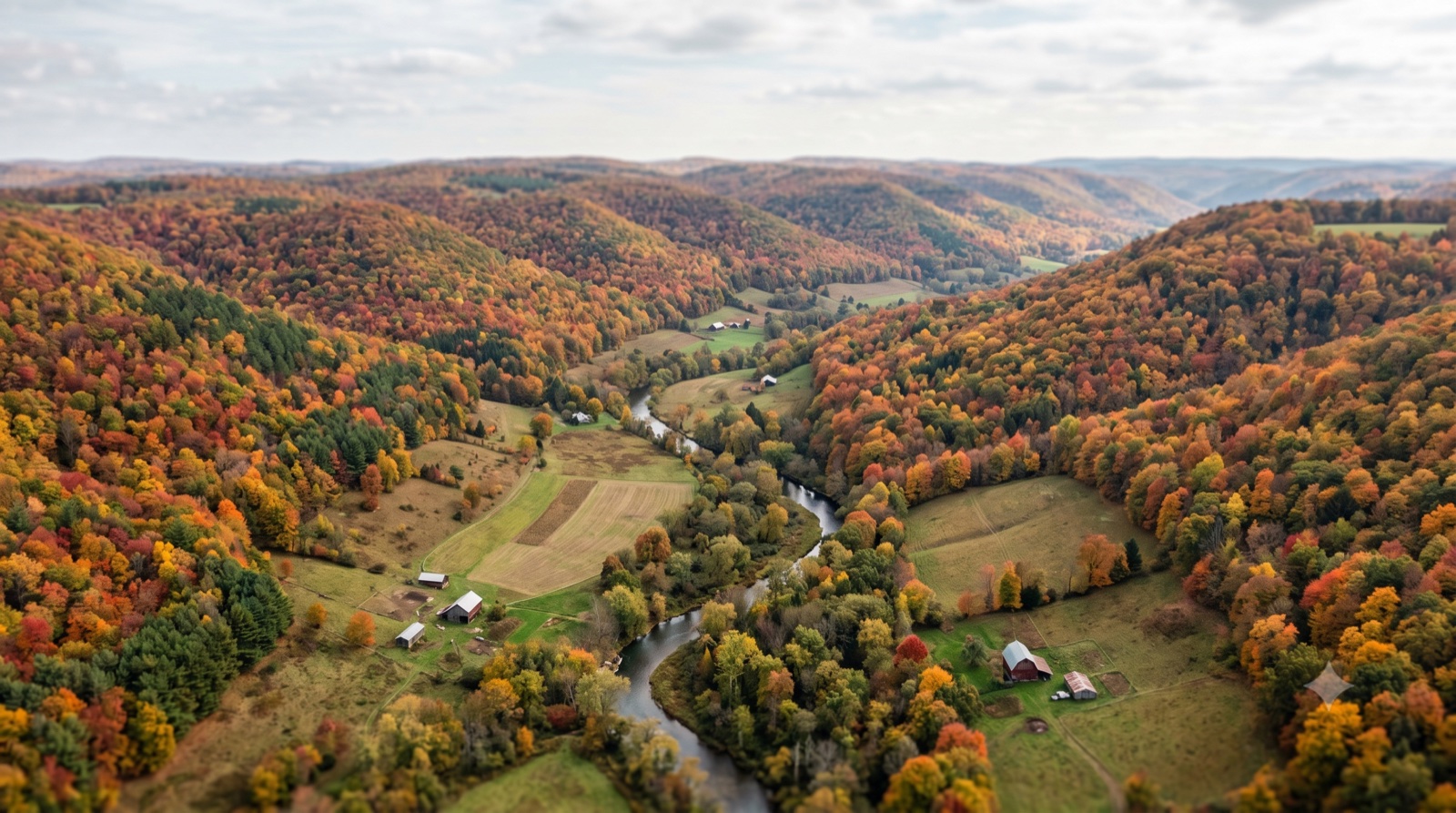
To sell land in Clinton County, you work with a title company or settlement agent—not an attorney, as Pennsylvania doesn't require one for closings—to handle the title search, closing documents, and recording with the Clinton County Register & Recorder. You'll navigate a rural north-central market shaped by a long population decline, an aging ownership base, and a landscape overwhelmingly defined by public forest and recreational holdings. Clinton County covers roughly 897 square miles of the Allegheny Plateau in the "Pennsylvania Wilds," anchored by the county seat and only city, Lock Haven, on the West Branch Susquehanna River. Sproul State Forest — the largest in Pennsylvania's state forest system — blankets the western and northern reaches of the county, and unbroken hardwood timberland cut by deep river and creek gorges defines much of the private acreage around it.
Understanding how Pennsylvania's property tax system, realty transfer tax, and title closing requirements interact — and how severed mineral rights factor into a sale — will help you set realistic expectations, whether you plan to list on the open market, sell by owner, or request a no-obligation cash offer from a direct buyer. For a statewide overview, start with our guide on how to sell land in Pennsylvania.
This guide covers Clinton County's property tax mechanics, the Pennsylvania closing process and realty transfer tax, how Clinton County compares to neighboring counties, and the practical options available to landowners ready to sell.
What Are the Tax Costs of Holding Vacant Land in Clinton County?
Pennsylvania does not use a uniform statewide assessment ratio the way some states do — each county maintains its own assessed values based on periodic reassessments. Clinton County has not conducted a recent countywide reassessment, which means its assessed values are based on older base-year market data. The State Tax Equalization Board publishes an annual Common Level Ratio (CLR) that captures the relationship between assessed values and current market values. According to Evans Estate Law Resources, Clinton County's CLR factor for documents accepted July 1, 2025 through June 30, 2026 is 1.98 — meaning assessed values average roughly half of current market levels in the county.
Clinton County's effective property tax rate is approximately 1.53% of fair market value, according to PropertyTax101 — above the Pennsylvania state average of roughly 1.33% and well above the national average near 1.08%. The median property tax bill in Clinton County runs about $1,502 on a median home value near $98,400, reflecting an older, low base-year assessment system. Total effective rates vary by municipality and school district, as each taxing authority applies its own millage on top of the county rate.
How Property Tax Bills Add Up for Vacant Land
Pennsylvania does not impose a separate higher assessment ratio on vacant land the way some states do — all real property is assessed under the same framework. However, vacant land that produces no income generates a recurring tax obligation with no offset. A parcel carrying a county market value of $50,000 at an effective rate of 1.53% produces an annual tax bill of roughly $765; properties in school districts with above-average millage will face higher combined bills. Over a decade of holding, those payments compound into thousands of dollars on land that may not appreciate fast enough to offset them.
Pennsylvania property tax payments are typically split into installments with deadlines set by each taxing authority — often with a discount period, a face period, and a penalty period. Delinquent taxes are collected by the Clinton County Tax Claim Bureau (1st Floor, Piper Building, 2 Piper Way, Lock Haven, PA 17745, 570-893-4004). Properties with two or more years of delinquent taxes become eligible for the county's annual Upset Tax Sale, held at a starting bid equal to the total delinquent taxes, costs, and municipal liens. Properties unsold at the Upset Sale proceed to a Judicial Sale, where the minimum bid drops to costs only and most liens are exonerated.
Beyond taxes, vacant landowners in Clinton County face liability insurance costs, potential trail and boundary maintenance expenses, and the carrying cost of holding an illiquid asset in a thin rural market. If you've inherited land with an unclear title or unpaid taxes, our guide on how to sell inherited land walks through the process. For landowners who are already behind on taxes, selling land with back taxes explains your options before the Tax Claim Bureau schedules a sale.
Clean and Green Act 319 Preferential Assessment
Landowners with parcels of at least 10 acres devoted to agricultural use, open space, or forest reserve can apply for Pennsylvania's Clean and Green program (Act 319), which taxes land based on use value rather than fair market value — ordinarily producing significant tax savings, according to the Pennsylvania Department of Agriculture. Given how much of Clinton County is woodland, the forest-reserve category is especially relevant here. Enrolled parcels must remain in qualifying use; withdrawing from the program triggers a rollback tax equal to seven years of the difference between market-value taxes and use-value taxes, plus 6% interest per year. Applications run through the Clinton County Assessment Office (located in the Piper Building, 2 Piper Way, Lock Haven). If your parcel is enrolled, factor the rollback exposure into your net proceeds before agreeing to a sale price.
What Zoning, Mineral Rights, and Closing Requirements Apply in Clinton County?
Clinton County is predominantly unzoned outside Lock Haven and its boroughs. Township-level zoning in Pennsylvania is handled at the municipal level, so land use requirements vary significantly depending on which township your parcel sits in. For zoning and permitting questions, contact the relevant township supervisors for the municipality where your land is located, or the Clinton County planning staff through the county offices in the Piper Building (2 Piper Way, Lock Haven, PA 17745).
For current deed information, legal descriptions, and recorded easements, contact the Clinton County Register & Recorder (Recorder of Deeds), located at 2 Piper Way, Suite 239, Lock Haven, PA 17745, 570-893-4010, open Monday, Tuesday, Thursday and Friday 8:00 a.m. – 5:00 p.m. and Wednesday 8:00 a.m. – 12:30 p.m. This office maintains the county's recorded land records.
A Note on Severed Oil-and-Gas and Mineral Rights
Clinton County lies within Pennsylvania's broader oil-and-gas country, and the surrounding north-central region has a long history of timber, coal, oil, and natural-gas activity. Across the county, the oil, gas, and mineral rights underlying a surface tract can be owned separately from the surface itself, having been sold, leased, or reserved generations ago. Before you sell, it is worth confirming through a title search whether your deed conveys the minerals along with the surface, or only the surface. This affects what you actually own, what a buyer is paying for, and whether existing wells, pipelines, or access easements run across the land. Our guide on selling mineral rights vs. surface rights explains how these split estates work and what each is worth.
Pennsylvania's Title Company Closing Process
Pennsylvania does not require a licensed attorney to conduct real estate closings. Most land transactions in the state are handled by a title company or settlement agent, which coordinates the title search, prepares closing documents, disburses funds, and records the deed with the county recorder. Attorneys are often involved but are not legally required for the closing itself.
The closing process for land in Clinton County typically works as follows:
- Title search: The title company searches public land records through the Clinton County Register & Recorder to verify clear title — no outstanding liens, unpaid taxes, or unresolved encumbrances, and to identify any severed mineral interests
- Title insurance: A lender's or owner's title insurance policy protects against defects not found in the standard search
- Closing: Buyer, seller, and agents execute the deed and settlement statement; the title company or settlement agent oversees the signing
- Recording: After closing, the deed is recorded with the Clinton County Register & Recorder, making the transfer part of the public record
For more detail on what documents are needed to complete a Pennsylvania land sale, our guide on paperwork needed to sell land covers the full checklist.
Pennsylvania Realty Transfer Tax
Pennsylvania imposes a 1% state realty transfer tax on all real property transfers, according to the Pennsylvania Department of Revenue. In addition, a local realty transfer tax of typically 1% applies, split between the municipality and school district — bringing the combined total to 2% in most of Clinton County. Some municipalities may charge a slightly different local rate.
By custom and in most transactions, the tax is split equally between buyer and seller — each paying 1% of the sale price — though the allocation can be negotiated. Cash buyers who advertise "no closing costs to seller" typically absorb both sides of the transfer tax as part of the offer terms. The deed must be recorded with the Register & Recorder in the county where the property is located.
How Does Clinton County Compare to Neighboring Pennsylvania Counties?
Clinton County's population of approximately 37,824 (2023 estimate) has declined from the 2010 Census count of 39,238, according to U.S. Census Bureau data — and from a peak near 2013 — a loss of nearly 1,900 residents between the 2010 and 2020 counts alone. The poverty rate sits near 14.8%, above the Pennsylvania rate of about 11.7% (Data USA). Median household income of approximately $60,816 runs roughly 20% below the state and national medians.
Clinton County is surrounded by other sparsely populated central and northern-tier Pennsylvania Wilds counties, with the notable exception of Centre County to the south, home to Penn State University and the State College metro. Out-of-state recreational landowners who purchased timber or hunting parcels decades ago represent a common seller profile here, as generational transitions and rising carrying costs motivate liquidation. Severed mineral estates and legacy wellheads further complicate many of these older holdings.
| Factor | Clinton County | Centre County | Lycoming County | Clearfield County |
|---|---|---|---|---|
| Population (2023 est.) | ~37,824 | ~158,300 | ~113,300 | ~80,200 |
| Population trend | Declining (peaked ~2013) | Growing | Declining | Declining |
| Effective tax rate | ~1.53% | ~1.42% | ~1.48% | ~1.36% |
| Median household income | ~$60,816 | ~$66,800 | ~$59,900 | ~$56,500 |
| Poverty rate | ~14.8% | ~17% | ~13% | ~13% |
| Defining feature | Sproul State Forest, West Branch Susquehanna | Penn State, Bald Eagle SF | Williamsport, Tiadaghton SF | Moshannon SF, coal country |
Clinton County's economy employs roughly 17,168 people, according to Data USA. The three largest sectors by employment are Manufacturing (about 2,735), Health Care & Social Assistance (about 2,594), and Retail Trade (about 1,864). Lock Haven anchors the regional economy as home to Commonwealth University-Lock Haven and a base of manufacturing along the river. There are no interstate highways in Clinton County — U.S. Route 220 and State Route 120 (the Bucktail State Park scenic route from Lock Haven to Emporium) are the primary through-routes — which limits commercial development and contributes to the county's rural, recreational-land character.
Clinton County's woodland is extensive given the dominance of Sproul State Forest, and the county retains a base of working farms documented in the 2022 USDA Census of Agriculture. That survey reported 276 farms across roughly 37,101 acres of land in farms — of which about 8,034 acres were woodland — confirming that most rural acreage here is timber and forest rather than open cropland. Much of the private acreage that changes hands is recreational timberland — hunting camps, hardwood tracts, and back-forty parcels rather than active cropland. If your land falls into that category, our guides on selling timberland and selling hunting land cover what drives value for recreational parcels.
For a broader view of land markets across the region, explore our blog.
What Are Your Options for Selling Land in Clinton County?
With a declining population, a thin rural buyer pool, an effective tax rate near 1.53%, and land that may have been held by out-of-state families for decades — sometimes with the minerals already severed — Clinton County landowners face a clear carrying-cost equation: annual property taxes, insurance, and maintenance accumulate every year a parcel sits unsold. Understanding what your land is actually worth, and whether you even hold the mineral rights, is the logical first step. Our guide on how much is my land worth explains the factors that drive valuation for rural parcels.
Before pursuing any sale path, verify your property's legal description and mineral-rights status through the Clinton County Register & Recorder (570-893-4010, 2 Piper Way, Suite 239, Lock Haven). Confirm property tax status with the Clinton County Tax Claim Bureau (570-893-4004, 1st Floor, Piper Building, 2 Piper Way, Lock Haven) to ensure no delinquent amounts could complicate closing. If your parcel is enrolled in Clean and Green, understand the rollback tax exposure before agreeing to a sale price.
Clinton County landowners have several selling paths:
Listing with a local real estate agent familiar with Pennsylvania Wilds recreational land offers market exposure to buyers searching for hunting, timber, or camp properties. However, agent commissions of approximately 5–6%, combined with Pennsylvania's 2% transfer tax and title company fees, reduce net proceeds. And in a thin rural market, carrying costs continue accumulating through a listing period that can stretch for many months. Whether an agent makes sense depends on your timeline — our guide on whether you need a realtor to sell land weighs the tradeoffs.
Selling by owner (FSBO) eliminates agent commissions but requires the seller to handle marketing, disclosures, mineral-rights research, and coordinating the title company. Online platforms provide some exposure to out-of-state recreational buyers, but landlocked or access-limited parcels can be especially hard to move; see our guide on selling landlocked land if that describes your tract.
For landowners who want to avoid extended timelines and ongoing carrying costs, companies like Jerez Land provide direct cash offers priced individually to the parcel — a firm written number, not a range or a formula. We absorb the carrying costs, marketing risk, and resale uncertainty, and we close in weeks rather than months. There are no agent commissions, and the title company closing process that Pennsylvania uses applies equally. Request a cash offer to see what your parcel is worth to a direct buyer.
Frequently Asked Questions
I own vacant land in Clinton County PA — how do I sell it?
Verify your property description and mineral-rights status through the Clinton County Register & Recorder (570-893-4010, 2 Piper Way, Suite 239, Lock Haven) and confirm tax status with the Clinton County Tax Claim Bureau. Pennsylvania land sales close through a title company or settlement agent — no attorney is legally required. You can list with a local agent, sell by owner, or request a direct cash offer from a land buyer.
What are my annual property tax costs for holding vacant land in Clinton County PA?
Clinton County's effective property tax rate is approximately 1.53% of fair market value, according to PropertyTax101 — above the Pennsylvania state average of about 1.33%. Total taxes vary by municipality and school district, as each applies additional millage on top of the county rate. The State Tax Equalization Board publishes an annual Common Level Ratio (CLR) factor; Clinton County's factor is 1.98 for July 2025 through June 2026, reflecting assessed values that average roughly half of current market value.
Do I own the oil and gas rights under my land in Clinton County?
Not always. Clinton County lies within Pennsylvania's broader oil-and-gas country, and the oil, gas, and mineral rights beneath many surface tracts were sold or reserved generations ago — meaning the surface and the minerals can be owned by different parties. A title search through the Register & Recorder will confirm whether your deed conveys the minerals along with the surface or only the surface, which directly affects what you own and what you can sell.
What transfer taxes do I owe when I sell land in Clinton County PA?
Yes. Pennsylvania imposes a 1% state realty transfer tax on all property transfers, plus a local tax that is typically 1% in most of Clinton County — bringing the combined rate to approximately 2% of sale price, according to the Pennsylvania Department of Revenue. By custom, this tax is split equally between buyer and seller (each paying 1%), though the split can be negotiated. Cash buyers sometimes cover both sides as part of their offer terms.
Do I need to hire a lawyer to close my land sale in Pennsylvania?
Pennsylvania does not require a licensed attorney for real estate closings, unlike some states. Most transactions use a title company or settlement agent to conduct the title search, prepare the deed, disburse funds, and record the transfer with the county Register & Recorder. An attorney may be retained by either party but is not legally mandated by the state.
Is Clinton County PA population growing or declining?
Clinton County's population has been declining, from 39,238 in the 2010 Census to 37,450 in the 2020 Census — a drop of about 4.8% — with U.S. Census Bureau estimates putting the count near 37,824 by 2023. The county's population peaked around 2013 and has trended down since. Clinton County is rural, anchored by the city and county seat of Lock Haven on the West Branch Susquehanna River, and ranks among the more sparsely populated of Pennsylvania's 67 counties.
Disclaimer: This article is for informational purposes only and does not constitute legal, financial, or professional advice. Laws and regulations vary by jurisdiction and change over time. Always consult with qualified professionals before making land purchase decisions. Jerez Land is not responsible for actions taken based on this information.