
Selling Land With an Active Oil or Gas Surface Use Agreement
Key Takeaways
- You can sell land while a surface use agreement is active — an SUA is a contract, not a lien or a bar to transfer, so a buyer simply takes the property subject to the operator's existing road, pad, tank battery, and any pipeline right-of-way, according to Pheasant Energy and Primerus
- The operator's plugging and reclamation bond is posted with the state regulator, not with you — every producing state requires the operator to secure financial assurance before drilling, and if an operator defaults, responsibility generally shifts to the state's orphan-well fund rather than to the surface owner, according to the State Energy & Environmental Impact Center and the National Conference of State Legislatures
- Whether the SUA itself binds the next owner depends on whether it (or a memorandum of it) was recorded in your county, and that turns on state law — a recorded SUA generally travels with the land to a buyer, while an unrecorded one can create a gap a title company will flag, so confirm your own recording status before listing
Can You Sell Land That Has an Active Oil or Gas Surface Use Agreement on It?
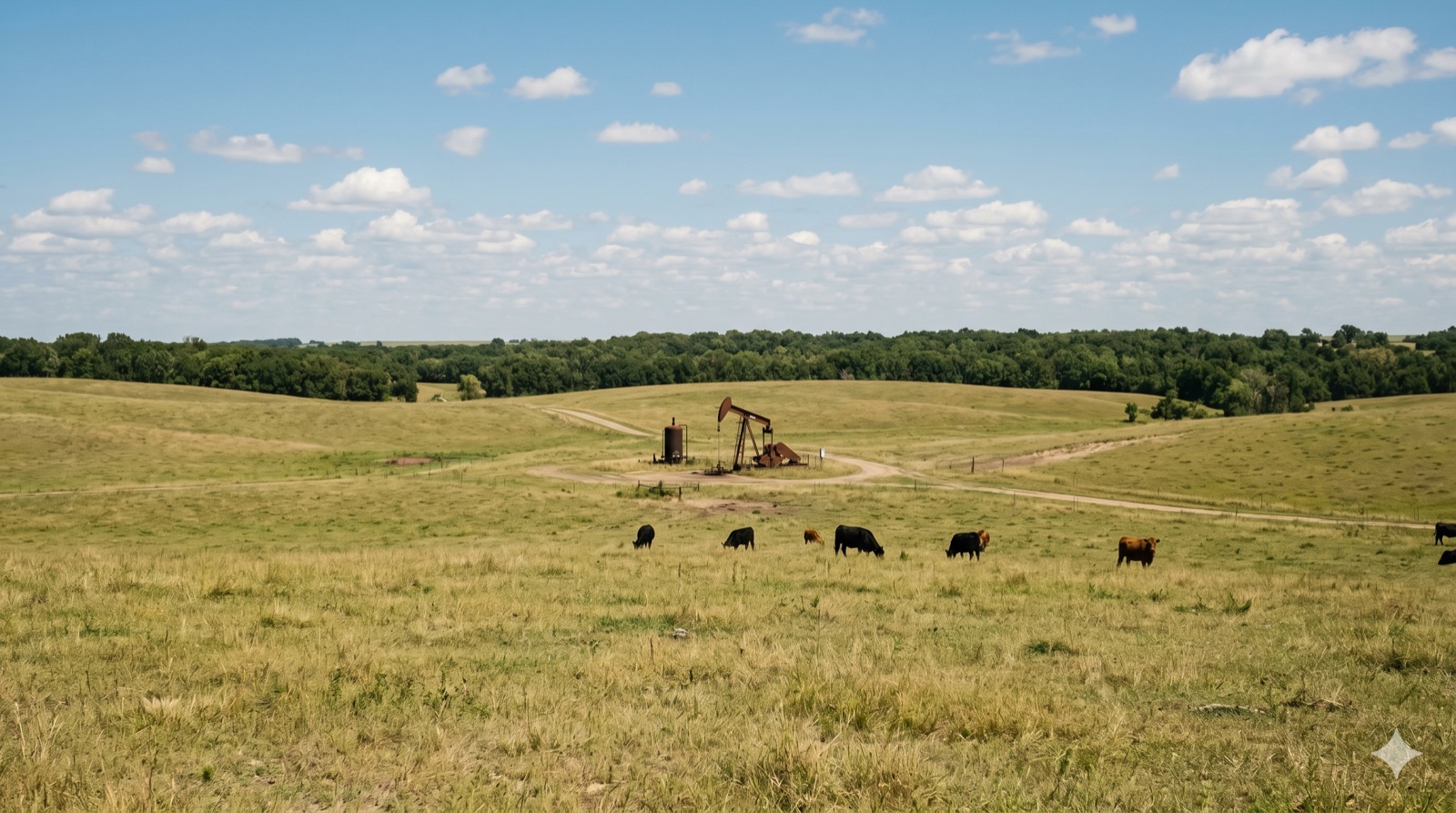
Yes. A surface use agreement does not stop a sale — it is a contract between you and the operator governing how they use your surface, and a buyer purchases the land subject to that existing agreement, taking your place as the surface owner the operator answers to. What changes hands is not just bare dirt but a working relationship: an access road the operator maintains, a well pad or tank battery sitting on part of your acreage, possibly a pipeline right-of-way, and a set of obligations — damages, indemnity, eventual reclamation — that were negotiated before you decided to sell.
This guide is about the seller who still owns the surface (and often some or all of the minerals) but has a live, physical industrial footprint on it under a signed SUA — not a landowner whose minerals were sold off long ago, and not a landowner with a fixed rooftop-style lease. If a prior owner already severed your minerals and you're dealing with a split estate rather than an active operation, see our companion guide on selling surface land when the minerals were already severed. If what's on your land is a wind turbine or solar array instead of a wellsite, that's a different animal entirely — see selling land with a wind or solar lease. Here we stay on the specific problem of selling land with an operator actively occupying part of your surface right now. If you'd rather skip ahead, you can request a no-obligation cash offer on your parcel, or browse more guides on our blog.
What Does a Surface Use Agreement Actually Cover?
A surface use agreement is a standalone contract, separate from the mineral lease, that spells out exactly how an operator may physically use your land and what they owe you for that use. It typically sits alongside — not instead of — an oil and gas lease on the minerals, and it's negotiated specifically because the lease alone rarely says enough about the surface.
Across the surface-owner guides published by Pheasant Energy, the Western Landowners Alliance, and Texas A&M AgriLife, the recurring provisions are:
- Access and location. Which roads the operator may use or build, where the well pad, tank battery, and any related facilities sit, and how much acreage is disturbed.
- Water use. Whether the operator can draw water from a pond, well, or stream on your land, and what happens if your water supply is damaged.
- Damages and compensation. A structure for what the operator owes you — often a mix of an upfront payment for the initial disturbance and additional compensation if new ground is disturbed later. Every SUA prices this differently based on the parcel, the operation, and the negotiation; there is no standard rate, and we don't publish one here.
- Reclamation. What "putting it back" means once the well or facility is retired: removing equipment, capping flowlines, regrading roads, and replacing topsoil and vegetation on disturbed ground.
- Indemnity and liability. Who is responsible if operations cause injury, environmental contamination, or property damage — usually the operator, with specific carve-outs.
- Term. Whether the agreement runs for the life of the well, a fixed number of years, or ties to the underlying lease.
Because every SUA is individually negotiated, the only reliable way to know what governs your parcel is to read your own copy. If you can't find it, the operator, the county recorder (if it was recorded), or your own attorney can usually help you track it down before you list.
Who Actually Controls Your Surface Right Now — You or the Operator?
You still own and use the surface, but the mineral estate is legally "dominant" in most states, meaning the operator has an implied right to use as much of your land as is reasonably necessary to produce the minerals — a right your SUA customizes rather than replaces. In a split estate, or wherever minerals have been leased for development, courts in most oil-and-gas states treat the mineral estate as dominant over the surface estate, because owning the right to develop minerals would be meaningless without a right to reach them, according to the accommodation-doctrine explainer from Haynes Boone.
A written SUA doesn't erase that background rule — it operates on top of it. The agreement is where you and the operator negotiated the specifics (this road, this pad size, these damage terms) instead of leaving everything to the state's default "reasonably necessary" standard. Many states also apply the accommodation doctrine, which requires an operator to accommodate an existing surface use — farming, grazing, a homesite — when the proposed development would substantially impair that use, you have no reasonable alternative, and the operator has a reasonable, industry-accepted way to still recover the minerals, according to the Texas Real Estate Research Center. An SUA is, in effect, the accommodation doctrine written down and made specific to your parcel, which is exactly why a buyer's attorney will want to read the actual document rather than assume the default rule applies.
Does My State Have Its Own Surface Owner Protection Law?
Some states go further than the common-law accommodation doctrine and put surface-owner notice and compensation rights into statute — but the details vary sharply by state, so confirm your own state's law rather than assuming one of these applies. Three we verified directly:
- Oklahoma's Surface Damages Act (Title 52, §§318.2–318.9) requires an operator to negotiate in good faith and reach a written agreement with the surface owner — or go through a court-appointed appraisal process — before drilling, and it applies to the surface owner specifically, not a lessee.
- North Dakota's Oil and Gas Production Damage Compensation law (North Dakota Century Code, Chapter 38-11.1) requires the mineral developer to give the surface owner notice before operations and to pay for loss of agricultural production, income, and disruption caused by drilling and production.
- West Virginia's Oil and Gas Production Damage Compensation Act (West Virginia Code, Article 22-7) requires the operator to make an offer of settlement to the surface owner within a set window after a damage claim, with a path to negotiation, appraisal, or court action if the parties don't agree — while also preserving the surface owner's common-law right of action.
Several other producing states — Alaska, Illinois, Montana, Pennsylvania, South Dakota, Tennessee, Texas, and Wyoming among them — have their own versions of surface-owner notice or compensation statutes, according to Earthworks' tracking of surface owner protection legislation. If your parcel is in one of those states, ask a local oil-and-gas attorney or your title company what your state's law actually requires; we're not asserting the details for states we haven't verified line-by-line, and this list is a starting point for your own confirmation, not a complete inventory.
Does the Surface Use Agreement Transfer When You Sell the Land?
In most cases, yes — the buyer takes the land subject to the SUA and steps into your position, but whether the agreement itself is legally binding on that buyer depends on whether it (or a memorandum of it) is recorded in your county, and that is governed by state law. An agreement drafted to "run with the land," with successors-and-assigns language, and recorded at the county recorder's or register of deeds' office generally binds whoever buys the property next — it shows up in the title search the same way a mineral lease or easement does. An SUA that was never recorded can create a real problem: a buyer who takes without notice of an unrecorded agreement may not be bound by its specific terms, even though the operator's underlying right to reasonably use the surface for production typically continues regardless, because that right usually flows from the mineral lease and the accommodation-doctrine background rule, not from the SUA alone.
Practically, this means two different questions matter for your sale:
- Is the SUA recorded? Check your own deed records or ask the operator whether a memorandum of the agreement was filed. If it was, your buyer's title company will find it and except it on the title commitment — normal, not a red flag.
- Does state law treat an unrecorded SUA as binding on a new owner anyway? This varies. Don't assume either way — have a local real estate or oil-and-gas attorney confirm how your state treats an unrecorded surface agreement before you rely on it transferring cleanly, or before you assume it disappears at closing.
Either way, disclosing the agreement and handing over your copy to the buyer (and the title company) is the straightforward path. The buyer's title work will surface an active operator relationship regardless — through the recorded lease, a memorandum, or simply the visible road and pad on the ground — so getting ahead of it with the actual document keeps the deal on schedule. For the fuller set of paperwork a sale typically touches, see our guide on the paperwork needed to sell land, and if the well itself is a bigger question than the SUA — age, status, whether it's still producing — see selling land that has an old oil or gas well on it. If the lease on your minerals is the main issue rather than the physical surface agreement, see selling land with an active oil or gas lease.
Who Is Responsible for Plugging the Well and Reclaiming the Site When Production Ends?
The operator is responsible for plugging the well and reclaiming the surface — and in nearly every producing state, that obligation is backed by a bond or other financial assurance the operator posts with the state oil and gas regulator before drilling, not by you as the landowner. Well permitting in producing states runs through an oil and gas commission, a department of environmental protection, or an equivalent agency, and that agency requires the operator to secure a bond sized to cover plugging and site reclamation as a condition of the permit, according to the National Conference of State Legislatures and the State Energy & Environmental Impact Center. Your SUA typically layers additional, more specific reclamation terms on top of that state requirement — regrading the access road, replacing topsoil, restoring vegetation to your particular ground — but the underlying financial backstop for plugging the well itself sits with the state regulator's bonding program, not with your deed.
The gap in this system shows up when an operator goes out of business or simply disappears before plugging a well: the well becomes "orphaned," and responsibility for it generally shifts to the state, which draws on its own well-plugging fund (increasingly supplemented by federal infrastructure funding in many states) rather than pursuing the surface owner. That's a meaningful protection for you as a seller, but it isn't automatic or instant — enforcement gaps mean some idle, unplugged wells sit for years before a state gets to them. A careful buyer will want to know the well's current operator, its production status, and whether the state's bonding and orphan-well backstop applies here — the same diligence a title company and an experienced cash buyer already run before making an offer.
Surface Use Agreement Scenarios at a Glance
| Dormant lease, no ground disturbance yet | Active SUA — road + pad, well drilling or newly producing | Active SUA — producing well, tank battery, and pipeline ROW | |
|---|---|---|---|
| Can you sell it? | Yes | Yes | Yes |
| What transfers to the buyer | The lease only | The lease plus the SUA's access, siting, and damage terms | The lease, the SUA, and any recorded pipeline right-of-way |
| Physical footprint on the ground | None yet | Road and pad; visible but contained | Road, pad, tank battery, and a pipeline corridor |
| Plugging/reclamation backstop | N/A | Operator's state-posted bond | Operator's state-posted bond, plus SUA reclamation terms |
| Typical buyer pool | Widest | Narrower; mostly cash and specialty buyers | Narrowest; cash buyers who evaluate active operations |
What Do Buyers and Title Companies Look For When There's an Active Surface Use Agreement?
A title company and an experienced buyer both work from the same starting point: read the recorded documents, then find and read the SUA itself, because the recorded lease alone rarely tells the whole surface story. The title commitment will except the mineral lease and any recorded memorandum of the SUA or pipeline right-of-way as Schedule B items — the section that lists interests the policy won't insure over — the same way it excepts any other recorded encumbrance, according to South Oak Title and the American Land Title Association's overview of how title insurance works. That's a normal part of a title commitment on land with active operations, not a defect.
Beyond the title work, a buyer evaluating land with an active SUA typically wants to know:
- What's actually on the ground today — a mowed pipeline corridor and a shared access road read very differently from a full well pad with a tank battery and truck traffic.
- The remaining term and status of the underlying lease, since the SUA's practical relevance often tracks whether the well is still producing.
- Whether the SUA was recorded, and if not, what the operator's rights look like without it (see the section above).
- What compensation structure the SUA sets up going forward, so the buyer understands what income or damage-payment rights they're stepping into.
- Access and use conflicts — whether the road serving the well also serves the rest of the parcel, and whether that limits how the buyer can use or subdivide the remaining acreage.
None of this makes the land unsellable. It does mean the parcel reads as a working, encumbered property rather than a blank canvas, which narrows the buyer pool toward cash and specialty buyers who are used to evaluating active oil-and-gas operations rather than walking away from them.
What Are Your Options for Selling Land With an Active Surface Use Agreement?
If your land has a live road, pad, tank battery, or pipeline corridor under an SUA, you generally have three realistic paths:
Option 1: List it on the open market and disclose the SUA. This can work when the operation is modest — a single well and access road, say — and the buyer pool is willing to underwrite an active industrial use. Expect financed retail buyers and their lenders to move more cautiously, and expect questions about the recorded documents and the reclamation timeline.
Option 2: Wait for the operation to wind down and reclamation to happen first. In theory you could hold the land until the well is plugged and the surface restored under the SUA's reclamation terms. In practice that can take years, depends entirely on the operator's timeline, and defeats the purpose if your goal is to sell now.
Option 3: Sell directly to a cash buyer who evaluates active operations as part of underwriting. A direct buyer like Jerez Land reads the recorded lease, the SUA if it's been recorded (or requests your copy if it hasn't), the operator's identity and the well's production status, and the state's bonding backstop for eventual plugging — then reflects all of that in a firm written cash offer on your specific parcel. Because we buy for cash, there's no lender to hesitate over an active wellsite, and because we absorb the carrying costs, the marketing, and the resale risk ourselves, we can move even when a title company would flag several open items on a conventional sale. Every offer is individually priced to your parcel; there's no generic formula, because no two surface use agreements — or the operations sitting on top of them — are alike.
Request a no-obligation cash offer and tell us what your SUA and lease say — we'll review the recorded documents, the operator, and what's physically on the ground together. There are no commissions and no listing fees.
Dealing with a related complication? See our guides on selling surface land when the minerals were already severed, selling land with an active oil or gas lease, selling land that has an old oil or gas well on it, and selling land with a pipeline or utility easement. For more guides, visit our blog.
Frequently Asked Questions
I have an active well pad, gravel access road, and tank battery cutting across my land under a surface use agreement — will a buyer take it with production still running?
Yes, many cash buyers will. A producing operation under a signed SUA doesn't block a sale — the buyer simply takes the land subject to the agreement and the operator's rights, the same way they'd take it subject to a recorded easement. What matters to the buyer is what's actually documented (the SUA terms, the lease, the operator's identity and status) and what's physically on the ground, all of which a direct buyer can underwrite and price rather than walk away from.
Does the surface use agreement automatically transfer to whoever buys my land?
Usually the buyer takes the land subject to the operator's existing rights, but whether the SUA's specific terms formally bind the new owner depends on whether the agreement or a memorandum of it was recorded in your county, which is governed by state law. A recorded SUA generally travels with the property like any other recorded document a title search would find. An unrecorded one can leave a gap, so confirm your own recording status and have a local attorney or your title company review it before you rely on either outcome.
My operator already paid me a lump-sum damage payment when the well was drilled — do I have to give that money back or share it with the buyer at closing?
No, a damage payment already made to you for past surface disturbance is yours; it doesn't transfer to the buyer or need to be refunded or split at closing. What does typically pass to the buyer is the right to receive any future compensation the SUA calls for if the operator disturbs new ground going forward, since that's a right tied to future surface ownership rather than a reimbursement of money already paid. Read your specific SUA's compensation clause, since structures vary by agreement.
Who is responsible for plugging the well and reclaiming the site — me or the operator?
The operator is responsible, and that obligation is backed by a bond the operator posted with your state's oil and gas regulator before drilling began, not by you as the landowner. If the operator defaults or disappears, responsibility for an "orphaned" well generally shifts to the state's own plugging fund rather than to you, though enforcement gaps mean some unplugged wells sit for years before the state gets to them. Your SUA's reclamation clause adds specific surface-restoration terms on top of that state-level bonding backstop.
I signed the surface use agreement years ago and can't find my copy — how do I even know what it says before I sell?
Start with the operator, who is required to have their own copy and can usually provide one on request, then check your county recorder's or register of deeds' office in case a memorandum of the agreement was recorded. If neither turns up a copy, a local real estate or oil-and-gas attorney can help track down the terms through the operator or the recorded lease before you list, since a buyer's title company will find evidence of the operator's presence regardless and you're better off knowing the terms first.
Does my state have a law that protects me as the surface owner during active oil and gas operations?
Several states do, but the requirements differ significantly, so you need to confirm your own state's rule rather than assume a general one applies. Oklahoma, North Dakota, and West Virginia each have statutes requiring notice and a compensation process for surface owners during drilling and production, and several other producing states have their own versions. A local oil-and-gas attorney or your title company can tell you what, if anything, your state requires beyond what your SUA already spells out.
Disclaimer: This article is for informational purposes only and does not constitute legal, financial, or professional advice. Laws and regulations vary by jurisdiction and change over time. Always consult a licensed real estate or oil-and-gas attorney before making decisions about a surface use agreement, an active oil and gas operation, or a property transaction. Jerez Land is not responsible for actions taken based on this information.