
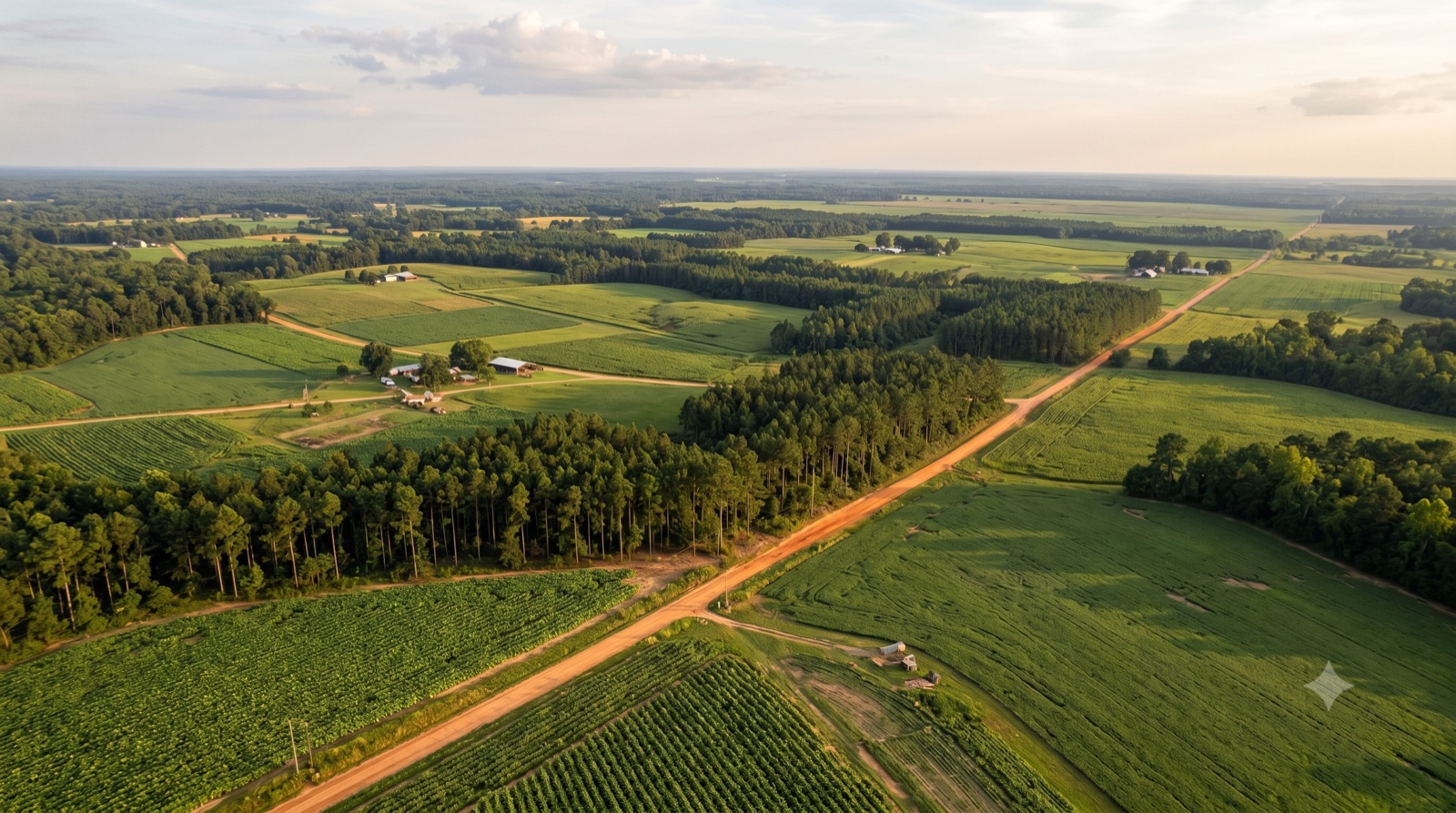
Sell My Land in Ashe County NC - What Landowners Need to Know
Key Takeaways
- Ashe County is the nation's second-largest Christmas tree county by farm sales: Cultivated Christmas trees generated $55.8 million in 2022 — ranked first in North Carolina and second in the United States, and accounting for 76% of every agricultural dollar the county earns, per the USDA 2022 Census of Agriculture county profile
- The population is growing again after a decade of decline: Ashe fell from 27,281 residents in 2010 to 26,577 in 2020, then rebounded to an estimated 27,514 by 2025 according to Census QuickFacts — a reversal that separates Ashe from most rural North Carolina counties
- Present-Use Value rollback is the single most overlooked cost here: Land enrolled in NC's PUV program owes deferred taxes for the current year plus the three prior years, with interest, when it leaves the program — and with tree farms and pasture everywhere in this county, enrollment is common
How Can You Sell Land in Ashe County North Carolina?
You can sell land in Ashe County by listing with an agent who knows the high-country market, listing yourself on land platforms, or working with a direct cash buyer — but every North Carolina closing requires a licensed attorney and a $2-per-$1,000 excise tax paid to the Register of Deeds. The two factors most likely to surprise an Ashe County seller are Present-Use Value rollback taxes on enrolled farm or forest ground and the reality that this is a growing, not shrinking, mountain market.
Ashe County occupies the far northwestern corner of North Carolina, roughly 426 square miles of Blue Ridge high country seated at Jefferson, bordered by Virginia to the north and Tennessee to the west. It is a genuinely isolated county — no interstate runs through it — but isolation has not translated into decline the way it has in much of rural North Carolina.
This guide covers North Carolina's property tax system and the Present-Use Value program, the state's attorney-closing requirement, how Ashe compares to its neighbors, and your practical options for selling.
What Are the Tax Costs of Holding Land in Ashe County?
Ashe County's effective property tax rate runs approximately 0.48% to 0.50%, well below both the North Carolina median near 0.81% and the national median near 1.0%. Tax-Rates.org reports 0.49% with a median annual bill of $727; Ownwell reports 0.48% with a median annual bill of $1,119. The rates agree closely — the dollar gap comes from the two services using different median home-value baselines, with Ownwell working from a more current figure. Ownwell also notes municipal variation inside the county, from roughly 0.47% in Jefferson to 0.56% in Warrensville.
Low rate or not, the bill repeats every year, and on land that produces no income it is pure carrying cost.
How Present-Use Value Works — and Why Rollback Matters More Here Than Almost Anywhere
North Carolina's Present-Use Value program lets qualifying agricultural, horticultural, and forestland be assessed on its income-producing value instead of market value. Minimum acreage thresholds are 10 acres for agricultural use, 5 acres for horticultural use, and 20 acres for forestland under a qualified management plan, per the NCDOR Present-Use Value Program Guide. Applications go to the county Tax Assessor.
The catch is the deferral. The difference between present-use value and full market value is not forgiven — it is carried as a deferred tax lien against the parcel. When land is disqualified or leaves the program, the owner owes three years of deferred taxes plus accrued interest, according to NCDOR and NC State Extension's farm law program.
This matters disproportionately in Ashe County because of what the land here is. A county whose agriculture is dominated by Christmas tree farms, hay ground, and pasture is a county where a very large share of working tracts are enrolled. If you are selling a tree farm, a hay field, or timbered acreage that a previous generation enrolled decades ago, the rollback obligation can surface at closing as a real number you did not budget for. Ask the Tax Administration office whether your parcel is enrolled before you list it, not after you are under contract.
For land carrying unpaid taxes, our guide on how to sell land with back taxes explains that process.
What Closing Requirements and Zoning Rules Apply in Ashe County?
North Carolina requires a licensed North Carolina attorney to conduct or supervise every real estate closing, including title review, deed preparation, payoff coordination, and recording. A title company can issue title insurance but cannot replace the attorney's legal role, per NC REALTORS' settlement guidance.
The closing sequence typically runs:
- Title search: An attorney orders a title search through Ashe County's deed records and resolves any clouds on title
- Deed preparation: The attorney prepares a warranty deed and coordinates any payoffs, including deferred PUV taxes if the parcel is enrolled
- Closing: Both parties execute the deed and settlement statement
- Recording and excise tax: The deed is recorded with the Register of Deeds and the seller pays excise tax at $1 per $500 of sale price — $2 per $1,000 — conventionally a seller cost in North Carolina
The Ashe County Register of Deeds, Deaett R. Roten, is located at 150 Government Circle, Suite 2300, Jefferson, NC 28640, phone 336-846-5580. Ashe County Tax Administration, led by Tax Administrator Chris Lambert, is at 150 Government Circle, Suite 2200, phone 336-846-5577.
Zoning and Land Use in Ashe County
Ashe County is rural, and agricultural, horticultural, and forestry uses on most tracts proceed without county use permits. Christmas tree production, cattle grazing, and hay operations are the established uses across the county's working land. Steep terrain is the practical constraint that matters more than zoning on most parcels here: slope affects road access, buildable area, septic feasibility, and how a tract shows to a buyer. Any manufactured home placement, subdivision, or commercial development plan warrants a direct call to county government before you market a parcel on that basis.
If your land is inherited, our guide on how to sell inherited land covers the steps. If your tract carries hardwood or planted timber, see how to sell timberland.
How Does Ashe County Compare to Neighboring North Carolina Counties?
Ashe County's population trajectory reversed direction in the last five years — down from 27,281 in 2010 to 26,577 in 2020, then back up to an estimated 27,514 by July 2025 per Census QuickFacts, a gain of roughly 3.5% since the 2020 count. Data USA shows the same firming in the underlying economics: median household income near $56,866 and a declining poverty rate.
| Factor | Ashe County | Watauga County | Wilkes County | Alleghany County |
|---|---|---|---|---|
| Population (latest est.) | ~27,514 | ~55,100 | ~66,000 | ~11,174 |
| Population trend | Declined, now growing | Growing (university) | Roughly flat | Small, roughly flat |
| Effective tax rate | ~0.48–0.50% | ~0.41–0.42% | 0.64% or 1.54% (sources conflict) | ~0.50% |
| County seat | Jefferson | Boone | Wilkesboro | Sparta |
| Land character | Christmas tree farms, pasture, hardwood | Boone/App State high country | Foothills farm and timber | High-country pasture and trees |
| Key economic driver | Christmas trees, agriculture, tourism | University, tourism | Manufacturing, agriculture | Agriculture, tourism |
Watauga County to the south, anchored by Boone and Appalachian State University, is the regional employment and retail center. Alleghany County to the east shares Ashe's high-country Christmas tree and pasture profile at roughly a third the population. Wilkes County to the southeast drops into the foothills and is a materially different market.
What the Farm Data Actually Says
Ashe County's agricultural economy is not merely Christmas-tree-influenced — it is Christmas-tree-dominated to a degree that is rare for any American county in any commodity.
The USDA 2022 Census of Agriculture county profile puts cultivated Christmas trees and short-rotation woody crops at $55.8 million in sales, ranked first in North Carolina and second in the United States. Total agricultural sales for the county were $73.4 million — meaning Christmas trees alone are 76% of everything Ashe County agriculture sells. Trees also lead by planted acreage at 13,096 acres, more than hay and forage at 9,483 acres.
Cattle and calves, the natural candidate for a co-equal commodity in a mountain county, brought $7.0 million and ranked 14th in the state — real, but roughly eight times smaller than trees. Crops account for 90% of county sales and livestock only 10%, an unusual split for the Blue Ridge.
The structural numbers point the other way from the sales growth: the county has 760 farms, down 12% since 2017, with land in farms down 23% to 84,498 acres and average farm size down 13% to 111 acres. Sales rose 29% over the same period. Fewer acres, fewer farms, more revenue — ground is coming out of production even as the operations that remain do better, and land leaving production is precisely the land that ends up on the market.
For a statewide overview of the selling process and other counties we buy in, see our guide on how to sell land in North Carolina. For county-level land analysis across the state, explore our blog. For help understanding value before you list, see how much is my land worth.
What Are Your Options for Selling Land in Ashe County?
Ashe County sellers face a specific combination: steep terrain that complicates access and buildability, widespread Present-Use Value enrollment that can generate an unexpected rollback bill at closing, an attorney-required closing process, and a buyer pool that — while healthier than most rural North Carolina counties — is still concentrated among tree growers, cattle operators, second-home buyers, and recreation buyers rather than broad residential demand.
Before listing or accepting any offer, verify your legal description and access through the Ashe County Register of Deeds, Deaett R. Roten, at 336-846-5580, 150 Government Circle, Suite 2300, Jefferson. Confirm your tax status — and specifically whether the parcel is enrolled in Present-Use Value — through Ashe County Tax Administration, Chris Lambert, at 336-846-5577, Suite 2200 at the same address. If your tract carries merchantable hardwood, a consulting forester's cruise will tell you something the tax assessment cannot.
Sellers have several paths. Listing with an agent who genuinely knows the high-country market reaches tree growers, recreation buyers, and second-home shoppers through the MLS and land platforms; commissions typically run 5–6% plus excise tax and closing costs, and remote or steep tracts can sit for months. For Sale By Owner on Land.com, LandWatch, or LandAndFarm puts you in front of active land buyers but requires you to assemble boundary, access, slope, and PUV documentation yourself — see how to sell land by owner. Working with a direct cash buyer like Jerez Land skips the listing period, commissions, and financing contingencies. We make parcel-specific, firm written offers based on a full review of your property — location, access, terrain, encumbrances, timber, and use designations — and we absorb the carrying costs, marketing expense, and resale risk. Our offers are not formulas. Request a cash offer for your land.
If you are weighing whether to involve an agent, see whether you need a realtor to sell land. If you live outside North Carolina, see our guide for the out-of-state land owner.
Frequently Asked Questions
I inherited my grandfather's Christmas tree farm in Ashe County and I don't want to run it — what happens tax-wise if I sell?
The most important thing to check first is whether the farm is enrolled in North Carolina's Present-Use Value program, which is very likely for working tree ground. If it is, selling to a buyer who does not continue a qualifying use triggers rollback: deferred taxes for the current year plus the three prior years, with interest, per NCDOR. Call Ashe County Tax Administration at 336-846-5577 and ask directly about enrollment status and the deferred balance. That figure needs to be in your math before you accept any offer, because it typically comes out of proceeds at closing.
I live out of state and inherited land near Jefferson — do I have to travel to North Carolina to sell it?
No. North Carolina requires a licensed North Carolina attorney to conduct or supervise the closing, but that attorney can work with you remotely, and deeds can be executed and notarized where you live. Start by confirming your legal description with the Ashe County Register of Deeds at 336-846-5580 and your tax and Present-Use Value status with Tax Administration at 336-846-5577. Expect the seller to pay excise tax at $2 per $1,000 of sale price at recording.
What will it cost me to sell land in Ashe County?
The unavoidable state cost is the excise tax of $1 per $500 of sale price — $2 per $1,000 — conventionally paid by the seller to the Register of Deeds at recording. Beyond that, expect attorney fees and title search costs (typically split by negotiation or paid by the buyer), agent commissions of roughly 5–6% if you list, and any deferred Present-Use Value taxes coming due if the parcel is enrolled and leaves the program.
Is Ashe County growing or declining?
Growing again, after a decade of decline. Ashe fell from 27,281 residents in 2010 to 26,577 in 2020, then rebounded to an estimated 27,514 by July 2025, according to Census QuickFacts — a gain of about 3.5% since the last decennial count. Median household income and poverty figures from Data USA point the same direction. That makes Ashe an exception among rural North Carolina counties, and it reflects the retiree and second-home in-migration reshaping much of the western part of the state.
My 30 acres in Ashe County is too steep to farm and just sits there — is anyone actually buying land like that?
Yes, though the buyer pool is narrower than for flatter ground and the timeline is usually longer. Steep Blue Ridge acreage in Ashe County attracts recreation buyers, hunters, adjoining landowners, timber buyers where there is merchantable hardwood, and second-home buyers looking for a view lot. What determines whether it moves is usually access — deeded road frontage or a recorded easement — rather than slope itself. If the parcel is landlocked or access is undocumented, resolving that before you market it changes the outcome more than anything else you can do.
Is Ashe County really a big Christmas tree county, or is that just local reputation?
It is real and larger than the reputation suggests. The USDA 2022 Census of Agriculture county profile ranks Ashe first in North Carolina and second in the entire United States for cultivated Christmas trees, at $55.8 million in sales. That single commodity is 76% of the county's total $73.4 million in agricultural sales, and trees cover 13,096 planted acres — more than hay and forage combined. Cattle, at $7.0 million, is a distant second. For land sellers, this concentration means tree-suitable ground has a defined and knowledgeable local buyer pool.
Disclaimer: This article is for informational purposes only and does not constitute legal, financial, or professional advice. Laws and regulations vary by jurisdiction and change over time. Always consult with qualified professionals before making land purchase decisions. Jerez Land is not responsible for actions taken based on this information.