Sell My Land in Yancey County NC - What Landowners Need to Know
Key Takeaways
- North Carolina charges a $2-per-$1,000 excise tax on deeds: Sellers pay $1 per $500 of the conveyed property value (equivalent to $2 per $1,000) to the Register of Deeds at closing, per N.C. Gen. Stat. § 105-228.30 — a modest but seller-paid closing cost on every Yancey County land sale
- Yancey County is Blue Ridge high country: The county holds Mount Mitchell, at 6,684 feet the highest peak east of the Mississippi River, and much of its land is steep, forested mountain terrain where access, slope, and site suitability drive value more than acreage alone, according to U.S. Census and USDA data
- Yancey's population has grown slowly, not shrunk: The county rose from 17,818 residents in 2010 to 18,470 in 2020 and an estimated 18,993 in 2024, according to U.S. Census Bureau data — steady, modest growth fed in part by its position within a short drive of Asheville
How Can You Sell Land in Yancey County North Carolina?
You can sell land in Yancey County through three primary paths: listing with a real estate agent for broad MLS exposure, selling by owner via online platforms, or working with a direct cash buyer to skip the listing period and close faster. In all cases, your closing must be supervised by a licensed North Carolina attorney under state law.
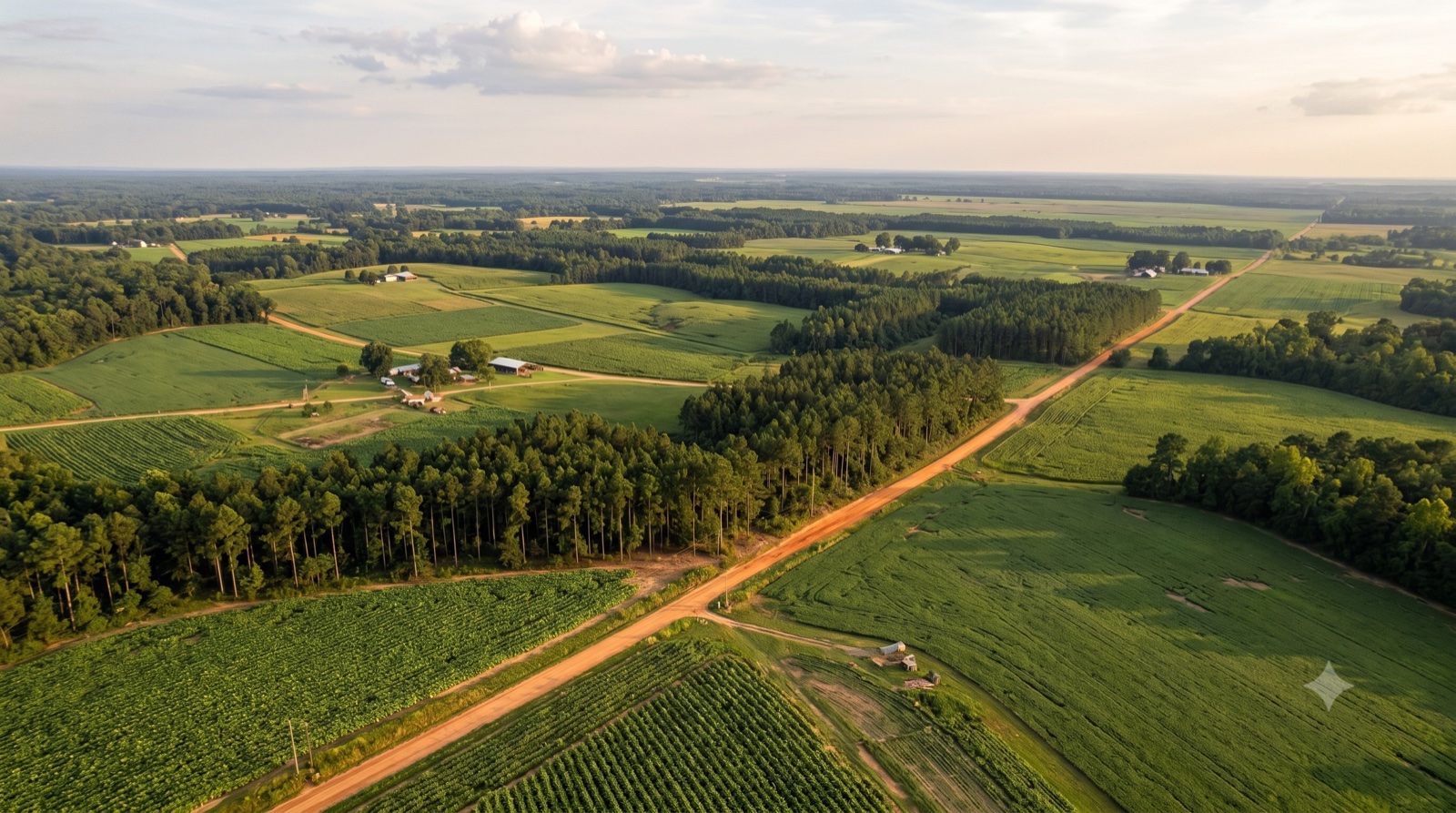
Selling land in Yancey County, North Carolina means selling into a small, isolated Blue Ridge mountain market. Yancey sits in the heart of North Carolina's high country — home to Mount Mitchell and the Black Mountains, the highest range in the eastern United States — and reported 288 farms and 21,341 acres of land in farms in the 2022 USDA Census of Agriculture. For landowners, that mountain setting shapes everything: who the likely buyers are, how steep-slope parcels are valued, and how a closing is handled under North Carolina's attorney-supervised system.
This guide covers North Carolina's property tax system and the Present-Use Value deferral program that qualifying farm and forest land here can enroll in, the state's attorney-closing requirement and what it means for your timeline, how Yancey County compares to neighboring Buncombe, Mitchell, and Avery counties, and the practical steps for completing a land sale. For a broader overview of the process across the state, visit our guide on how to sell land in North Carolina.
What Are the Property Tax and Carrying Costs of Holding Land in Yancey County?
North Carolina assesses all real property — including vacant land — at 100% of fair market value, unlike states that apply fractional assessment ratios. The county then applies its rate per $100 of that assessed value. According to the North Carolina Department of Revenue's 2024-2025 county tax rate schedule, Yancey County's rate is $0.52 per $100 of assessed value, down from $0.60 in prior years. The county's median effective property tax rate works out to roughly 0.45% of value, with a median annual bill near $580, according to Tax-Rates.org — among the lower property tax burdens in the state and well below the national average near 1.02%. A municipal rate applies on top for parcels inside Burnsville town limits.
Even at a low effective rate, holding vacant mountain land generates a recurring bill with no income to offset it, year after year — one reason absentee and inherited-land owners often decide to sell rather than keep carrying a tract they cannot easily use.
How the Present-Use Value (PUV) Program Can Reduce Your Tax Bill
North Carolina's Present-Use Value program, authorized under N.C. Gen. Stat. §§ 105-277.2 through 105-277.7, allows qualifying agricultural, horticultural, and forestland to be assessed on its income-producing value rather than market value, according to the NCDOR and NC State Extension. In a mountain county with substantial hardwood woodland and Christmas-tree and nursery operations, forestland and horticultural enrollment can meaningfully lower the tax basis on qualifying tracts.
To qualify, a parcel must meet minimum acreage thresholds — generally 10 acres in agricultural production, 5 acres in horticultural use, or 20 acres under a qualified forest management plan — and agricultural and horticultural land must generate at least $1,000 in average gross annual income. Applications are due by January 31 each year with the county Tax Assessor. If ownership changes or the land is converted to a non-qualifying use, deferred taxes from the current year plus the three prior years become immediately due with interest — a "rollback" that can be a meaningful, often overlooked cost when an enrolled tract changes hands. If you're carrying back taxes on a Yancey County parcel, resolving delinquency before listing matters because a tax lien will appear in any title search and must be satisfied at closing.
Yancey County Tax Department Contact
Yancey County Tax Department | Tax Administrator Jessica McIntosh | 110 Town Square, Room 2, Burnsville, NC 28714 | Assessor's office: (828) 682-2198 | Tax Collector: (828) 682-2197
What Closing and Zoning Requirements Apply in Yancey County?
North Carolina is an attorney-close state. Under established North Carolina case law and State Bar opinions, a licensed North Carolina attorney must conduct or supervise every real estate closing — including reviewing title, preparing the deed, coordinating payoffs, and recording the deed with the Register of Deeds. A title company can issue title insurance but cannot replace the attorney's legal role.
The closing sequence for a Yancey County land sale typically works as follows: the buyer's (or seller's, if agreed) attorney orders a title search through Yancey County's deed records, resolves any clouds on title, prepares a warranty deed, and schedules the closing. The seller pays the excise tax — $1 per $500 of the sale price, or $2 per $1,000 — directly to the Register of Deeds when the deed is recorded, per N.C. Gen. Stat. § 105-228.30. For a parcel selling at $50,000, the excise tax obligation would be $100. Our guide on who pays closing costs when selling land covers how these costs are typically allocated, and our overview of the paperwork needed to sell land lists the documents you'll need.
Zoning, Access, and Site Suitability in Yancey County
Yancey County administers planning, zoning, and building inspections through its county offices, with much of the unincorporated county lightly regulated. The bigger practical constraints on mountain land here are physical rather than regulatory: steep slopes, ridge and cove terrain, driveway and grading costs, and legal road access all shape what a parcel can support and what a buyer will pay. Many high-country tracts are reached only by private mountain roads, shared easements, or no recorded access at all, so confirming a legal access route is a first-order due-diligence step.
Site suitability for a well and septic system is another key question on vacant mountain land, and it is parcel-specific. A general soil-survey map rating is not a septic determination — only a site soil evaluation performed by Yancey County Environmental Health (with a licensed soil scientist where needed) establishes whether, where, and what kind of on-site wastewater system a parcel can support. Buyers of building lots will want that evaluation, so it's worth understanding your parcel's status before marketing it.
Yancey County Register of Deeds | Susan Jobe | 110 Town Square, Room 4, Burnsville, NC 28714 | Phone: (828) 682-2174
If you've inherited the property and are unsure about title, our guide on how to sell inherited land walks through the process, and if a parcel has no legal road frontage, selling landlocked land covers your options.
How Does Yancey County Compare to Neighboring Counties?
Yancey County's population rose from 17,818 in the 2010 Census to 18,470 in 2020 and an estimated 18,993 in 2024, according to U.S. Census Bureau data — modest, steady growth rather than the decline seen in many rural counties, helped by its short drive to Asheville. Burnsville, the county seat, anchors a small mountain economy where tourism, second homes, nursery and Christmas-tree agriculture, and construction all play a role.
| Factor | Yancey County | Buncombe County | Mitchell County | Avery County |
|---|---|---|---|---|
| Population (2024 est.) | ~19,000 | ~275,000 | ~15,000 | ~17,900 |
| Population trend | Growing slowly | Growing | Flat / slight decline | Slight growth |
| County tax rate (per $100) | $0.52 | ~$0.52 | $0.56 | $0.40 |
| Relationship to Asheville | ~35–45 min NE | Is the Asheville metro | ~50 mi NE | ~60 mi NE |
| Key economic driver | Tourism, nursery/Christmas trees, construction | Tourism, healthcare, regional hub | Minerals (Spruce Pine), Christmas trees | High-country resorts, Christmas trees |
Buncombe County to the southwest is the Asheville metro itself — the regional economic anchor whose high land prices push second-home and recreation buyers outward into quieter, more affordable counties like Yancey. Mitchell County to the northeast shares much of Yancey's high-country character and adds the Spruce Pine minerals district, while Avery County to the east is resort-and-ski country around Banner Elk and Beech Mountain. Yancey's draw is being genuinely close to Asheville while still feeling remote and costing less.
Motivated-Seller Signals in Yancey County
Several patterns concentrate motivated sellers here. Yancey's farm base has contracted sharply — farm numbers, acreage, and total agricultural sales all fell more than 20% between 2017 and 2022, per the USDA — leaving many small, fragmenting tracts in the hands of heirs who have moved away. Steep, hard-to-access parcels; inherited mountain acreage held by out-of-state families; and lots that never got built on because of slope or septic constraints are exactly the properties that sit unsold. For context on what drives value, see our guide on how much is my land worth, and for timber tracts, selling timberland. For more county-level land analysis across North Carolina, explore our blog.
What Are Your Options for Selling Land in Yancey County?
In a small, isolated mountain market, a steep or access-limited vacant parcel can be genuinely hard to sell. The natural buyers are second-home seekers, recreation buyers, and a limited pool of local builders — and they scrutinize slope, access, and site suitability closely. Understanding your options helps you choose the path that fits your timeline and goals.
Listing with a real estate agent gives your parcel the broadest market exposure through the MLS and land platforms. Agents who know the western North Carolina mountain market can reach second-home and recreation buyers coming out of Asheville and beyond. Agent commissions typically run 5–6% of the sale price, plus the state excise tax and other closing costs, and steep or access-limited tracts in a thin market can sit listed for many months. If you own farmland or timberland, an agent with genuine land experience matters more than a general residential broker.
For Sale By Owner (FSBO) and online platforms like Land.com, LandWatch, and LandAndFarm let you list directly. These platforms have active audiences of land buyers, but marketing a mountain parcel effectively — with slope and access documentation, survey, PUV status, and septic-suitability information — takes time and knowledge of what high-country buyers look for. For a closer look at going it alone, see our guide on how to sell land by owner.
Working with a direct cash buyer like Jerez Land means skipping the listing period, agent commissions, and the uncertainty of buyer financing. We make parcel-specific, firm written offers based on a full review of your property — location, access, slope, encumbrances, use designations, and condition — and we absorb the carrying costs, marketing expense, and resale risk. Our offers are not formulas; they reflect what we can actually do with your specific land. If you have inherited land, are dealing with multiple heirs, or own the tract from another state, we are experienced working through those situations — see also selling land as an out-of-state owner. Request a cash offer to get a specific number on your Yancey County parcel, or read our full guide on whether you need a realtor to sell land before deciding.
Frequently Asked Questions
I inherited steep mountain land in Yancey County but live out of state — can I sell it without coming to North Carolina?
Yes. You can sell Yancey County land from out of state. Confirm your legal description and any Present-Use Value enrollment through the Tax Department (828-682-2198), verify clean title and legal access through the Register of Deeds (828-682-2174), and check for delinquent taxes. North Carolina requires a licensed attorney to supervise the closing, but that attorney and a title company can handle title, deed, and recording; signing can be done remotely by mail or mobile notary, so you generally never need to appear in person.
How do I sell my land in Yancey County fast?
The fastest path to closing on a Yancey County parcel is working with a direct cash buyer who does not require mortgage financing. Cash closings eliminate lender timelines and can often close in a few weeks once title is clear, though a North Carolina attorney must still supervise. Before any sale, confirm your legal description with the Register of Deeds, verify there are no delinquent taxes, and check whether the land is enrolled in Present-Use Value, since deferred-tax rollback may come due at closing.
I want to sell my land in North Carolina — do I have to hire an attorney?
Yes. North Carolina requires a licensed attorney to supervise every real estate closing — this is not optional or waivable by the parties. The attorney conducts the title examination, prepares the deed, coordinates the disbursement of funds, and records the deed with the county Register of Deeds. A title company can issue title insurance but cannot complete the closing on its own.
My Yancey County lot is steep and I'm not sure it can pass a septic test — can I still sell it?
Yes. Plenty of mountain land sells even when a conventional building site is uncertain. Whether a parcel can support an on-site septic system is determined only by a site soil evaluation from Yancey County Environmental Health, not by a general soil-survey map — so the honest answer for many lots is "it depends on the site eval." You can order that evaluation to strengthen your listing, or sell as-is to a buyer or direct cash purchaser who prices in the uncertainty and handles the testing themselves.
I own land in Yancey County — what will I pay in property taxes?
Yancey County's rate is $0.52 per $100 of assessed value, according to the North Carolina Department of Revenue, producing a median effective rate near 0.45% and a median annual bill around $580, per Tax-Rates.org. Parcels inside Burnsville pay an additional municipal rate. Land enrolled in the Present-Use Value program may be taxed at significantly lower amounts based on income-producing capacity rather than market value.
My farm is enrolled in the Present-Use Value program — how does that affect my sale?
North Carolina's PUV program allows qualifying agricultural, horticultural, and forest land to be taxed on its income-producing value rather than market value. If you sell PUV-enrolled land, deferred taxes from the current year and the three prior years can become due immediately at closing, with interest. This rollback obligation is a real cost that affects your net proceeds and should be factored into any offer evaluation, so confirm your enrollment status with the county Tax Department before you sell.
Disclaimer: This article is for informational purposes only and does not constitute legal, financial, or professional advice. Laws and regulations vary by jurisdiction and change over time. Always consult with qualified professionals before making land purchase decisions. Jerez Land is not responsible for actions taken based on this information.