
Sell My Land in Burke County GA - What Landowners Need to Know
Key Takeaways
- 403 farms covering 214,575 acres: Burke County had 403 farms on 214,575 acres of farmland in 2022, producing $142,134,000 in total agricultural products — with cotton, peanuts, and corn as the top three crops — according to the 2022 USDA Census of Agriculture
- Georgia assesses land at 40% of fair market value: Under Georgia law, all real property, including vacant land, is assessed at 40% of fair market value as of January 1 each year — a uniform standard statewide — according to the Georgia Department of Revenue
- Population declined after Vogtle construction peak: Burke County's population fell from 24,596 in 2020 to an estimated 24,408 in July 2025, reversing modest gains tied to Plant Vogtle construction activity, according to U.S. Census Bureau estimates
How Can You Sell Land in Burke County Georgia?
Selling land in Burke County, Georgia, means navigating a state that requires an attorney at every closing, a $1-per-$1,000 transfer tax on the deed, and a rural market where large cotton and peanut farms dominate the landscape. Burke County spans 827 square miles of Georgia's coastal plain east of Augusta, with Waynesboro as the county seat. The county ranks 38th among Georgia's 159 counties for total rural acreage actively listed for sale, according to LandWatch data, with approximately 142 listings totaling roughly $56 million in active inventory.
This guide covers Georgia's property tax structure and how it applies to Burke County vacant land, the county's zoning framework and attorney-required closing process, how the local market compares to neighboring counties, and practical options for landowners who are ready to sell — including what to expect from a direct cash offer.
What Are the Property Tax Costs of Holding Land in Burke County?
Georgia law establishes a single assessment ratio of 40% of fair market value for all real property, according to the Georgia Department of Revenue. Unlike some states that apply different ratios to residential versus non-residential land, Georgia uses the same 40% figure regardless of whether the land is farmed, forested, or vacant. That assessed value is then multiplied by the combined millage rate to produce the annual tax bill.
In Burke County, the combined millage rate for unincorporated land includes the County M&O levy (4.127 mills in 2024), the School M&O levy (11.75 mills), and a fire district levy (2.0 mills), producing an approximate base rate of 17.877 mills, according to a 2024 Burke County property tax statement. The county's median effective property tax rate is 0.78%, which is lower than the Georgia statewide average of approximately 0.74–0.84% for rural counties and below the national median of 1.02%, according to Ownwell. Property taxes in Georgia are due by February 28 each year, with delinquent properties subject to a tax lien (Fi. Fa.) and eventual tax sale conducted on the courthouse steps.
How Property Tax Adds Up on a Vacant Burke County Parcel
For a vacant parcel with a county-assessed market value of $100,000, the 40% assessment produces a taxable value of $40,000. At the approximate combined base rate of 17.877 mills, the annual tax bill calculates to approximately $715. That is a modest annual carrying cost in isolation — but vacant land generates no income to offset it, and property values declined sharply after Plant Vogtle construction wound down. If you are also carrying liability insurance, maintaining fences, or managing invasive vegetation on unused acreage, total annual costs climb quickly.
Landowners with qualifying agricultural or timber operations may be eligible for significant relief through Georgia's Conservation Use Valuation Assessment (CUVA). Under CUVA, qualifying land is assessed at its current use value — determined by soil type and productivity — rather than fair market value, which typically produces a substantially lower assessed value. Burke County falls in CUVA Rate Group #6, along with Bulloch, Emanuel, Jefferson, and Jenkins counties, according to Georgia Department of Revenue conservation use rules. CUVA requires a 10-year covenant, and breaking the covenant triggers a penalty equal to twice the cumulative tax savings. If you are considering selling CUVA-enrolled land, review the penalty exposure before listing.
For land with potential delinquent taxes, see our guide on how to sell land with back taxes before proceeding.
What Zoning and Closing Requirements Apply in Burke County?
Burke County's land use is governed by the Burke County Planning and Zoning Department, which administers the county's zoning ordinance for unincorporated areas. The county seat of Waynesboro maintains its own municipal zoning. Most rural Burke County land is either unzoned or falls under agricultural and low-density residential classifications. Before listing a parcel, confirm the current zoning designation and any applicable deed restrictions through the Burke County Planning Department, reached at the County Administration offices at 602 Liberty Street, Waynesboro, GA 30830.
For deed records, parcel boundaries, and ownership history, the Clerk of Superior Court for Burke County maintains the official land records. Contact: 602 Liberty Street, Suite 100, Waynesboro, GA 30830. The Tax Assessors office, overseen by Chief Appraiser Phillip W. Wren (706-554-2607), handles assessed value records and CUVA/FLPA applications and can be searched at qpublic.net/ga/burke.
Georgia's Attorney-Required Closing Process
Georgia is an attorney-closing state: a licensed Georgia attorney must supervise every real estate closing, including title examination, deed preparation, and recording, according to Brian Douglas Law. No closing may occur without an attorney overseeing the process. The steps are:
- Title search: The attorney searches Burke County Superior Court Clerk records to confirm clear title and identify any liens, encumbrances, or judgments
- PT-61 filing: Before the deed can be recorded, a PT-61 Real Estate Transfer Tax Declaration must be filed electronically through the Georgia Superior Court Clerks' Cooperative Authority (GSCCCA), according to Georgia Title & Escrow Company
- Transfer tax payment: Georgia levies a transfer tax of $1.00 for the first $1,000 of consideration, plus $0.10 for each additional $100 of consideration, under O.C.G.A. § 48-6-1 — on a $100,000 sale, that is $100 in transfer tax, according to Georgia Title & Escrow Company
- Recording: The deed is recorded with the Burke County Clerk of Superior Court at a flat $25 recording fee per instrument, under O.C.G.A. § 15-6-77, according to Georgia Title & Escrow Company
- Title insurance: Protects the buyer and lender against defects not discovered in the title search
Attorney closing fees in Georgia typically range from $500 to $1,500 depending on transaction complexity, according to Brian Douglas Law. If your parcel has unclear title, heir property complications, or a prior CUVA covenant, budget toward the higher end. You can request a no-obligation cash offer from Jerez Land before committing to any listing strategy — our process works within Georgia's attorney-closing framework.
For a full walkthrough of what paperwork is involved in a Georgia land closing, see our guide on paperwork needed to sell land.
How Does Burke County Compare to Neighboring Georgia Counties?
Burke County sits at the center of a cluster of rural east-Georgia counties, each with its own land market dynamics. Understanding how Burke stacks up against adjacent counties matters because buyers shopping the region will be comparing across county lines, and so will the investors most likely to send you a cash offer.
| Factor | Burke County | Jefferson County | Screven County | Jenkins County |
|---|---|---|---|---|
| Population (2024 est.) | ~24,472 | ~15,600 | ~14,400 | ~8,600 |
| Population trend | Declining (-0.5% since 2020) | Declining | Stable/Flat | Declining |
| Effective property tax rate | ~0.78% | ~0.90% | ~0.80% | ~0.85% |
| Top crop/industry | Cotton, peanuts, corn | Cotton, peanuts | Timber, agriculture | Timber, agriculture |
| Land inventory (LandWatch) | ~142 listings | Moderate | Limited | Very limited |
| Key advantage/challenge | Largest active inventory, Vogtle proximity | Low population limits buyers | Very thin market | Smallest market in region |
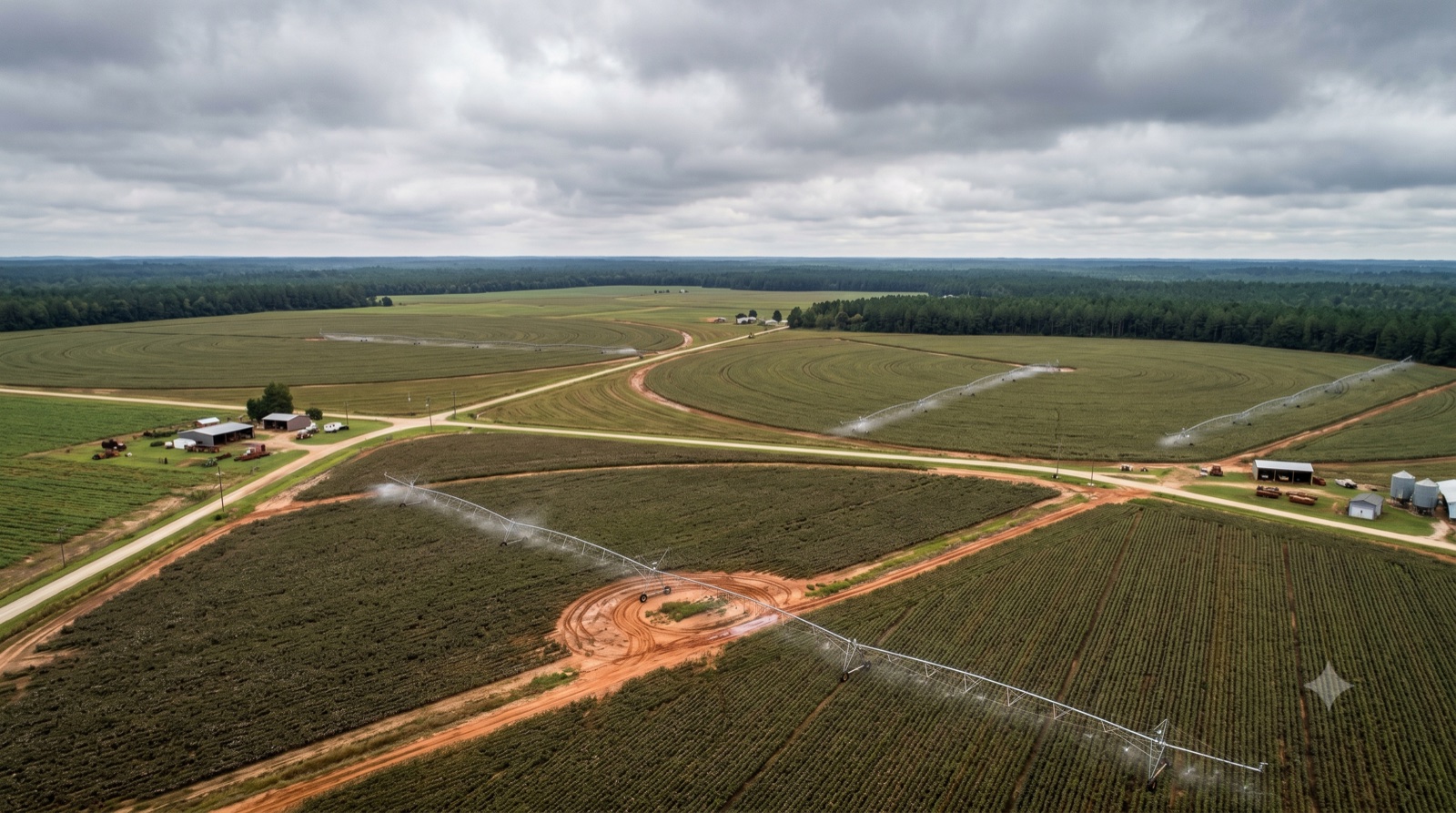
Burke County's agricultural profile is dominated by row crops — cotton (35,883 acres), peanuts (20,421 acres), and corn (19,292 acres) top the list — on 403 farms with an average size of 532 acres, according to the 2022 USDA Census of Agriculture. Total market value of agricultural products reached $142,134,000, representing 57% crop and 43% livestock sales. Woodland accounts for 66,271 acres, or 31% of farmland, supporting a secondary timber market. Burke County earned the nickname "Bird Dog Capital of the World," and hunting and recreational land demand from Georgia and South Carolina buyers adds another buyer pool beyond agricultural purchasers.
The presence of Georgia Power's Plant Vogtle near Waynesboro — which employs a large operations and maintenance workforce — creates an unusual demand dynamic for residential land close to the plant corridor. However, construction employment peaked with the completion of Units 3 and 4, and population has been trending downward since the 2020 census base, according to U.S. Census Bureau estimates. That shift illustrates the illiquidity risk facing vacant landowners: a use case that drove demand can disappear faster than a listing can sell on the open market.
Burke County's median household income of $53,014 and poverty rate of 18.3% reflect a rural economy with limited replacement industry to sustain long-term land demand growth, according to U.S. Census Bureau QuickFacts. The combination of modest income levels, high vacancy in rural areas, and declining population supports the case for addressing carrying costs sooner rather than later.
Conservation Programs for Burke County Landowners
Burke County landowners with qualifying agricultural and timber operations can access two major tax reduction programs through the Georgia Board of Tax Assessors. The Conservation Use Valuation Assessment (CUVA) assesses qualifying land at current use value based on soil productivity rather than market value, requiring a 10-year covenant, according to the Georgia Landowner's Guide to Conservation Resources. The Forest Land Protection Act (FLPA), passed in 2008, provides a similar but deeper valuation preference for large working forest tracts, requiring a 10-year covenant. Both programs are administered by the county Board of Tax Assessors and require applications filed between January 1 and April 1 each year.
If you have inherited land in Burke County with uncertain title history, our guide on how to sell inherited land covers the specific steps Georgia requires.
For more county-level land analysis across Georgia and the Southeast, explore our blog.
What Are Your Options for Selling Land in Burke County?
Burke County landowners have several realistic paths forward, each with different timelines, costs, and outcome certainty. Before choosing, confirm your property's current assessed value and tax status through the Burke County Tax Commissioner, Marian S. Jackson (706-554-3223, 524 Myrick Street Suite A, Waynesboro, GA 30830), and verify any active CUVA or FLPA covenants with the Board of Assessors (Phillip W. Wren, 706-554-2607).
Listing with a real estate agent provides market exposure to buyers searching the Augusta-area and regional rural land markets. Agent commissions for land in rural Georgia typically run 6–10%, and listings for rural parcels often sit for 12–24 months before closing, according to our analysis of typical land timelines. For an independent perspective on timelines, see our guide on how long it takes to sell land.
FSBO through land platforms such as Land.com and LandWatch can reduce commission costs, but still requires you to manage showings, negotiate, verify buyer financing, and coordinate the attorney-supervised closing. For a full breakdown of the FSBO process for rural land, see our guide on how to sell land by owner.
Getting an independent appraisal before listing helps avoid under-pricing large irrigated farm tracts or heavily wooded parcels. If you want to understand how value is calculated on your parcel before exploring any option, see our guide on how much your land is worth.
Direct cash offers from land buyers like Jerez Land eliminate commissions, listing fees, and extended marketing timelines. We price each parcel individually based on its specific characteristics — soil quality, timber volume, water access, location relative to demand centers — not generic market benchmarks. The buyer absorbs resale risk and all carrying costs from the closing date forward. Georgia's attorney-closing requirement applies equally to cash transactions, so a licensed Georgia closing attorney still handles title, the PT-61 filing, and deed recording. Request a cash offer for your Burke County land to get a firm written number — no obligation, no pressure.
Frequently Asked Questions
How do I sell vacant land in Burke County GA?
Start by verifying your parcel's legal description and tax status through the Burke County Tax Commissioner (706-554-3223). Confirm any CUVA or FLPA covenant status with the Board of Assessors. Georgia requires a licensed attorney to handle the closing, including title examination, PT-61 filing, deed preparation, and recording with the Clerk of Superior Court. You can list with an agent, use online platforms, or request a direct cash offer.
I own vacant land in Burke County — how much will my annual property taxes be?
Burke County's approximate combined base millage rate is 17.877 mills (4.127 county M&O + 11.75 school M&O + 2.0 fire district), producing a median effective property tax rate of approximately 0.78%, according to Ownwell. Georgia assesses all real property at 40% of fair market value as of January 1 each year, under state law. CUVA and FLPA programs can significantly reduce assessed values for qualifying agricultural and timber land.
When I sell my land in Georgia, will I pay a transfer tax?
Yes. Georgia levies a real estate transfer tax of $1.00 for the first $1,000 of consideration, plus $0.10 for each additional $100 of consideration, under O.C.G.A. § 48-6-1, according to Georgia Title & Escrow Company. On a $200,000 sale, the transfer tax totals $200. The seller is typically liable by statute, though contracts can shift the obligation to the buyer. A PT-61 form must be filed electronically before the deed can be recorded.
Do I need to hire an attorney to close my land sale in Georgia?
Yes. Georgia requires a licensed attorney to supervise every real estate closing, including title examination, deed preparation, and recording. No closing may legally occur without attorney oversight, according to Brian Douglas Law. Attorney closing fees typically range from $500 to $1,500. The deed is recorded with the Burke County Clerk of Superior Court at a flat $25 recording fee per instrument.
I have agricultural land in Burke County — can the CUVA program save me money on taxes?
The Conservation Use Valuation Assessment (CUVA) is a Georgia program that taxes qualifying agricultural and timber land at its current use value — based on soil type and productivity — rather than fair market value, significantly reducing annual property taxes. Burke County is in CUVA Rate Group #6, per Georgia Department of Revenue rules. Applications must be filed with the county Board of Tax Assessors between January 1 and April 1. CUVA requires a 10-year covenant, and breaking it triggers a penalty equal to twice the tax savings received.
Is Burke County Georgia population growing or declining?
Burke County's population declined from 24,596 in the 2020 Census to an estimated 24,408 in July 2025 — a loss of about 188 residents — following modest gains during the Plant Vogtle nuclear expansion, according to U.S. Census Bureau data. The county's 2010 census population was 23,316, meaning the long-term trajectory has been gradual growth punctuated by construction-project surges, with post-project declines likely to continue until a new major employer enters the county.
Disclaimer: This article is for informational purposes only and does not constitute legal, financial, or professional advice. Laws and regulations vary by jurisdiction and change over time. Always consult with qualified professionals before making land purchase decisions. Jerez Land is not responsible for actions taken based on this information.