
Sell My Land in Echols County GA - What Landowners Need to Know
Key Takeaways
- Only about a tenth of Echols County is in farms at all: The 2022 USDA Census of Agriculture reports 27,413 acres of land in farms across a county covering roughly 415 square miles — about 265,600 acres. The overwhelming majority of Echols County is something other than working farmland, which is the single most important fact for anyone trying to price or sell a tract here.
- Echols is one of the very few Georgia counties with no incorporated municipality: There is no city government, no municipal water and sewer district, and no in-town lot market to set a floor under rural land values. Every parcel in the county is unincorporated county land.
- Georgia assesses all real property at 40% of fair market value, and a CUVA covenant runs for ten years: Conservation Use Valuation Assessment can substantially lower the taxable value of qualifying agricultural or timber ground, but breaching the covenant before the ten-year term ends triggers a penalty, under O.C.G.A. § 48-5-7.4. That covenant follows the land into a sale.
How Can You Sell Land in Echols County Georgia?
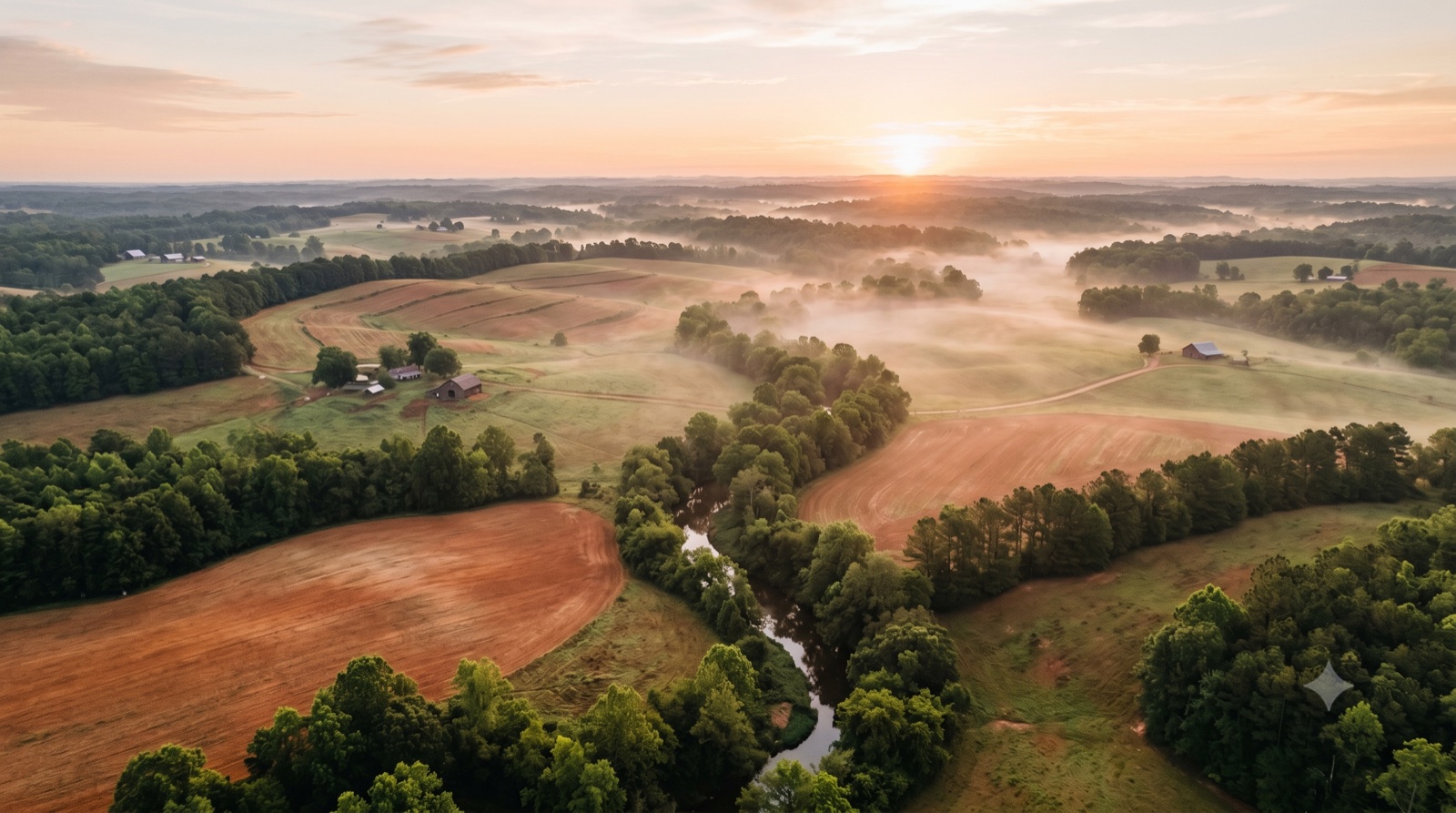
Selling land in Echols County requires a Georgia attorney to close, a transfer tax of $1 per $1,000 of consideration, and a clear-eyed view of a market where the buyer pool is genuinely small — the county's population has fallen from 4,034 in 2010 to roughly 3,685 today. Echols County sits in the far southern corner of Georgia on the Florida line, a flat landscape of pine flatwoods, cypress sloughs, and irrigated vegetable ground drained by the Alapaha and Suwannee river systems, with county offices in Statenville.
What makes Echols unusual among Georgia counties is not just its size. It is that the county has no incorporated municipality — no city limits, no town council, no municipal utility district. In most rural counties, a county seat with water, sewer, and small platted lots creates a base layer of demand that puts a floor under land prices nearby. Echols does not have that layer. Every acre is unincorporated, and a buyer's plans depend entirely on the parcel itself: its access, its soils, and whether a well and septic system will work.
This guide covers what Georgia's assessment and CUVA rules mean for your tax bill, the attorney-managed closing process, how Echols compares with its Georgia neighbors on the data that actually exists, and your realistic selling options. For the statewide process, start with how to sell land in Georgia. For more guides, browse the blog.
What Are the Tax Costs of Holding Land in Echols County?
Georgia assesses all real property at 40% of fair market value, which means your annual bill is the county millage rate applied to 40% of what the assessor concludes your land is worth. The lever that matters most for rural acreage is not the millage — it is whether the parcel carries a conservation-use covenant that changes the value being assessed.
We are deliberately not publishing an "effective property tax rate" for Echols County. Several private websites publish one, and they disagree with each other by a wide margin because they use different methodologies and different bases. None of them traces to the county or to the Georgia Department of Revenue, and the Department's own millage-rate page directs taxpayers to verify rates with the County Tax Commissioner rather than relying on a published table. For the rate that will actually appear on your bill, call the Echols County Tax Commissioner at 229-559-5253.
CUVA: A Ten-Year Covenant That Follows the Land
Conservation Use Valuation Assessment lets qualifying agricultural and timber land be assessed on its current-use value rather than its fair market value, which can meaningfully reduce the annual bill on working ground. Georgia's Department of Revenue sets current-use values annually based on soil productivity, and those values are distributed to county tax assessors, per the Rules of the Georgia Department of Revenue, Chapter 560-11-6.
The part that catches sellers is the covenant. CUVA is a ten-year commitment, and breaching it before the term runs triggers a penalty under O.C.G.A. § 48-5-7.4 — generally calculated as twice the tax savings the covenant produced, plus interest. This matters at closing for a specific reason: a covenant does not simply evaporate because the land changed hands. A buyer can typically continue the covenant, but if the sale or the buyer's intended use breaks it, someone pays the penalty, and who that someone is should be settled in the purchase agreement rather than discovered afterward.
If your parcel is enrolled, confirm the covenant's start date and remaining term with the Echols County Tax Assessor's office at 229-559-7370 before you market the land. A buyer who learns about a covenant late will reprice around it; a buyer who is told up front usually does not.
What Zoning and Closing Rules Apply to Echols County Land?
Georgia requires an attorney to oversee every real estate closing, including the title examination and deed preparation, and deeds are recorded through the Clerk of Superior Court. In Echols County, the Superior Court office is in Statenville and can be reached at 229-559-5642.
Because the county has no incorporated municipality, there is no city zoning to navigate anywhere in Echols County — a genuine simplification compared with most Georgia markets. What replaces it as the binding constraint is site suitability. On flat, wet, sandy Coastal Plain ground, whether a parcel will support a septic system is often the question that decides whether a residential buyer can use it at all. If you have ever had a perc test come back badly on this kind of terrain, sell land after a failed perc test covers how that affects a sale.
Georgia's Attorney-Required Closing Process
A typical Echols County land closing follows this sequence:
- Pull your deed and confirm the legal description through the Clerk of Superior Court in Statenville.
- Verify tax status and CUVA enrollment with the Tax Commissioner and Tax Assessor.
- Engage a Georgia closing attorney, who orders the title examination.
- Resolve title defects — unprobated estates, old unreleased liens, and undocumented access are the recurring three on rural Georgia tracts.
- Settle who bears any CUVA breach penalty in the purchase agreement, if the covenant will not continue.
- Close and record the deed, paying Georgia's transfer tax of $1 per $1,000 of consideration.
If back taxes are involved, read sell land with back taxes first — they are far easier to address before a title examiner surfaces them.
How Does Echols County Compare to Neighboring Georgia Counties?
Echols County has the smallest farm base and the only declining population among its Georgia neighbors. The table below uses 2022 USDA Census of Agriculture figures, which are the most reliable and directly comparable county-level land-use data available.
| Factor | Echols County | Clinch County | Lanier County | Lowndes County |
|---|---|---|---|---|
| Population (recent est.) | ~3,685 | ~6,850 | ~10,900 | ~120,000 |
| Population trend | Declining | Growing slightly | Growing | Growing, decelerating |
| County seat | Statenville | Homerville | Lakeland | Valdosta |
| Land in farms (2022) | 27,413 acres | 44,721 acres | 48,841 acres | 84,299 acres |
| Woodland in farms (2022) | 8,728 acres | 19,027 acres | 10,250 acres | 38,593 acres |
| Assessment ratio | 40% of FMV | 40% of FMV | 40% of FMV | 40% of FMV |
| Distinguishing pattern | Smallest farm base; only declining county | Woodland exceeds cropland | 27% of farmland irrigated | Largest farm base despite being the urban county |
What a 27,413-Acre Farm Base Means for Your Tract
Run the arithmetic and the picture sharpens. Echols County covers roughly 415 square miles — about 265,600 acres — and the 2022 Ag Census counts 27,413 acres in farms. That is roughly a tenth of the county. The other ninety percent is pine flatwoods, wetland, and timber ground that never appears in agricultural statistics at all.
That single ratio explains more about selling land in Echols County than any market commentary could. In counties where farms cover a third or half of the land, an expanding operator is a plausible buyer for almost any tract, because almost any tract adjoins working ground. In Echols, most parcels do not, and the realistic buyer is a timber or recreational buyer rather than a farmer.
The farm economy that does exist is small and unusual. Echols reported $18.5 million in agricultural products sold in 2022, 78% of it from crops, with vegetables, melons, potatoes, and sweet potatoes alone accounting for $8.3 million — this is irrigated vegetable country, not a cattle or row-crop county. Farm count actually rose 45% since 2017 while average farm size fell 17% to 286 acres, meaning more and smaller operations, the opposite of the consolidation seen across most of the Southeast. And the income picture is thin: net cash farm income of $1,156,000 was down 16%, against government payments of $889,000 that were up 314%.
Two more numbers matter to a seller. Of 144 producers in the county, 71 are 65 or older — about half — which points toward succession-driven turnover and more inventory reaching the market in the coming years. And with a county population of roughly 3,685 and falling, there is no local demographic engine generating new buyers.
On the timberland question: Echols is frequently described as one of Georgia's most heavily timbered counties, with the timberland largely in institutional rather than individual hands. We attempted to verify a specific timberland percentage and ownership split and could not source it to a current, dated figure — the commonly circulated numbers appear to trace to a forest-inventory factsheet whose data year we could not confirm. Rather than publish a statistic we cannot stand behind, we are noting the limitation. Current county-level forest data lives in the USDA Forest Service Forest Inventory and Analysis program's query tools if you want to check it for your own tract. What the Ag Census does establish is narrower but solid: of the 27,413 acres in farms, 8,728 acres are woodland.
If your Echols County tract is timbered, how to sell timberland covers what a cruise does for you, and sell a cutover or recently logged timber tract covers the post-harvest case. Neighboring Clinch County faces a closely related version of the same thin-buyer-pool problem.
What Are Your Options for Selling Land in Echols County?
You have three realistic paths: list with a land broker who works south Georgia timber and recreational tracts, sell privately to an adjoining owner, or take a direct cash offer. In a county of roughly 3,685 people, the third option carries more weight than it would elsewhere, simply because the local retail buyer pool is so small.
Start by gathering your facts from the county's own offices, all in Statenville. The Echols County Tax Commissioner is at 149 Highway 94 East, Statenville, GA 31648, phone 229-559-5253 — that office handles tax bills and payment status. The Echols County Tax Assessor's Office is at 110 Highway 94 East (mailing address P.O. Box 326), Statenville, GA 31648, phone 229-559-7370 — that office holds your assessed value and CUVA covenant status. The Echols County Superior Court, at P.O. Box 213, Statenville, GA 31648, phone 229-559-5642, is where deeds are recorded and where you can pull your chain of title.
Listing works best for an accessible tract with merchantable timber or paved frontage, marketed to timber and recreational buyers who will mostly come from outside the county. Plan on months; how long does it take to sell land gives realistic expectations for rural parcels. A private sale to an adjoining landowner is frequently the cleanest outcome available in a county this size, because the adjoiner is often the only buyer with a specific reason to want your exact acreage.
A direct cash sale fits when certainty matters more than a marketing period — an estate that needs to close, a CUVA covenant you would rather not manage, back taxes accruing, heirs scattered across states, or an out-of-state owner who has never seen the land. Request a no-obligation cash offer on your Echols County property. We buy timbered, cutover, wet, and landlocked tracts, we price each parcel on its own characteristics rather than by any formula, and we cover closing costs. If you are still deciding whether to sell, should I sell my land or keep it works through the carrying-cost side.
Frequently Asked Questions
I inherited land in Echols County and live out of state — can I sell it without traveling to Georgia?
Yes. Georgia conveys land by deed recorded with the Clerk of Superior Court, and your deed can be signed and notarized where you live, then recorded in Statenville. Georgia does require an attorney to oversee the closing, but the attorney can handle that remotely. The real obstacle is usually probate: if the land is still titled in a deceased relative's name, nobody has authority to convey it until an estate is opened in Georgia or the heirs are otherwise established of record. Confirm the current record owner with the Echols County Superior Court at 229-559-5642 before you set a timeline.
My Echols County land is in CUVA and I want to sell before the ten years are up — what happens?
The covenant does not disappear at closing. Under O.C.G.A. § 48-5-7.4, breaching a CUVA covenant before its ten-year term ends triggers a penalty, generally calculated as twice the tax savings the covenant produced, plus interest. In many sales the buyer simply continues the covenant and no penalty is owed — but if the buyer's intended use breaks it, someone pays, and your purchase agreement should say explicitly who. Get the covenant's start date and remaining term from the Echols County Tax Assessor at 229-559-7370 before you list, not after you have an offer.
We own a wooded tract in Echols County that has been in the family for decades and nobody local seems interested — why?
Because the local buyer pool is genuinely small, and that is a structural feature of the county rather than a reflection on your land. Echols County's population is roughly 3,685 and declining from 4,034 in 2010, and only about 27,413 acres of the county's roughly 265,600 acres are in farms — about a tenth — so most tracts do not adjoin working agricultural ground and no expanding farmer has a reason to want them. There is also no incorporated city in the county to generate in-town demand. Realistic buyers for family timber tracts here are timber and recreational buyers from outside the county, adjoining landowners, and direct cash buyers.
Does Georgia charge a transfer tax when I sell land?
Yes. Georgia imposes a real estate transfer tax of $1 per $1,000 of consideration, typically paid by the seller at closing — about $100 on a $100,000 sale. Georgia also requires an attorney to oversee every real estate closing, including title examination and deed preparation, so attorney fees are a separate and usually larger line item than the transfer tax itself. Recording fees are charged separately by the Clerk of Superior Court.
Is Echols County's population growing or declining?
Declining. Echols County recorded 4,034 residents in the 2010 census and 3,697 in 2020, with recent estimates near 3,685 — a loss of roughly 350 residents, or about 9%, since 2010. It is the only one of its immediate Georgia neighbors on a downward trend: Clinch, Lanier, and Lowndes counties are all growing. For a land seller, a shrinking population means the pool of local buyers is contracting rather than replenishing, which is why marketing to buyers outside the county usually matters more here than in a growing market.
Do I need a survey to sell vacant land in Echols County?
Not as a legal requirement, but often as a practical one. Georgia does not mandate a survey to convey land, and many rural Echols County parcels are still described by older metes-and-bounds or aliquot descriptions that have never been tied to a modern plat. A survey becomes genuinely important when the description is ambiguous, when boundaries are disputed, when you are selling only part of a larger tract, or when a lender is involved. Your closing attorney's title examination will usually reveal whether the existing description is clean enough to convey without one.
Disclaimer: This article is for informational purposes only and does not constitute legal, financial, or tax advice. Laws, tax rates, millage, and conservation-use rules change over time and vary by parcel. Population and land-area figures are drawn from published Census-derived sources and USDA data as cited. Always confirm your parcel's assessment, CUVA covenant status, and tax standing with the Echols County Tax Assessor and Tax Commissioner, and consult a licensed Georgia attorney before making land sale decisions. Jerez Land is not responsible for actions taken based on this information.