
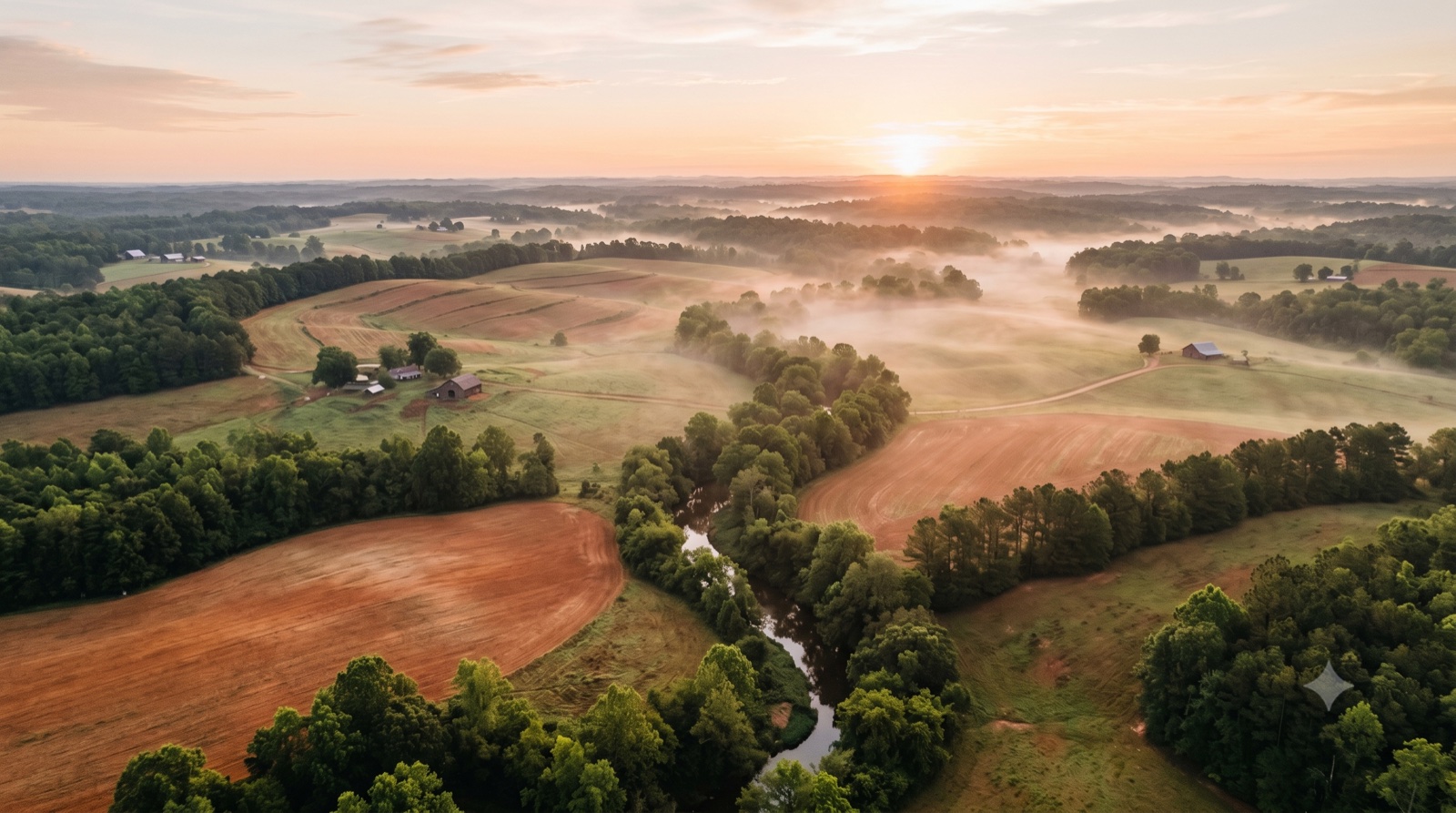
Sell My Land in Clinch County GA - What Landowners Need to Know
Key Takeaways
- Most of Clinch County is timberland, and historically most of that timberland was corporate-owned: A UGA and U.S. Forest Service inventory factsheet reported Clinch County holding the largest timberland acreage (469,000 acres) and the largest growing-stock volume (497 million cubic feet) of any county in its southeast Georgia survey unit — with forest industry owning 280,000 of those acres, roughly 60%. That data dates to a 1990s survey cycle, but the ownership pattern it describes is the single biggest reason the retail buyer pool here is thin
- Clinch is Georgia's #1 county for fruits, tree nuts, and berries — essentially blueberries: That category generated $59,556,000 of the county's $71,144,000 in 2022 agricultural sales, about 84%, ranking first among Georgia's 159 counties on 7,066 acres of berries, according to the USDA 2022 Census of Agriculture. Yet farms cover only about 8.7% of the county's land area, so the Ag Census describes a small slice of a mostly forested county
- Georgia taxes standing timber only once, at harvest or sale: Rather than assessing timber annually, Georgia levies an ad valorem tax on standing timber when it is harvested or sold, at 100% of fair market value rather than the 40% assessment ratio used for other property, under O.C.G.A. § 48-5-7.5. For a timber county, that timing changes when the tax bill actually lands
How Can You Sell Land in Clinch County Georgia?
You can sell land in Clinch County by listing with an agent, selling by owner, or requesting a direct cash offer — and every path closes through a Georgia closing attorney, who calculates and remits the transfer tax and records the deed with the Clerk of Superior Court. Before you start, verify your legal description with the Clerk and confirm whether the parcel sits under a CUVA or FLPA covenant, because breaching either one costs twice the tax savings you have received plus interest.
Clinch County covers roughly 824 square miles in the far south of Georgia, with Homerville as the county seat and the Okefenokee Swamp reaching into its eastern and southeastern reaches. Most of the county drains toward the Upper Suwannee River. Homerville sits about 35 miles east of Valdosta, 27 miles west of Waycross, and 35 miles south of Douglas.
The market reality here is unusual and worth understanding before you set expectations: this is a county where a large share of the acreage has historically been held by forest industry and timberland investment owners rather than individuals, which means much of the land was never going to reach a retail buyer pool in the first place. This guide covers Clinch County's property tax and use-value programs, Georgia's timber tax and attorney-closing process, how the county compares to its neighbors, and your practical options. Start with how to sell land in Georgia for the statewide view, and explore our blog for more.
What Are the Tax Costs of Holding Land in Clinch County?
Georgia assesses real property at 40% of fair market value, and Clinch County's effective property tax rate falls in a range of roughly 1.19% to 1.33% depending on the source and pull. Ownwell reports 1.33% for Homerville, Fargo, and Argyle, and 1.25% for Du Pont. Those figures come from aggregators rather than the county, so treat the range as the honest answer rather than picking a single number.
How Property Tax Bills Add Up for Vacant Land
Vacant land in Georgia carries the same 40% assessment ratio as other property, with county, school, and any municipal millage applied on top. Raw land generates no income to offset the bill, so the cost compounds quietly year after year. Because Clinch County is overwhelmingly rural, most parcels fall outside municipal millage entirely — but confirm which taxing districts apply to your specific parcel rather than assuming.
If you have fallen behind, selling land with back taxes explains the options before the county schedules a sale. If the parcel came through an estate, see how to sell inherited land.
CUVA, FLPA, and the Covenant Trap
Georgia offers two use-value programs that matter enormously on Clinch County acreage, and both carry covenants that outlast a casual sale decision.
Conservation Use Valuation Assessment (CUVA), under O.C.G.A. § 48-5-7.4, allows qualifying agricultural and timber land to be assessed on current use value rather than fair market value. It requires a minimum of 10 acres, caps enrollment at 2,000 acres per owner, and runs on a 10-year covenant. Breaching that covenant costs twice the tax savings received to date, plus interest.
The Forest Land Protection Act (FLPA) targets larger tracts: generally 200 or more contiguous acres of forest land, or qualifying parcels of 100+ acres within a county. It also runs a 10-year covenant, with a breach penalty of twice the annual tax savings plus interest and a 30-day cure window.
Two figures circulate widely online that are wrong: covenant lengths of 15 years and penalties of twice the tax savings. Both programs run 10 years, and both penalize at twice the savings. If your land is enrolled, the remaining covenant term travels with the sale conversation — a buyer who intends a non-qualifying use is triggering a breach, and that cost has to land somewhere. Confirm your parcel's status with the Board of Tax Assessors before agreeing to terms.
How Georgia Taxes Standing Timber
Georgia does not tax standing timber annually. Instead, under O.C.G.A. § 48-5-7.5, standing timber is taxed once, following its harvest or sale, assessed at 100% of fair market value rather than the 40% ratio applied to other property, then multiplied by the applicable local millage. Reporting mechanics differ between a lump-sum sale, where the sale price sets fair market value as of the sale date, and unit-price or owner-harvest sales, which are reported quarterly against a standing timber price schedule. For a county where timber is the dominant land cover, that one-time timing is a meaningful planning fact. If you are weighing a harvest against a sale, see should I sell the timber or sell the land.
What Zoning and Closing Rules Apply to Clinch County Land?
Land-use regulation in rural south Georgia is generally light outside municipal limits, so requirements depend on whether your parcel sits inside Homerville, Fargo, Argyle, or Du Pont, or in the unincorporated county. Confirm with the relevant jurisdiction before marketing land as buildable or subdividable.
Georgia's Attorney-Closing Process
Georgia real estate closings are conducted by a closing attorney, who examines title, prepares the deed, calculates and remits transfer taxes, and records the transfer. A typical Clinch County land sale runs:
- Purchase agreement: Buyer and seller execute a contract addressing price, earnest money, contingencies, and — for raw land — access, timber rights, and any recorded covenant such as CUVA or FLPA
- Title examination: The closing attorney traces the chain of title through Superior Court records, checking for liens, easements, timber deeds, and reserved interests
- Transfer tax: Georgia's real estate transfer tax is $1.00 for the first $1,000 of consideration, plus $0.10 per additional $100, customarily paid by the seller under standard Georgia purchase agreements, though negotiable
- Recording: The deed is recorded with the Clinch County Clerk of Superior Court, Mary Ruth Handley, 25 Court Square, Suite C, Homerville, GA 31634, (912) 487-5854
Where financing is involved, Georgia's intangible recording tax applies at $1.50 per $500 of a long-term note secured by real estate — about 0.30% — capped at $25,000. As of July 1, 2025, notes maturing in 62 months or less are exempt as short-term. On an all-cash purchase, neither the intangible tax nor a lender's requirements apply. For the complete document checklist, see paperwork needed to sell land.
For assessment questions and covenant status, contact the Clinch County Board of Tax Assessors, 25 Court Square, Suite D, Homerville, GA 31634, (912) 487-2561 — we recommend contacting that office by title rather than asking for a specific appraiser by name, as we could not independently confirm the current chief appraiser to our two-source standard. For tax payment and delinquency, the Tax Commissioner is Jamie Stalvey Douglas, 25 Court Square, Suite H, (912) 487-2480.
How Does Clinch County Compare to Neighboring Georgia Counties?
Clinch County's population has been essentially flat rather than collapsing: 6,798 in the 2010 Census, 6,749 in 2020, and roughly 6,759 on the most recent American Community Survey estimate. It is sparsely populated but not among Georgia's very smallest counties — neighboring Echols, at about 3,698 residents, is considerably smaller.
| Factor | Clinch County | Ware County | Echols County | Atkinson County |
|---|---|---|---|---|
| Population | 6,749 (2020); ~6,759 recent est. | 36,251 (2020) | ~3,698 (2024 est.) | Not verified — gap |
| Population trend | Flat since 2010 | Largest neighbor | Among Georgia's smallest | Not verified — gap |
| Effective tax rate | ~1.19%–1.33% | 0.83% or 1.23% (sources disagree) | 0.64% or 1.39% (sources disagree) | ~1.19%–1.39% |
| Defining land character | Largest timberland acreage in its survey unit; Georgia's #1 blueberry county | Shares the Okefenokee refuge; adopted timber-tax relief measures | Highest timberland percentage in the survey unit (94%) | Agricultural county seated at Pearson |
The tax-rate columns come from aggregators that disagree with each other substantially, so they are shown as ranges or as competing figures rather than averaged. We could not verify a current population figure for Atkinson County and have left that as an honest gap.
One clarification worth making, because it comes up in searches about this area: the Twin Pines titanium mining proposal was a Charlton County matter, not a Clinch County one. The Conservation Fund purchased that mining property and its mineral rights in June 2025, ending the dispute. Clinch County's connection to the Okefenokee story is the shared regional visitor economy — reported at $91.5 million across Ware, Charlton, and Clinch counties combined, not broken out by county.
Why the Buyer Pool Here Is Genuinely Thin
The ownership structure is the real story. According to the UGA and Forest Service inventory factsheet, forest industry owned 280,000 of Clinch County's 469,000 acres of timberland — roughly 60%, against a statewide Georgia pattern where about 91% of forestland is privately owned and a majority of that by non-industrial family owners. Clinch runs far more institutionally concentrated than the state norm. That figure comes from a 1990s survey cycle and should not be quoted as a current-year statistic, but institutional presence persists today: Molpus Woodlands Group, a timberland investment manager, has held and marketed tracts in the county.
When a large share of a county's acreage sits in institutional portfolios, it simply never enters the individual-owner resale market. The parcels that do trade compete for a small pool of local buyers in a county of under 7,000 people. We found no published days-on-market figure for Clinch County land and will not estimate one — but listing counts on land marketplaces run to a couple dozen properties at a time, consistent with a thin market.
Against that backdrop, the Ag Census picture is striking. Clinch County recorded 158 farms in 2022, up 40% from 2017, on 44,721 acres, up 63% — genuine growth, driven by the blueberry economy. Fruits, tree nuts, and berries brought $59,556,000, or 84% of the county's $71,144,000 in agricultural sales, ranking first in Georgia. Crops overall accounted for 94% of sales against 6% for livestock. But that entire farm economy sits on just 8.7% of the county's land. The other 91% is largely timber, and it plays by different rules. If your tract carries merchantable pine, see selling timberland and selling a cutover or recently logged tract; for hunting-lease parcels, selling hunting land.
What Are Your Options for Selling Land in Clinch County?
Your options are an agent listing, a for-sale-by-owner effort, or a direct cash sale — and in Clinch County the decisive question is usually whether your tract is large enough and clean enough to interest a timberland investor, or small enough to need a local individual buyer who may not exist in numbers. Those are very different sale paths.
Before pursuing any of them, verify your legal description and check for recorded timber deeds, easements, or reserved interests through the Clerk of Superior Court (Mary Ruth Handley, 25 Court Square, Suite C, Homerville, (912) 487-5854). Confirm your CUVA or FLPA covenant status with the Board of Tax Assessors (25 Court Square, Suite D, (912) 487-2561), and your tax standing with the Tax Commissioner (Jamie Stalvey Douglas, Suite H, (912) 487-2480). A recorded timber deed from a prior owner is a specific thing to look for in a county like this — it can mean the standing timber is not yours to sell.
Listing with an agent who specializes in south Georgia timber and recreational tracts gives you exposure to hunting-lease buyers and regional investors, which matters more here than local retail exposure. Commissions of roughly 5–6% plus closing costs reduce net proceeds, and large timber tracts can carry long marketing periods. Our guide on whether you need a realtor to sell land covers the tradeoffs.
Selling by owner eliminates commission but puts marketing, disclosure, timber-status research, and attorney coordination on you. Access-limited parcels are the hardest to move — see selling landlocked land. For what drives value on rural parcels, start with how much is my land worth.
For landowners who want to avoid extended timelines and ongoing carrying costs, companies like Jerez Land make direct cash offers priced individually to the parcel — a firm written number, not a range or a formula. We absorb the carrying costs, marketing expense, and resale risk, and we coordinate with the Georgia closing attorney. Request a cash offer to see what your parcel is worth to a direct buyer.
Frequently Asked Questions
I own timberland in Clinch County GA and want to sell — where do I start?
Start by verifying your legal description and checking for any recorded timber deed, easement, or reserved interest with the Clinch County Clerk of Superior Court, 25 Court Square, Suite C, Homerville, GA 31634, (912) 487-5854. Then confirm whether your parcel sits under a CUVA or FLPA covenant with the Board of Tax Assessors at (912) 487-2561. Georgia closings run through a closing attorney, so line one up before marketing the land.
I've been holding land in Clinch County for years — what am I paying in property taxes?
Georgia assesses real property at 40% of fair market value, and Clinch County's effective rate falls roughly between 1.19% and 1.33% depending on the source. Ownwell reports 1.33% for Homerville, Fargo, and Argyle, and 1.25% for Du Pont. Those come from aggregators rather than the county, so treat the range as the answer and confirm your specific parcel's taxing districts with the Tax Commissioner.
My Clinch County land is enrolled in CUVA — what happens when I sell?
CUVA runs on a 10-year covenant under O.C.G.A. § 48-5-7.4, and breaching it costs twice the tax savings you have received to date, plus interest. Selling does not automatically breach the covenant if the buyer continues a qualifying use and assumes it, but a buyer intending a non-qualifying use triggers the penalty — and that cost has to be accounted for in your terms. Confirm your remaining covenant term with the Clinch County Board of Tax Assessors before agreeing to a price.
I inherited land near Homerville but live out of state — can I sell it without traveling to Georgia?
Yes. Georgia closings are handled by a closing attorney who can coordinate title examination, deed preparation, transfer tax remittance, and funding remotely, and documents can generally be signed before a notary where you live. You will need the legal description verified through the Clinch County Clerk of Superior Court and the covenant and tax status confirmed with the Board of Tax Assessors and Tax Commissioner, all located at 25 Court Square in Homerville.
How is standing timber taxed in Georgia?
Georgia taxes standing timber only once, following its harvest or sale, rather than assessing it annually. Under O.C.G.A. § 48-5-7.5 it is assessed at 100% of fair market value — not the 40% ratio used for other property — then multiplied by the applicable local millage. A lump-sum sale sets fair market value at the sale price as of the sale date, while unit-price and owner-harvest sales are reported quarterly against a standing timber price schedule.
Is Clinch County's population growing or declining?
Essentially flat. The county counted 6,798 residents in the 2010 Census and 6,749 in 2020 — a decline of about 0.7% — with the most recent American Community Survey estimate at roughly 6,759. Clinch is sparsely populated but not one of Georgia's very smallest counties; neighboring Echols County, at about 3,698 residents, is considerably smaller.
Disclaimer: This article is for informational purposes only and does not constitute legal, financial, or professional advice. Laws and regulations vary by jurisdiction and change over time. Always consult with qualified professionals before making land purchase decisions. Jerez Land is not responsible for actions taken based on this information.