
Sell My Land in Gladwin County MI - What Landowners Need to Know
Key Takeaways
- Michigan transfer tax is seller-paid at $3.75 per $500 state plus $0.55 per $500 county: Michigan sellers fund both levies at closing, totaling $4.30 per $500 (0.86%) of the sale price — a meaningful line item on the wooded recreational and river-frontage parcels that dominate Gladwin County, according to the Michigan Department of Treasury
- Gladwin County property is assessed at 50% of true cash value (SEV), with taxable value capped annually by Proposal A (1994) at the lesser of inflation or 5% — but taxable value uncaps and resets to SEV whenever the property is sold, which can significantly increase annual tax bills for buyers
- Population has been essentially flat: roughly 25,692 in 2010, 25,386 in 2020, and approximately 26,000 in recent estimates, per U.S. Census Bureau data — a stable but aging base with a heavy seasonal and out-of-state presence around the Au Sable State Forest and the chain of impoundment lakes on the Tittabawassee and Cedar rivers
How Can You Sell Land in Gladwin County Michigan?
To sell land in Gladwin County, Michigan, you can work with a title company to handle the closing (attorney not required in Michigan), list with a recreational property broker to reach seasonal buyers, or request a direct cash offer from a land buyer. Selling land in Gladwin County means contending with a property tax system built on two layers — the State Equalized Value (SEV) and a taxable value cap that resets at sale — a seller-paid transfer tax of $3.75 per $500 (state) plus $0.55 per $500 (county), and a land market shaped heavily by forest, farmland, and river-and-lake recreation across the north-central Lower Peninsula.
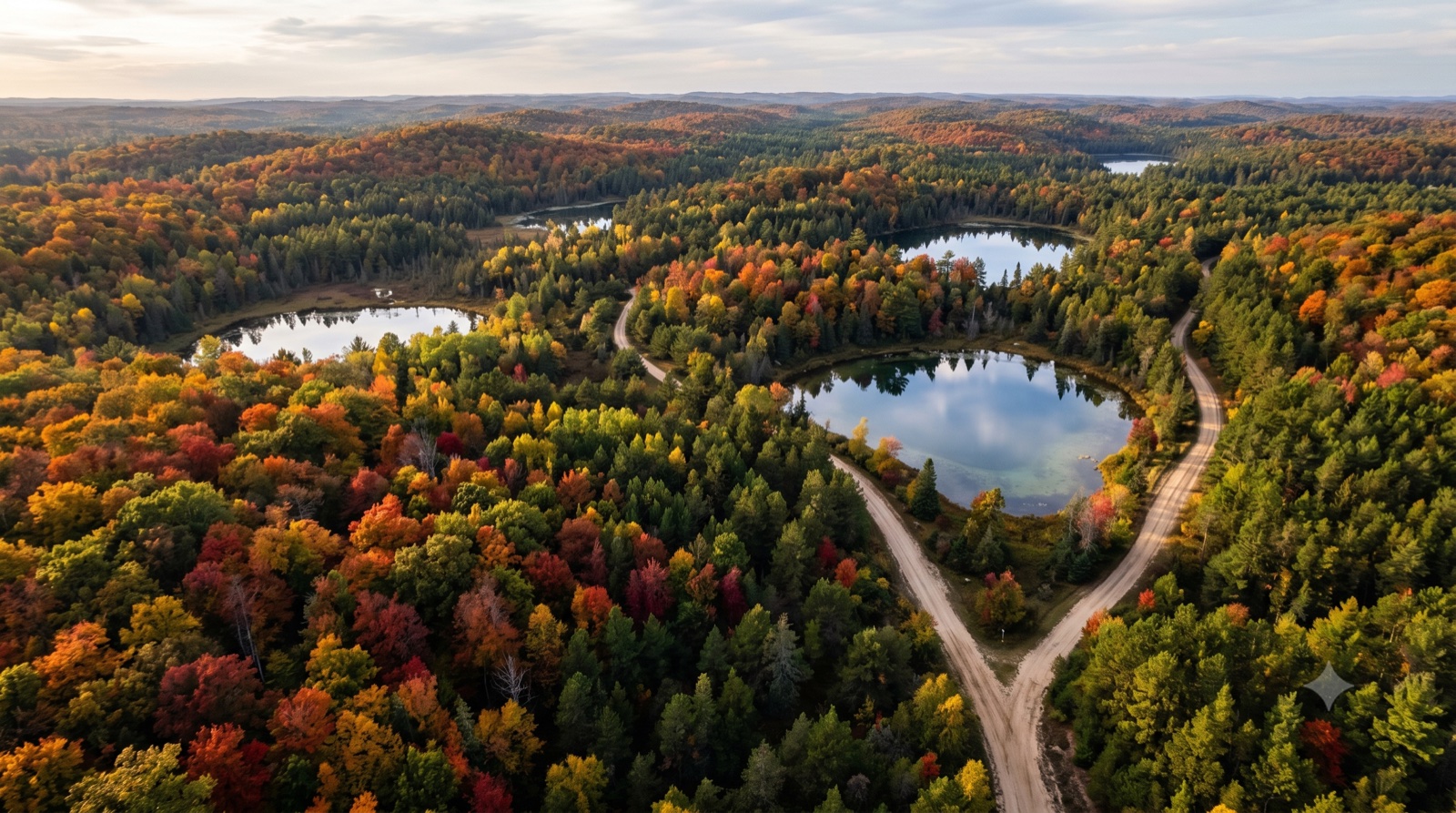
The county covers roughly 516 square miles, with the city of Gladwin serving as the county seat near the center. The terrain is flat to gently rolling, a patchwork of mixed hardwood and red pine woodland, working farmland, and the river corridors of the Cedar and Tittabawassee rivers. A large share of the county lies within or borders the Au Sable State Forest, and a chain of impoundment lakes — Secord, Smallwood, and (historically) Wixom — drew decades of cottage and recreational-lot buyers. Hunting, fishing, canoeing, and seasonal cottage use anchor a substantial population of downstate and out-of-state property owners.
This guide walks through Gladwin County's property tax mechanics, Michigan's title-company closing process, how the county compares to its neighbors, and your practical options for exiting a parcel. For the statewide picture, start with our Michigan land selling guide, and browse more county-level guides on our blog.
What Are the Tax Costs of Holding Land in Gladwin County?
Michigan's property tax system is more layered than most states. Every parcel has two relevant values: the State Equalized Value (SEV), which equals 50% of the assessor's estimate of true cash value (market value), and the taxable value, which is the figure millage rates are actually applied to.
Under Proposal A (1994), taxable value increases annually at the lesser of the Consumer Price Index or 5% — regardless of how fast market values rise. This cap protects long-term owners from large tax swings. However, when a property is sold, taxable value uncaps and resets to the property's current SEV in the year following the sale. For buyers purchasing land that has been held for many years — common in Gladwin County, where wooded recreational lots and river-frontage cottages have changed hands within families for generations — this uncapping can substantially increase the annual tax bill.
Gladwin County's property taxes are modest by national standards. The median effective property tax rate runs near 0.52% of market value, and the median annual property tax bill is roughly $747, according to Ownwell — well below the national median. But the effective rate on any one parcel depends heavily on township, school district, and how long it has been held, because the gap between a long-capped taxable value and a freshly uncapped SEV can be large. Millage rates differ by township and school district; the Gladwin County Equalization Department publishes annual assessment and millage data, and the Michigan Department of Treasury publishes total millage rates statewide.
Michigan Transfer Tax: Seller Pays Both State and County Levies
Michigan's real estate transfer tax is seller-paid at two levels:
- State transfer tax: $3.75 per $500 of sale price (or fraction thereof)
- County transfer tax: $0.55 per $500 of sale price (or fraction thereof)
- Combined: $4.30 per $500, or approximately 0.86% of the purchase price
On a $50,000 land sale, the combined transfer tax would be $430. This is a meaningful cost compared to states like Mississippi (which charges no transfer tax). Michigan sellers should factor both levies into their net proceeds calculation.
Certain transfers are exempt from Michigan's transfer tax, including transfers between spouses, certain foreclosure deeds, and transfers where no money changes hands. See the Michigan Department of Treasury for a complete exemption list.
If you're an out-of-state owner managing a Gladwin County parcel from afar, our guide on selling land as an out-of-state owner covers the remote-closing logistics Michigan title companies handle routinely.
Use-Value Programs: QFP, Commercial Forest, and PA 116
Michigan offers three use-value programs that can lower the tax burden on rural land — and each carries consequences at sale that a seller must understand before signing anything.
The Qualified Forest Program (QFP) is a property tax incentive for forestland owners — open to landowners with 20 to 39 contiguous acres (at least 80% productive forestland) or 40+ acres (at least 50% productive forestland), with an approved forest management plan. QFP exempts the land from school operating millage (up to 18 mills) and protects against taxable-value uncapping when the property transfers within the program. This matters in Gladwin County, where the USDA's 2022 Census of Agriculture counts 7,643 acres of woodland within farms alone, and where parcels bordering the Au Sable State Forest are common. When QFP property is sold to a buyer who does not continue the program, a recapture provision applies: the seller (or buyer, depending on the purchase agreement) must repay the tax benefit, going back up to 10 years, according to MSU Extension — similar to Tennessee's Greenbelt rollback.
The Commercial Forest program offers a low flat per-acre specific tax on 40+ acre productive forest tracts, but unlike QFP it requires public foot access for hunting and fishing. PA 116 (the Farmland and Open Space Preservation Act) lets a farm owner enter a Farmland Development Rights Agreement with the state for at least 10 years in exchange for an income tax credit and exemption from certain special assessments; terminating or withdrawing land early can trigger a repayment lien. Before accepting any offer on land enrolled in any of these programs, consult MDARD or a qualified forester to calculate potential recapture or lien liability. If your parcel is primarily wooded, our guide on selling timberland covers what buyers look for, and for working ground see selling farmland.
What Zoning and Closing Rules Apply in Gladwin County?
Michigan does not require a licensed attorney to be present at a real estate closing. Closings are routinely handled by title companies, which conduct the title search, issue title insurance, prepare the deed (warranty deed or limited warranty deed), collect the transfer tax, and record documents with the county Register of Deeds. Attorney involvement is optional but advisable for complex transactions — particularly those involving easements, river or lake access rights, timber rights, or Qualified Forest Program recapture.
A typical Michigan title-company closing on Gladwin County land follows these steps:
- Open title and order a search — the title company pulls the chain of title and identifies liens, easements, and any delinquent taxes.
- Resolve exceptions — outstanding taxes, expired use-value enrollments, plat restrictions, or heir/probate gaps are cleared before closing.
- Prepare the deed and closing statement — the title company drafts the warranty or limited warranty deed and itemizes the seller-paid transfer tax.
- Sign and fund — documents are signed (remote/mail-away closings are routine for out-of-state owners), and funds are disbursed.
- Record with the Register of Deeds — the deed and any transfer affidavit are recorded with Gladwin County, and the buyer files a Property Transfer Affidavit to trigger the taxable-value uncapping.
The Gladwin County Register of Deeds is located in the Gladwin County Courthouse at 401 West Cedar Avenue, Gladwin, MI 48624, phone 989-426-7551, with office hours Monday through Friday, 8:30 a.m. to 4:30 p.m. The Register of Deeds records all deeds, mortgages, and land contracts for the county.
Zoning and Land Use
Gladwin County's townships maintain their own zoning ordinances; there is no single county-wide zoning code, though the county supports planning at the township level. Most rural land in the county is zoned agricultural, forest-recreational, or residential-rural, with recreational, hunting, and forestry uses generally permitted by right. River-adjacent and lakefront parcels frequently carry additional shoreline or setback rules, and many older platted lake subdivisions have recorded plat restrictions that survive a sale.
The Au Sable State Forest and Michigan DNR maintain substantial public land in and around Gladwin County. Proximity to that public land can be a selling point for buyers seeking hunting, fishing, and recreational access, or a limitation for those seeking privacy. If your parcel is held mainly for deer or turkey hunting, our guide on selling hunting land explains how access, cover, and food sources factor into a sale.
How Does Gladwin County Compare to Neighboring Michigan Counties?
Gladwin County's population has been essentially flat over the past decade and a half — roughly 25,692 in 2010, 25,386 in 2020, and approximately 26,000 in recent estimates, per U.S. Census Bureau data. Unlike the steep rural declines seen in some southern states, north-central Michigan holds its base through a combination of retiree presence and a large seasonal cottage population. The county's agriculture is real but shrinking at the edges: the USDA's 2022 Census of Agriculture counts 419 farms (down 9% from 2017) across 52,978 acres of farmland (down 10%), averaging 126 acres per farm — a profile of small family farms and woodlots, not large commercial operations.
| Factor | Gladwin County | Clare County | Arenac County | Midland County |
|---|---|---|---|---|
| Population (recent est.) | ~26,000 | ~31,000 | ~15,000 | ~83,000 |
| Population trend | Stable | Stable | Stable/slight decline | Stable |
| Effective tax rate | ~0.52% | ~0.82% | ~0.95% | ~1.30% |
| County seat | Gladwin | Harrison | Standish | Midland |
| Distance to Flint/Detroit | ~95 mi / ~150 mi | ~110 mi / ~165 mi | ~75 mi / ~130 mi | ~70 mi / ~125 mi |
| Key recreational draw | Au Sable State Forest, Cedar & Tittabawassee rivers, Secord Lake | Clare lakes, AuSable headwaters | Saginaw Bay, waterfowl | Chippewa & Tittabawassee rivers, Dow corporate base |
The comparison shows Gladwin County as a classic mid-Michigan forest-and-farm county: smaller and more rural than Midland (anchored by the Dow corporate economy to the south) and Clare (with its lake cluster to the west), and broadly similar to Arenac to the southeast in its recreation-and-retiree profile. Roscommon and Ogemaw counties lie to the north; Bay County lies to the south. All share a heavy reliance on seasonal property, hunting, and outdoor recreation rather than high-wage year-round employment.
The Dam Failures and the River-Lake Market
The defining recent event in Gladwin County's recreational-land market is the May 2020 failure of the Edenville Dam, which triggered the downstream Sanford Dam failure and drained the impoundment lakes on the Tittabawassee River — most dramatically Wixom Lake, which sits on the Gladwin–Midland line. As of mid-2026, the Four Lakes Task Force reports that restoration is underway: Secord, Smallwood, and Sanford lakes are projected to return toward normal levels by 2026, while Wixom Lake is not expected to refill until 2028 and the Edenville Dam itself is not slated for completion until 2027. Residents within the special assessment district are funding a large share of the roughly $200 million-plus restoration. For owners of former lakefront lots — particularly on Wixom Lake — this means years of carrying a parcel whose water has not yet returned, with a special assessment attached. That is precisely the kind of carrying-cost-and-uncertainty situation that drives owners to sell.
For help understanding what your parcel might be worth before you list, our guide on how much is my land worth explains the factors that drive value in northern Michigan's recreational market. And if you're weighing whether to involve an agent at all, see do you need a realtor to sell land.
What Are Your Options for Selling Land in Gladwin County?
The most common Gladwin County seller is an out-of-state or downstate Michigan owner who inherited or bought a wooded recreational tract, a hunting forty, or a lake lot decades ago, no longer uses it, and is now weighing whether ongoing taxes, special assessments, and maintenance justify holding on. Watch for the signals that usually mean it's time to sell: you haven't set foot on the lot in years, the annual tax bill arrives and you'd struggle to say exactly where the parcel sits, you've inherited a hunting parcel alongside siblings who all live out of state, your former Wixom Lake lot still has no water but the assessment keeps coming, or you're simply tired of paying every year for land that does nothing for you. Any one of those is a reason landowners in this county decide to cash out.
Before accepting any offer, take these steps. Confirm your current taxable value and SEV through the Gladwin County Equalization Department (401 West Cedar Avenue, Gladwin, 989-426-7551). Verify deed and title through the Register of Deeds (401 West Cedar Avenue, Gladwin, 989-426-7551). Check for delinquent property taxes through the Gladwin County Treasurer (401 West Cedar Avenue, Gladwin, 989-426-7251, Treasurer@gladwincounty-mi.gov) — Michigan's tax-forfeiture timeline moves faster than most states, with forfeiture roughly one year after delinquency and foreclosure the year after. If the property is enrolled in QFP, Commercial Forest, or PA 116, contact MDARD to calculate any recapture or lien liability. And if your lot sits in a recorded lake-subdivision plat, pull the plat restrictions so you know what conveys. If you're behind on taxes, our guide on selling land with back taxes walks through your options.
Sellers have several realistic paths. Listing with a Michigan land-specialist agent or recreational property broker gives access to downstate buyers through platforms like LandSearch and Lands of America — but wooded-recreational and lake-lot demand is seasonal, commissions apply, the buyer pool for raw and undeveloped land is thin, and a remote owner may wait many months for the right buyer. For landowners who want a specific number in hand quickly — without the uncertainty of seasonal demand cycles — Jerez Land provides a direct, parcel-specific written cash offer for your land. Because we buy for cash and absorb the carrying, marketing, and resale risk ourselves, our offer reflects the certainty and speed we provide. There are no agent commissions, no repairs, and a closing timeline driven by when the title is clear, not when the seasonal market cooperates. For owners of raw, unimproved acreage, our guide on selling raw undeveloped land covers what to expect.
Frequently Asked Questions
How do I sell vacant land in Gladwin County Michigan?
Verify your deed and title through the Gladwin County Register of Deeds (989-426-7551, 401 West Cedar Avenue, Gladwin). Check your current taxable value through the Equalization Department and confirm any Qualified Forest Program, Commercial Forest, or PA 116 enrollment. Michigan does not require an attorney at closing — title companies handle most rural and recreational land transactions, including remote closings for out-of-state owners. You can list with a recreational land broker, market on platforms like LandSearch and Lands of America, or request a direct cash offer from a land buyer.
What's my property tax bill likely to be if I buy land in Gladwin County?
Gladwin County's median effective property tax rate is roughly 0.52% of market value, with a median annual tax bill near $747, according to Ownwell — though the rate on any individual parcel varies by township, school district, and how long it has been held. Taxable value equals 50% of the assessor's true cash value (SEV), capped annually at the lesser of CPI or 5% under Proposal A (1994). When a property sells, taxable value uncaps and resets to the current SEV, which can substantially increase annual taxes for the buyer. Millage rates vary by township and school district.
I'm selling land in Michigan — how much will the transfer tax cost me?
Michigan charges two seller-paid transfer taxes: $3.75 per $500 of sale price (state) and $0.55 per $500 (county), totaling $4.30 per $500 — approximately 0.86% of the purchase price. On a $50,000 land sale, the combined transfer tax is $430. Certain transfers — between spouses, some foreclosure deeds — are exempt. The transfer tax is paid at closing and recorded alongside the deed with the Gladwin County Register of Deeds.
Do I need a lawyer to close my land sale in Michigan?
No. Michigan does not require a licensed attorney to be present at a real estate closing. Title companies conduct the title search, issue title insurance, prepare the deed, collect the transfer tax, and record documents with the Register of Deeds. Attorney involvement is optional but recommended for transactions involving Qualified Forest Program recapture, river or lake access rights, timber rights, plat restrictions, or complex ownership history.
My property is enrolled in Michigan's Qualified Forest Program — what happens when I sell?
Michigan's Qualified Forest Program (QFP) exempts qualifying forestland owners (20+ contiguous acres with an approved forest management plan) from school operating millage — up to 18 mills — and prevents taxable-value uncapping during qualifying transfers. When QFP property is sold to a buyer who does not continue the program, a recapture provision requires repayment of the tax benefit for up to 10 years, according to MSU Extension. QFP recapture can equal several thousand dollars on a long-held parcel and must be addressed in the purchase agreement before closing. Commercial Forest and PA 116 carry similar at-sale consequences.
What happened to Wixom Lake and the Gladwin County lakes?
The May 2020 failure of the Edenville Dam — and the downstream Sanford Dam — drained several impoundment lakes on the Tittabawassee River, including Wixom Lake on the Gladwin–Midland line. As of mid-2026, the Four Lakes Task Force reports restoration underway: Secord, Smallwood, and Sanford lakes are projected to return toward normal levels by 2026, while Wixom Lake is not expected to refill until 2028 and the Edenville Dam is not slated for completion until 2027. Owners of former lakefront lots are carrying parcels — often with a special assessment attached — while the water has not yet returned, a common reason these lots come up for sale.
Disclaimer: This article is for informational purposes only and does not constitute legal, financial, or professional advice. Laws and regulations vary by jurisdiction and change over time. Always consult with qualified professionals before making land purchase decisions. Jerez Land is not responsible for actions taken based on this information.