
Sell My Land in Missaukee County MI - What Landowners Need to Know
Key Takeaways
- Michigan transfer tax is seller-paid at $3.75 per $500 state plus $0.55 per $500 county: Unlike states with no transfer tax, Michigan sellers fund both levies at closing, totaling $4.30 per $500 (0.86%) of the sale price — a meaningful line item on the timber, farmland, and recreational tracts that change hands in Missaukee County
- Missaukee County property is assessed at 50% of true cash value (SEV), with taxable value capped annually by Proposal A (1994) at the lesser of inflation or 5% — but taxable value uncaps and resets to SEV whenever the property is sold, which can significantly increase annual tax bills for buyers
- Population is small but quietly growing: From approximately 14,849 in 2010 to 15,052 in 2020, with a heavy agricultural and forest economy and a notable share of seasonal lake lots and absentee out-of-state owners characteristic of the northern Lower Peninsula, according to U.S. Census Bureau data
How Can You Sell Land in Missaukee County Michigan?
Selling land in Missaukee County, Michigan means contending with a property tax system built on two layers — the State Equalized Value (SEV) and a taxable value cap that resets at sale — a seller-paid transfer tax of $3.75 per $500 (state) plus $0.55 per $500 (county), and a land market shaped by dairy and crop farmland, working timber, the Pere Marquette State Forest, and a scatter of recreational lake lots owned by aging out-of-state buyers.
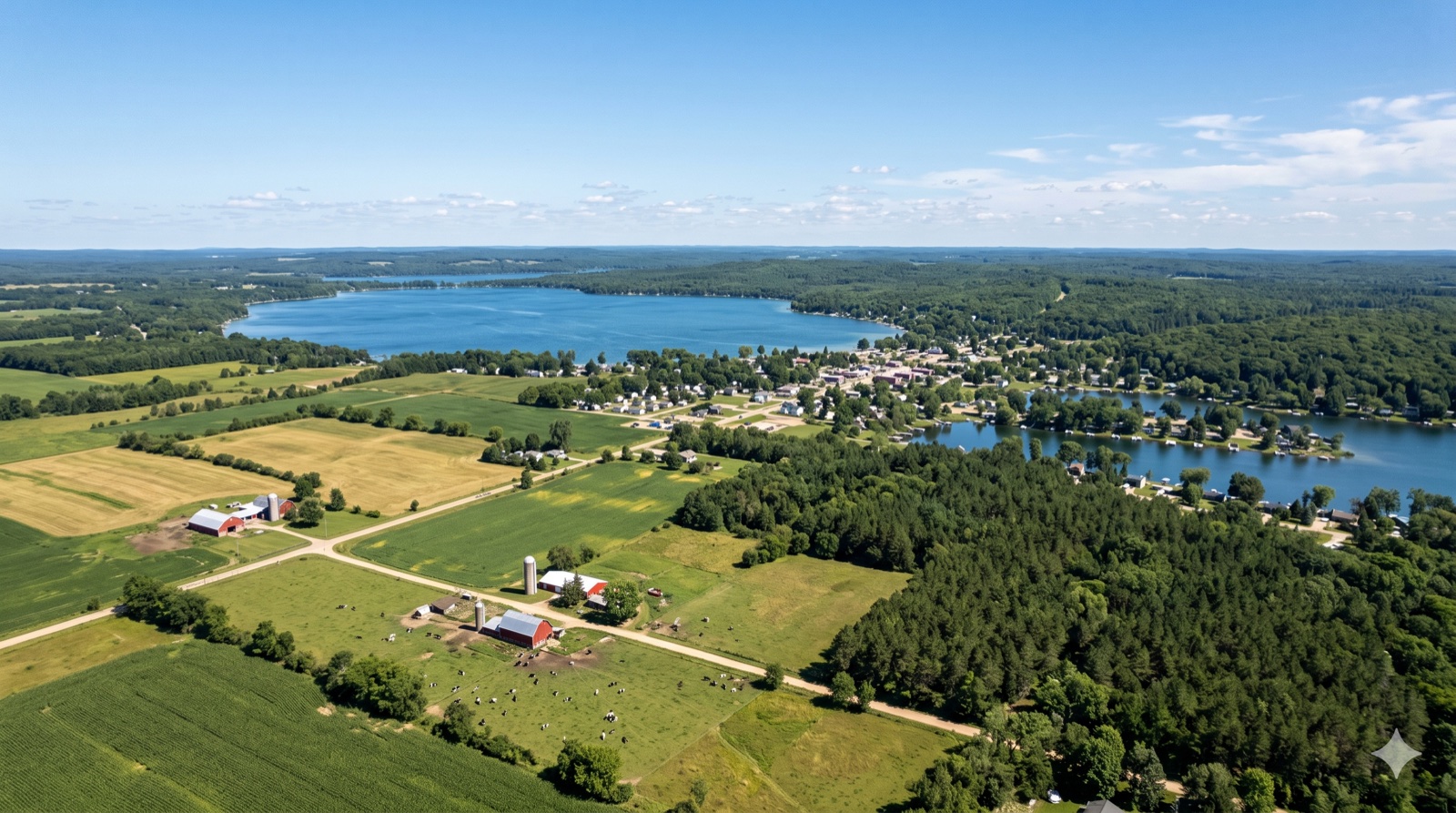
The county sits in the north-central Lower Peninsula, with Lake City serving as the county seat on the shore of Lake Missaukee. The landscape is a patchwork: rolling cropland and dairy pasture in the west and south, jack pine, red pine, and northern hardwood timber across the east, and the Pere Marquette State Forest threading through the townships. Lake Missaukee, Sapphire Lake, and smaller inland waters anchor a seasonal recreational population, while snowmobile and ORV trails draw winter and off-road traffic. It is an affordable, slow-moving rural market where parcels can sit for a long time before the right buyer appears.
This guide walks through Missaukee County's property tax mechanics, Michigan's title-company closing process, how the county compares to its neighbors, and your practical options for exiting a parcel. For the statewide picture, start with our Michigan land selling guide, and browse more county and topic guides for related reading.
What Are the Tax Costs of Holding Land in Missaukee County?
Missaukee County's property tax costs depend on two key values: the State Equalized Value (SEV) — which equals 50% of the assessor's estimate of true cash value (market value) — and the taxable value, which is the figure millage rates are actually applied to. Michigan's property tax system is more layered than most states, with special rules that affect how long you hold the land and what happens when you sell.
Under Proposal A (1994), taxable value increases annually at the lesser of the Consumer Price Index or 5% — regardless of how fast market values rise. This cap protects long-term owners from large tax swings. However, when a property is sold, taxable value uncaps and resets to the property's current SEV in the year following the sale. For buyers purchasing land that has been held for many years — common across Missaukee County, where farm ground and recreational lots have stayed within families for generations — this uncapping can substantially increase the annual tax bill.
Missaukee County's effective property tax rate on land typically lands near 0.95% of true cash value for non-homestead vacant parcels, though the relationship between assessed value, taxable value, and market price means the figure varies widely by township, school district, and how long the parcel has been held. The median property tax bill in the county runs approximately $1,099 per year, according to Ownwell. Millage rates differ by township and school district; the Missaukee County Equalization Department publishes annual millage rates and reports, and the Michigan Department of Treasury maintains a statewide property tax estimator.
Michigan Transfer Tax: Seller Pays Both State and County Levies
Michigan's real estate transfer tax is seller-paid at two levels:
- State transfer tax: $3.75 per $500 of sale price (or fraction thereof)
- County transfer tax: $0.55 per $500 of sale price (or fraction thereof)
- Combined: $4.30 per $500, or approximately 0.86% of the purchase price
On a $60,000 land sale, the combined transfer tax would be $516. This is a meaningful cost compared to states like Mississippi (which charges $0.00) or Tennessee (which charges $0.37 per $100, or 0.37%). The seller is legally responsible for the tax, and the county Register of Deeds will not record the deed until it has been paid — so Michigan sellers should factor both levies into their net proceeds calculation.
Certain transfers are exempt from Michigan's transfer tax, including transfers between spouses, certain foreclosure deeds, and transfers where no money changes hands. See the Michigan Department of Treasury for a complete exemption list.
If you're an out-of-state owner managing a Missaukee County parcel from afar, our guide on selling land as an out-of-state owner covers the remote-closing logistics Michigan title companies handle routinely.
What Closing Requirements and Zoning Rules Apply in Missaukee County?
Michigan does not require a licensed attorney to be present at a real estate closing. Closings are routinely handled by title companies, which conduct the title search, issue title insurance, prepare the deed (warranty deed or limited warranty deed), collect the transfer tax, and record documents with the county Register of Deeds. Attorney involvement is optional but advisable for complex transactions — particularly those involving easements, lake access rights, timber rights, or Qualified Forest Program recapture.
The Missaukee County Register of Deeds is part of the combined Clerk & Register of Deeds office, located at the county building at 111 South Canal Street, P.O. Box 800, Lake City, MI 49651, phone (231) 839-4967 (Register of Deeds Ext. 203), email clerk@missaukee.org. Office hours are Monday through Friday, 8:30 a.m. to 5:00 p.m. Deeds are not recorded — and the transfer therefore not complete — until the transfer tax is paid.
The Missaukee County Equalization Department, which oversees county property assessment, is in the same county building at 111 South Canal Street, Lake City, phone (231) 839-2702.
Michigan's Qualified Forest Program: Tax Savings with Recapture on Sale
Michigan's Qualified Forest Program (QFP) is a state tax incentive for forestland owners with at least 20 acres of forestland and a forest management plan. Qualifying landowners receive two benefits: an exemption from school operating millage (up to 18 mills depending on township), and protection from taxable-value uncapping when the property transfers within the program. A separate, older Commercial Forest Act (CFA) offers a flat per-acre tax in exchange for keeping land open to public hunting and fishing — relevant on larger timber holdings.
The savings can be significant in Missaukee County, where school operating millage is often the largest single millage component, and where working timber stands within and bordering the Pere Marquette State Forest are common. However, when QFP property is sold and the new owner does not continue the program, a recapture provision applies. The seller (or buyer, depending on the purchase agreement) must repay the taxes that would have been paid without the QFP exemption, going back up to a defined recapture period, according to MSU Extension. This is similar to Tennessee's Greenbelt rollback and can represent a substantial sum on parcels held under QFP for many years.
Before accepting any offer on QFP-enrolled or CFA-enrolled land, consult with the Michigan Department of Agriculture and Rural Development (MDARD), the Michigan DNR, or a qualified forester to calculate potential recapture liability. If your parcel is primarily wooded, our guide on selling timberland covers what buyers look for; if it's working farm ground, see selling farmland.
Zoning and Land Use
Missaukee County's townships maintain their own zoning ordinances; there is no unified county-wide zoning code, though the county supports planning at the county level. Lake City (the county seat) and the village of McBain anchor the populated areas. Most rural land in the county is zoned agricultural, forest-recreational, or residential-rural, with farming, forestry, and recreational uses generally permitted by right. Qualified Agricultural property used for farming may receive a use-value exemption from certain school operating millage. Lakefront parcels on Lake Missaukee and Sapphire Lake frequently carry additional shoreline or setback rules, and many older platted subdivisions have recorded plat restrictions that survive a sale.
The Pere Marquette State Forest and Michigan DNR maintain substantial public land throughout the county. Proximity to that public land — and to the area's snowmobile and ORV trail network — can be a selling point for buyers seeking hunting, fishing, and recreational access. If your land is hunting ground, our guide on selling hunting land explains how access, cover, and trail proximity factor into a sale.
How Does Missaukee County Compare to Neighboring Michigan Counties?
Missaukee County's population has grown modestly over the past decade and a half — roughly 14,849 in 2010 and 15,052 in 2020, per U.S. Census Bureau data. Unlike the steep rural declines seen in some southern states, this corner of the northern Lower Peninsula has held and slightly grown its base on the strength of agriculture and a steady recreational draw. Median household income is approximately $66,194, with roughly 6% of families below the poverty line, according to Census and Data USA figures — a working farm-and-forest economy rather than a high-wage one.
The agricultural footprint is real and distinctive: the USDA's 2022 Census of Agriculture counted 344 farms working 118,133 acres in Missaukee County, with livestock and dairy driving about 79% of the roughly $289.6 million in products sold. Milk from cows alone accounted for about $189 million — ranking the county third in Michigan — and Missaukee is the state's leading producer of cultivated Christmas trees. Forage, corn for silage, and corn for grain top the crop acreage, with woodland making up a substantial share of land in farms.
| Factor | Missaukee County | Wexford County | Roscommon County | Osceola County |
|---|---|---|---|---|
| Population (2020) | ~15,052 | ~33,673 | ~23,459 | ~22,891 |
| Population trend | Slight growth | Stable/slight growth | Stable | Stable |
| Effective tax rate | ~0.95% | ~1.00% | ~0.90% | ~1.05% |
| County seat | Lake City | Cadillac | Roscommon | Reed City |
| Land character | Dairy & crop farmland, timber, state forest, lake lots | Cadillac hub, lakes, forest, light industry | Higgins & Houghton Lakes, heavy seasonal/recreational | Farmland, forest, US-131 corridor |
| Key recreational draw | Pere Marquette State Forest, Lake Missaukee, ORV/snowmobile trails | Lake Cadillac, Lake Mitchell, Manistee NF | Higgins Lake, Houghton Lake, Au Sable headwaters | Hersey & Muskegon rivers, state game areas |
The comparison shows Missaukee as the smallest of this cluster by population, with Wexford County's Cadillac serving as the regional commercial hub to the west. Roscommon, to the east, is the most heavily recreational of the group thanks to Higgins and Houghton Lakes. All four counties share an affordable, rural northern-Michigan land market driven by farming, forestry, and seasonal recreation rather than year-round wage employment.
Economy and Absentee Ownership
Missaukee County's year-round economy is anchored by agriculture — dairy in particular — along with forestry, retail trade, and health care and social assistance. The county's remote location relative to major industrial centers limits large-scale manufacturing, so farm ground, timber, and seasonal property remain central to the land market.
The absentee-owner dynamic is a defining feature of that market. Many recreational parcels — platted lake lots on Lake Missaukee and Sapphire Lake, and wooded tracts bordering the Pere Marquette State Forest — were purchased decades ago by families from southern Michigan, Ohio, and beyond. Those original buyers are often now in their 70s and 80s, or have passed the lots to heirs who have never visited. Succession, estate settlement, and outright sale grow more common as a generation of out-of-state lot owners ages out. Absentee owners managing land from a distance often underestimate annual carrying costs: taxes, liability exposure, basic maintenance, and the quiet erosion of title clarity over decades. If you inherited your parcel, our guide on how to sell inherited land walks through the steps.
For help understanding what your parcel might be worth before you list, our guide on how much is my land worth explains the factors that drive value in northern Michigan's farm, timber, and recreational market. And if you're weighing whether to involve an agent at all, see do you need a realtor to sell land.
What Are Your Options for Selling Land in Missaukee County?
The most common Missaukee County seller is an out-of-state or downstate Michigan owner who inherited or purchased a recreational lot or wooded tract decades ago, no longer uses it, and is now weighing whether ongoing taxes and maintenance justify holding on. Another is a farm or timber owner ready to step back from working the ground. Watch for the signals that usually mean it's time to sell: you haven't set foot on the lot in years, the annual tax bill arrives and you'd struggle to say exactly where the parcel is, you've inherited land alongside siblings who all live out of state, or you're simply tired of paying every year for land that does nothing for you. Any one of those is a reason landowners in this county decide to cash out.
Before accepting any offer, take these steps. Confirm your current taxable value and SEV through the Missaukee County Equalization Department (111 S. Canal St., Lake City, (231) 839-2702). Verify deed and title through the Register of Deeds, part of the Clerk's office under Adriana Fowler (111 S. Canal St., (231) 839-4967 Ext. 203, clerk@missaukee.org). Check for any delinquent county property taxes with Treasurer Lori Cox (treasurer@missaukee.org, (231) 839-4967 Ext. 205) — Michigan's tax-forfeiture timeline moves faster than most states once a parcel falls behind, and our guide on selling land with back taxes covers the options. If the property is enrolled in the Qualified Forest Program or Commercial Forest Act, contact MDARD or the DNR to calculate potential recapture before you sign.
Sellers have several realistic paths. Listing with a Michigan land-specialist agent or recreational property broker gives access to downstate buyers through platforms like LandSearch and Lands of America — but timber, farmland, and lake-lot demand can be seasonal and slow-moving in this market, commissions apply, and a remote owner may wait many months for the right buyer. For landowners who want a specific number in hand quickly — without the uncertainty of a thin, slow market — Jerez Land provides a direct, parcel-specific written cash offer for your land. Because we buy for cash and absorb the carrying, marketing, and resale risk ourselves, our offer reflects the certainty and speed we provide, not a retail listing price. There are no agent commissions, no repairs, and a closing timeline driven by when the title is clear, not when the seasonal market cooperates.
Frequently Asked Questions
I own vacant land in Missaukee County Michigan — how do I sell it?
Verify your deed and title through the Missaukee County Register of Deeds, part of the Clerk's office ((231) 839-4967 Ext. 203, 111 S. Canal St., Lake City). Check your current taxable value and confirm any Qualified Forest Program or Commercial Forest enrollment through the Equalization Department ((231) 839-2702). Michigan does not require an attorney at closing — title companies handle most rural land transactions, including farm, timber, and recreational parcels. You can list with a land-specialist broker, market on platforms like LandSearch and Lands of America, or request a direct cash offer from a land buyer.
What annual property taxes will I owe on Missaukee County land?
Missaukee County's effective property tax rate on vacant land generally falls near 0.95% of true cash value, though it varies widely by township, school district, and how long the parcel has been held. The median annual tax bill runs approximately $1,099, according to Ownwell. Taxable value equals 50% of the assessor's true cash value (SEV), capped annually at the lesser of CPI or 5% under Proposal A (1994). When a property sells, taxable value uncaps and resets to the current SEV, which can substantially increase annual taxes for the buyer. Millage rates vary by township and school district; the Equalization Department publishes the full schedule annually.
How much will I pay in transfer taxes when I sell Missaukee land?
Michigan charges two seller-paid transfer taxes: $3.75 per $500 of sale price (state) and $0.55 per $500 (county), totaling $4.30 per $500 — approximately 0.86% of the purchase price. On a $75,000 land sale, the combined transfer tax is $645. Certain transfers — between spouses, some foreclosure deeds — are exempt. The transfer tax is paid at closing, and the Missaukee County Register of Deeds will not record the deed until it has been paid.
Is an attorney required to close a land sale in Michigan?
No. Michigan does not require a licensed attorney to be present at a real estate closing. Title companies conduct the title search, issue title insurance, prepare the deed, collect the transfer tax, and record the documents with the Register of Deeds. Attorney involvement is optional but recommended for transactions involving Qualified Forest Program or Commercial Forest recapture, lake access rights, timber rights, plat restrictions, or complex ownership history.
I own Qualified Forest Program land in Michigan — how does that affect my sale?
Michigan's Qualified Forest Program (QFP) exempts qualifying forestland owners (20+ acres, with a forest management plan) from school operating millage — up to 18 mills depending on township — and prevents taxable-value uncapping during qualifying transfers. When QFP property is sold to a buyer who does not continue the program, a recapture provision requires repayment of the school operating millage savings, according to MSU Extension. The older Commercial Forest Act offers a flat per-acre tax in exchange for public hunting and fishing access. Recapture can equal several thousand dollars on a long-held parcel and must be addressed in the purchase agreement before closing.
Is Missaukee County Michigan population growing or declining?
Missaukee County's population has grown modestly: roughly 14,849 in 2010 and 15,052 in 2020, per U.S. Census Bureau data. Unlike counties experiencing sharp rural decline, this part of the northern Lower Peninsula has held and slightly grown its base on the strength of agriculture — dairy in particular — and a steady recreational draw. A meaningful share of land is held by absentee owners and out-of-state lot holders from southern Michigan and beyond, creating a steady stream of estate-driven and maintenance-fatigue sales.
Disclaimer: This article is for informational purposes only and does not constitute legal, financial, or professional advice. Laws and regulations vary by jurisdiction and change over time. Always consult with qualified professionals before making land purchase decisions. Jerez Land is not responsible for actions taken based on this information.