
Sell My Land in Laurens County GA - What Landowners Need to Know
Key Takeaways
- 674 farms on 155,200 acres: Laurens County had 674 farms covering 155,200 acres of farmland in 2022, with cotton, corn, forage, and peanuts as the top crops, and total agricultural product sales of $35,281,000 — according to the 2022 USDA Census of Agriculture
- 0.84% median effective tax rate: Laurens County's median effective property tax rate is 0.84%, below the national median of 1.02% but above the Georgia statewide average for rural counties, according to Ownwell; Georgia assesses all land at 40% of fair market value under state law
- Population grew slightly but rural tracts face illiquidity: Laurens County's population grew from 48,388 in 2010 to 49,543 in 2020 and to an estimated 50,585 in 2024, according to World Population Review — but 112 active land listings on LandWatch signal an oversupply of rural inventory that lengthens timelines for motivated sellers
How Can You Sell Land in Laurens County Georgia?
You can sell land in Laurens County GA through three paths: listing with a licensed land agent, selling by owner (FSBO), or accepting a direct cash offer. All sales require a Georgia-mandated attorney closing with a $1-per-$1,000 transfer tax on the deed in a rural market where timber and crop land dominates.
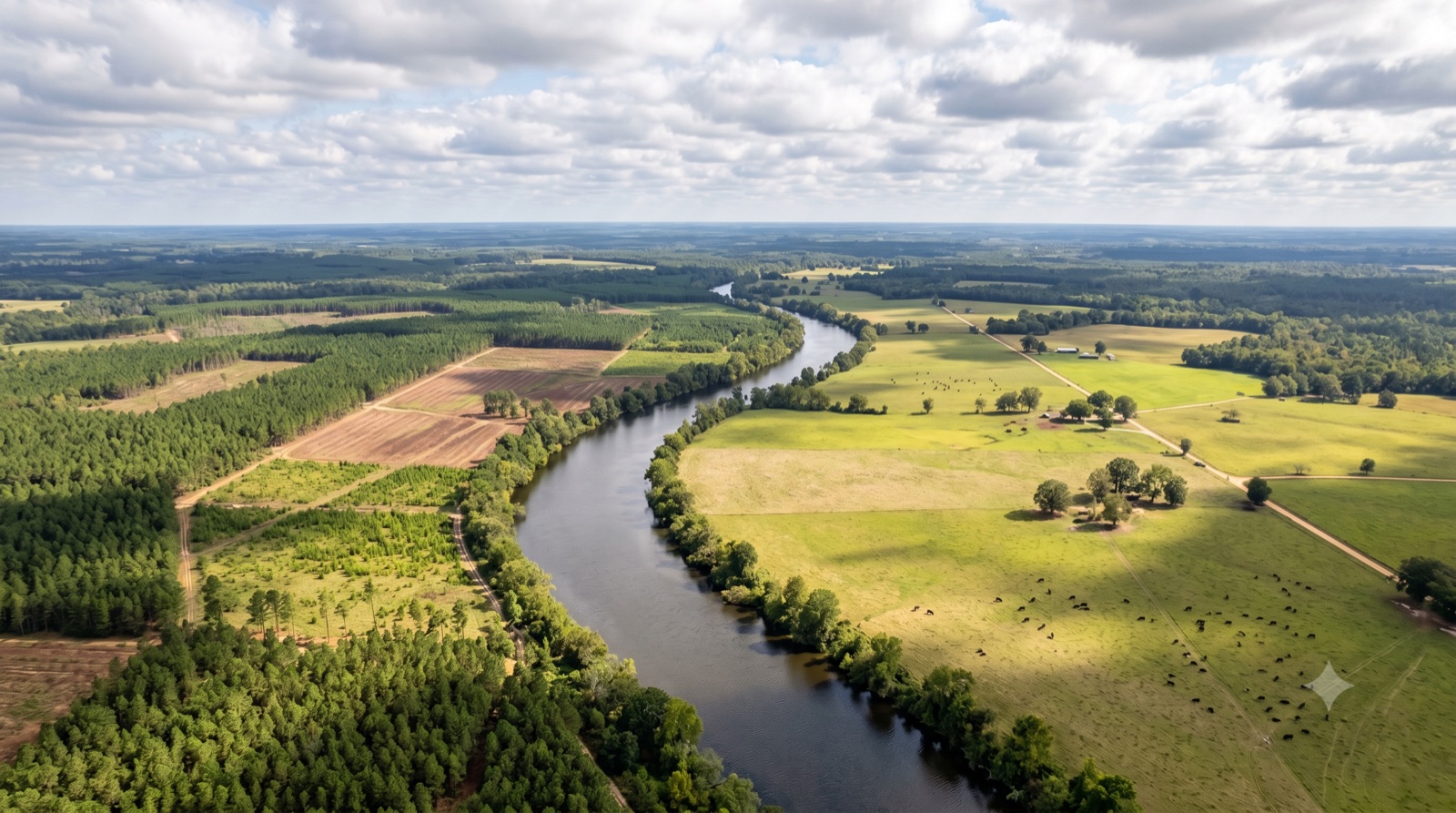
Laurens County covers 818 square miles of central Georgia — the state's third-largest county by land area — with the Oconee River running through the county and the county seat of Dublin anchoring a regional economy led by healthcare, manufacturing, and distribution. The county ranks 52nd among Georgia's 159 counties for total rural acreage actively listed, with approximately 112 listings representing over $48 million in active inventory, according to LandWatch data.
This guide covers Georgia's property tax structure and how it applies to Laurens County landowners, the county's zoning and attorney-required closing process, a comparison to neighboring counties, and practical options for selling — including what a direct cash offer actually looks like.
What Are the Tax Costs of Holding Land in Laurens County?
Georgia law sets a single assessment ratio: all real property — including vacant land, timber tracts, and agricultural parcels — is assessed at 40% of fair market value as of January 1 each year, according to the Georgia Department of Revenue. There is no separate ratio for non-owner-occupied or vacant land as some states impose; the same 40% standard applies statewide.
In Laurens County, the 2023 county millage rate was rolled back to 5.744 mills from the prior year's 6.698 mills, according to the Courier Herald. Adding the school district millage produces a combined rate that generates a county median effective property tax rate of 0.84%, according to Ownwell. Dublin, the county seat, carries the highest effective rate at 1.00%, while unincorporated areas such as Alamo fall as low as 0.78%. The county's median annual tax bill is $899, well below the national median of $2,400, according to Ownwell.
How Property Tax Adds Up for Vacant Laurens County Land
For a vacant parcel with a county-assessed market value of $100,000, the 40% assessment produces a taxable assessed value of $40,000. At the county median effective rate of 0.84%, the annual tax bill totals approximately $840. That number grows with acreage. A 50-acre rural parcel assessed at $150,000 generates approximately $1,260 per year — recurring, whether or not the land produces income.
Laurens County offers meaningful relief for qualifying landholders through Georgia's Conservation Use Valuation Assessment (CUVA) and Forest Land Protection Act (FLPA). Under CUVA, qualifying agricultural and timber land is assessed at its current use value — calculated by soil type and productivity — rather than fair market value. Laurens County falls in CUVA Rate Group #5, alongside Baldwin, Bibb, Bleckley, Johnson, and Washington counties, according to Georgia Department of Revenue conservation use rules. Applications must be filed between January 1 and April 1 with the Laurens County Board of Tax Assessors. CUVA and FLPA covenants both run 10 years. A breach triggers a penalty equal to twice the cumulative tax savings received over the life of the covenant.
For CUVA land being considered for sale, buyers acquiring mid-covenant can continue the enrolled use and maintain the tax benefit — but if you sell to a buyer who plans to develop or convert the land, they face the penalty. This affects negotiating dynamics and should be disclosed.
For more context on carrying costs and back taxes that can accumulate on rural land, see our guide on how to sell land with back taxes.
What Zoning and Closing Requirements Apply in Laurens County?
Laurens County's unincorporated land is subject to county zoning administered by the Laurens County Planning Department. Dublin, the county seat, maintains its own municipal zoning code covering residential, commercial, and mixed-use districts. For unincorporated rural tracts, agricultural and low-density residential classifications are most common, with minimal restrictions on timber operations, row crops, and rural homesteads. Confirm zoning classification before listing by contacting the Laurens County Planning and Zoning Department at the county administration offices in Dublin.
For deed records, title history, and parcel records, the Laurens County Clerk of Superior Court maintains land records accessible at the Dublin courthouse. The Tax Assessors Office, reachable at 478-272-6443, handles assessed value records and all CUVA/FLPA applications. Property owners can search records online through qpublic.net/ga/laurens. The Tax Commissioner, Darla Williams Brown, handles tax billing and can be reached at 121 E Jackson Street, Suite B, Dublin, GA 31021, phone 478-272-6994.
Georgia's Attorney-Required Closing Process
Georgia requires a licensed attorney at every real estate closing — no exceptions. The attorney must examine and certify title, prepare the deed, file the PT-61 transfer tax declaration, and record the deed with the county Clerk of Superior Court, according to Brian Douglas Law. Here is what the process looks like step by step:
- Title search: The closing attorney searches Laurens County Superior Court records to confirm clear title, identify any liens or encumbrances, and verify the legal description
- PT-61 e-filing: Before recording, the attorney files the PT-61 Real Estate Transfer Tax Declaration electronically through the Georgia Superior Court Clerks' Cooperative Authority (GSCCCA), according to Georgia Title & Escrow Company
- Transfer tax payment: Georgia charges $1.00 for the first $1,000 of consideration, plus $0.10 per additional $100, under O.C.G.A. § 48-6-1 — on a $150,000 sale, that is $150 in transfer tax, according to Georgia Title & Escrow Company
- Deed recording: The deed is recorded with the Laurens County Clerk of Superior Court at a flat $25 per instrument, under O.C.G.A. § 15-6-77
- Title insurance: Issued at closing, protecting the buyer against title defects not found in the search
Attorney fees for a Georgia land closing typically run $500 to $1,500 depending on transaction complexity, according to Brian Douglas Law. Timber tracts or heir property with fragmented ownership histories may require additional attorney hours for title curative work. Before any listing decision, you can request a no-obligation cash offer from Jerez Land to understand your options — we coordinate directly with your chosen Georgia closing attorney.
For a complete breakdown of what documents a seller needs to close a Georgia land transaction, see our guide on paperwork needed to sell land.
How Does Laurens County Compare to Neighboring Georgia Counties?
Laurens County borders seven counties — Johnson, Treutlen, Wheeler, Dodge, Bleckley, Wilkinson, and Twiggs — and sits roughly equidistant between Macon and Savannah along the I-16 corridor. Its position as the third-largest Georgia county by land area means it has more total land for sale than most of its neighbors, but also more competition among sellers.
| Factor | Laurens County | Johnson County | Treutlen County | Wheeler County |
|---|---|---|---|---|
| Population (2024 est.) | ~50,585 | ~8,900 | ~6,900 | ~7,800 |
| Population trend | Slowly growing | Declining | Declining | Growing slightly |
| Effective property tax rate | ~0.84% | ~0.80% | ~0.85% | ~1.21% |
| Top industry | Healthcare, manufacturing | Agriculture, timber | Agriculture (soybeans, cotton) | Agriculture, timber |
| Land inventory | Active (112 listings LandWatch) | Very limited | Very limited | Very limited |
| Key selling challenge | Competition among sellers | Thin buyer pool | Tiny market, few buyers | High tax rate, small market |
Laurens County's population grew from 48,388 in 2010 to 49,543 in 2020 and an estimated 50,585 in 2024, according to World Population Review — a slow upward trend driven by the county's relatively diversified employer base. The Dublin-Laurens County Development Authority lists major employers including Carl Vinson VA Medical Center, Fairview Park Hospital, YKK AP (architectural aluminum), WestRock (recycled paper), Parker Aerospace, and Best Buy's distribution operation, according to the Dublin-Laurens County Development Authority. The county's median household income reached $55,010 in 2024, according to DataUSA.
Laurens County's agricultural base — 674 farms averaging 230 acres, with 60,867 acres of woodland — positions it as a target for both recreational/hunting buyers and timber investors, according to the 2022 USDA Census of Agriculture. Total market value of agricultural products reached $35,281,000, with 74% from crops and 26% from livestock. The top crops are cotton (8,029 acres), corn (7,693 acres), forage/hay (7,485 acres), and peanuts (4,719 acres). The county's standing timber inventory and Oconee River frontage parcels attract buyers from outside the immediate area, including investors from Atlanta and Savannah.
Wheeler County to the south carries a notably higher effective tax rate of 1.21%, making Laurens land comparatively less expensive to hold annually, according to Ownwell. Johnson and Treutlen counties to the north and east have much thinner land markets with very limited buyer demand and fewer active listings — making Laurens the dominant regional market for rural land.
If you are working through an inherited property with multiple heirs or unclear title in the Dublin area, our guide on how to sell inherited land covers Georgia-specific steps including the probate process.
For more county-level land analysis across Georgia and the Southeast, explore our blog.
What Are Your Options for Selling Land in Laurens County?
Laurens County landowners facing recurring tax bills on non-productive land have three primary paths to a closing, each with materially different timelines and net proceeds.
Before choosing a path, verify your property's tax status with Tax Commissioner Darla Williams Brown (478-272-6994, 121 E Jackson Street Suite B, Dublin, GA 31021) and confirm any active CUVA or FLPA enrollment with the Laurens County Board of Tax Assessors (478-272-6443). If your parcel is enrolled in a conservation use program, a pending sale requires careful timing to avoid covenant-breach penalties.
Listing with a licensed land agent gives your parcel access to buyers on Land.com, LandWatch, and local MLS systems. LandWatch shows approximately 112 active Laurens County listings, which means new listings compete with existing inventory. Commission rates for rural Georgia land typically run 6–10%, and marketing timelines for rural parcels average 12–24 months in central Georgia markets. For a realistic picture of timelines, see our guide on how long it takes to sell land.
FSBO through land platforms reduces commission exposure but requires you to manage buyer inquiries, showings, financing verification, and attorney coordination independently. For a step-by-step walkthrough, see our guide on how to sell land by owner.
Understanding your land's value before listing avoids under-pricing a timber tract or over-pricing a parcel relative to active competing listings. Our guide on how much your land is worth explains the key value drivers for rural Georgia land including timber cruises, soil classifications, water access, and road frontage.
Selling to a direct land buyer like Jerez Land removes commissions, listing fees, and the uncertainty of marketing timelines. We price each Laurens County parcel based on its individual characteristics — timber quality, soil rating, access, water features, proximity to Dublin or I-16 — not on market averages. We absorb the carrying costs, resale risk, and marketing expenses from the closing date forward. Georgia's attorney-closing requirement applies to all transactions, so a licensed Georgia attorney still handles the PT-61 filing, title work, and deed recording. Request a cash offer for your Laurens County land — firm written number, no obligation.
Frequently Asked Questions
I want to sell my vacant land in Laurens County GA — where do I start?
Verify your parcel's legal description and any delinquent taxes through the Laurens County Tax Commissioner (478-272-6994). Confirm any CUVA or FLPA covenant enrollment with the Board of Tax Assessors (478-272-6443). Georgia law requires a licensed attorney to supervise the closing, including title examination, PT-61 filing, deed preparation, and recording with the Laurens County Clerk of Superior Court. Options include listing with a land agent, FSBO platforms, or a direct cash offer.
What property tax will I pay annually on land in Laurens County Georgia?
Laurens County's median effective property tax rate is 0.84%, according to Ownwell — below the national median of 1.02% but above some neighboring counties. Georgia assesses all real property at 40% of fair market value as of January 1 each year, under state law. Dublin carries a higher effective rate of approximately 1.00%; unincorporated rural areas run as low as 0.78%. Qualifying land under CUVA or FLPA programs is assessed at current use value, which is typically much lower.
If I sell land in Georgia, what transfer tax will I owe?
Yes. Georgia charges a real estate transfer tax of $1.00 for the first $1,000 of consideration plus $0.10 for each additional $100, under O.C.G.A. § 48-6-1, according to Georgia Title & Escrow Company. On a $100,000 sale, the transfer tax is $100; on a $300,000 sale, it is $300. The seller is the party legally liable by default, though the purchase contract can shift this cost to the buyer. A PT-61 declaration must be filed electronically before the deed can be recorded.
Do I need to hire an attorney to close my Georgia land sale?
Yes. Georgia requires a licensed attorney to supervise every real estate closing. The attorney examines title, prepares the deed, files the PT-61 transfer tax declaration, and records the deed with the Clerk of Superior Court, according to Brian Douglas Law. This requirement applies equally to cash transactions and financed purchases. Attorney fees typically range from $500 to $1,500. Recording is $25 flat per instrument under O.C.G.A. § 15-6-77.
I have CUVA-enrolled land in Laurens County GA — how does selling it affect my tax status?
CUVA (Conservation Use Valuation Assessment) taxes qualifying agricultural and timber land at its current use value rather than fair market value, producing a significantly lower assessed value and annual tax bill. Laurens County is in CUVA Rate Group #5, per Georgia Department of Revenue rules. CUVA and FLPA covenants both run 10 years. Selling CUVA land mid-covenant does not automatically trigger the penalty if the buyer continues the qualified use — but if the buyer converts the land, the penalty (twice cumulative tax savings) applies.
Is Laurens County Georgia a good county for land investment?
Laurens County has several characteristics land investors evaluate positively: active timber and row-crop markets, Oconee River frontage, relatively moderate property tax burden, and a diversified employer base centered on Dublin. The county's population has grown slowly since 2010, and I-16 access provides logistics connectivity. However, 112 active listings on LandWatch signal significant seller competition in the current market, which can lengthen marketing timelines for landowners who list without a competitive pricing strategy.
Disclaimer: This article is for informational purposes only and does not constitute legal, financial, or professional advice. Laws and regulations vary by jurisdiction and change over time. Always consult with qualified professionals before making land purchase decisions. Jerez Land is not responsible for actions taken based on this information.